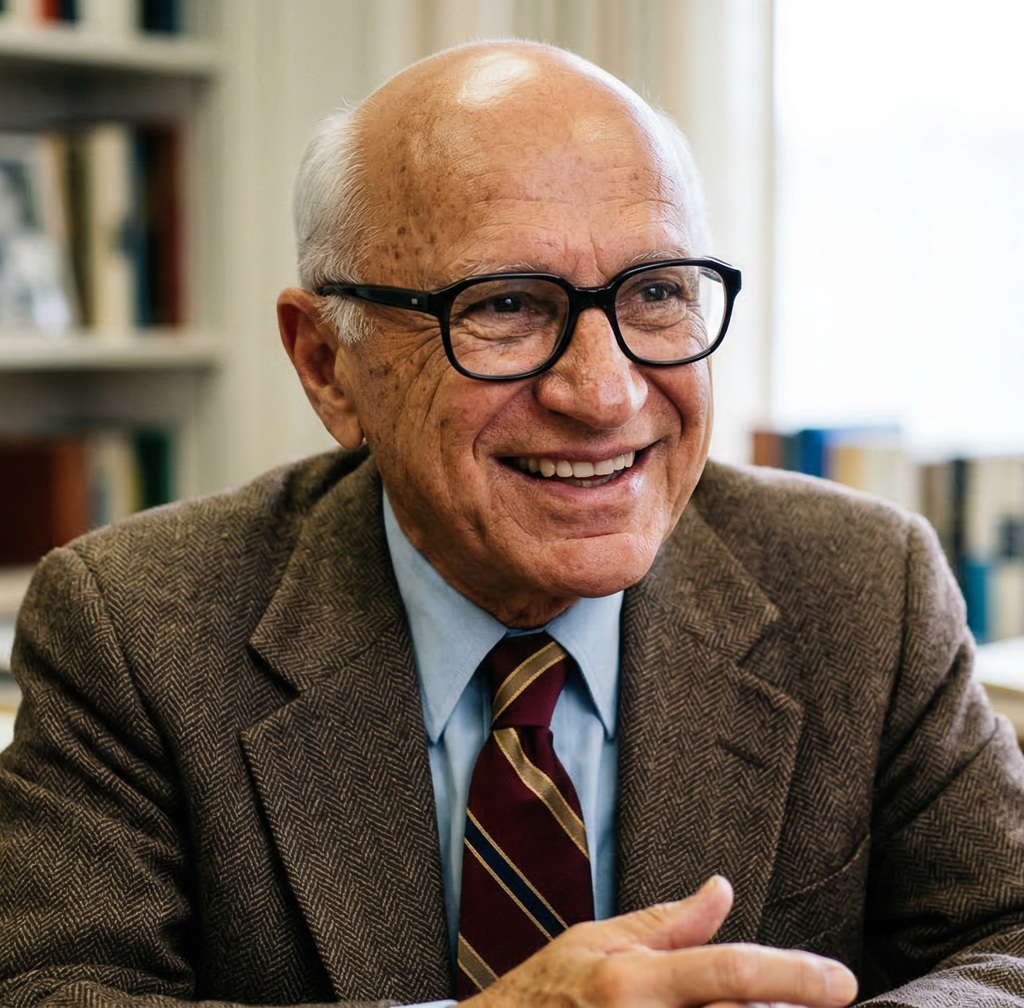
In January 1961, John F. Kennedy called on his fellow Americans not to ask what their country could do for them, but what they could do for their country. The line remains one of the most famous in American politics. A year later, an economics professor from Chicago answered him in the introduction to a slim book: “The free man will ask neither what his country can do for him nor what he can do for his country” (Capitalism and Freedom, 1962). Both halves of Kennedy’s formula, Milton Friedman argued, made the state either the guardian or the master of its citizens, and neither suited people who take responsibility for their own lives.
Friedman was a rigorous academic economist who received the Nobel Prize for his research, and at the same time a teacher who explained to millions of people on television why voluntary exchange benefits both sides. This combination makes him one of the most effective advocates of liberty in the 20th century.
At a glance
- Life: July 31, 1912, in Brooklyn, New York, to November 16, 2006, in San Francisco
- Work: Professor at the University of Chicago (1946 to 1976), then Senior Research Fellow at the Hoover Institution at Stanford (1977 to 2006), president of the American Economic Association and of the Mont Pelerin Society
- Awards: John Bates Clark Medal (1951), Nobel Prize in Economic Sciences (1976), Presidential Medal of Freedom (1988)
- Major works: A Theory of the Consumption Function (1957), Capitalism and Freedom (1962), A Monetary History of the United States, 1867–1960 (1963, with Anna J. Schwartz), Free to Choose (1980, with Rose Friedman), Two Lucky People (1998, memoirs with Rose Friedman)
- In one sentence: He proved with data what friends of liberty suspected, and explained it so that everyone could understand.
A scholarship student from Rahway
Friedman’s parents were Jewish immigrants from Beregszász, a small town in what was then Hungary and is now in Ukraine. Shortly after his birth the family moved to Rahway, New Jersey, where they ran a small dry goods store. On a scholarship, the son studied at Rutgers University, graduated in 1932, and went to Chicago for his master’s degree. In Jacob Viner’s course he sat next to Rose Director, a young economist whom he married in 1938. The two remained a couple for almost seventy years and later wrote their most influential books together.
During the war he worked at the Treasury Department in Washington and in 1942 helped introduce income tax withholding, which takes the tax directly out of people’s paychecks. In his memoirs he openly admitted that hardly anyone had thought about the long-term consequences at the time, and later he wished withholding could be abolished again.
In 1946 he received his doctorate from Columbia University and returned to Chicago as a professor that same year. For three decades he shaped a school there whose name stands worldwide for the market economy and empirical rigor.
The central bank in the dock
Friedman received the Nobel Prize in 1976 for his work on consumption theory, on monetary history and monetary theory, and for demonstrating how difficult it is for government to steer the business cycle. The most consequential of these works is the Monetary History of the United States, which he published with Anna J. Schwartz in 1963. For a long time the Great Depression was regarded as proof that capitalism collapses of its own accord and that the state must rescue it. Using long data series, Friedman and Schwartz showed something else: between 1929 and 1933 the money supply in the United States shrank by about a third because the Federal Reserve stood by as the banks collapsed. Their thesis has largely prevailed. At a celebration of Friedman’s 90th birthday in 2002, Ben Bernanke, then a member of the Federal Reserve Board, addressed the two authors: “You’re right, we did it. We’re very sorry. But thanks to you, we won’t do it again.”
The same research produced the line most often associated with Friedman: inflation is “always and everywhere a monetary phenomenon,” that is, always and everywhere the result of the money supply growing faster than the supply of goods. From this he drew a clear conclusion. Instead of steering at its own discretion, the central bank should let the money supply grow steadily according to a fixed rule. In his presidential address to the American Economic Association in 1967, he also argued that higher inflation cannot buy lower unemployment in the long run. The years of stagflation in the 1970s, when high inflation and high unemployment came together, proved him right.
For friends of liberty, there is more than technique in this work. It shows that even the most severe economic crises can arise from the mistakes of the very institutions that are supposed to guide the market, and that a government that prints money takes purchasing power from its citizens without letting them vote on it.
Liberty that cannot be divided
Capitalism and Freedom appeared in 1962 and opens with a clear thesis. Economic freedom, it argues, is on the one hand itself a part of freedom and on the other “an indispensable means toward the achievement of political freedom” (chapter 1). Those who may not decide for themselves about work, property, and consumption gain little from elections. Friedman did not claim that markets alone bring about democracy. He explicitly called capitalism a necessary but not a sufficient condition for political freedom.
In the book he assigned the state a clearly defined role. It should set rules and, as an umpire, see that they are kept, but not play the game itself. How consistently Friedman pursued this idea is shown by his criticism of government occupational licensing. As early as 1945, he and Simon Kuznets had shown that restrictions on entry into the medical profession drove up physicians’ fees. He regarded such licenses as a means by which professional groups protect themselves from competition, at the expense of patients and customers.
Proposals that changed lives
The best known is the school voucher. As early as 1955, in the essay “The Role of Government in Education,” Friedman proposed that the state might finance schooling without having to run the schools itself. Parents would receive a voucher they could redeem at any school that meets minimum standards. That way families decide which school their child attends, and schools have to compete for students. In 1996 Milton and Rose Friedman founded a foundation for school choice, which today operates under the name EdChoice and has advanced the idea in many American states.
He thought just as practically about poverty. Instead of a tangle of separate programs, each with its own agency, he proposed in Capitalism and Freedom a negative income tax: anyone whose income stays below a certain threshold receives a payment from the tax authorities and decides for themselves how to use it. The model was meant to help without patronizing people and to preserve the incentive to work.
Friedman achieved his greatest political success on the military draft. In 1969 President Nixon appointed him to the commission on an all-volunteer armed force, which was divided at first and in February 1970 unanimously recommended abolishing the draft. Friedman was regarded as the one who had won the members over. Since July 1973 the American armed forces have relied on volunteers. By his own account, this was almost the only cause for which he ever personally lobbied members of Congress.
Then there were positions on which he was ahead of his time. As early as 1953 he argued for freely floating exchange rates, when almost the whole world still clung to fixed parities. And in 1989 he wrote an open letter in the Wall Street Journal to the drug czar William Bennett, declaring drug prohibition a failure: the harm caused by other people’s addiction, he wrote, arises almost entirely from illegality itself.
Teacher to a whole nation
From 1966 to 1983 Friedman wrote regular columns for Newsweek magazine. But he became truly famous through television. From January to March 1980, the public broadcaster PBS aired the ten-part series Free to Choose, in which he explained how markets work and what government intervention does. The companion book, written together with Rose Friedman, became the best-selling nonfiction book of the year in the United States.
The chapter “Created Equal” contains an idea that is often quoted in shortened form. In essence, the Friedmans write there that a society that puts equality, in the sense of equal outcomes, ahead of freedom will end up with neither equality nor freedom. A society that gives freedom priority, on the other hand, will achieve more of both as a by-product. Behind this lies the observation that enforced equality concentrates power in the hands of those who enforce it.
Friedman advised Barry Goldwater, Richard Nixon, and Ronald Reagan, but his advice was not tied to any party. When he lectured in Chile for a week in 1975 at the invitation of his colleague Arnold Harberger, and in the process spoke once with Augusto Pinochet, he recommended what he recommended everywhere: cut spending and inflation and open up trade. His letter to the general contains no criticism of the repression, which is still held against him today. In the same year, however, he wrote that he approved of none of the authoritarian regimes he had advised, among them communist Yugoslavia, and in 1991 he called Pinochet’s rule a “terrible political regime.” He was convinced that economic freedom creates pressure for political freedom over time, and Chile returned to democracy after the 1988 referendum.
What friends of liberty can learn from him
The first lesson concerns money. Anyone who wants to understand why prices rise should look first at the central bank and only then at merchants and labor unions. Friedman backed up this connection with data covering almost a century of American monetary history.
The second lesson concerns the path. Friedman was willing to take steps that did not reach the whole goal at once, as long as they led in the right direction. The school voucher does not abolish government funding of schools, but it gives the decision back to parents. The negative income tax does not end all redistribution, but it takes away the bureaucracy’s control over the lives of recipients. For some radical libertarians that did not go far enough, yet many of his proposals have actually brought people more liberty.
The third lesson concerns attitude. Friedman argued in a friendly way, with data and with patience, even before hostile audiences. He admitted mistakes, as with tax withholding, and he spoke about liberty in a language that reached even viewers with no background in economics.
Free to choose
When Milton Friedman died in San Francisco in November 2006 at the age of 94, much of what he had campaigned for over decades had become accepted wisdom: that inflation is a monetary problem, that an army can consist of volunteers, that parents should have a say in their children’s schooling. The title of his best-known book sums up his life’s work in three words. Free to Choose means the freedom to choose for yourself the work, the school, the money, and the life you consider right. Whether or not you follow his proposals in every detail, no serious thinking about liberty can get around this question.
Further reading
- Milton Friedman: Capitalism and Freedom, University of Chicago Press, Chicago 1962 (German edition: Kapitalismus und Freiheit)
- Milton and Rose Friedman: Free to Choose. A Personal Statement, Harcourt Brace Jovanovich, New York 1980
- Milton Friedman and Anna J. Schwartz: A Monetary History of the United States, 1867–1960, Princeton University Press, Princeton 1963
- Milton and Rose Friedman: Two Lucky People. Memoirs, University of Chicago Press, Chicago 1998
This article is part of our series on thinkers, doers, and historical figures of liberty.
Sources
- Friedman, Milton; Kuznets, Simon: Income from Independent Professional Practice, National Bureau of Economic Research, New York 1945.
- Friedman, Milton: “The Case for Flexible Exchange Rates,” in: Essays in Positive Economics, University of Chicago Press, Chicago 1953.
- Friedman, Milton: “The Role of Government in Education,” in: Robert A. Solo (ed.): Economics and the Public Interest, Rutgers University Press, New Brunswick 1955.
- Friedman, Milton: A Theory of the Consumption Function, Princeton University Press, Princeton 1957.
- Friedman, Milton (with the assistance of Rose D. Friedman): Capitalism and Freedom, University of Chicago Press, Chicago 1962 (German edition: Kapitalismus und Freiheit).
- Friedman, Milton; Schwartz, Anna J.: A Monetary History of the United States, 1867–1960, Princeton University Press, Princeton 1963.
- Friedman, Milton: “The Role of Monetary Policy,” in: American Economic Review 58 (1968), no. 1, pp. 1–17.
- Friedman, Milton: The Counter-Revolution in Monetary Theory, Institute of Economic Affairs, Occasional Paper 33, London 1970.
- Friedman, Milton: “The Social Responsibility of Business Is to Increase Its Profits,” in: The New York Times Magazine, September 13, 1970.
- Friedman, Milton; Friedman, Rose: Free to Choose. A Personal Statement, Harcourt Brace Jovanovich, New York 1980.
- Friedman, Milton: “An Open Letter to Bill Bennett,” in: The Wall Street Journal, September 7, 1989, https://druglibrary.drugsense.org/special/friedman/an_open_letter_to_bill_bennett.htm
- Friedman, Milton; Friedman, Rose: Two Lucky People. Memoirs, University of Chicago Press, Chicago 1998.
- Nobelprize.org: Milton Friedman, Biographical, https://www.nobelprize.org/prizes/economic-sciences/1976/friedman/biographical/
- Nobelprize.org: Press release on the 1976 prize, https://www.nobelprize.org/prizes/economic-sciences/1976/press-release/
- Hoover Institution: Profile of Milton Friedman, https://www.hoover.org/profiles/milton-friedman
- Concise Encyclopedia of Economics (Econlib): Milton Friedman, https://www.econlib.org/library/Enc/bios/Friedman.html
- Liberty Fund, Online Library of Liberty: Friedman on Capitalism and Freedom, https://oll.libertyfund.org/pages/friedman-on-capitalism-and-freedom
- Cato Institute: “Ask Not What Frankenstein Can Do for You” (on the introduction to Capitalism and Freedom), https://www.cato.org/blog/ask-not-what-frankenstein-can-do-you
- David Henderson: “Milton and Rose Friedman on Inequality,” EconLog, March 16, 2014, https://www.econlib.org/archives/2014/03/milton_and_rose_1.html
- Bruegel: “Milton Friedman’s ‘The Role of Monetary Policy’: 50 years later,” https://bruegel.org/blog-post/milton-friedmans-role-monetary-policy-50-years-later
- Wikipedia (en): Great Contraction (with Bernanke’s speech of November 8, 2002), https://en.wikipedia.org/wiki/Great_Contraction
- Britannica: All-volunteer force, https://www.britannica.com/topic/all-volunteer-force
- Richard Nixon Foundation: “45 Years Later: Nixon and the Gates Commission,” https://www.nixonfoundation.org/2015/02/45-years-later-nixon-gates-commission/
- EdChoice: “The Idea That Changed American Education,” https://www.edchoice.org/2026-the-idea-that-changed-american-education/
- EdChoice: Rose Friedman, Early Beginnings to 1945, https://www.edchoice.org/celebrating-the-life-and-legacy-of-rose-friedman-early-beginnings-to-1945/
- FEE: “Wartime Origins of Modern Income-Tax Withholding,” https://fee.org/articles/wartime-origins-of-modern-income-tax-withholding/
- Mises Wire: “Tax Withholding and Tax Consciousness,” https://mises.org/mises-wire/tax-withholding-and-tax-consciousness
- Brian Doherty: “The Economist and the Dictator,” Reason, December 15, 2006, https://reason.com/2006/12/15/the-economist-and-the-dictator/
- Sebastian Edwards, Leonidas Montes: Milton Friedman in Chile (CEP Chile), https://static.cepchile.cl/uploads/cepchile/2022/09/20190708_paper_final_jhet.pdf