On November 9, 1776, Adam Smith wrote a letter from his hometown of Kirkcaldy to the London publisher William Strahan. In it he described the last weeks of his friend David Hume, who had died in August: how he read Lucian’s Dialogues of the Dead, joked with his friends about the excuses he might offer the ferryman Charon, and faced death without fear and without belief in an afterlife. Smith closed with the judgment that Hume had come as near to the ideal of a perfectly wise and virtuous man as human frailty would perhaps permit.
The letter was printed and set off a storm. Four years later, in a letter to the Dane Andreas Holt, Smith complained that a single sheet of paper had “brought upon me ten times more abuse than the very violent attack I had made upon the whole commercial system of Great Britain.” He meant The Wealth of Nations. For friends of liberty, Hume matters for a different reason than he did for his pious opponents: he described with great force how property, law, and money come into being without anyone inventing them.
At a glance
- Life: May 7, 1711, in Edinburgh to August 25, 1776, in Edinburgh
- Work: philosopher, historian, and economist of the Scottish Enlightenment; librarian of the Advocates’ Library (1752 to 1757), secretary to the British ambassador in Paris (1763 to 1766), Under-Secretary of State (1767 to 1768)
- Major works: A Treatise of Human Nature (1739/40), Essays, Moral and Political (from 1741), Political Discourses (1752), The History of England (1754 to 1762)
- In one sentence: He showed that the load-bearing rules of a free society grow out of experience and that all rule rests on the opinion of the ruled.
A philosopher without a chair
Hume was the second son of a landowner from Ninewells in Berwickshire, near the English border. In 1734 he tried his luck with merchants in Bristol and found that world, as he later wrote, totally unsuited to him. He went to France, first to Reims and then to the small town of La Flèche in Anjou, and there, at 23, began his major work. A Treatise of Human Nature appeared anonymously in 1739 and 1740 and, as Hume himself mocked, “fell dead-born from the press,” which was a gross exaggeration.
He never obtained a professorship. His applications in Edinburgh in 1745 and in Glasgow in 1751 failed because of his reputation as a critic of religion. Instead he made his living as librarian to the Faculty of Advocates in Edinburgh and as a writer. His Essays and his six-volume History of England found many readers, and his writings made him, as he himself recorded, “not only independent, but opulent.”
In 1763 the ambassador Lord Hertford brought him to Paris as his private secretary, and in 1765 he formally became secretary to the embassy. In 1766 he took the persecuted Jean-Jacques Rousseau with him to England, which ended in a bitter falling-out, and in 1767 he served for about a year as Under-Secretary of State in London. From about 1750 he was bound to Adam Smith by a friendship that lasted until his death. At the end of his life Hume described himself as a man of mild disposition who kept his temper under control.
Rules nobody invented
Hume’s most important contribution to political philosophy is found in the third book of the Treatise. There he asks where justice and property come from, and he answers with an image that is hard to forget: “Two men, who pull the oars of a boat, do it by an agreement or convention, tho’ they have never given promises to each other” (Treatise 3.2.2.10). Two men rowing together thus follow a convention without ever having promised each other anything. In the same way, Hume continues, languages gradually take shape, and in the same way gold and silver become the common medium of exchange.
Property arises on this pattern from the repeated experience that everyone fares better when each person may keep what he has. Hume sums up the result in three fundamental laws: the stability of possession, its transfer by consent, and the performance of promises (3.2.6.1). He calls these rules artificial because human beings produced them, and he adds at once that this does not make them arbitrary: “Tho’ the rules of justice be artificial, they are not arbitrary” (3.2.1.19).
More than two centuries later, Friedrich August von Hayek gave a lecture on Hume’s legal and political philosophy. In it he called that philosophy probably the only comprehensive statement of the legal and political doctrine that later became known as liberalism (1963). Hayek’s own theory of spontaneous order, according to which the most valuable institutions of a society are the result of human action but not of human design, explicitly appeals to this predecessor.
The passenger carried on board asleep
In his 1748 essay Of the Original Contract, Hume took on the favorite idea of his century. John Locke and others had grounded the duty of obedience in a contract to which the citizens had supposedly consented. Hume tested this claim against history and concluded that “almost all the governments, which exist at present, or of which there remains any record in story, have been founded originally, either on usurpation or conquest, or both.”
He was especially sharp on the idea of tacit consent, according to which anyone who does not leave his country consents to its rule. One might just as well claim, he wrote, that a man freely consents to the captain’s authority because he stays on board, “though he was carried on board while asleep, and must leap into the ocean, and perish, the moment he leaves her.” Hume by no means wanted to abolish government with this argument, but he did want its justification to be honest. Since then, many have regarded the image of the sleeping passenger as one of the strongest arguments against any theory that turns merely staying put into consent.
The power of opinion
A second idea from the early Essays reaches even further. In Of the First Principles of Government (1741), Hume marvels at the ease with which the many are governed by the few. His explanation: “as Force is always on the side of the governed, the governors have nothing to support them but opinion.” This holds, he adds, for the most despotic and most military governments as well as for the most free.
Two hundred years later, Ludwig von Mises reached a related conclusion by a different route in Human Action: a durable system of government, he argued, must rest on an ideology accepted by the majority. Mises does not mention Hume at this point, but both place the decision between liberty and unfreedom in the minds of the governed.
How realistically Hume thought about power is shown by a rule from Of the Independency of Parliament. In designing a constitution, he wrote, “every man ought to be supposed a knave,” that is, someone who seeks nothing but his private interest in everything he does. By this rule, good institutions are recognized by the fact that they still work when the officeholders are not angels.
Trade without envy
Hume also wrote fundamental work on trade and money before Adam Smith. In the Political Discourses of 1752 he opposed the mercantilist doctrine that a country grows rich by hoarding gold and throttling imports. To make his case he proposed a thought experiment: if Great Britain lost four-fifths of its money overnight, wages and prices would fall accordingly, British goods would become unbeatably cheap abroad, and money would flow back until the country was once again on a level with its neighbors (Of the Balance of Trade). A policy that tries to force permanent surpluses is therefore fighting a mechanism it cannot switch off.
In Of the Jealousy of Trade he went a step further and took aim at the envy nations feel toward one another. A prosperous neighbor, he was convinced, is a better trading partner than a poor one, and so he closed with a profession that was bold for his time: “not only as a man, but as a British subject, I pray for the flourishing commerce of Germany, Spain, Italy, and even France itself.”
Hume saw the dangers of growing public debt just as clearly. Of Public Credit contains the often-quoted sentence: “either the nation must destroy public credit, or public credit will destroy the nation.” And in Of the Rise and Progress of the Arts and Sciences there is an idea that will please friends of small political units: nothing, he wrote, is “more favourable to the rise of politeness and learning, than a number of neighbouring and independent states, connected together by commerce and policy.”
What friends of liberty can learn from Hume
The first lesson is humility in the face of every grand plan. Nobody designed the most valuable institutions of a society, property, contract, money, and language, at a desk. They have proved themselves because people used and improved them over generations, and anyone who wants to rebuild them according to a blueprint can easily destroy more than he understands. Hayek took this insight into his critique of the notion that reason could construct a society anew from the ground up.
Second, Hume shows that liberty can be defended even without metaphysical certainties. His arguments for property, trade, and limited government come from experience and history, and for that very reason they also persuade people who have little use for natural law.
Third, he teaches realism about those who govern. A constitution must reckon with power being used for private advantage, and it must be built so that even self-interested officeholders can do little harm. In 1957 the historian Douglass Adair put forward the widely noted thesis that James Madison drew on Hume’s essay Idea of a Perfect Commonwealth for his defense of the large republic in the tenth of the Federalist Papers. If that is true, a piece of Hume lies in the foundations of the American Constitution.
A complete picture includes two dark spots. In a footnote to the essay Of National Characters in 1753, he voiced the suspicion that Black people were naturally inferior to whites, a claim that James Beattie firmly rejected as early as 1770; in the posthumous edition of 1777 the passage is toned down but not removed. A letter published only in 2014 also shows that in 1766 he encouraged Lord Hertford to buy a plantation on Grenada worked by slaves. His insights into spontaneous order, trade, and government do not depend on this footnote and this letter, but anyone who honors him should know about both.
A cheerful farewell
Hume was no opponent of the state. All the more remarkable, then, that a philosopher who started from experience concluded that the load-bearing rules of society grow from below, that trade makes neighbors richer, and that every government lives on the opinion of those it governs. He achieved this without a university chair, solely through books he wrote for a broad public.
The picture Adam Smith handed down fits this well: the ailing Hume reading Lucian and bargaining with Charon for a little more time to see how his corrected works would be received. It is the serenity of a thinker who trusted that people find their own order through experience, and he left that trust to all friends of liberty.
Further reading
- David Hume: A Treatise of Human Nature, Book III, Part 2
- David Hume: Essays, Moral, Political, and Literary, ed. Eugene F. Miller, Liberty Fund, Indianapolis 1987
- Friedrich August von Hayek: “The Legal and Political Philosophy of David Hume,” in: Il Politico 28 (1963)
- Dennis C. Rasmussen: The Infidel and the Professor. David Hume, Adam Smith, and the Friendship That Shaped Modern Thought, Princeton University Press, Princeton 2017
This article is part of our series on thinkers, doers, and historical figures of liberty.
Sources
- Hume, David: A Treatise of Human Nature, John Noon, London 1739–1740; quoted from Hume Texts Online (T 3.2.1.19, 3.2.2.10, 3.2.6.1), https://davidhume.org/texts/t/
- Hume, David: Essays, Moral, Political, and Literary, ed. Eugene F. Miller, Liberty Fund, Indianapolis 1987 (including Of the First Principles of Government, Of the Independency of Parliament, Of the Rise and Progress of the Arts and Sciences, Of National Characters, Of the Original Contract, Of the Balance of Trade, Of the Jealousy of Trade, Of Public Credit, Idea of a Perfect Commonwealth); texts from https://davidhume.org/texts/empl1/ and https://davidhume.org/texts/empl2/
- Hume, David: Political Discourses, A. Kincaid & A. Donaldson, Edinburgh 1752.
- Hume, David: My Own Life, London 1777, https://davidhume.org/texts/mol/
- Smith, Adam: Letter to William Strahan, Kirkcaldy, November 9, 1776, https://econlib.org/book-chapters/chapter-letter-from-adam-smith-l-l-d-to-william-strahan-esq
- Smith, Adam: Letter to Andreas Holt, October 26, 1780, in: The Correspondence of Adam Smith, ed. E. C. Mossner and I. S. Ross, Glasgow Edition, Oxford 1977 (Liberty Fund 1987), letter 208.
- Waldmann, Felix (ed.): Further Letters of David Hume, Edinburgh Bibliographical Society, Edinburgh 2014.
- Beattie, James: An Essay on the Nature and Immutability of Truth, Kincaid & Bell, Edinburgh 1770.
- Mises, Ludwig von: Human Action, ch. IX, section 3, “Might,” https://www.econlib.org/library/Mises/HmA/msHmA9.html
- Stanford Encyclopedia of Philosophy: “David Hume,” https://plato.stanford.edu/entries/hume/
- University of Edinburgh, Our History: “David Hume (1711-1776),” https://ourhistory.is.ed.ac.uk/index.php/David_Hume_(1711-1776)
- National Library of Scotland: David Hume and the Advocates’ Library, https://nls.uk/exhibitions/david-hume/advocates-library-ex-libris
- Hayek, Friedrich August von: “The Legal and Political Philosophy of David Hume,” in: Il Politico 28 (1963); reprinted in V. C. Chappell (ed.): Hume, Anchor Books, Garden City 1966; see also https://oll.libertyfund.org/publications/liberty-matters/2018-01-11-hume-a-hayekian
- Rasmussen, Dennis C.: The Infidel and the Professor. David Hume, Adam Smith, and the Friendship That Shaped Modern Thought, Princeton University Press, Princeton 2017.
- Adair, Douglass: “‘That Politics May Be Reduced to a Science’: David Hume, James Madison, and the Tenth Federalist,” in: Huntington Library Quarterly 20 (1957), pp. 343–360.
- Immerwahr, John: “Hume’s Revised Racism,” in: Journal of the History of Ideas 53 (1992).
- Institute for Advanced Studies in the Humanities, Edinburgh: “David Hume and slavery” (on Waldmann’s discovery), https://www.iash.ed.ac.uk/node/5992
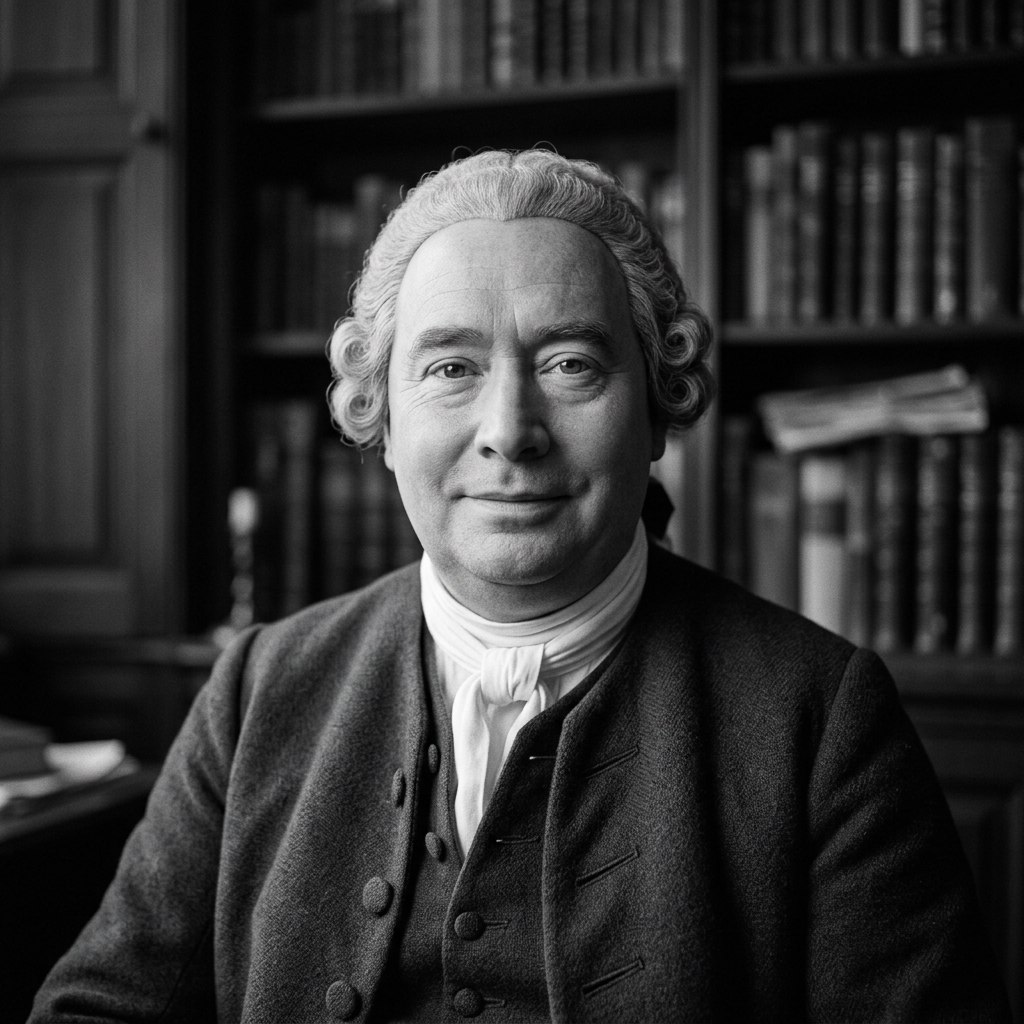
Featured image: David Hume (AI illustration)