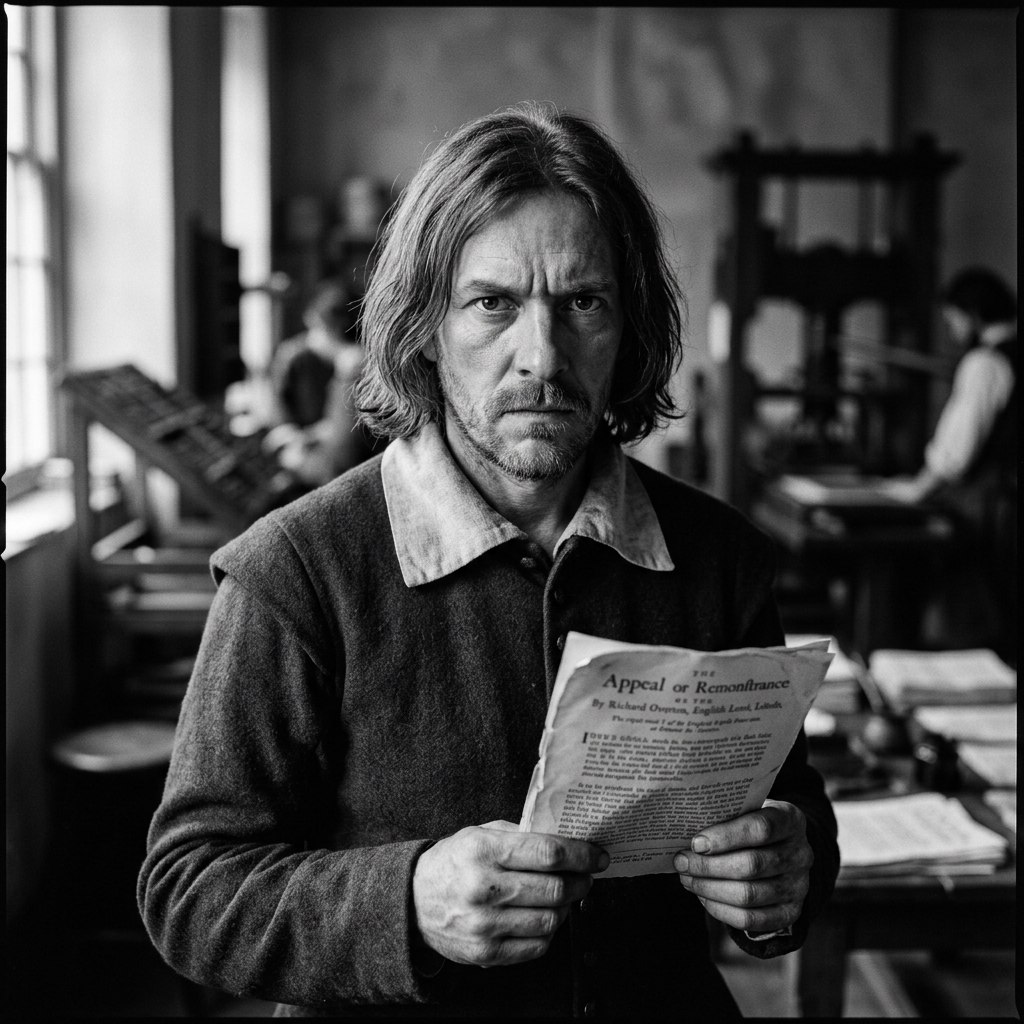
On November 3, 1646, a prisoner in London was supposed to walk to Newgate Prison, and he did not. Richard Overton let his legs hang limp, as he later wrote, as if they did not belong to him at all, dangling like two farthing candles. The guards had to carry him and dragged him over the cobblestones. Overton told the story himself, in a pamphlet titled The Commoners Complaint, and he added that he had been secretly laughing up his sleeve as it happened.
A few weeks earlier, the same man had written a letter in his cell whose influence reached far beyond that day. An Arrow Against All Tyrants contains perhaps the first clear statement of an idea that thinkers of liberty have regarded ever since as their starting point: that every person belongs to himself.
At a glance
- Life: Year of birth unknown, last documented in the sources in 1663
- Work: Printer, satirist, and pamphleteer in London; alongside John Lilburne and William Walwyn, one of the leading voices of the Levellers
- Major works: Mans Mortalitie (1644), A Remonstrance of Many Thousand Citizens (1646, with William Walwyn), An Arrow Against All Tyrants (1646), An Appeale from the Degenerate Representative Body (1647), An Agreement of the Free People of England (1649, with Lilburne, Walwyn, and Thomas Prince)
- In one sentence: He wrote down that every person is the owner of himself and that every government has only the power that free people are able to lend it.
A man without a biography
Almost nothing certain is known about Overton’s origins. His year of birth is placed sometimes shortly before 1600, sometimes about fifteen years later. A Richard Overton enrolled at Queens’ College, Cambridge, in 1631 as a sizar, a student who earned his way through college by performing services; whether this was the same man remains an open question. Some evidence suggests that he spent part of his youth in Holland, and he probably belonged to the Baptists, the congregations that recognized only the baptism of professing adults.
He becomes tangible only through his writings. Around 1642 his first pamphlets appeared, attacking the church policy of Archbishop Laud. In 1644 came Mans Mortalitie, published anonymously and with the false imprint of Amsterdam, a theological treatise teaching that the whole person is mortal and that body and soul will rise together only on the Day of Judgment. In August 1644 the House of Commons ordered a search for its author, printer, and publisher. This did not make Overton any more cautious, as his next writings show.
After the fall of the bishops, Presbyterian clergy wanted to set up a new state church that would be just as strict. Against them Overton wrote a series of satires in 1645 under the name Martin Marpriest, printed on secret presses and modeled on the famous Marprelate tracts of the Elizabethan era.
Principals and agents
In the summer of 1646 John Lilburne was in prison, and his friends responded with a text that is regarded today as the founding document of the Levellers. The Remonstrance of Many Thousand Citizens of July 7, 1646, is essentially Overton’s work, with contributions from William Walwyn. It reminds the House of Commons who elected it. The election, it says, conferred only a power held in trust, which could be revoked at any time, and then comes a sentence of great clarity: “We are your principals, and you our agents.” Any power not derived from this commission, it goes on, is usurpation and oppression, no matter who exercises it.
The text also gets specific. It asks why the Lords should be less liable for debts and acts of violence than other people, and it denounces imprisonment for debt, which it says was ruining many thousands of families.
An arrow from Newgate
In August 1646 Overton defended Lilburne against the House of Lords in another pamphlet. On August 11 the Lords had him arrested. He refused to recognize their jurisdiction and was taken to Newgate. From there, on October 12, 1646, he wrote the Arrow, an open letter to Henry Marten, a member of the House of Commons. On the title page he mockingly calls himself the “Prerogative archer” of the House of Lords, and he gives the place of printing as the backside of the Cyclopian mountains, which shows that prison had not robbed him of his sense of humor.
Right at the beginning stands the core of his teaching: “To every individual in nature is given an individual property by nature not to be invaded or usurped by any. For every one, as he is himself, so he has a self-propriety, else could he not be himself.” Overton calls this self-propriety. And he immediately draws the conclusion for all other property: there could be no mine and thine if this did not exist.
The idea cuts both ways. “No man has power over my rights and liberties, and I over no man’s,” Overton writes. Anyone who reaches beyond his own self, he says, is an invader upon another man’s right. The justification is at once religious and grounded in natural law: God, he argues, brought every person into the world by the hand of nature with an innate freedom, written, as it were, in the table of every heart. All people, he holds, are equal by birth, with an equal claim to property and liberty.
What no one can give away
From self-ownership Overton develops a theory of government that still seems astonishingly modern today. Every person, he writes, is by nature “a king, priest and prophet in his own natural circuit and compass,” and no one has any share in this sphere except by commission and free consent. When people establish a government, they transfer to it part of their natural powers so that it can better protect their safety and liberty. They may not transfer more than that, and the government may not take more.
The limit follows from a simple consideration. No one may abuse or torment himself, so he cannot give anyone else the power to abuse him either. Nothing more can be derived from the whole than is contained in the individuals, Overton writes. Whoever gives away more sins against his own flesh, and whoever takes more is a thief and a robber of his fellow men. In his view, members of Parliament are deputies who received their power solely for the well-being, safety, and liberty of their principals.
Overton thus set down the essentials of government by consent a good four decades before John Locke’s Two Treatises of Government, published in 1689, even though no direct influence on Locke has been demonstrated.
The road to Bridewell
The House of Lords did not stop at Overton himself. In January 1647 his wife Mary and her brother Thomas Johnson were arrested while producing Overton’s writings. Before the Lords, Mary refused to say anything at all. According to Overton’s account, she was dragged headlong over the cobblestones through dirt and mud with her six-month-old child in her arms, and the Lords ordered her taken to the Bridewell house of correction. She was released in July 1647.
Meanwhile, with An Appeale from the Degenerate Representative Body, Overton went over Parliament’s head to its electors and to the army under Sir Thomas Fairfax. The army took up the prisoners’ cause and demanded that they be brought to trial or released. On September 16, 1647, Overton left Newgate without conditions.
A constitution from the Tower
His freedom did not last long. In March 1649, a few weeks after the execution of the king, the new Council of State had Overton arrested together with Lilburne, Walwyn, and Thomas Prince. Once again he refused to answer his accusers’ questions and to incriminate himself. From the Tower, on May 1, 1649, the four published the final version of their draft constitution, An Agreement of the Free People of England.
This text was meant to stand above every Parliament and to place certain rights entirely beyond its reach. No one was to be compelled in matters of faith or pressed into military service. No one was to be punished for refusing to testify against himself, and convictions were to be handed down only by twelve jurors from the neighborhood. Church tithes were to be phased out. And Article XXX expressly forbade any future Parliament to level estates, destroy property, or make all things common. The derisive name Levellers, which their opponents had pinned on them, thus described the very opposite of what they wanted.
After Lilburne’s acquittal, Overton too was released in November 1649. His later years remain largely in the dark. The sources link him to conspiracies against Cromwell’s Protectorate, and in October 1663 he was sought once more because he was alleged to have printed writings against the government of Charles II. After that, his trail goes cold.
What friends of liberty can learn from him
The most important lesson lies in the order of his reasoning. At the beginning stands the individual, who belongs to himself. Property in things, contracts, and finally government come afterward, and they can have only as much right as free people are permitted to transfer to them. This is why Murray Rothbard credited the Levellers around Lilburne, Overton, and Walwyn with a remarkably coherent doctrine of liberty that combined self-ownership, private property, religious liberty, and limited government.
Just as relevant today is Overton’s insight that even an elected assembly has its limits. He had seen how a Parliament that had set out to resist the king’s arbitrary rule began arresting printers and jailing critics itself. His answer was a fundamental law binding every majority, because even a majority cannot confer more power than its members themselves possess.
And finally, his life shows how closely freedom of speech is bound up with all other liberties. Overton’s ideas reached their readers only because there were secret presses and people like Mary Overton who were willing to go to prison for printing.
Mine and thine
No grave of Richard Overton is known, no year of death, and hardly any well-documented stretch of his life outside his times in prison. What remains is a letter from Newgate whose central idea can be put in a single sentence: mine and thine exist only if every person first belongs to himself. Anyone today who asks by what right an authority intervenes in a person’s life is essentially asking Overton’s question: whether this power could have been transferred to it by someone who possessed it himself.
Further reading
- Richard Overton: An Arrow Against All Tyrants (1646), in: Andrew Sharp (ed.), The English Levellers, Cambridge University Press, Cambridge 1998
- Online Library of Liberty (Liberty Fund): Tracts on Liberty by the Levellers and their Critics, with the full texts of Overton’s writings
- Rachel Foxley: The Levellers. Radical Political Thought in the English Revolution, Manchester University Press, Manchester 2013
- Murray N. Rothbard: Economic Thought Before Adam Smith, Edward Elgar, Aldershot 1995
This article is part of our series on thinkers, doers, and historical figures of liberty.
Sources
- Overton, Richard: Mans Mortalitie, London (imprint “Amsterdam”) 1644.
- Overton, Richard; Walwyn, William: A Remonstrance of Many Thousand Citizens, London, July 7, 1646; transcription: https://constitution.org/1-History/lev/eng_lev_04.htm
- Overton, Richard: An Arrow Against All Tyrants and Tyranny, London, October 12, 1646; transcription: https://constitution.org/1-History/lev/eng_lev_05.htm
- Overton, Richard: The Commoners Complaint: or, A Dreadful Warning from Newgate, London 1647; text: https://distantreader.org/stacks/earlyprint/txt/A90231.txt
- Overton, Richard: An Appeale from the Degenerate Representative Body, London 1647 (catalog: https://explore.library.leeds.ac.uk/special-collections-explore/287170).
- Lilburne, John; Walwyn, William; Prince, Thomas; Overton, Richard: An Agreement of the Free People of England, London, May 1, 1649; transcription: https://www.marxists.org/history/england/english-revolution/may-day.htm
- Sharp, Andrew (ed.): The English Levellers, Cambridge University Press, Cambridge 1998.
- Online Library of Liberty (Liberty Fund): Tracts on Liberty by the Levellers and their Critics, https://oll.libertyfund.org/page/lt078
- Firth, C. H.: “Overton, Richard (fl. 1646),” in: Dictionary of National Biography, vol. 42, London 1895, pp. 385–387.
- BCW Project: Richard Overton, Leveller, https://bcw-project.org.uk/biography/richard-overton
- Wikipedia (en): Richard Overton (Leveller), https://en.wikipedia.org/wiki/Richard_Overton_(Leveller) (starting point)
- Spartacus Educational: Mary Overton, https://spartacus-educational.com/Mary_Overton.htm (based on Pauline Gregg, Free-Born John, 1961, and Antonia Fraser, The Weaker Vessel, 1984)
- Rothbard, Murray N.: Economic Thought Before Adam Smith (An Austrian Perspective on the History of Economic Thought, vol. 1), Edward Elgar, Aldershot 1995; excerpt: https://mises.org/mises-daily/liberty-and-property-levellers-and-locke
- Foxley, Rachel: The Levellers. Radical Political Thought in the English Revolution, Manchester University Press, Manchester 2013.
Featured image: Richard Overton (AI illustration, free interpretation)