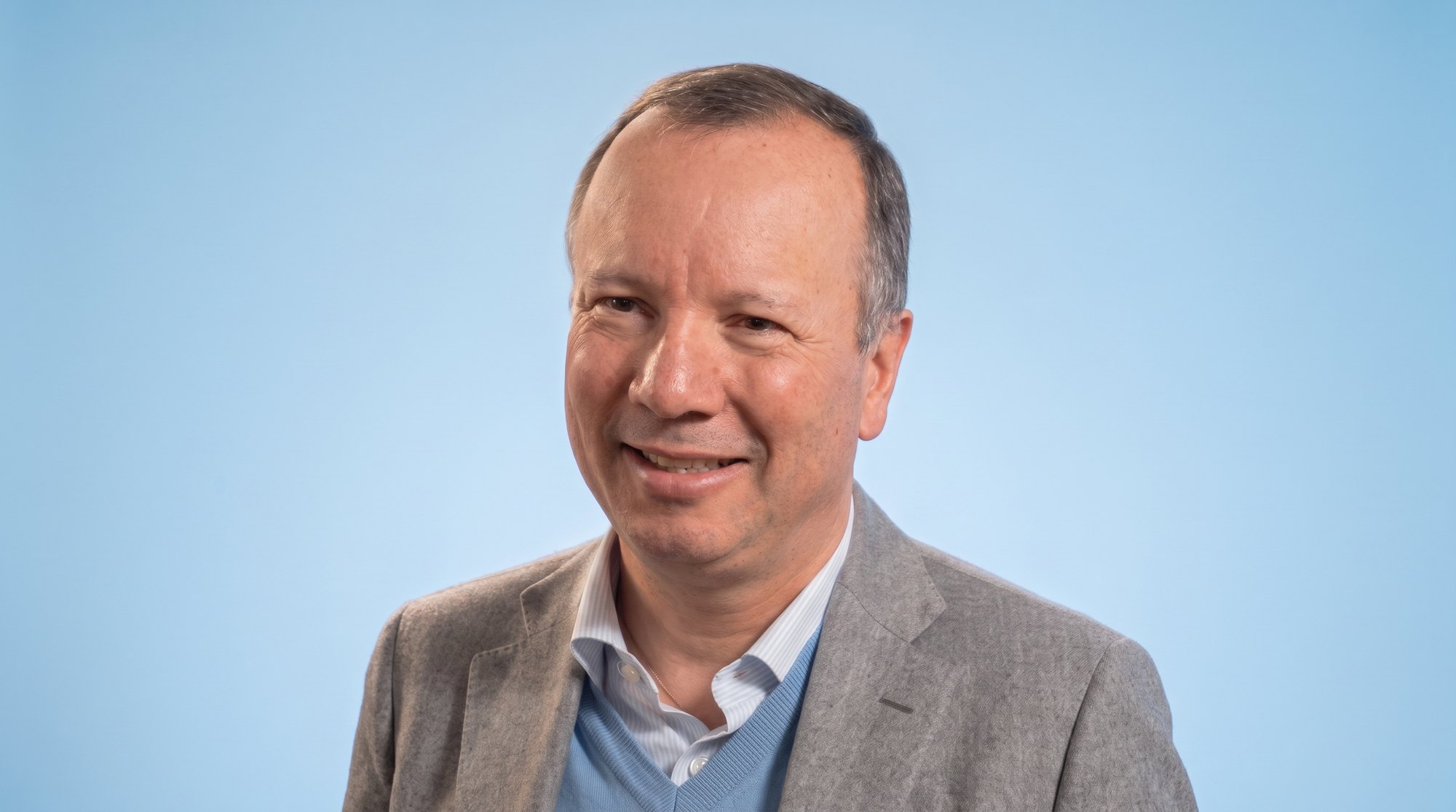
In March 2018, the German opinion magazine Tichys Einblick quoted from an interview Markus Krall had given to the business magazine Focus Money and put one sentence from it at the top: “It has never been so cheap to be irresponsible.” At the time, the European Central Bank (ECB) was holding its key interest rate at zero, and Krall saw an underestimated danger in this. When money costs nothing, his reasoning went, even companies that should have given up long ago survive, and the banks that lend to them hardly earn anything anymore.
The man who said this came from inside the world of finance. For more than two decades, Krall had advised banks and insurers on how to manage risk, among other roles as a senior partner at McKinsey.
At a glance
- Born: October 10, 1962, in Aschaffenburg, Germany
- Education: studied economics in Freiburg, research stay at Nagoya University, doctorate in Freiburg in 1993 on the Japanese stock market
- Work: risk manager and consultant (Allianz, Boston Consulting Group, Oliver Wyman, McKinsey, Roland Berger, goetzpartners), chief executive of Degussa Goldhandel from 2019 to 2022, chairman of the Atlas Initiative, founder of the precious metals brand GoldRevolution
- Major works: Der Draghi-Crash (2017), Wenn schwarze Schwäne Junge kriegen (2018), Die Bürgerliche Revolution (2020), Freiheit oder Untergang (2021), Die Stunde Null (2024), Götterdämmerung (2026)
- In one sentence: He explains why money that costs nothing ends up being very expensive, and he calls for an order in which citizens are once again responsible for themselves.
From Risk Models to Polemics
Krall studied economics in Freiburg and then went to Nagoya University on a scholarship from the Japanese Ministry of Education. His dissertation on the price-earnings ratio in the Japanese stock market was published in 1994 by Duncker & Humblot.
Years in consulting and finance followed: at McKinsey as head of the risk management practice, at the reinsurer Converium as the board member responsible for that field, and at Roland Berger until 2012. In April 2013 he gave up his plan to found a European credit rating agency, and he then spent five years as a managing director at goetzpartners. In September 2019 he took over the management of Degussa Sonne/Mond Goldhandel, Germany’s largest precious metals dealer independent of the banks. At the end of November 2022, the company relieved him of his duties with immediate effect; it did not publish a detailed explanation.
Undead Companies
His first major polemic, Der Draghi-Crash (The Draghi Crash), appeared in 2017 with the subtitle Warum uns die entfesselte Geldpolitik in die finanzielle Katastrophe führt (Why unleashed monetary policy is leading us into financial catastrophe). In it, Krall argues that the European Central Bank under Mario Draghi had escaped any effective oversight and slid into financing governments. Cheap money, the book says, redistributes wealth, eats away at the banks’ earnings, and quietly piles up risks on their balance sheets.
At the core of this analysis is a term that has recurred in almost all of his writing since: the zombie company. He means firms that still exist only because their loans cost almost nothing. In an article for Tichys Einblick in December 2019, he called the zero interest rate a subsidy for companies that had in fact failed and wrote of these firms: “their bankruptcy has not been canceled, only postponed.” As evidence, he cited the insolvency rate, which he said had been 1.5 to 2 percent a year before the financial crisis and had since fallen below half a percent.
Anyone familiar with the Austrian School of economics will recognize the idea. Ludwig von Mises and Friedrich August von Hayek described how artificially low interest rates steer capital into projects that would not pay off at honest prices. Krall translates this into the language of the lending business: once the interest burden no longer matters, ratios such as debt service coverage lose their meaning, and credit ratings can hardly tell good borrowers from bad ones. As early as 2018, he spoke of a “creeping and so far unrecognized contamination of the loan books.”
What Came True and What Did Not
Krall attached dates to his diagnosis, and he has to be measured against them. In March 2018 he said: “In two years, the banking system will blow up in our faces.” In the summer of 2019 he named 2020 as the year in which the banks’ earnings would be eroded so far that a crisis would follow, and in January 2020, according to the business daily Handelsblatt, he expected a severe recession in the eurozone that same year. In his scenario, bank failures would be followed by sovereign defaults, the breakup of the euro, and hyperinflation.
The recession did come, but for a reason that had played no part in his thinking: according to Eurostat, the COVID-19 pandemic shrank the eurozone’s economic output by 6.6 percent in 2020. The wave of bank collapses, on the other hand, never came, and neither did the breakup of the euro or hyperinflation. After interest rates turned upward in 2022, the large banks in the euro area were even earning well again; according to the ECB’s banking supervision, their return on equity stood at around 10 percent in the third quarter of 2023.
A fair assessment, however, also includes the other side. Inflation in the eurozone, below two percent for years, reached a peak of 10.6 percent in October 2022. And when interest rates rose, what Krall had described happened: the postponed bankruptcies arrived. According to the Federal Statistical Office, 21,812 corporate insolvencies were filed in Germany in 2024, 22.4 percent more than the year before and more than in any year since 2015. Krall himself holds to his basic thesis and interprets the rescue programs of the pandemic years as a postponement of the crisis. His dates did not hold, but since the turn in interest rates, reality has partly demonstrated the mechanism he described.
No Progress Without Risk
In Wenn schwarze Schwäne Junge kriegen (When Black Swans Have Young), Krall broadened his view in 2018. His thesis is that a society that wants to avoid every risk makes itself especially vulnerable. Central banks that cover up every crisis with money, and governments that cushion every hardship with handouts, in his account deprive people of the experience of learning from their mistakes. Without risk, Krall says, there is neither progress nor new knowledge.
This contains a basic idea of liberty. Anyone who wants to act freely must be allowed to bear the consequences of his actions, the good ones as well as the bad. A system that socializes losses therefore weakens not only balance sheets but also the individual responsibility on which a free society depends.
A Revolution of the Citizens
With Die Bürgerliche Revolution (The Civic Revolution), published by Langen Müller in March 2020, Krall moved from monetary policy to the order of society. He addresses the high achievers, that is, those whose work pays for the community, and calls on them to use the coming crisis as an opportunity. He wants to restore five pillars of civil society: “family, property, individuality, religion, and culture.”
In an interview with Tichys Einblick in March 2020, he became specific. He proposed a ban on government debt, sound money, the abolition of most types of taxes, lower government spending as a share of GDP, and term limits. He even considered it conceivable to repeal all laws and regulations of the past thirty years. The proposal that drew the most attention concerned the right to vote. Everyone should “have to decide for each legislative term whether he wants to vote or receive transfers,” Krall said, and he expressly included students receiving BAföG, Germany’s state student aid, as well as recipients of subsidies. His reasoning: “If only those who receive no transfers are allowed to vote, these will be handled more sparingly.”
The proposal contradicts the universal and equal suffrage guaranteed by Article 38 of the Basic Law, Germany’s constitution, and is accordingly controversial. But it takes up an old question in the liberal tradition. In his Considerations on Representative Government of 1861, John Stuart Mill wanted to exclude recipients of poor relief from the vote, in essence on the grounds that whoever cannot support himself has no claim to a say in how other people’s money is spent.
Krall promotes his ideas above all through the Atlas Initiative, which he was already calling an extra-parliamentary movement in March 2020. He is chairman of the association, based in Frankfurt, which describes itself as a nonprofit and, by its own account, has more than 3,800 members in over a hundred regional chapters.
Forays into Party Politics
Krall was a member of the Christian Democratic Union (CDU), Germany’s main center-right party, until 2012. In July 2023 he became an associate member of the Werteunion (Values Union), but left it again in February 2024, shortly after it was founded as a party. His letter of resignation stated: “Lip service is no substitute for a program of liberty.” In September 2024 he joined Bündnis Deutschland (Alliance Germany), which nominated him as a candidate for the 2025 federal election. During the campaign he invoked Argentina’s president Javier Milei and his chainsaw: government agencies should be put to the test, almost all laws passed since 1970 should go, and taxes should fall sharply. The party won 0.2 percent of the party-list vote.
In December 2022 Krall came close to a criminal case, though only as a witness. In connection with the investigation into the group around Heinrich XIII Prince Reuss, his premises were also searched at the time. He was not a suspect. According to the indictment by the Federal Prosecutor’s Office, the group would have liked to see him as minister of economics and finance, which, according to press reports, he did not go along with. In July 2025 he testified in court as a witness, described his contacts with Reuss as business-related, and stated that he had learned of the coup plans only from the media.
A New Start in Switzerland
Krall has lived in Switzerland since 2024; in April of that year he registered as a resident of Schaffhausen. That same month, the University of Zurich, citing security costs, did not allow a lecture he was to give at the invitation of the Liberales Institut, a Zurich think tank, to take place on its premises; it was held instead in Zürich-Altstetten.
Since the fall of 2024, Krall has been building his own precious metals business under the GoldRevolution brand, and since March 2024 he has run the video channel Krall & Bubeck with Christian Bubeck, which had around 174,000 subscribers in September 2026. Readers should keep in mind that he recommends gold as protection against currency debasement and sells it at the same time.
His most recent book, Götterdämmerung. Der Kampf um die neue Weltordnung (Twilight of the Gods: The Struggle for the New World Order), was published by Langen Müller in March 2026. In it, Krall describes a worldwide contest between free societies and state-directed ones. He sees Europe on the losing side and identifies countermovements in the United States, in parts of Asia, and in Argentina. Back in 2024 he had written the afterword to Philipp Bagus’s book Die Ära Milei (The Milei Era); the foreword is by Milei himself.
What friends of liberty can learn from him
The most important lesson of Krall’s work is the one about hidden costs. An interest rate of zero looks like a gift, but it keeps companies alive that tie up capital and workers, and it merely postpones their bankruptcies. Anyone who wants to understand why so many firms had to give up after the end of zero interest rates will find a convincing explanation in his work.
Just as instructive is his insistence that liberty and liability belong together, for banks and companies as well as for the state, which can shift its debts onto everyone who holds money by way of the central bank. Here he meets Walter Eucken, for whom the principle of liability was one of the cornerstones of a free economic order.
The Price of Cheap Money
Markus Krall has been wrong about more than one date, and he has made proposals that can be debated at length. But his basic question has gained weight since interest rates, prices, and insolvencies rose again: who ultimately pays for money that costs nothing? His answer, in essence, is that it is savers and taxpayers, precisely those who provide for their own livelihood. That he encourages these people to become aware of their role and to stand up for a freer order makes him one of the most audible voices of liberty in the German-speaking world.
Further reading
- Markus Krall: Der Draghi-Crash. Warum uns die entfesselte Geldpolitik in die finanzielle Katastrophe führt, FinanzBuch Verlag, Munich 2017 (in German)
- Markus Krall: Wenn schwarze Schwäne Junge kriegen. Warum wir unsere Gesellschaft neu organisieren müssen, FinanzBuch Verlag, Munich 2018 (in German)
- Markus Krall: Die Bürgerliche Revolution. Wie wir unsere Freiheit und unsere Werte erhalten, Langen Müller, Munich 2020 (in German)
- Philipp Bagus: Die Ära Milei. Argentiniens neuer Weg, with an afterword by Markus Krall, Langen Müller, Munich 2024 (in German)
This article is part of our series on thinkers, doers, and historical figures of liberty.
Sources
- Krall, Markus: Das Kurs-Gewinn-Verhältnis am japanischen Aktienmarkt, Duncker & Humblot, Berlin 1994 (dissertation, Freiburg 1993; in German).
- Krall, Markus: Der Draghi-Crash. Warum uns die entfesselte Geldpolitik in die finanzielle Katastrophe führt, FinanzBuch Verlag, Munich 2017 (in German).
- Krall, Markus: Wenn schwarze Schwäne Junge kriegen. Warum wir unsere Gesellschaft neu organisieren müssen, FinanzBuch Verlag, Munich 2018 (in German).
- Krall, Markus: Die Bürgerliche Revolution. Wie wir unsere Freiheit und unsere Werte erhalten, Langen Müller, Munich 2020 (in German).
- Krall, Markus: Freiheit oder Untergang, Langen Müller, Munich 2021 (in German).
- Krall, Markus: Die Stunde Null, Langen Müller, Munich 2024 (in German).
- Krall, Markus: Götterdämmerung. Der Kampf um die neue Weltordnung, LMV/Langen Müller, Munich 2026 (in German).
- Krall, Markus: “Ohne Logik für Niedrigzinsen: EZB-Beamte wollen keine Zombies sehen,” Tichys Einblick, December 6, 2019, https://www.tichyseinblick.de/?p=354361 (in German)
- Interview with Markus Krall: “Die bürgerliche Revolution: notwendige Reform unserer Gesellschaft,” Tichys Einblick, March 22, 2020, https://www.tichyseinblick.de/?p=393605 (in German)
- Krall, Markus: letter of resignation to the Werteunion, published in Tichys Einblick, February 21, 2024, https://www.tichyseinblick.de/?p=945405 (in German)
- Bagus, Philipp: Die Ära Milei. Argentiniens neuer Weg, with a foreword by Javier Milei and an afterword by Markus Krall, Langen Müller, Munich 2024 (in German).
- Mill, John Stuart: Considerations on Representative Government, London 1861, ch. 8, https://www.gutenberg.org/ebooks/5669
- ATLAS, Förderung der Initiative für Recht und Freiheit e.V., website and legal notice (accessed November 7, 2026), https://www.atlas-initiative.de/impressum (in German)
- Wikipedia (de): Markus Krall, https://de.wikipedia.org/wiki/Markus_Krall (in German; introduction, biography, references)
- Kagels Trading: “Markus Krall: GoldRevolution, Bücher und Kritik (2026),” as of September 17, 2026, https://www.kagels-trading.de/markus-krall-erfahrung/ (in German)
- Handelsblatt (Jakob Blume): “Degussa-Chef Markus Krall: Provokateur mit Kalkül,” January 16, 2020, https://www.handelsblatt.com/finanzen/maerkte/devisen-rohstoffe/goldhandel-degussa-chef-markus-krall-provokateur-mit-kalkuel/25407060.html (in German)
- Der Spiegel: “Goldhändler Degussa trennt sich von umstrittenem Geschäftsführer,” 2022, https://www.spiegel.de/wirtschaft/unternehmen/markus-krall-goldhaendler-degussa-trennt-sich-von-umstrittenem-geschaeftsfuehrer-a-ce410590-74b4-464d-b786-dde4500f4fce (in German)
- Tichys Einblick: “Banken-Crash in zwei Jahren” (after Focus Money), March 12, 2018, https://www.tichyseinblick.de/?p=192264 (in German)
- Tichys Einblick: “Ökonom Markus Krall: Schon 2020 große Bankenkrise,” July 14, 2019, https://www.tichyseinblick.de/?p=318200 (in German)
- Tichys Einblick: “Markus Krall: So retten wir unsere Freiheit und unsere Werte,” March 15, 2020, https://www.tichyseinblick.de/feuilleton/buecher/markus-krall-so-retten-wir-unsere-freiheit-und-unsere-werte/ (in German)
- Tichys Einblick (Mario Thurnes): “Politik mit der Kettensäge und ‘Balko’, der in den Bundestag einziehen möchte,” January 13, 2025, https://www.tichyseinblick.de/?p=1083305 (in German)
- Perlentaucher: Der Draghi-Crash, https://www.perlentaucher.de/buch/markus-krall/der-draghi-crash.html (in German)
- Lesejury: Götterdämmerung, https://www.lesejury.de/markus-krall/buecher/goetterdaemmerung/9783784437620 (in German)
- Tagesspiegel: “Wegen Glückwunsch-WhatsApp: Maaßen tauchte wohl in den Ermittlungen zum Reichsbürger-Putsch auf,” August 18, 2023, https://www.tagesspiegel.de/politik/wegen-gluckwunsch-whatsapp-maassen-tauchte-wohl-in-den-ermittlungen-zum-reichsburger-putsch-auf-10329796.html (in German)
- nd: “Reichsbürger-Prozess: Markus Krall, der Crashprophet und der Plan vom Putsch,” July 30, 2025, https://www.nd-aktuell.de/artikel/1192979.reichsbuerger-prozess-markus-krall-der-crashprophet-und-der-plan-vom-putsch.html (in German)
- NZZ: Krall moves to Switzerland, 2024, https://www.nzz.ch/schweiz/der-umstrittene-unternehmensberater-markus-krall-zieht-in-die-schweiz-weil-er-niemals-in-die-lage-kommen-will-die-von-hitler-erfundene-wegzugssteuer-zu-bezahlen-ld.1826462 (in German)
- Republik: “Universität Zürich lädt radikalen Redner aus,” April 18, 2024, https://www.republik.ch/2024/04/18/universitaet-zuerich-laedt-radikalen-redner-aus (in German)
- Berliner Zeitung: interview with Markus Krall, July 24, 2026, https://www.berliner-zeitung.de/article/markus-krall-10197451 (in German)
- Federal Returning Officer (Bundeswahlleiterin): final result of the 2025 Bundestag election, press release no. 29/25 of March 14, 2025, https://www.bundeswahlleiterin.de/info/presse/mitteilungen/bundestagswahl-2025/29_25_endgueltiges-ergebnis.html (in German)
- Eurostat: euro area GDP 2020 (−6.6%), euro indicators of March 9, 2021, https://ec.europa.eu/eurostat/en/web/products-euro-indicators/-/2-09032021-AP
- Eurostat: euro area inflation, October 2022 (10.6 percent)
- ECB Banking Supervision: Annual Report 2023, https://www.bankingsupervision.europa.eu/press/other-publications/annual-report/html/ssm.ar2023~2def923d71.de.html (German version)
- Federal Statistical Office (Statistisches Bundesamt): corporate insolvencies 2024 (21,812, +22.4%), as reported in Börsen-Zeitung, https://www.boersen-zeitung.de/konjunktur-politik/firmenpleiten-auf-10-jahreshoch (in German)
Featured image: Photo: NearEMPTiness, Wikimedia Commons, CC BY-SA 4.0, background edited