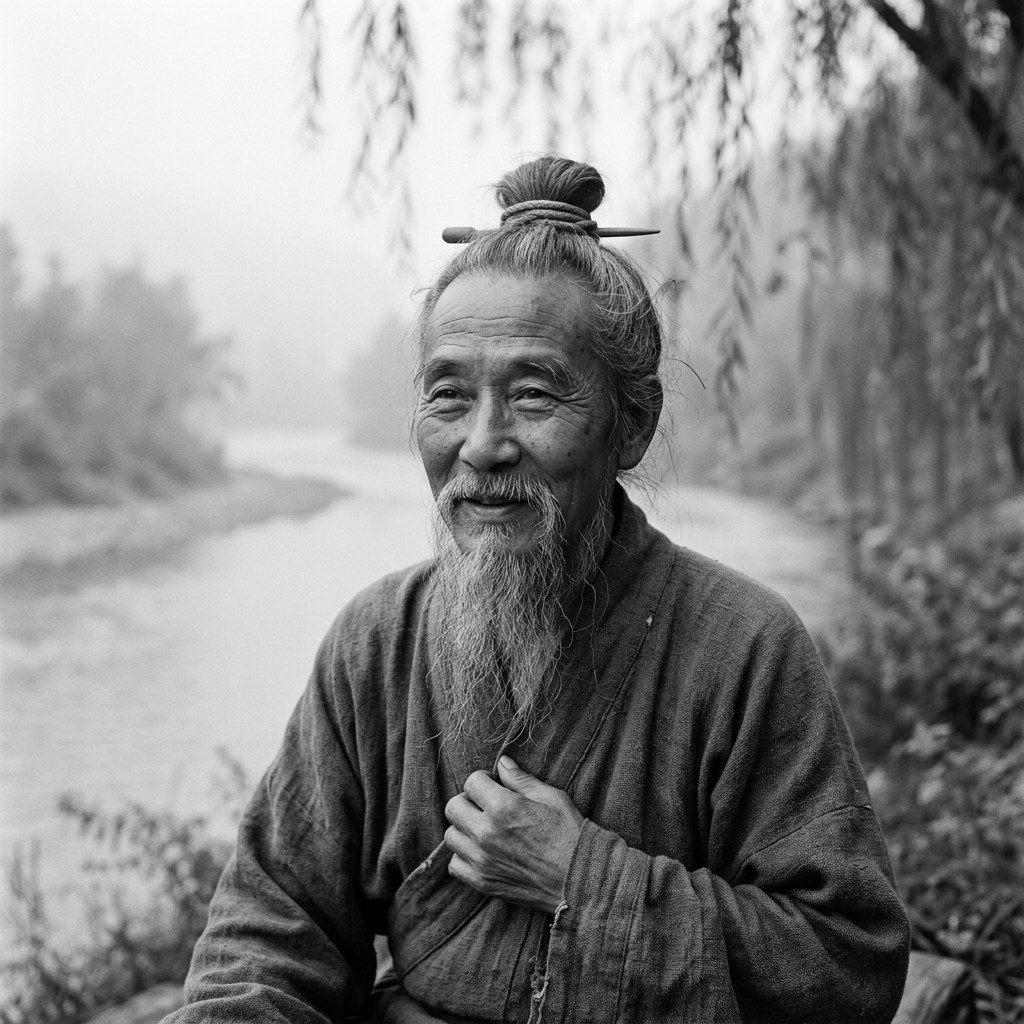
Zhuangzi was fishing on the Pu River when two high officials of the king of Chu came to him. Their lord wished to entrust him with the administration of his realm, the king had them say. Zhuangzi kept the fishing rod in his hand and, without looking around, asked about the sacred tortoise that had been dead for three thousand years and that the king kept in a shrine, wrapped in silk cloths, in the temple. Would this creature rather leave behind honored bones, or rather live and drag its tail through the mud? Rather live, said the officials. In Burton Watson’s English translation, Zhuangzi answers: “Go away! I’ll drag my tail in the mud!”
The scene appears in chapter 17 of the book Zhuangzi, and no one knows whether it happened that way. Around 100 BC, the historian Sima Qian tells of the same refusal with a different image. On the point that matters, both versions agree: a scholar turns down the power he is offered.
At a glance
- Life: 4th century BC; frequently cited dates such as 369 to 286 BC are estimates
- Background: Meng, probably in the state of Song in present-day Henan
- Work: according to Sima Qian, a minor official in the “lacquer garden” of Meng; declined the post of chancellor
- Writings: Zhuangzi, since AD 742 also Nanhua zhenjing (“True Scripture of Southern Florescence”), 33 chapters in the edition of Guo Xiang; the seven “inner” chapters are the most likely to be his own text
- In one sentence: He placed a free life above any office and described how well-meant order destroys what it sets out to order.
A name and a book from many hands
Almost nothing is certain about Zhuang Zhou the man. The only early account comes from Sima Qian, who wrote some two centuries after him. According to it, Zhou came from Meng and once served there as an official in the lacquer garden, though it is unclear whether this means a place or a plantation of lacquer trees. He lived in the time of King Hui of Liang and King Xuan of Qi, that is, in the second half of the 4th century BC, the era of the Warring States.
The question of who wrote the book is harder. The scholar Guo Xiang, who died in AD 312, cut down the 52 sections listed in a Han-era bibliography and arranged the rest into seven “inner,” fifteen “outer,” and eleven “miscellaneous” chapters, on which all present-day versions are based. The inner chapters are regarded as the oldest core, but even their origin with Zhuang Zhou remains an assumption, in the judgment of the Stanford Encyclopedia of Philosophy.
The British sinologist A. C. Graham distinguished several groups of authors in the remaining chapters. He attributed chapters 8 to 10 and the beginning of chapter 11 to an author he called the “Primitivist” and dated to the years between the fall of the Qin and the rise of the Han, roughly 209 to 202 BC. The philosopher Liu Xiaogan groups them, together with chapters 28 to 31, with a school of “Anarchists” (in Chinese, literally “without rulers”) from the late Warring States period, whose authors he takes to be disciples of Zhuangzi. Sima Qian, for his part, still saw chapter 10 as a work of the master himself.
Anyone who writes “Zhuangzi says” therefore often means a book and a school, which is why this article names the chapter each time. Passages in quotation marks are quoted word for word from Burton Watson’s English translation (the German edition of this article quotes Richard Wilhelm’s 1912 translation instead); all other passages are the editors’ paraphrases based on Watson’s complete English translation.
The sacrificial ox and the single branch
In Sima Qian’s account, King Wei of Chu sends messengers with rich gifts and offers Zhuangzi the post of chancellor. Zhuangzi laughs and recalls the ox that is fattened for years for the great sacrifice and dressed in embroidered cloths until it is led into the temple; at that moment it would wish in vain to be a lonely piglet. He would rather amuse himself in a filthy ditch, he says, than be reined in by a ruler, and he would accept no office as long as he lived.
The same attitude appears in the inner chapters. In the first, called Xiaoyao you, “Free and Easy Wandering” in Watson’s version, the legendary ruler Yao wants to hand his realm over to the hermit Xu You. Xu You declines: the tailorbird that builds its nest in the deep forest needs no more than a single branch, and he has no use for rule over the world.
Letting the world be
Chapter 11 bears the title Zai you, “Let It Be, Leave It Alone” in Watson’s version. Its first sentence, the best-known political sentence in the book, reads in Watson’s translation: “I have heard of letting the world be, of leaving it alone; I have never heard of governing the world.” One leaves it alone so that its inborn nature is not corrupted, and if that nature stays uncorrupted, what need is there for governing?
Even the good ruler Yao, the chapter says, threw the world off balance because he filled people with joy, just as the tyrant Jie plunged them into misery. Here the steering itself is the mistake, whatever the intention behind it, and rewards and punishments cannot put the world in order either, because they are never enough for that.
The full picture also includes how the chapter goes on. If the noble man has no choice but to steer the world, non-action, wu wei, is the best course, and the world can be entrusted to someone who values his own person more than the administration of the world. So the chapter asks whoever rules to hold back; it does not sketch an order entirely without rulers. And since its opening belongs to the part Graham attributes to the Primitivist, the voice in Zai you is more likely that of an early school invoking Zhuangzi than of the master himself.
Horses, ducks, and a seabird
Chapters 8 and 9, also attributed to the Primitivist, contain two well-known parables. The duck’s legs are short and the crane’s are long, and anyone who stretches the one or shortens the other brings both nothing but misery. In chapter 9, Bo Le appears, in tradition the master of horse training. He singes, clips, and brands the animals, shuts them in stables, and drills them with bit and whip until more than half of them are dead. Those who administer the affairs of the world, the text says, make the same mistake.
In chapter 18, one of the outer chapters, a seabird alights outside the capital of the state of Lu. The ruler leads it into the ancestral temple, has solemn music played, and sets meat and wine before it. The bird touches nothing and is dead after three days, because the ruler fed it with what nourishes himself instead of with what nourishes a bird.
The seventh and last of the inner chapters shows that the idea is already present in the oldest core of the book. There a madman calls the plan that a ruler should issue his own regulations and bring everyone to obedience false virtue. At the end of the chapter stands Hundun, the ruler of the center, who has no openings in his body. His grateful guests bore one into him each day so that he can see, hear, and eat like everyone else, and on the seventh day he dies.
What Rothbard found in him
Murray Rothbard claimed Zhuangzi for the history of the idea of liberty, first in an essay in 1990, then in 1995 in Economic Thought Before Adam Smith. In his view, Zhuangzi carried Laozi’s teaching of letting things be to its logical conclusion, individualist anarchism, and was the first anarchist in intellectual history. He was the first, Rothbard argued, to develop the idea of spontaneous order, later elaborated by Proudhon and Hayek, and perhaps the first to recognize the state as a robber on a grand scale. Chapter 10 puts it this way: whoever steals a belt buckle pays with his life, whoever steals a state becomes a lord, and at the gates of the lords benevolence and righteousness then appear as well. Rothbard calls the refusal to King Wei, which he quotes in the version with the sacrificial ox, “one of the great declarations in history.”
This reading captures something real, because the refusal of office, the sentence about letting things be, and the image of the state as thief are among the earliest testimonies of thought critical of rule. Rothbard read the book in older English translations and as the work of a single author, so his strongest evidence comes from the later chapters discussed above. A line about spontaneous order that he cites as a quotation cannot be found word for word in the standard translations and is therefore not repeated here. The word anarchism itself comes from 19th-century Europe. The chapters on horses and ducks praise a primeval age without sages and inventions, in which people lived simply alongside birds and beasts, and nowhere does the book develop a theory of property, contract, and trade. What it shares with Rothbard is a distrust of any power that wants to shape people according to its plan.
What friends of liberty can learn from him
First, there is the refusal itself. Zhuangzi, or the figure the book makes of him, takes the honors of power seriously and turns them down anyway, because he knows what they cost: the sacrificial ox is well fed before it is led into the temple.
Then there is well-meant rule. The ruler of Lu wants only to do the seabird good, Bo Le knows his craft, and Hundun dies of his friends’ gratitude. Long before Hayek’s warning against the pretence of knowledge, these parables show that great harm often springs from the zeal to improve others by one’s own measure.
And finally, respect for difference: anyone who knows that ducks have short legs and cranes long ones will be wary of uniform rules for everyone. The book does not answer how free people should arrange their life together in detail. But it showed early, and in very memorable images, why one should regulate as little as possible in the first place.
The tortoise in the mud
In the end, what remains is the man by the river who does not put down his fishing rod. Whether he was an anarchist, a sage in retreat, or the literary figure of a school can no longer be settled. But his answer to the king’s messengers puts a question to anyone who receives an honorable offer from power: would you rather be kept in the temple or be alive in the mud?
Further reading
- Burton Watson (trans.): The Complete Works of Zhuangzi, Columbia University Press, New York 2013
- Richard Wilhelm (trans.): Dschuang Dsi. Das wahre Buch vom südlichen Blütenland, Diederichs, Jena 1912 (in German; many later editions)
- A. C. Graham: Chuang-tzŭ. The Inner Chapters, Allen & Unwin, London 1981
- Murray N. Rothbard: Economic Thought Before Adam Smith, Edward Elgar, Aldershot 1995
This article is part of our series on thinkers, doers, and historical figures of liberty.
Sources
- Zhuangzi: The Complete Works of Zhuangzi, translated by Burton Watson, Columbia University Press, New York 2013 (chs. 1, 2, 7, 8, 9, 10, 11, 17, 18, 32; introduction, pp. vii–xix).
- Dschuang Dsi: Das wahre Buch vom südlichen Blütenland, translated by Richard Wilhelm, Diederichs, Jena 1912 (in German); excerpt with the tortoise scene at Projekt Gutenberg (in German): https://projekt-gutenberg.org/authors/richard-wilhelm/books/dschuang-dsi/chapter/2
- Sima Qian: Shiji (Records of the Grand Historian), ch. 63, section on Zhuangzi, Chinese text: https://zh.wikisource.org/wiki/史記/卷063
- Chuang Tzŭ: Mystic, Moralist, and Social Reformer, translated by Herbert A. Giles, Bernard Quaritch, London 1889, ch. 11, “On Letting Alone”: https://gutenberg.org/files/59709/59709-h/59709-h.htm
- Rothbard, Murray N.: Economic Thought Before Adam Smith (An Austrian Perspective on the History of Economic Thought, vol. 1), Edward Elgar, Aldershot 1995; excerpt “Libertarianism in Ancient China”: https://mises.org/mises-daily/libertarianism-ancient-china
- Rothbard, Murray N.: “Concepts of the Role of Intellectuals in Social Change toward Laissez Faire,” Journal of Libertarian Studies 9, no. 2, 1990; excerpt “The Ancient Chinese Libertarian Tradition”: https://mises.org/mises-daily/ancient-chinese-libertarian-tradition
- Stanford Encyclopedia of Philosophy: “Zhuangzi,” first published 2014, revised 2024, https://plato.stanford.edu/entries/zhuangzi/
- Coutinho, Steve: “Zhuangzi (Chuang-Tzu, 369–298 B.C.E.),” Internet Encyclopedia of Philosophy, https://iep.utm.edu/zhuangzi/
- Graham, A. C.: Chuang-tzŭ. The Inner Chapters, Allen & Unwin, London 1981.
- Graham, A. C.: Disputers of the Tao. Philosophical Argument in Ancient China, Open Court, La Salle 1989.
- Liu Xiaogan: Classifying the Zhuangzi Chapters, translated by William E. Savage, Center for Chinese Studies, University of Michigan, Ann Arbor 1994; Open Access: https://library.oapen.org/handle/20.500.12657/41839
- Rapp, John A.: Daoism and Anarchism. Critiques of State Autonomy in Ancient and Modern China, Continuum, London/New York 2012, https://theanarchistlibrary.org/library/john-a-rapp-daoism-and-anarchism
Featured image: Zhuangzi (AI illustration, free interpretation)