
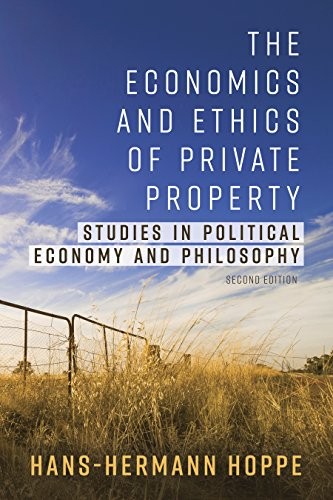
The Economics and Ethics of Private Property
Studies in Political Economy and Philosophy
Hans-Hermann Hoppe combines economic theory and philosophy into a consistent defense of private property, as both an ethical foundation and an engine of prosperity.
- Level
- Advanced
- Published
- 1993
- Publisher
- Mises Institute
- ISBN
- 1610166892
What it is about
In this work, Hans-Hermann Hoppe places at the center a thesis that he seeks to establish on both economic and philosophical grounds: private property is not merely a legal construct but an ethical principle that can be derived from the logic of human action. Those who can dispose of themselves and the fruits of their labor create the precondition for cooperation, prosperity, and social peace.
Hoppe analyzes why government interference with property rights not only produces economic inefficiency but also cannot be justified ethically. He draws a clear line: half-hearted reforms are not enough. Anyone who wants to overcome the consequences of socialized property cannot avoid thoroughgoing privatization. He derives this conclusion not from political preferences but from a systematic analysis of incentives, knowledge, and responsibility.
The book combines the Austrian tradition of economic theory with a property-rights ethics that Hoppe develops further in the footsteps of Murray Rothbard. Readers who want to understand how economic and moral arguments for a self-determined life can support each other will find a dense, demanding treatment here.
The work is suited to readers who have some basic knowledge of economic theory or political philosophy and are willing to engage with rigorous argument. You will not always agree with Hoppe, but you will rarely come away unimpressed.
Did you enjoy the book? The author and publisher will appreciate a short review, for example with the retailer you bought it from.