
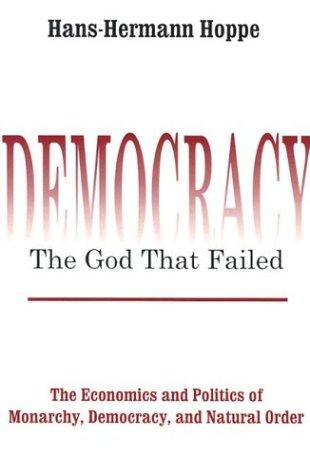
Democracy: The God That Failed
The Economics and Politics of Monarchy, Democracy, and Natural Order
For advanced readers who want to question the state at its root. Provocative, dense, and far-reaching.
- Level
- Specialist
- Published
- 2001
- Publisher
- Routledge
- ISBN
- 9780765808684
What it is about
Hans-Hermann Hoppe is one of the best-known representatives of the Austrian School of economics and of libertarian thought. In this work he scrutinizes democracy as a form of government, not to defend it but to question its inner logic. His central thesis: democracy is no guarantee of liberty but a mechanism that creates certain incentives, and these incentives tend to favor growing state power, rising debt, and the erosion of private property.
Hoppe compares democratic systems with monarchical and other forms of rule, not out of nostalgia but to make the economic structure of rule visible. A monarch, the argument goes, thinks long term as the owner of his country; an elected politician, by contrast, has a short time horizon and strong incentives to consume resources that do not belong to him. Whether or not one shares this conclusion, the thought experiment forces a fresh look at institutions.
The book combines economic theory, political philosophy, and historical analysis. Hoppe builds on the theory of property rights and develops from it a critique of government redistribution that he presents consistently and without compromise. Anyone who wants to understand liberty not just as a political slogan but as an institutional and economic problem will find dense, challenging reading here.
The book suits readers who are already familiar with the basic concepts of economics and political philosophy and who are willing to subject established convictions to serious scrutiny.
Did you enjoy the book? The author and publisher will appreciate a short review, for example with the retailer you bought it from.
More about the author: Hans-Hermann Hoppe: The Property Theorist and His Limits