On January 27, 1848, a 42-year-old deputy stood up in the French Chamber and told those in power something they did not want to hear. Among the working classes, he warned, political passions had become social ones; there, people considered the distribution of property unjust, and he believed “that we are at this moment sleeping on a volcano.” The record notes protests in the chamber. About four weeks later, King Louis-Philippe had been overthrown.
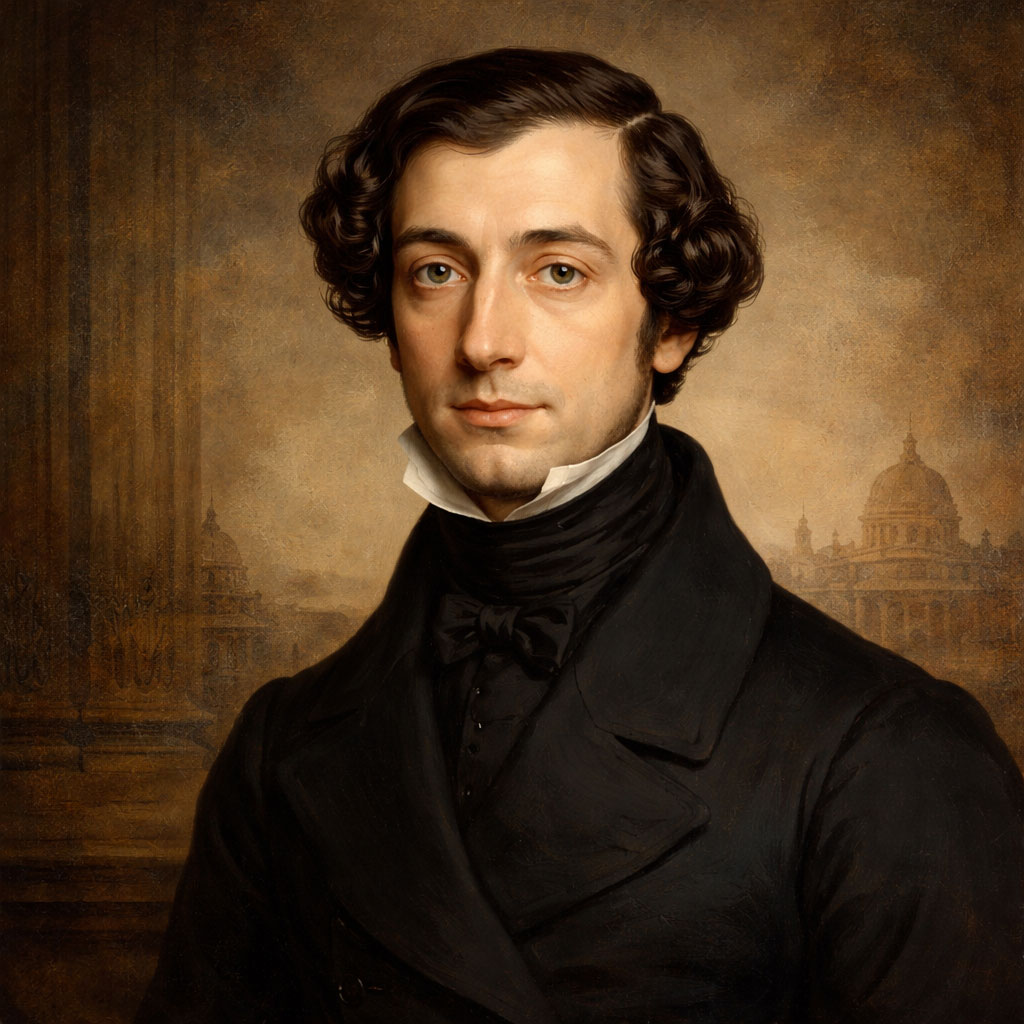
The speaker was Alexis de Tocqueville. He had long been known as the author of a work on democracy in America that still ranks among the wisest books about liberty in a society of equals. His guiding question, how people remain free once no social ranks divide them anymore, runs through his entire work.
At a glance
- Life: July 29, 1805, in Paris to April 16, 1859, in Cannes
- Work: judge in Versailles, journey through the United States in 1831–32, deputy from 1839 to 1851, member of the Académie française from 1841, foreign minister from June to October 1849
- Major works: De la démocratie en Amérique (vol. I 1835, vol. II 1840), L’Ancien Régime et la Révolution (1856), Souvenirs (posthumous)
- In one sentence: He showed that liberty in a democracy is threatened less by tyrants than by a solicitous administration and by citizens who forget how to govern themselves.
A nobleman between two worlds
Tocqueville came from Norman nobility that the Revolution had marked deeply. His maternal great-grandfather was Malesherbes, the enlightened minister who had defended Louis XVI before the Convention and was himself executed in 1794. His parents survived the Terror in prison. Under the Restoration his father served as a prefect, among other places in Metz, where the son finished school.
After studying law in Paris, Tocqueville became a judge at the court in Versailles in 1827. According to his friend Gustave de Beaumont, he took the oath to the monarchy of the July Revolution of 1830 with sadness; a few months later the two set out for America.
In 1836 he wrote to his friend Eugène Stoffels, in substance, that he hoped to show so much respect for justice, order, and law, for morality and religion, that people would recognize in him a liberal of a new kind, not to be confused with the ordinary democrats of his day. This combination of a love of liberty with a sense for the moral foundations of a society shapes his entire work.
Nine months that became a book
Officially, Tocqueville and Beaumont were to study the American prison system from May 1831 to February 1832, and they did submit their report on it. What really interested Tocqueville was democracy itself. In America he saw where Europe was heading too: toward a society of “equality of conditions,” in which no estate of birth stands above another.
The first volume of De la démocratie en Amérique appeared in 1835 and made him famous; the second followed in 1840. In 1839 Tocqueville entered the Chamber of Deputies, and in 1841 the Académie française elected him. As rapporteur of a parliamentary commission, he argued in 1839 for the abolition of slavery in the French colonies. On the Algerian question, by contrast, he sided with conquest and settlement; he traveled through the country in 1841 and 1846 and wrote two reports on it in 1847. This part of his career remains controversial to this day.
When equality matters more than liberty
Tocqueville considered democracy unstoppable and wanted to understand how people could remain free within it. Democratic peoples, he writes in the second volume, have a natural taste for liberty, but for equality they have a passion that he calls “ardent, insatiable, eternal, invincible”: “They want equality in liberty, and if they cannot obtain it, they still want it in servitude.”
Equality, as he observed, produces two tendencies. One drives people toward independence, and he explicitly praises this tendency because it plants in every person an instinctive inclination toward political independence. The other leads “by a longer, more secret, but more certain road to servitude.” People resist the first tendency because they see it; they follow the second without noticing it, and that is why he considered it especially important to point it out.
He saw a further danger in the power of the majority over people’s minds, which he called the tyranny of the majority. He knew of no country, he wrote about the America of the 1830s, in which there was less independence of mind and real freedom of discussion.
Township and association as schools of liberty
He found the remedy in America as well, first in the self-governing townships of New England. “Municipal institutions are to liberty what primary schools are to science,” he says in the first volume; they bring liberty within the people’s reach and accustom them to its use. “Without municipal institutions a nation can give itself a free government, but it does not have the spirit of liberty.”
He distinguished carefully between governmental centralization, the uniform direction of affairs that concern everyone, and administrative centralization, in which local matters, too, are decided in the capital. In his view the United States had the first to the highest degree and the second not at all, and he saw in this one reason for its liberty.
The second remedy is voluntary associations. “Americans of all ages, all conditions, all types of mind constantly unite,” he noted, for business as well as for festivities, churches, or inns. Where in France the state, and in England a great lord, would stand at the head of a new undertaking, in the United States you would be sure to find an association. He called the art of associating the “mother science” of democratic countries, on whose progress all the others depend.
Associations are necessary because in democratic times the individual alone is too weak to preserve his liberty, and because these times have a temptation of their own. Tocqueville called it individualism: a calm, considered feeling that leads the citizen to withdraw with his family and friends and leave the larger society to itself.
A rule that does not hurt
At the end of the second volume, Tocqueville paints his best-known picture, for which, in his words, the old terms despotism and tyranny do not fit. He sees a countless multitude of equal people revolving around petty pleasures, each one withdrawn into himself and a stranger to the others. Above them rises “an immense, tutelary power” that alone takes charge of securing their well-being. “It is absolute, detailed, regular, provident, and mild.” It would resemble paternal authority if it sought to prepare people for adulthood, but instead it seeks to keep them irrevocably in childhood.
It does not destroy, it prevents things from coming into being; it does not tyrannize, it hinders, compresses, enervates, extinguishes, and stupefies, until each nation is nothing more than a flock of timid and industrious animals with the government as its shepherd. Such servitude, according to Tocqueville, could even establish itself in the shadow of the sovereignty of the people, that is, alongside the outward forms of liberty.
Equality in liberty or in servitude
After the February Revolution, Tocqueville sat in the Constituent Assembly. On September 12, 1848, he spoke there against a right to work guaranteed in the constitution, in one of the clearest speeches on democracy and socialism. What all socialists had in common, he said, was above all “a profound distrust of liberty, of human reason” and the idea that the state should not merely direct society but be the master of each individual, “what am I saying! his master, his tutor, his pedagogue.” If he were to sum up socialism in a formula, he would call it “a new formula of servitude.”
Then comes the distinction that Hayek would quote almost a hundred years later: “Democracy extends the sphere of individual freedom, socialism restricts it. Democracy attaches all possible value to each man; socialism makes each man a mere agent, a mere number.” The two, he said, shared only one word, equality, but democracy sought equality in liberty, and socialism equality in coercion and servitude. The Assembly rejected the right to work by 596 votes to 187.
In 1849 Tocqueville served for a few months as foreign minister. During Louis-Napoléon’s coup of December 2, 1851, he was briefly arrested, and afterward he withdrew from politics.
The old state in new clothes
His second great work took shape in retirement. In L’Ancien Régime et la Révolution (1856) he showed that French administrative centralization was not the work of the Revolution and Napoleon, as people liked to claim. It was an institution of the old monarchy, whose intendants in the provinces and subdelegates in every canton had carried out the will of the government long before 1789. The Revolution had done away with the king and inherited the bureaucracy.
This book also contains his finest sentence about liberty. Those who valued liberty only for its material advantages, he wrote, had never kept it for long; its real appeal lay in the joy of being able “to speak, to act, to breathe without constraint, under the sole rule of God and the laws.” And then: “Whoever seeks in liberty anything other than liberty itself is made to serve.”
What friends of liberty can learn from him
In 1944 Friedrich August von Hayek placed a sentence by Tocqueville at the front of his book The Road to Serfdom as its motto: “I should have loved freedom, I believe, at all times, but in the time in which we live I am ready to worship it.” In the second chapter Hayek quotes the 1848 speech on democracy and socialism, and according to his biographer Alan Ebenstein, the book’s title, too, goes back to Tocqueville’s phrase about the road to servitude.
The first thing to learn from Tocqueville is that liberty has to be practiced. “Nothing is richer in wonders than the art of being free,” he writes, “but nothing is harder than the apprenticeship of liberty.” Those who manage their own affairs in township and association learn this art, and those who leave everything to the administration forget it.
The second lesson concerns the form the threat takes. In democracies it comes less often with force than with care, and anyone who wants to recognize it pays attention to how many decisions are taken out of citizens’ hands.
Finally, he shows that decentralization is more than an administrative technique, because it keeps power close to the people and educates the citizens a free order needs. For everyone who values subsidiarity and civil society, he therefore remains an important authority.
A liberal who loved liberty for its own sake
Tocqueville died of tuberculosis in Cannes on April 16, 1859, only 53 years old. His question arises anew for every generation: whether the citizens of a democracy still practice the art of liberty or allow a mild power to keep them in childhood. He himself believed liberty was possible; otherwise, as he writes toward the end of his book on America, he would not have written this work.
Further reading
- Alexis de Tocqueville: De la démocratie en Amérique, vol. I (1835) and vol. II (1840), in English as Democracy in America, in German as Über die Demokratie in Amerika
- Alexis de Tocqueville: L’Ancien Régime et la Révolution (1856), in English as The Old Regime and the Revolution, in German as Der alte Staat und die Revolution
- Friedrich August von Hayek: The Road to Serfdom, Routledge, London 1944, in German as Der Weg zur Knechtschaft
- Alan S. Kahan: Alexis de Tocqueville, Major Conservative and Libertarian Thinkers series, Bloomsbury Academic, London 2010
This article is part of our series on thinkers, doers, and historical figures of liberty.
Sources
- Tocqueville, Alexis de: De la démocratie en Amérique, vol. I, Paris 1835; vol. II, Paris 1840; quoted from the 12th edition, Paris: Pagnerre 1848, https://fr.wikisource.org/wiki/De_la_d%C3%A9mocratie_en_Am%C3%A9rique/%C3%89dition_1848 (quotations in the article: our own translation)
- Tocqueville, Alexis de: L’Ancien Régime et la Révolution, Paris 1856, books II and III, https://fr.wikisource.org/wiki/L%E2%80%99Ancien_R%C3%A9gime_et_la_R%C3%A9volution
- Tocqueville, Alexis de: speech in the Chamber of Deputies, January 27, 1848, in: Œuvres complètes, Paris: Michel Lévy 1866, vol. IX, https://fr.wikisource.org/wiki/%C5%92uvres_compl%C3%A8tes_d%E2%80%99Alexis_de_Tocqueville,_L%C3%A9vy/Discours_27_janvier_1848
- Tocqueville, Alexis de: Discours à l’Assemblée constituante (12 septembre 1848) sur la question du droit au travail, in: Œuvres complètes, Paris: Michel Lévy 1866, vol. IX, pp. 536–552, https://fr.wikisource.org/wiki/%C5%92uvres_compl%C3%A8tes_d%E2%80%99Alexis_de_Tocqueville,_L%C3%A9vy/Discours_%C3%A0_l%E2%80%99Assembl%C3%A9e_constituante_sur_la_question_du_droit_au_travail
- Tocqueville, Alexis de: Rapport fait au nom de la Commission chargée d’examiner la proposition de M. de Tracy, relative aux esclaves des colonies, July 23, 1839, https://fr.wikisource.org/wiki/%C5%92uvres_compl%C3%A8tes_d%E2%80%99Alexis_de_Tocqueville,_L%C3%A9vy/Rapport_sur_l%E2%80%99esclavage
- Beaumont, Gustave de (ed.): Memoir, Letters, and Remains of Alexis de Tocqueville, vol. 1, Cambridge/London 1861/62 (letters to Eugène Stoffels, July 24, 1836, and to Louis de Kergorlay, 1836), https://archive.org/details/memoirlettersrem01tocquoft
- Hayek, Friedrich August von: The Road to Serfdom, London: Routledge 1944 (motto and ch. 2, “The Great Utopia”), https://archive.org/stream/in.ernet.dli.2015.46585/2015.46585.Road-To-Serfdom_djvu.txt
- Académie française: Alexis de Tocqueville (dates of life, election in 1841), https://www.academie-francaise.fr/les-immortels/alexis-de-tocqueville
- Encyclopedia of Modern Europe: “Tocqueville, Alexis Charles Henri Maurice Clérel de (1805–1859),” via encyclopedia.com, https://encyclopedia.com/international/encyclopedias-almanacs-transcripts-and-maps/tocqueville-alexis-charles-henri-maurice-clerel-de-1805-1859
- Ebenstein, Alan: Friedrich Hayek. A Biography, University of Chicago Press 2003, p. 116 (origin of the title The Road to Serfdom; quoted in https://en.wikipedia.org/wiki/The_Road_to_Serfdom)
- Pitts, Jennifer (ed.): Alexis de Tocqueville, Writings on Empire and Slavery, Johns Hopkins University Press, Baltimore 2001
- Welch, Cheryl B.: “Colonial Violence and the Rhetoric of Evasion: Tocqueville on Algeria,” Political Theory 31 (2003), no. 2
- Kahan, Alan S.: Alexis de Tocqueville, Major Conservative and Libertarian Thinkers, Bloomsbury Academic, London 2010
- Wikipedia (de): Alexis de Tocqueville (introduction, biography), https://de.wikipedia.org/wiki/Alexis_de_Tocqueville (in German)
- Wikipedia (en): Guillaume-Chrétien de Lamoignon de Malesherbes, https://en.wikipedia.org/wiki/Guillaume-Chr%C3%A9tien_de_Lamoignon_de_Malesherbes