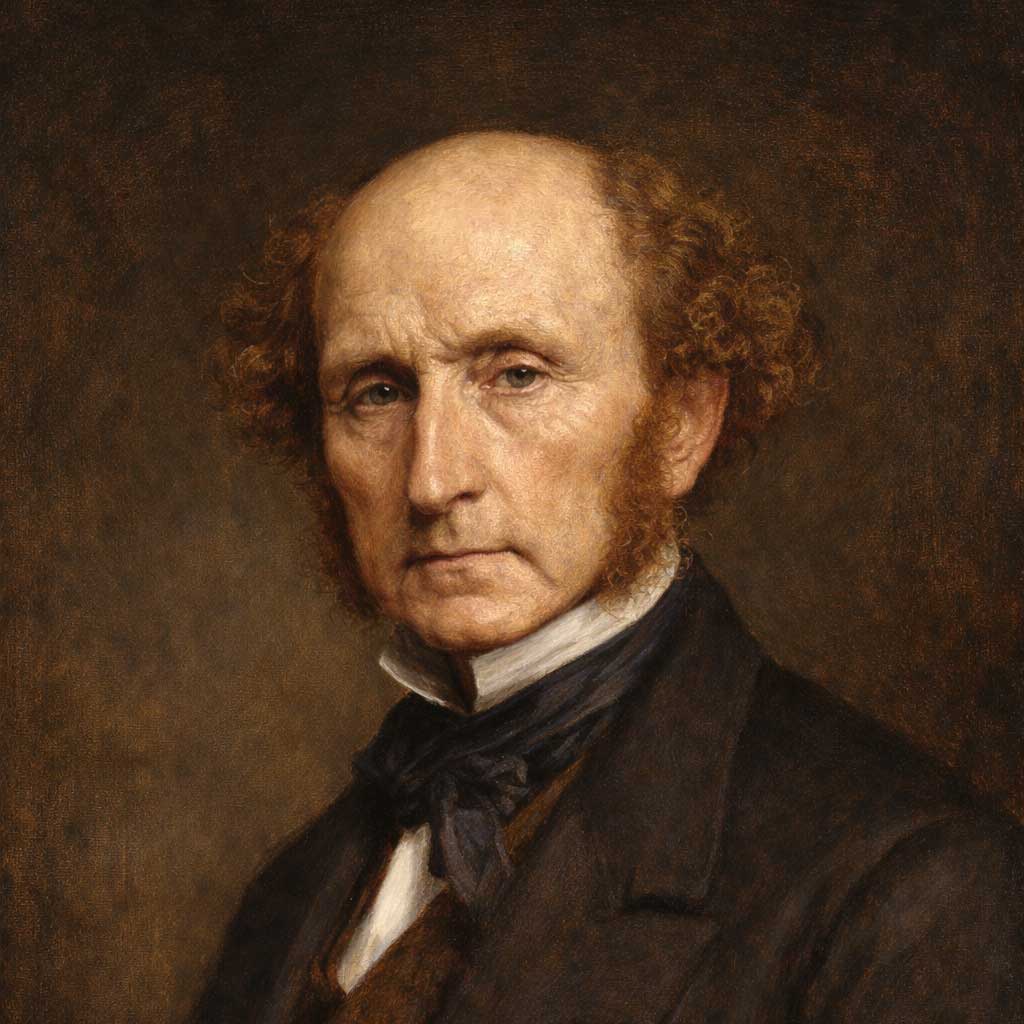
On May 20, 1867, his sixty-first birthday, John Stuart Mill, then a member of the British House of Commons, moved to change a single word in the new franchise bill. Where the voter was referred to as “man,” the text was to read “person,” and with that, women who met the same requirements as men would have received the vote. The motion was clearly defeated, yet 73 members voted for it, and Mill later wrote in his autobiography that the surprise in the House had been general and the encouragement great.
The man who made this motion had published On Liberty eight years earlier, a founding text of liberalism. Anyone who reads Mill today finds in him the clearest formula for the limits of state power, but also an economist who believed the distribution of wealth could be shaped at will, and a colonial official who explicitly justified the tutelage of “backward” peoples.
At a glance
- Life: born May 20, 1806, in Pentonville near London; died May 7, 1873, in Avignon
- Work: official of the East India Company (1823 to 1858, finally as Examiner of India Correspondence), member of Parliament for Westminster (1865 to 1868), rector of the University of St Andrews (1865 to 1868)
- Major works: A System of Logic (1843), Principles of Political Economy (1848), On Liberty (1859), Considerations on Representative Government (1861), Utilitarianism (1861), The Subjection of Women (1869), Autobiography (1873)
- In one sentence: He grounded the liberty of the individual in its usefulness to all and drew conclusions from it that liberals to this day partly celebrate and partly dispute.
A Childhood by Curriculum
His father, James Mill, a philosopher and economist, educated the boy at home according to a plan of his own. As he was later told, the boy learned Greek at the age of three and Latin from the age of eight. At about twelve he began logic, and in 1819, at thirteen, his father took him through a complete course of political economy based on David Ricardo’s newly published principal work.
In May 1823 he joined the East India Company in London, which at the time governed large parts of India. Mill stayed for 35 years and from 1856 headed the department that drafted the correspondence with India. In the autumn of 1826 he fell into a severe crisis when he asked himself whether the realization of all the reforms he was working for would make him happy, and the honest answer was no. Later he found support in, among others, William Wordsworth.
In 1830 he met Harriet Taylor. After her husband’s death the two married in 1851, and Mill rated her share in his writings highly. She died in 1858 in Avignon while traveling, a few months before On Liberty appeared.
The Sole Purpose
The core of On Liberty fits into one sentence from the first chapter: “the only purpose for which power can be rightfully exercised over any member of a civilised community, against his will, is to prevent harm to others.” The person’s own good, whether physical or moral, is not a sufficient warrant for it. One may remonstrate with a person, reason with him, and entreat him, but one may not compel him, as long as his conduct concerns only himself. Mill sums this up in the formula: “Over himself, over his own body and mind, the individual is sovereign.”
This harm principle is aimed at two opponents at once. One is the state with its laws and penalties. The other is society itself, which exerts pressure through custom and public opinion. Mill considered this second pressure especially insidious. A society that meddles in matters that are none of its business, he argued, practices a social tyranny that can weigh more heavily than many kinds of political oppression, because it leaves fewer means of escape and penetrates more deeply into the details of life. Mill knew the idea of a tyranny of the majority from Alexis de Tocqueville’s Democracy in America.
As a motto for the book, Mill chose a sentence by Wilhelm von Humboldt that stresses the “absolute and essential importance of human development in its richest diversity.” According to Mill, people flourish when they choose their own plan of life and, in doing so, also dare “experiments of living” that strike their neighbors as strange. From this follows his warning that a general state education is a mere contrivance for molding people to be like one another, and that the more successful it is, the more it establishes a despotism over the mind. The state, he held, should require education and pay the school fees of the poor, but should not control the schools themselves.
Even One Against All
The best-known part is the second chapter, on liberty of thought and discussion. If all mankind but one were of one opinion, Mill writes, mankind would be no more justified in silencing that one person than he, if he had the power, would be justified in silencing mankind.
His reasoning has two parts. The suppressed opinion may be true, and whoever shuts down all discussion, according to Mill, assumes an infallibility that no one possesses. If it is false, something is still lost, namely the living understanding of the truth that arises only from its collision with error. A conviction that never had to be openly defended, Mill argues, is held as a dead dogma rather than as a living truth. Anyone who argues today about laws against unwelcome opinions or about the content rules of large platforms still finds in him the basic concepts of that debate.
Equal Rights for Half of Humanity
The Subjection of Women appeared in 1869. In it Mill set out the principle that the legal subordination of one sex to the other is wrong in itself and must be replaced by perfect equality, with no power or privilege on the one side and no disability on the other. As far as legal obligation goes, he wrote, the wife is the actual bond-servant of her husband, no less so than slaves commonly so called. In this way Mill applied the liberal idea of equal rights to a group that the law of his time excluded from it.
He acted in a similar way on slavery. When Thomas Carlyle demanded at the end of 1849 that the freed slaves of the West Indies be forced back to work, Mill answered in January 1850 with a sharp rebuttal. And when, after unrest in Jamaica, hundreds of people had been killed by soldiers and courts-martial, he took an active part in the Jamaica Committee, which sought to hold the responsible governor, Edward Eyre, to account. This earned him bitter enmity.
What friends of liberty can learn from Mill
The most important lesson is the question the harm principle poses: Who is actually being harmed? Anyone who wants to forbid an adult something, whether drugs, risky sports, or an unusual way of life, must answer this question, and according to Mill, pointing to the person’s own good is not enough.
Just as valuable is the insight that liberty can be lost even without police, when people fall silent for fear of being ostracized. Precisely because public opinion makes eccentricity a reproach, Mill says, it is desirable that people be eccentric.
Mill the economist also has something to say to friends of liberty. His Principles of Political Economy contains the sentence: “Laisser-faire, in short, should be the general practice: every departure from it, unless required by some great good, is a certain evil.” The burden of proof therefore lies with whoever wants to intervene, even though Mill admits numerous exceptions in the same chapter, for instance for minors, education, and poor relief. He rejected a tax graduated by income because it would penalize those who had worked harder and saved more than their neighbors.
Where it does not fit
The first tension lies in the justification. In On Liberty Mill expressly forgoes the idea of an abstract right independent of utility and declares utility the ultimate appeal on all ethical questions, though in the largest sense, grounded in the interests of man as a progressive being. This makes the liberty of the individual depend on a calculation of the welfare of all. Those who ground liberty in natural law or in the self-ownership of the human being stand on different ground and must ask themselves what happens when someone presents a more favorable calculation.
The second tension concerns property. In the second book of the Principles, Mill separates the laws of production, which he considered as fixed as natural laws, from the distribution of wealth, which he called “a matter of human institution solely.” Everyone should be free to dispose of his property, but no one should receive by inheritance or bequest more than the means of a moderate independence. Without a will, the estate was to pass to the state, which would make fair provision for the descendants. He wanted to tax the increase in the value of land, which in his words accrues to owners as it were in their sleep, and he considered temporary protective tariffs for infant industries defensible.
He went furthest in his approach to socialism. In the autobiography he writes that his and Harriet’s ideal of a future society would class them “decidedly under the general designation of Socialists.” In the same breath he stresses that both had firmly rejected the tyranny of society over the individual that was attributed to most socialist systems. What he had in mind were cooperatives in which workers jointly own enterprises that compete with one another. In the unfinished Chapters on Socialism, published in 1879 after his death, he regarded the central management of a whole country’s production as something entirely different from such small experiments, and he warned against it. So Mill did not want a planned economy, but he defended private property only with reservations.
Weightiest of all is his attitude toward peoples he considered backward. By Mill’s own formulation, the harm principle applies only to “civilised” communities; he explicitly excludes “backward states of society.” Shortly afterward he writes: “Despotism is a legitimate mode of government in dealing with barbarians, provided the end be their improvement.” In 1858, when Parliament transferred rule over India from the Company to the Crown, Mill was, by his own account, the chief organizer of the Company’s resistance and wrote petitions and a memorandum on the improvements in its administration for that purpose. In Considerations on Representative Government he describes the ideal of rule by a free people over a “barbarous or semi-barbarous” one and declares that whoever does not at least approach this ideal violates the highest moral trust that can devolve upon a nation.
Mill combined this view with the demand that rulers be held accountable, as his campaign against Governor Eyre shows. From today’s libertarian point of view, the contradiction nonetheless remains. Whoever grants no one the right to decide for an adult in that adult’s own interest can hardly grant this right to a foreign government over an entire people.
A Book Greater Than Its Author
Mill gave liberty its best-known formula and championed it in practice, in Parliament, for women, and against the violence in Jamaica. At the same time he declared the distribution of wealth a matter of human institution, sought to limit inheritances, and defended foreign rule over India. Both belong to the same thinker and follow from the same justification, which measures liberty by its usefulness and therefore permits exceptions where the usefulness seems to come out differently.
On Liberty can be turned against its author, and therein perhaps lies its greatest strength. Whoever takes the harm principle seriously and applies it to all human beings arrives at conclusions that go beyond Mill. The question he puts to every government is still this: by what right does it interfere in a life that harms no one except, at most, the person who leads it?
Further reading
- John Stuart Mill: On Liberty, London 1859 (German edition: Über die Freiheit, Reclam, Stuttgart)
- John Stuart Mill: Autobiography, London 1873
- John Stuart Mill: The Subjection of Women, London 1869 (German edition: Die Hörigkeit der Frau)
- Christopher Macleod: “John Stuart Mill,” in: Stanford Encyclopedia of Philosophy
This article is part of our series on thinkers, doers, and historical figures of liberty.
Sources
- Mill, John Stuart: On Liberty, John W. Parker and Son, London 1859; full text: https://www.gutenberg.org/ebooks/34901; German edition: Über die Freiheit, Reclam, Stuttgart.
- Mill, John Stuart: Principles of Political Economy with some of their Applications to Social Philosophy, John W. Parker, London 1848; quoted from the 7th edition (ed. W. J. Ashley, 1909), https://www.econlib.org/library/Mill/mlP.html (Book II, ch. 1 and 2; Book V, ch. 2, 9, 10, 11).
- Mill, John Stuart: Considerations on Representative Government, Parker, Son and Bourn, London 1861, ch. 18; full text: https://www.gutenberg.org/ebooks/5669
- Mill, John Stuart: The Subjection of Women, Longmans, Green, Reader and Dyer, London 1869; full text: https://www.gutenberg.org/ebooks/27083
- Mill, John Stuart: Autobiography, Longmans, Green, Reader and Dyer, London 1873; full text: https://www.gutenberg.org/ebooks/10378
- Mill, John Stuart: Chapters on Socialism, in: Fortnightly Review, February to April 1879, ed. Helen Taylor; full text: https://laits.utexas.edu/poltheory/jsmill/cos/cos.int.html
- Mill, John Stuart: “The Negro Question,” in: Fraser’s Magazine for Town and Country, vol. 41, January 1850, pp. 25 to 31; text: https://cruel.org/econthought/texts/carlyle/millnegro.html
- Macleod, Christopher: “John Stuart Mill,” in: Stanford Encyclopedia of Philosophy, https://plato.stanford.edu/entries/mill/
- Cohen, Marshall: Mill’s parliamentary career, The Victorian Web, https://victorianweb.org/philosophy/mill/parliament.html
- The Victorian Web: Mill and the East India Company petition of 1858, https://victorianweb.org/philosophy/mill/petition.html
- UK Parliament, Living Heritage: Women’s suffrage petition 1866 and the vote of May 20, 1867, https://webtest.parliament.uk/about/living-heritage/transformingsociety/electionsvoting/womenvote/parliamentary-collections/1866-suffrage-petition/presenting-the-petition
- History of Parliament: “The first humble beginnings of an agitation”: the women’s suffrage petition of 7 June 1866, https://historyofparliament.com/2025/03/21/womens-suffrage-petition/
- Wikipedia (en): John Stuart Mill, https://en.wikipedia.org/wiki/John_Stuart_Mill (overview, dates, offices)
- Wikipedia (en): Occasional Discourse on the Negro Question, https://en.wikipedia.org/wiki/Occasional_Discourse_on_the_Negro_Question
Featured image: John Stuart Mill