On October 12, 1794, a seventy-year-old professor in Königsberg received a letter from Berlin. In the name of King Frederick William II, the minister Woellner accused him of misusing his philosophy to distort and disparage many of the principal and fundamental teachings of Holy Scripture and of Christianity, and warned him of unpleasant measures should he persist in his defiance (AA VII, 6). The main occasion was Kant’s book on religion within the boundaries of mere reason, whose second part the Berlin censors had refused to license for print in 1792.
Immanuel Kant replied obediently and at the same time with great care, promising, as the king’s most loyal subject, to refrain from all public lectures on religion (AA VII, 10). When he published the correspondence in 1798, a year after the death of Frederick William II, in the preface to The Conflict of the Faculties, he revealed in a footnote why he had chosen precisely those words: he had not meant to renounce his freedom of judgment forever, but only for the king’s lifetime (AA VII, 10, paraphrased).
At a glance
- Life: April 22, 1724, in Königsberg to February 12, 1804, in Königsberg
- Work: professor of logic and metaphysics at the University of Königsberg from 1770 until he withdrew from teaching in 1796
- Major works: Critique of Pure Reason (Kritik der reinen Vernunft, 1781), An Answer to the Question: What Is Enlightenment? (Beantwortung der Frage: Was ist Aufklärung?, 1784), Groundwork of the Metaphysics of Morals (Grundlegung zur Metaphysik der Sitten, 1785), On the Common Saying (Über den Gemeinspruch, 1793), Toward Perpetual Peace (Zum ewigen Frieden, 1795), The Metaphysics of Morals (Die Metaphysik der Sitten, 1797)
- In one sentence: He gave liberty a philosophical foundation in the dignity of every single human being.
A Life in a Trading City
Kant was the son of a master harness maker and attended the Pietist Collegium Fridericianum. After his studies in Königsberg he worked for six years as a private tutor in the countryside, and from 1755 on he taught as an unsalaried lecturer, paid solely by his students. Only in 1770 did he receive the chair of logic and metaphysics.
Apart from his years as a tutor, Kant spent his whole life in Königsberg, an important trading center and port with a cosmopolitan university. Among Kant’s closest friends was the English merchant Joseph Green of Hull, who traded in grain, coal, and herring and whose trading house also managed Kant’s money. At 57, Kant published the Critique of Pure Reason, and his writings on ethics, law, and politics followed in quick succession. He died in 1804, shortly before his eightieth birthday, with the words “It is good,” according to the account of his confidant Wasianski.
Release from Self-Incurred Tutelage
In December 1784 the Berlinische Monatsschrift, a Berlin monthly, published the essay that remains one of Kant’s best-known texts to this day. “Enlightenment is man’s release from his self-incurred tutelage,” it says, and tutelage is “man’s inability to make use of his understanding without direction from another.” It is self-incurred, Kant adds, when its cause lies “not in lack of reason but in lack of resolution and courage.” From this follows the famous motto: “Sapere aude! Have courage to use your own reason!” (AA VIII, 35)
As causes Kant names “laziness and cowardice,” and he describes the temptation that comes with every form of tutelage so precisely that one can still endorse the passage today: “It is so easy not to be of age. If I have a book which understands for me, a pastor who has a conscience for me, a physician who decides my diet, and so forth, I need not trouble myself.” (AA VIII, 35)
For enlightenment, he wrote, “nothing is required but freedom, and indeed the most harmless among all the things to which this term can properly be applied. It is the freedom to make public use of one’s reason at every point” (AA VIII, 36). What he meant is the right to write what one thinks before the entire reading public: a citizen must pay his taxes, but he may publicly explain why he considers them unjust (AA VIII, 37). A public, Kant wrote, will enlighten itself “if only freedom is granted” (AA VIII, 36), and that people work their way gradually out of barbarity “if only intentional artifices are not made to hold them in it” (AA VIII, 41).
Yet Kant remained a child of Prussian absolutism. He praised Frederick II for the attitude “Argue as much as you will, and about what you will, but obey!” (AA VIII, 37), and he paired a generous freedom of speech with an equally firm duty of obedience.
No Human Being Is a Thing
In the Groundwork of the Metaphysics of Morals of 1785, among the formulas of the categorical imperative, the unconditional moral law, stands this one: “So act that you use humanity, whether in your own person or in the person of any other, always at the same time as an end, never merely as a means.” (AA IV, 429) On the same page he adds that a human being is not a thing and therefore cannot be used merely as a means.
Kant distinguishes between price and dignity. Whatever has a price can be replaced by something of equal value; “what on the other hand is raised above all price and therefore admits of no equivalent has a dignity” (AA IV, 434). A human being therefore cannot be traded off against others, not even against many, and whoever harnesses him for other people’s purposes without asking him wrongs him, however noble those purposes may be.
The Greatest Conceivable Despotism
What this means for the state Kant set out in 1793 in the essay On the Common Saying. There he sums up the principle of freedom in a sentence that ranks among the finest in political philosophy: “No-one can compel me to be happy in accordance with his conception of the welfare of others, for each may seek his happiness in whatever way he sees fit,” as long as he respects the equal freedom of others (AA VIII, 290).
Immediately afterward comes his verdict on the well-meaning paternalistic state. A government that treats its subjects the way a father treats his children, as if they could not tell what is useful or harmful to them, is “the greatest conceivable despotism” (AA VIII, 290 f.). For Kant, the wrong lies precisely in the solicitude with which such a state takes from adults the decisions about their own lives.
Kant also understands equality before the law the way liberals understand it. Every member of the commonwealth, he says, must be entitled to reach any rank “which a subject can earn through his talent, his industry and his good fortune,” and no hereditary privilege may stand in his way (AA VIII, 292). And no one can, through any rightful act, whether his own or another’s, “cease to be his own master” (AA VIII, 293), in Kant’s German Eigner seiner selbst, literally the owner of himself. Kant calls the freedom of the pen “the sole palladium” of the rights of the people (AA VIII, 304), and it also remains the citizen’s only recourse, since Kant does not permit active resistance to the legislative power even against a tyrannical government (AA VIII, 299).
Right as an Order of Freedom
In the Doctrine of Right in The Metaphysics of Morals of 1797, right is “the sum of the conditions under which the choice of one can be united with the choice of another in accordance with a universal law of freedom” (AA VI, 230). Choice (in German, Willkür) here means the capacity to act on one’s own decision, and so right asks only whether an action is compatible with the freedom of others, regardless of what end someone pursues with it. For Kant there is only one single innate right: freedom as “independence from being constrained by another’s choice,” insofar as it can coexist with the freedom of everyone else in accordance with a universal law (AA VI, 237).
Kant did, however, allow the government to compel the wealthy, through levies, to support those who cannot provide for themselves (AA VI, 326), and he tied the right to vote to economic independence, so that journeymen, servants, and women remained merely “passive” citizens (AA VI, 314). In his lectures on physical geography, which Friedrich Theodor Rink edited in 1802, he also set up a ranking of the human races with whites at the top, placing Black people far below them (AA IX, 316); this cannot be reconciled with his own teaching of the equal dignity of all human beings.
The Spirit of Commerce and Peace
The essay Toward Perpetual Peace of 1795 is structured in articles like a peace treaty, and they can be read as a program against the power state. “Standing armies (miles perpetuus) shall be abolished in course of time,” Kant demands, partly because paying soldiers to kill means using human beings as “mere machines and instruments in the hand of another (namely, the state)”; he considered the voluntary military training of citizens for defense something entirely different (AA VIII, 345). Likewise, “No national debts shall be contracted in connection with the external affairs of the state,” because an endlessly growing credit system makes waging war all too easy for governments (AA VIII, 345).
Kant explains why republics are more peaceful with a sober eye on incentives: citizens who decide on a war are at the same time deciding to fight themselves and to bear the costs, and they will think long and hard before starting so bad a game. A head of state, by contrast, who is not a fellow citizen but the owner of the state, loses nothing of his banquets and hunts and can decide on war for the most trifling reasons “as if it were a kind of pleasure party” (AA VIII, 351). In the long run Kant placed his hopes in a force that does not depend on morality: “the spirit of commerce, which cannot co-exist with war and which sooner or later seizes every nation.” (AA VIII, 368)
For him, trade was peaceful intercourse: cosmopolitan right allows every foreigner to offer exchange, but not to conquer a country, and so Kant sharply condemned the conduct of the European trading powers. When they were discovered, America, Africa, the Spice Islands, and the Cape were for them lands that belonged to no one, “for the native inhabitants were reckoned as nothing” (AA VIII, 358).
What Friends of Liberty Can Learn from Kant
The first lesson is the dignity of the individual, which cannot be traded off against other goods. In Anarchy, State, and Utopia (1974), Robert Nozick explicitly based his theory of rights as side constraints, which no one may cross for any goal, however good, on the Kantian principle that individuals are ends and not merely means.
The second lesson concerns friendly coercion. Because paternalistic tutelage appears so harmless, Kant’s warning is as useful today as it was in 1793, for whoever treats adults like children takes away their rights, even when he means well.
Finally, Kant shows how closely liberty and courage are connected. His remark that one need not think as long as one can pay (AA VIII, 35) describes a complacency against which no constitution helps, because freedom of speech withers where people permanently leave judgment to others.
The Venture of One’s Own Judgment
Immanuel Kant was no revolutionary; he relied on reform through public debate and on the slow progress of a public that is allowed to speak freely. That he made human dignity the measure of every order and called the caring state a despotism gives his writings their power beyond his own time. The motto he gave the Enlightenment still speaks to every individual today, and it asks you to whom you leave your thinking when thinking becomes uncomfortable.
Further reading
- Immanuel Kant: Beantwortung der Frage: Was ist Aufklärung? (1784), in: Academy edition vol. VIII, pp. 33–42, freely available at korpora.org (in German); in English as An Answer to the Question: What Is Enlightenment?
- Immanuel Kant: Zum ewigen Frieden. Ein philosophischer Entwurf (1795), Reclam, Stuttgart (in German); in English as Toward Perpetual Peace: A Philosophical Sketch
- Manfred Kühn: Kant. Eine Biographie, C. H. Beck, Munich 2003 (in German); in English as Manfred Kuehn: Kant: A Biography, Cambridge University Press, Cambridge 2001
This article is part of our series on thinkers, doers, and historical figures of liberty.
Sources
- Kant, Immanuel: Gesammelte Schriften (Academy edition, AA), ed. by the Royal Prussian Academy of Sciences, Berlin 1900 ff.; electronic edition: https://korpora.org/Kant/ (in German)
- Kant, Immanuel: Beantwortung der Frage: Was ist Aufklärung?, Berlinische Monatsschrift, December 1784, AA VIII, pp. 33–42 (cited: AA VIII, 35, 36, 37, 41) (in German).
- Kant, Immanuel: Grundlegung zur Metaphysik der Sitten, Riga 1785, AA IV (cited: AA IV, 429, 434) (in German).
- Kant, Immanuel: Über den Gemeinspruch: Das mag in der Theorie richtig sein, taugt aber nicht für die Praxis, Berlinische Monatsschrift 1793, AA VIII, pp. 273–313 (cited: AA VIII, 290, 291, 292, 293, 299, 304) (in German).
- Kant, Immanuel: Zum ewigen Frieden. Ein philosophischer Entwurf, Königsberg 1795, AA VIII, pp. 341–386 (cited: AA VIII, 345, 351, 358, 368) (in German).
- Kant, Immanuel: Die Metaphysik der Sitten, Part One: Metaphysische Anfangsgründe der Rechtslehre, Königsberg 1797, AA VI (cited: AA VI, 230, 237, 314, 326) (in German).
- Kant, Immanuel: Der Streit der Fakultäten, Königsberg 1798, preface with the rescript of October 1, 1794, and Kant’s reply, AA VII, pp. 5–11 (cited: AA VII, 10) (in German).
- Kant, Immanuel: Physische Geographie, ed. Friedrich Theodor Rink, Königsberg 1802, AA IX (cited: AA IX, 316) (in German).
- Kant, Immanuel: Die Religion innerhalb der Grenzen der bloßen Vernunft, Friedrich Nicolovius, Königsberg 1793; edition by Karl Kehrbach with an introduction on the history of its censorship: https://www.gutenberg.org/ebooks/56182 (in German)
- Wasianski, Ehregott Andreas Christoph: Immanuel Kant in seinen letzten Lebensjahren, Friedrich Nicolovius, Königsberg 1804 (in German).
- Rohlf, Michael: Immanuel Kant, Stanford Encyclopedia of Philosophy, https://plato.stanford.edu/entries/kant/
- Naragon, Steve: Kant in the Classroom, Notes on Kant’s Life, Manchester University, https://users.manchester.edu/Facstaff/SSNaragon/Kant/Helps/KantsLifeNotes.htm
- Encyclopaedia Britannica: Immanuel Kant, Last years, https://www.britannica.com/biography/Immanuel-Kant/Last-years
- Kühn, Manfred: Kant. Eine Biographie, C. H. Beck, Munich 2003 (in German; English edition: Kant: A Biography, Cambridge 2001).
- Wikipedia (en): Joseph Green (merchant), https://en.wikipedia.org/wiki/Joseph_Green_(merchant)
- Hull Merchants and the Philosopher Immanuel Kant, https://gsey.org.uk/?p=491
- Nozick, Robert: Anarchy, State, and Utopia, Basic Books, New York 1974, pp. 30 f.
- Libertarianism.org: Liberty and Respect for Persons, https://libertarianism.org/blog/liberty-respect-persons
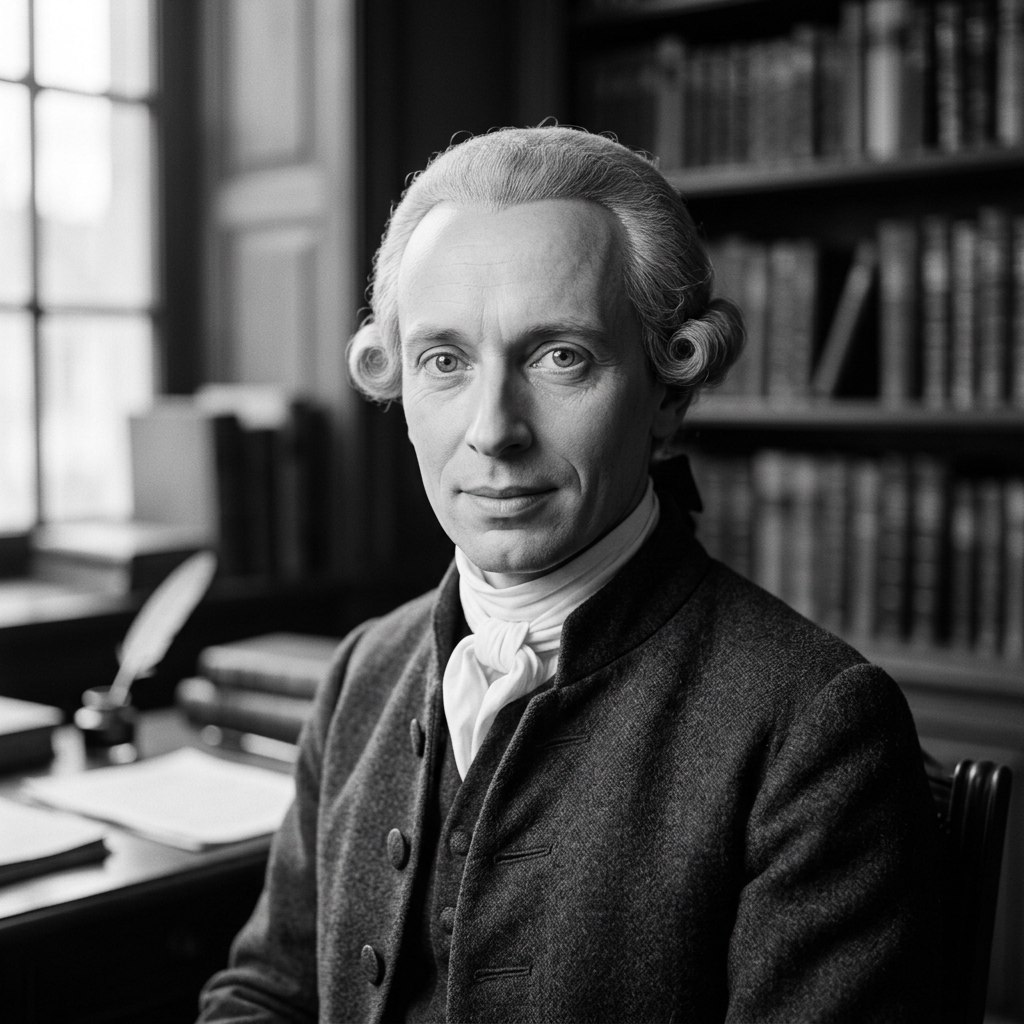
Featured image: Immanuel Kant (AI illustration)