On November 23, 1644, a tract appeared in London with an unusually spare imprint. It named neither printer nor publisher, only place and year. The author’s name, however, stood on the title page: Areopagitica. A Speech of Mr. John Milton for the Liberty of Unlicenc’d Printing, to the Parlament of England. Since the summer of 1643, nothing could be printed in England that an official censor had not approved beforehand. Milton asked Parliament to repeal this law, and he did so with a book that had itself appeared without a license.
Who printed the tract remained unknown for almost four centuries. Only in 2019 did researchers at Carnegie Mellon University attribute the printing to the London printers Matthew Simmons and Thomas Paine, on the basis of damaged pieces of type that work like fingerprints. Milton, however, put his name to it, and so begins a story in which a poet gave freedom of speech reasons that even courts still invoke today.
At a glance
- Life: December 9, 1608, in London to November 1674 in London
- Work: Poet, scholar, and pamphleteer; from 1649 to 1660 Secretary for Foreign Tongues to the Council of State of the English Republic
- Major works: Areopagitica (1644), The Tenure of Kings and Magistrates (1649), A Treatise of Civil Power in Ecclesiastical Causes (1659), Paradise Lost (1667, expanded 1674)
- In one sentence: He was one of the first to argue why no authority may decide in advance what people are allowed to read.
A scholar between king and Parliament
Milton grew up on Bread Street in London, the son of a scrivener and moneylender who also composed music. He studied at Christ’s College, Cambridge, from 1625, took his degrees in 1629 and 1632, and then spent years in private study, finally in the countryside at Horton. In 1638 he set out on a journey through France and Italy. In Florence, by his own account, he visited the aged Galileo Galilei, who was under house arrest, and in Areopagitica he recalled him as a man who had become a prisoner of the Inquisition because he thought differently about astronomy than the Franciscan and Dominican censors.
Milton returned in the summer of 1639, and as the conflict between King Charles I and Parliament came to a head, he began writing against the bishops of the state church in 1641. Soon afterward he found his own subject. Shortly after his marriage to Mary Powell, he published The Doctrine and Discipline of Divorce in 1643, a defense of divorce when a marriage has broken down. He described marriage as a covenant of affection and spiritual companionship that could not be enforced by church law once it had inwardly broken apart. The tract first appeared without a name and without a license. Puritan ministers condemned it, and in petitions for stricter prepublication censorship it served as a cautionary example. Milton thus knew from experience what it is like when others judge whether a thought may be printed.
A book as a preserved spirit of life
Areopagitica is framed as a speech to Parliament and named after the Areopagus, the ancient council hill of Athens. Milton begins with history. In Athens and Rome, he shows, books were examined only after they appeared and condemned if necessary. Systematic prior control with catalogs and lists of banned books, he argues, was perfected only by the Council of Trent and the Spanish Inquisition. A Protestant Parliament that saw itself as the defender of liberty was therefore adopting a tool of its opponents.
Then comes the sentence for which the work is best known: “Who kills a man kills a reasonable creature, God’s image; but he who destroys a good book, kills reason itself.” Books, Milton writes, are not dead things; they contain a vital power as active as the soul from which they came. Whoever suppresses a book before it appears thus prevents a thought from entering the world at all, and no one can know what is lost in the process.
Practical objections follow. Prepublication censorship misses its goal, he argues, because bad ideas also spread by word of mouth, and anyone serious about protecting morals would logically have to police music, theater, and dancing as well. For authors, readers, and learning as a whole, it is a humiliation when an official decides in advance what is worthy of print.
Virtue needs an adversary
Milton’s argument reaches deepest where it concerns human beings themselves. Only someone who could act otherwise can act well. “I cannot praise a fugitive and cloistered virtue, unexercised and unbreathed, that never sallies out and sees her adversary,” he writes in Areopagitica. A virtue that never had to prove itself against evil deserves no praise in his eyes. Only someone who encounters temptation and error and still chooses the good is good in the full sense. It follows that a state that shields its citizens from every dangerous book takes away their chance to grow through the trial.
Just as strong is his trust in open debate. “Let her and Falsehood grapple; who ever knew Truth put to the worse, in a free and open encounter?” Milton was no relativist. He believed in a truth that is there to be found, and precisely for that reason he did not want to block its path.
The close is a personal plea: “Give me the liberty to know, to utter, and to argue freely according to conscience, above all liberties.” In place of prepublication censorship, Milton proposed that the printer and the author be named on every book. Whoever publishes something should answer for it, and a harmful book may well be condemned, but only after it appears and in full public view.
Power as a trust
Parliament was not persuaded, prepublication censorship remained, and in England it ended only in 1695. Milton, however, became one of the most important pamphleteers of the Revolution. In February 1649, less than two weeks after the execution of Charles I, he published The Tenure of Kings and Magistrates. In it he declares that no one who knows anything could be so foolish as to deny that all men are by nature born free, as the image of God. Kings and magistrates, he argues, receive their power from the people only in trust, and whoever abuses it to the harm of the governed may be called to account and deposed.
Milton thus advanced the idea that rule is something the people lend, four decades before John Locke’s Two Treatises of Government. In March 1649 he entered the service of the Council of State as Secretary for Foreign Tongues and defended the Republic before learned Europe in Latin writings. During these years he lost his sight; by 1652 at the latest he was completely blind.
No coercion in matters of faith
Milton presented his most consistent work on liberty of conscience in 1659. The very title of A Treatise of Civil Power in Ecclesiastical Causes states the thesis: no power on earth may use coercion in matters of religion. No one should be punished or harassed by outward force on account of his faith, and the authorities have no right to sit in judgment over conscience. In a companion piece from the same year, Considerations Touching the Likeliest Means to Remove Hirelings out of the Church, he attacked the tithe collected by the state. It was the compulsory levy, he held, that turned preachers into hirelings, and without that coercion the relationship between congregation and minister would once again rest on voluntary reciprocity.
Honesty requires naming the limits of this liberty, which Milton himself stated openly. In Areopagitica he expressly excluded Catholicism from toleration, as he did in the Treatise, because he saw it above all as a political allegiance to a foreign power. In the early 1650s, as an official, he reviewed the government newsbook Mercurius Politicus before it went to press and was thus a censor himself. One episode from this period is revealing: in 1650 he licensed the printing of the Racovian Catechism, a confession of faith of the anti-Trinitarian Socinians, which was regarded as heresy in England. Parliament had the matter investigated and in 1652 had all copies burned.
Blind but not silenced
With the restoration of the monarchy in May 1660, Milton became a hunted man. He went into hiding, the House of Commons ordered his defense of the English people to be burned by the hangman, and in August a royal proclamation against the book followed. He was not among those excepted from the Act of Indemnity, but he was nevertheless arrested and briefly held. His friend, the poet and member of Parliament Andrew Marvell, intervened on his behalf when Milton was charged excessive jail fees.
Blind and now politically ostracized, Milton completed the epic Paradise Lost, which he dictated to scribes and which appeared in ten books in 1667 and in twelve in 1674, the year of his death. The poem of the Fall turns on the same question as Areopagitica: How can a creature be good if it is not also free to fall?
What friends of liberty can learn from Milton
The first lesson is the rejection of prior approval. Whoever demands that a thought may enter the world only after official review claims a knowledge of right and wrong that no office possesses. This holds for the printing presses of the 17th century as much as for any present-day body that wants to determine in advance what may be seen. For this reason the Supreme Court of the United States has cited Areopagitica several times, for instance in 1964 in New York Times Co. v. Sullivan, where the question was the value of even erroneous statements for public debate.
The second lesson concerns the view of human nature. Milton defended the freedom to read because he considered people capable of examining, choosing, and learning from their mistakes. Related arguments appear two centuries later in John Stuart Mill, who in On Liberty likewise relied on the idea that truth stays alive through contradiction.
Third, Milton shows how closely the liberties are connected. He treated speech, conscience, marriage, and government by the same principle: what is meant to rest on conviction and free consent cannot be compelled. That he did not apply this principle to everyone does not diminish its force, for later generations were able to carry it further precisely because he had stated it so clearly.
The question for every examiner
John Milton wrote his defense of a free press as a citizen of a revolution that was itself not free of coercion, and he found words that reached further than the politics of his friends. Areopagitica failed in its immediate purpose and still won, for the prepublication censorship it opposed is regarded today in free countries as a mark of unfreedom. Anyone who considers vetting ideas before others may read them will find in Milton a question worth answering honestly: Where does the examiner get the knowledge he denies the readers possess?
Further reading
- John Milton: Areopagitica. A Speech for the Liberty of Unlicensed Printing, London 1644 (freely available at Project Gutenberg)
- John Milton: A Treatise of Civil Power in Ecclesiastical Causes, London 1659
- Barbara K. Lewalski: The Life of John Milton. A Critical Biography, Blackwell, Oxford 2000
- John Stuart Mill: On Liberty, 1859
This article is part of our series on thinkers, doers, and historical figures of liberty.
Sources
- Milton, John: The Doctrine and Discipline of Divorce, London 1643.
- Milton, John: Areopagitica. A Speech of Mr. John Milton for the Liberty of Unlicenc’d Printing, to the Parlament of England, London 1644; edition: Project Gutenberg #608, https://www.gutenberg.org/files/608/608-h/608-h.htm
- Milton, John: The Tenure of Kings and Magistrates, London 1649; excerpt: Columbia University, https://columbia.edu/itc/composition/blurton/milton2.html
- Milton, John: A Treatise of Civil Power in Ecclesiastical Causes, London 1659; edition: Project Gutenberg #79107, https://gutenberg.org/files/79107/79107-h/79107-h.htm
- Milton, John: Considerations Touching the Likeliest Means to Remove Hirelings out of the Church, London 1659.
- Milton, John: Paradise Lost, London 1667 (ten books), 2nd edition 1674 (twelve books).
- House of Commons Journal, vol. 7, April 2, 1652 (Racovian Catechism), British History Online, https://prod.british-history.ac.uk/node/17122
- Mill, John Stuart: On Liberty, London 1859.
- Lewalski, Barbara K.: The Life of John Milton. A Critical Biography, Blackwell, Oxford 2000 (recommended reading, not consulted).
- Warren, Christopher N., et al.: “Damaged Type and Areopagitica’s Clandestine Printers,” Milton Studies 62.1 (2020), https://muse.jhu.edu/article/748968
- Carnegie Mellon University: news release on the identification of the printers of Areopagitica (November 2019), https://www.cmu.edu/news/stories/archives/2019/november/john-milton-mystery.html
- Free Speech Center, Middle Tennessee State University: John Milton, https://firstamendment.mtsu.edu/article/john-milton/
- Dictionary of National Biography, vol. 38, article John Milton (via Wikisource)
- Goldman, Peter: essay on Milton’s Hirelings, Anthropoetics 22.2, https://anthropoetics.ucla.edu/ap2202/2202goldman
- Rutgers University Libraries: exhibition “Milton,” Execution of Charles I, https://exhibits.libraries.rutgers.edu/milton/execution-charles-i
- UWM Libraries Special Collections: Milton, Paradise Lost, https://web.uwm.edu/lib-omeka-spc2/exhibits/show/classictext/milton
- Museo Galileo, catalog entry Areopagitica 1644, https://opac.museogalileo.it/imss/resourceXsl?uri=397937
- Wikipedia (en): John Milton; Areopagitica; Licensing Order of 1643; The Tenure of Kings and Magistrates; A Treatise of Civil Power; Racovian Catechism (starting point and cross-check), https://en.wikipedia.org/wiki/John_Milton
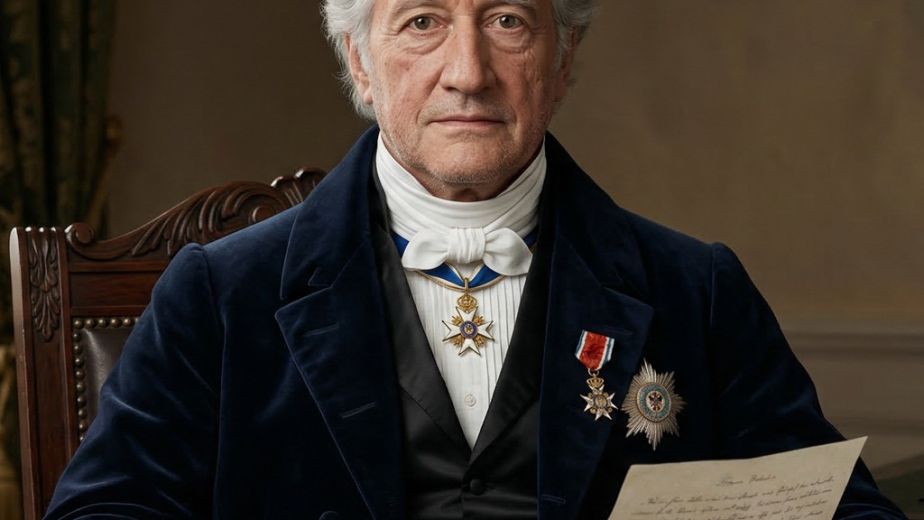
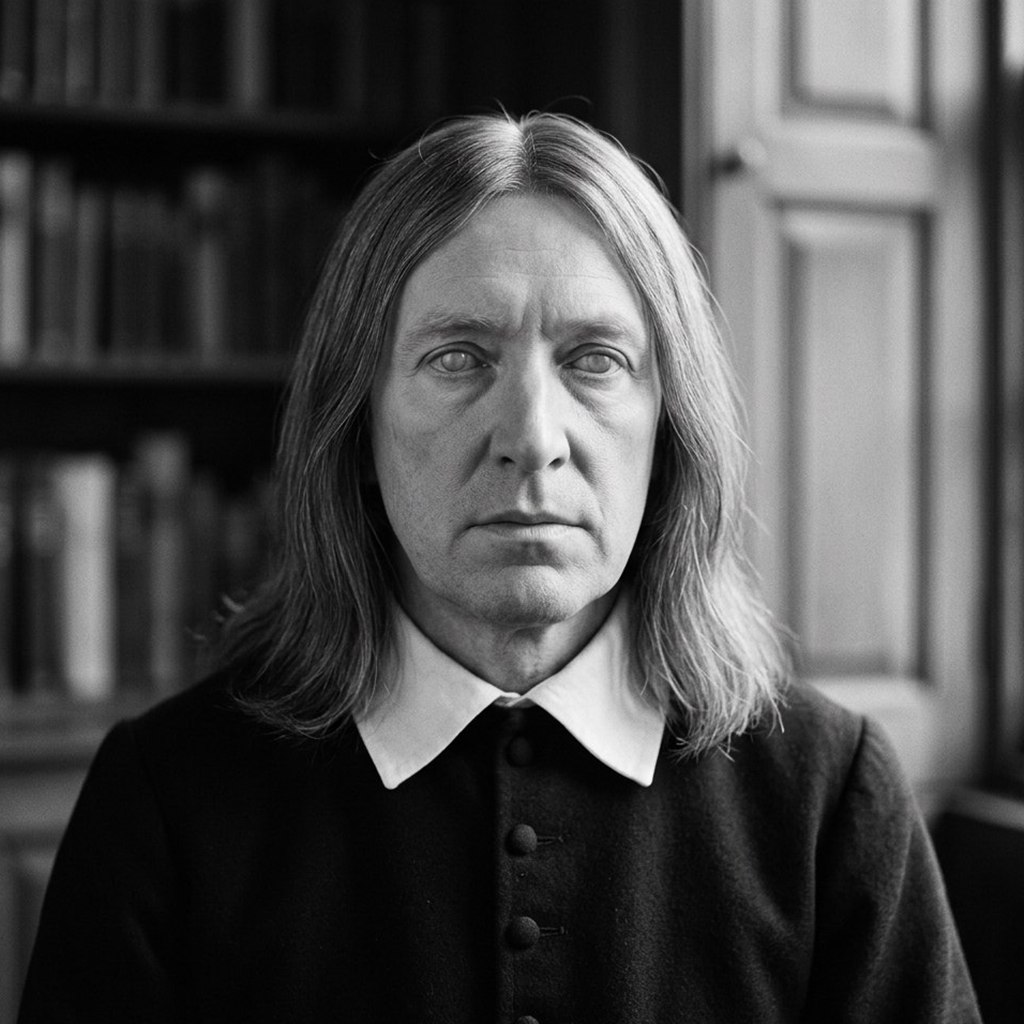
Featured image: John Milton (AI illustration)