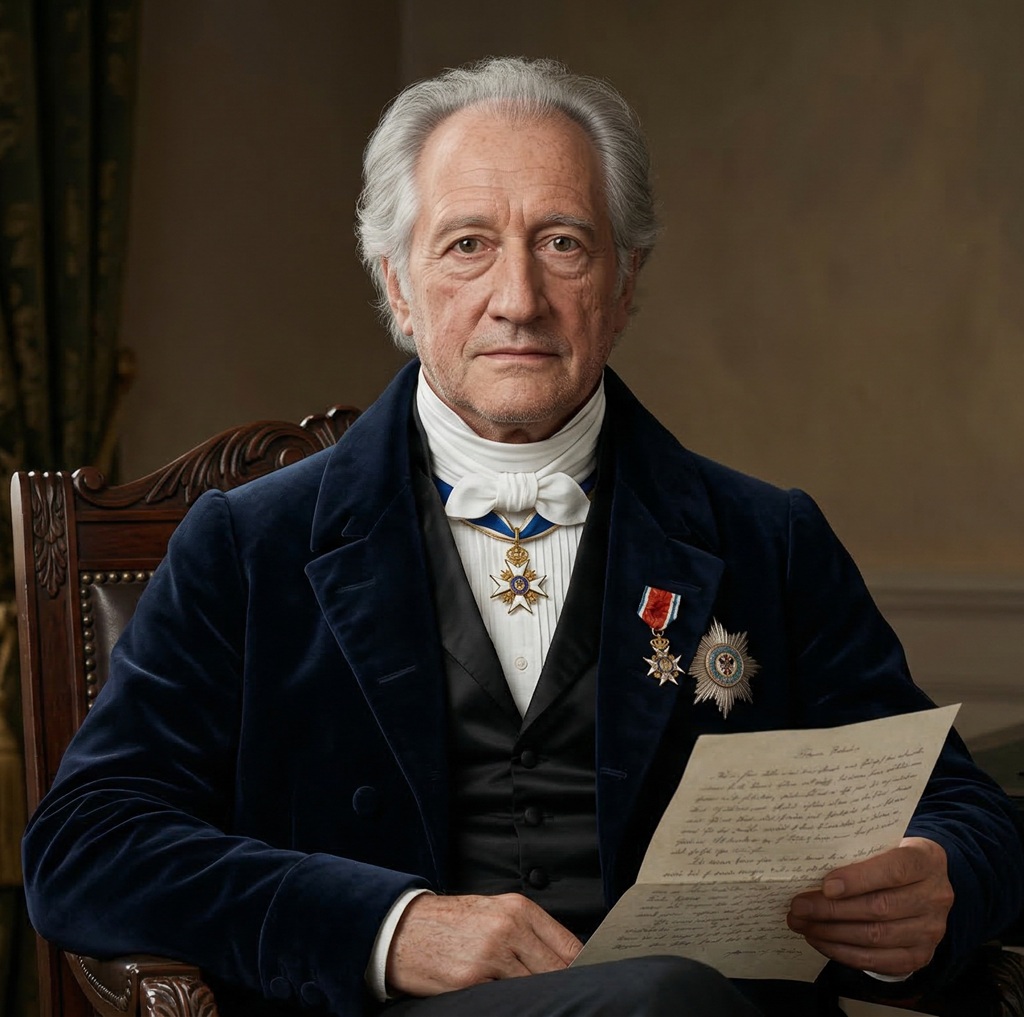
In the play that made Johann Wolfgang Goethe famous in 1773, the hero dies with a single word on his lips. The imperial knight Götz von Berlichingen, captured, wounded, and overtaken by his times, asks for a drink of water, breathes the “heavenly air,” and dies with the cry “Freedom! Freedom!” Almost sixty years later, Goethe puts the same word into the mouth of his Faust, in the last speech before his death: “He only earns his freedom and existence, / Who daily conquers them anew.”
Between these two passages lies a life that can hardly be called libertarian. Goethe served a prince, sat in his government, and thought little of revolutions. Even so, it is worth reading him with liberty in mind, for scarcely any German writer observed so precisely what paternalism does to people and how the temptations of power give themselves away.
At a glance
- Life: August 28, 1749, in Frankfurt am Main to March 22, 1832, in Weimar
- Work: poet, natural scientist, and state official in Saxe-Weimar-Eisenach; from 1776 a member of the Privy Council, ennobled in 1782
- Major works: Götz von Berlichingen (1773), Egmont (1788), Wilhelm Meisters Lehrjahre (1795/96; in English, Wilhelm Meister’s Apprenticeship), Faust I (1808), Die Wahlverwandtschaften (1809; in English, Elective Affinities), Wilhelm Meisters Wanderjahre (1821/1829; in English, Wilhelm Meister’s Journeyman Years), Faust II (1832)
- In one sentence: He was no liberal, but he knew the temptations of power intimately and saw the human being as a creature that must shape itself.
A Burgher’s Son on the Duke’s Council
Goethe came from a wealthy Frankfurt family and studied law at his father’s wish. On November 7, 1775, he arrived in Weimar at the invitation of the young Duke Carl August, and as early as June 1776 he held a seat and a vote on the Privy Council (Geheimes Consilium), the highest advisory body of the small state. He looked after road building, the recruitment of soldiers, and the mine near Ilmenau, took over the war commission in 1779, and from 1782 deputized for two and a half years for the head of the finance chamber. In the same year he was ennobled.
These years saw a criminal case that is still debated today. In 1783 a maidservant, Johanna Catharina Höhn, was held in custody in Weimar for killing her newborn child. Under the law then in force, the Jena Schöppenstuhl, a panel of jurists, had proposed the death sentence; it had to be confirmed by the duke. Prompted by the case, Carl August put the question of principle to the government and the four members of the Privy Council: should the death penalty for infanticide be abolished? The majority was against it, and Goethe, then the most junior of the privy councillors, joined his colleagues in his written opinion of November 4, 1783, and judged it more advisable to keep it. The sentence against Johanna Höhn herself was not put to a vote. The duke, who also held the power of pardon, confirmed it on his own decision, and on November 28 she was executed.
How much weight Goethe’s opinion carried is disputed among scholars. Rüdiger Scholz sees Goethe’s share of responsibility as long concealed, W. Daniel Wilson gives the opinion great weight, while Volker Wahl, who edited the Weimar records, denies that Goethe voted for the execution. What is undisputed is that the same poet who, in Gretchen in Faust, made a child murderer one of the most moving figures in German literature came out in favor of the death penalty on the question of principle. He had sketched the Gretchen material before Weimar, prompted by the case of Susanna Margaretha Brandt, executed in Frankfurt in 1772. In a late maxim he still writes that abolishing the death penalty would be “hard to achieve.”
Goethe had at first linked his offices with the hope of a principality governed according to the principles of the Enlightenment for the good of all its subjects, not merely for the benefit of the landowning nobility. The results were sobering: the mine failed because of flooding and poor ore, fundamental reforms remained out of reach, and in 1785 Goethe largely withdrew from the council’s business, although he formally remained a member until 1815. After his journey to Italy from 1786 to 1788, his share in the administration was essentially limited to science and the arts.
Shaping Oneself
In Wilhelm Meister’s Apprenticeship, the hero, a merchant’s son, explains to his friend Werner why he is staying with the theater: “To speak it in a word, the cultivation of my individual self, here as I am, has from my youth upwards been constantly though dimly my wish and my purpose.” (Book Five, Chapter Three). In the same letter Wilhelm laments that in Germany only the nobleman can attain a universal, “personal” cultivation, while the burgher may acquire merit but loses his personality. Against a society of estates in which birth decides how far a person may develop, the novel sets the claim of the individual to form himself by his own measure.
This idea links Goethe with Wilhelm von Humboldt, who in 1794 in Jena belonged to the close circle around him and Schiller. As early as 1792, in his Ideen zu einem Versuch, die Grenzen der Wirksamkeit des Staats zu bestimmen (in English, The Limits of State Action), Humboldt had concluded from it that the state must hold back, because human beings can develop only in freedom and in a variety of situations. In 1859 John Stuart Mill placed a motto from this work at the head of his essay On Liberty. Goethe never drew the political conclusion so explicitly, but he gave literary form to the view of humanity behind it like hardly anyone else.
To Lead Them Like Children for Their Own Good
The sharpest critique of paternalism is found in Egmont, and Goethe puts the argument for it into the mouth of an enemy of liberty. In the fourth act, the Dutch count Egmont meets the Duke of Alba, whom the Spanish king has sent to subdue the rebellious provinces. Asked who will be surety to the Netherlanders for their liberty, Alba answers: “Liberty! A fair word when rightly understood.” And further: “Far better is it to circumscribe their power, to control and guide them for their good, as children are controlled and guided.”
Right after comes the sentence “a people remains always in its infancy,” and without noticing it, Alba thereby describes the vicious circle of all paternalism: whoever keeps people like children always finds himself confirmed in the belief that they never grow up. Egmont asks in return whether many should not rather entrust themselves to many than to a king and the few courtiers who “have grown old under the eyes of their master.” He describes his countrymen as men each “complete in himself, a little king”: “They may be crushed, but not subdued.” The burgher, he says, wants to keep his old constitution and to be governed by his own countrymen, because he knows how he will be led.
Neither Apostles of Freedom nor Arbitrary Power
Goethe did not experience the French Revolution only from afar: in 1792 he accompanied his duke on the campaign against revolutionary France, and in 1793 he was present at the siege of Mainz. In the Venezianische Epigramme (in English, Venetian Epigrams), printed in Schiller’s Musen-Almanach (Muses’ Almanac) for the year 1796, he writes: “All apostles of freedom have always been repugnant to me; / in the end each was only seeking arbitrary power for himself.” The next line names his standard: “If you would free the many, then dare to serve the many.”
That this distrust was directed just as much against the authorities is shown by a conversation of January 4, 1824, recorded by his confidant Johann Peter Eckermann. He could not have been a friend of the Revolution, Goethe says there, because its atrocities outraged him daily, and he adds: “But I was as little a friend to arbitrary rule.” A great revolution, he says, is never the fault of the people but of the government, which resists necessary improvements until what is necessary is forced from below. Because he hated revolutions, people called him a “Friend of the powers that be,” but he wished to decline this ambiguous title. Two years later he printed in his journal Über Kunst und Altertum (On Art and Antiquity) a maxim that puts the thought into a question and an answer: “Which is the best government? That which teaches us to govern ourselves.”
Ten Centers Instead of One
On October 23, 1828, Goethe and Eckermann talked about the unity of Germany. Goethe meant something different by it than the nationalists after him. Germany should be one in that the thaler and the groschen were worth the same everywhere, that weights and measures, trade and commerce were uniform, and that “my travelling-chest may pass unopened through all the six-and-thirty states.” He considered a single great capital a mistake and, with a map in view on which the French departments far from Paris appeared as dark patches, asked what things would look like there if the country, “instead of one great focus, had ten foci, whence life and light might proceed.”
The many princely residences, often mocked as the patchwork of petty states (in German, Kleinstaaterei), were for him the bearers of a culture that had permeated the whole country, with more than twenty universities, more than a hundred public libraries, and a “generally diffused opulence.” His idea of unity recalls what we would today call a common market: free movement of people, goods, and money alongside political diversity. Science and art, as a late maxim puts it, belong to the whole world and can be furthered only by “a free and general interchange of ideas among contemporaries.”
The Emperor’s Paper Note
In the first act of Faust II, an empire faces bankruptcy. Mephisto promises a remedy, and in the scene “Pleasure Garden” the chancellor reads out the result: “To all to whom this cometh, be it known: / A thousand crowns in worth this note doth own. / It to secure, as certain pledge, shall stand / All buried treasure in the Emperor’s land.” (lines 6057 to 6060). At first the emperor suspects “a most enormous cheat, a crime,” then he lets himself be persuaded by the sudden prosperity. Goethe, who had himself managed a prince’s treasury, describes the temptation of an indebted ruler to print wealth instead of earning it. In 2012 Jens Weidmann, then president of the Bundesbank (Germany’s central bank), saw in the scene the core problem of a monetary policy based on paper money: the dangerous connection between money creation, government financing, and inflation.
In the fifth act, Goethe shows the other side of the grand plan. Faust is lord over newly reclaimed land, but the hut of the old couple Philemon and Baucis bothers him: “The old folk up there ought to give way, / I wanted the lindens for my seat.” Mephisto and his henchmen take care of it in their own way: the hut burns, and the old couple die of fright. Faust protests: “Exchange I meant, not robbery.” He wants to open up “spaces for many millions,” but whoever regards the small property of the few as an obstacle finds helpers who remove it. The lines on freedom come only afterward, spoken by a man gone blind who takes the digging of his own grave for work on his project and dreams of standing “on free soil among a people free.”
What friends of liberty can learn from him
Goethe offers no theory of the free state, but he offers a knowledge of human nature that every such theory needs. Alba’s speech contains the argument for paternalism so precisely that one recognizes it in today’s debates about the caring state. Wilhelm Meister teaches that the self-development of the individual is an end in its own right.
Just as instructive is his twofold distrust: of liberators who in the end seek arbitrary power for themselves, and of governments that refuse improvements. His picture of a country with many independent centers and without customs barriers seems astonishingly modern, and the paper money scene is a reminder that the temptation of easy money is as old as public debt.
Conquered Daily
Goethe’s own life ran its course within the order he described, and as a minister he helped uphold it, up to his opinion in favor of keeping the death penalty. His freedom was first of all inner freedom, that of the person who shapes himself. In a note from his posthumous papers, he gave it a form that goes beyond mere toleration: “Tolerance should really be only a passing attitude: it must lead to recognition. To tolerate is to insult. True liberality is recognition.” Whoever recognizes others in their individuality instead of merely putting up with them is already some way along the path Faust describes, on which freedom must be earned anew every day.
Further reading
- Johann Wolfgang von Goethe: Egmont. Ein Trauerspiel in fünf Aufzügen (1788) (in German); in English: Egmont
- Johann Wolfgang von Goethe: Faust. Der Tragödie zweiter Teil (1832) (in German); in English: Faust, Part Two
- Johann Peter Eckermann: Gespräche mit Goethe in den letzten Jahren seines Lebens (1836/1848) (in German); in English: Conversations with Goethe
- Hans Christoph Binswanger: Geld und Magie. Eine ökonomische Deutung von Goethes Faust, Murmann, Hamburg 2005 (in German); in English: Money and Magic: A Critique of the Modern Economy in the Light of Goethe’s Faust, University of Chicago Press, 1994
This article is part of our series on thinkers, doers, and historical figures of liberty.
Sources
- Goethe, Johann Wolfgang: Götz von Berlichingen mit der eisernen Hand. Ein Schauspiel (1773), act 5, ending; full text Project Gutenberg no. 2321 (in German), https://www.gutenberg.org/ebooks/2321
- Goethe, Johann Wolfgang: Egmont. Ein Trauerspiel in fünf Aufzügen (1788), act 4, “Der Culenburgische Palast” (The Culemborg Palace); Project Gutenberg no. 2146 (in German), https://www.gutenberg.org/ebooks/2146
- Goethe, Johann Wolfgang: Wilhelm Meisters Lehrjahre (1795/96), book V, chapter 3; Project Gutenberg no. 2339 (in German), https://www.gutenberg.org/ebooks/2339
- Goethe, Johann Wolfgang: Venetianische Epigramme (Musen-Almanach für das Jahr 1796), no. L; Project Gutenberg no. 5326 (in German), https://www.gutenberg.org/ebooks/5326
- Goethe, Johann Wolfgang: Faust. Der Tragödie zweiter Teil (1832), act 1, “Lustgarten” (lines 6057–6060), act 5, “Palast,” “Tiefe Nacht,” “Großer Vorhof des Palasts” (lines 11575 f., 11580); Project Gutenberg no. 2230 (in German), https://www.gutenberg.org/ebooks/2230
- Goethe, Johann Wolfgang: Die Wahlverwandtschaften (1809), part II, chapter 5; Project Gutenberg no. 2403 (in German), https://www.gutenberg.org/ebooks/2403
- Goethe, Johann Wolfgang: Maximen und Reflexionen: Aus „Kunst und Altertum“, vol. V, no. 3 (1826); Aus Makariens Archiv; Aus dem Nachlaß, Über Literatur und Leben; zeno.org (in German), http://www.zeno.org/Literatur/M/Goethe,+Johann+Wolfgang/Aphorismen+und+Aufzeichnungen/Maximen+und+Reflexionen
- Eckermann, Johann Peter: Gespräche mit Goethe in den letzten Jahren seines Lebens (1836/1848), conversations of January 4, 1824, and October 23, 1828; Projekt Gutenberg-DE (in German), https://projekt-gutenberg.org/authors/johann-peter-eckermann/books/johann-peter-eckermann-gespraeche-mit-goethe/chapter/245 and …/chapter/287
- Flitner, Wilhelm: Goethe, Johann Wolfgang von, in: Neue Deutsche Biographie 6 (1964), pp. 546–575 (in German), https://www.deutsche-biographie.de/sfz53095.html
- Encyclopaedia Britannica: Johann Wolfgang von Goethe, section “First Weimar period (1776–86),” https://www.britannica.com/biography/Johann-Wolfgang-von-Goethe/First-Weimar-period-1776-86
- Wahl, Volker: “Augenblick” no. 1 of May 9, 2025, Goethe-Gesellschaft Weimar (on the Höhn case) (in German), https://www.goethe-weimar.de/fileadmin/user_upload/Augenblick_Folge_1_final.pdf
- Wahl, Volker (ed.): „Das Kind in meinem Leib“. Sittlichkeitsdelikte und Kindsmord in Sachsen-Weimar-Eisenach unter Carl August. Eine Quellenedition 1777–1786, Weimar 2004 (in German; not consulted, quoted in Wahl 2025)
- Scholz, Rüdiger (ed.): Das kurze Leben der Johanna Catharina Höhn, Königshausen & Neumann, Würzburg 2004 (in German); Perlentaucher (in German), https://www.perlentaucher.de/buch/ruediger-scholz/das-kurze-leben-der-johanna-catharina-hoehn.html
- Wilson, W. Daniel: “Goethe, his Duke and Infanticide: New Documents and Reflections on a Controversial Execution,” in: German Life and Letters 61/1 (2008), pp. 7–32, https://doi.org/10.1111/j.1468-0483.2007.00408.x
- Kronauer, Ulrich: conference report “Recht und Literatur um 1800” (Law and Literature around 1800), Herzog August Bibliothek Wolfenbüttel 2005 (Goethe’s file notes of October 25 and November 4, 1783) (in German), https://diglib.hab.de/periodica/wbi/2005-30_1_4/s36.pdf
- Weidmann, Jens: welcoming address at the 18th colloquium of the Institute for Banking History Research (Institut für bankhistorische Forschung), “Paper Money, Government Financing, Inflation: Did Goethe Identify a Core Problem of Monetary Policy?”, Frankfurt am Main, September 18, 2012 (in German), https://www.bundesbank.de/de/presse/reden/begruessungsrede-710686
- Binswanger, Hans Christoph: Geld und Magie. Eine ökonomische Deutung von Goethes Faust, Murmann, Hamburg 2005 (first edition 1985) (in German)
- Mill, John Stuart: On Liberty (1859), epigraph and chapter III; Project Gutenberg, https://www.gutenberg.org/files/34901/34901-h/34901-h.htm
- Quote Investigator: “What You Can Do, or Dream You Can, Begin It” (misattribution), https://quoteinvestigator.com/2016/02/09/boldness/