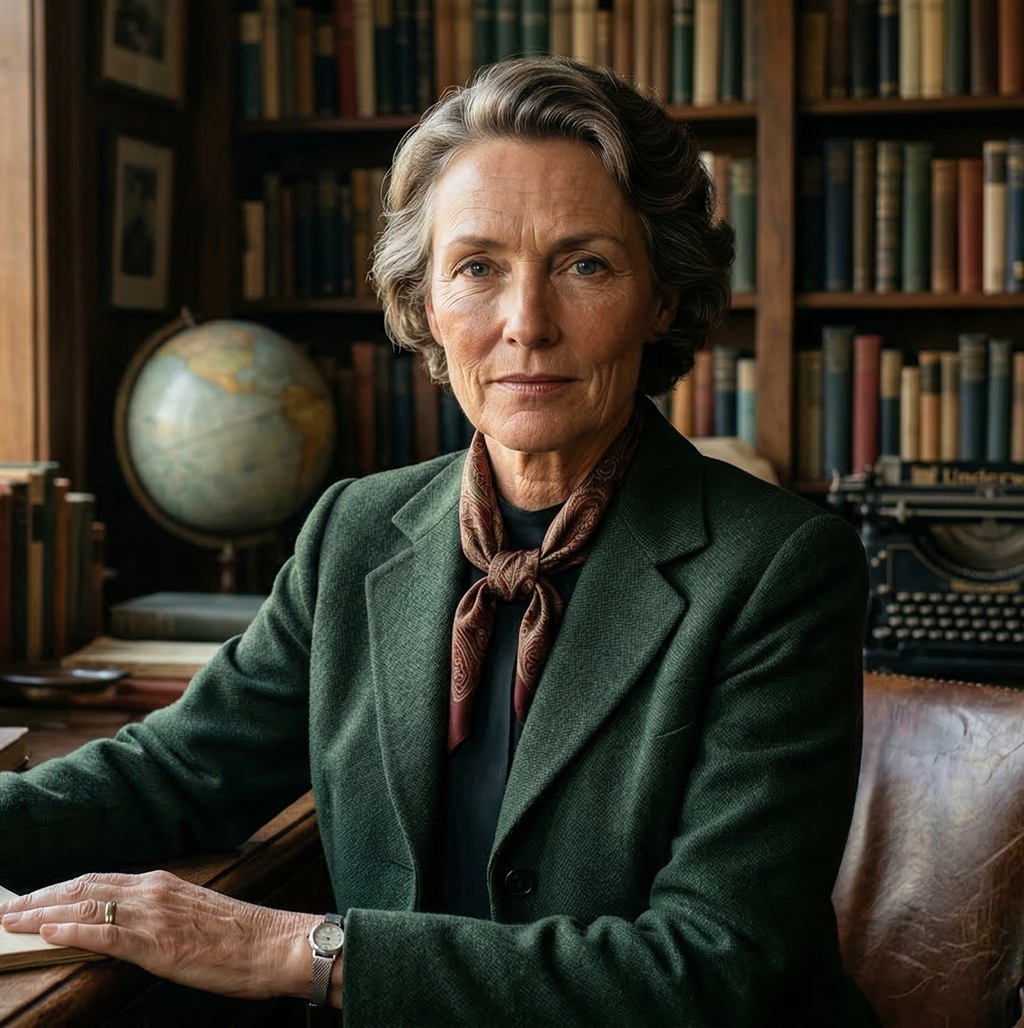
On a summer day in 1943, Rose Wilder Lane was weeding her garden in Danbury, Connecticut, when a uniformed state trooper walked up to her. The local postmaster had reported her to the FBI because she had written a postcard to a New York radio host in response to a listener poll. In it she sharply criticized Social Security and pointed out that the idea had come from Bismarck’s Germany. Lane is said to have shouted at the officer: “What is this, THE GESTAPO?” Shortly afterward she turned the line into the title of a pamphlet.
The scene fits a woman who had published a book about freedom that same year and who stood by her convictions in everyday life as well. Today The Discovery of Freedom is regarded, alongside Isabel Paterson’s The God of the Machine and Ayn Rand’s The Fountainhead, both also published in 1943, as one of the founding works of American libertarianism. Stephen Cox, Isabel Paterson’s biographer, called the three authors the “Libertarians of ’43.”
At a glance
- Life: December 5, 1886, near De Smet, Dakota Territory, to 1968 in Danbury, Connecticut
- Background: only surviving child of Laura Ingalls Wilder and Almanzo Wilder
- Work: telegrapher, reporter for the San Francisco Bulletin, publicist for the American Red Cross, novelist, columnist for the Pittsburgh Courier (1942 to 1945)
- Major works: Give Me Liberty (1936), Free Land (novel, 1938), The Discovery of Freedom: Man’s Struggle Against Authority (1943)
- In one sentence: In Europe she recognized what America possessed, and she described freedom as a fact of human nature that no government can grant and none can truly take away.
From prairie child to sought-after reporter
Rose Wilder was born in 1886 on her parents’ homestead in Dakota. In 1894 the family moved to Mansfield, Missouri, where it made a fresh start on Rocky Ridge Farm. After finishing school in 1904, the daughter became independent early, working as a telegrapher. In 1909 she married Gillette Lane, from whom she separated a few years later.
From 1915 on she wrote for the San Francisco Bulletin, where the editor, Fremont Older, trained her in the craft. Soon she was writing life stories of celebrities that ran as serials, among them Henry Ford, Charlie Chaplin, and Jack London. In 1920 came The Making of Herbert Hoover, written with Charles K. Field, about the future president. Not everyone she profiled was pleased with her, since she liked to embellish, but her reputation as a writer grew. At times she was considered one of the best-paid women writers in the United States.
Over tea in Georgia
In July 1919 Lane traveled to Europe for the American Red Cross, and the trip turned into many years abroad. She saw Paris and Budapest, Armenia and the Caucasus, wrote the travel book Peaks of Shala (1923) about Albania, and later lived in Tirana for about fifteen months.
Politically, she had set out with different convictions. Her book Give Me Liberty opens with the sentence “In 1919 I was a communist.” In the months before her departure she had sympathized with communism in New York. This faith suffered its first crack in a village in Georgia, then part of Russian Transcaucasia. Over tea with cherry preserves, she described to her host, a peasant, how the equality and fairly shared prosperity of his village would one day spread to all of Russia. He called the plan too big and, as she remembered it, said: “It will not work. In Moscow there are only men, and man is not God.”
At first Lane put this down to peasant narrow-mindedness, but the words stayed with her. Whatever the new state might do for the people of Russia, she later wrote, it would not be done by them but to them. In 1936 she described this path in the essay “Credo” in the Saturday Evening Post. More than three thousand readers wrote her letters in response, and the same year the text appeared in expanded form as a book.
The little houses on the prairie
Between her travels Lane repeatedly lived with her parents in Missouri. Around 1930 she urged her mother to write down her own childhood memories. The 1930 manuscript Pioneer Girl became, between 1932 and 1943, the eight volumes of the Little House series. Lane edited and typed the manuscripts, suggested changes, and negotiated with agents and publishers. Exactly how large her share in the finished text is remains a question for scholars to this day.
From the same family material she wrote two novels of her own, Let the Hurricane Roar and Free Land (1938). Free Land tells of settlers who make their way by their own efforts; it became a bestseller and earned Lane the money for her house in Danbury.
Freedom is not a permission
In 1942 an editor at the New York publisher John Day asked her for a book about freedom. Lane began writing it in a trailer park in Texas, and the following year The Discovery of Freedom appeared. The book tells the history of humankind as a struggle between the belief in a controlling authority and the insight that every person controls himself.
Lane calls the belief in authority pagan, whether it is directed at gods, god-kings, or an all-powerful state. Against it she sets a simple observation: every adult human being controls his own energy, and no outside authority does it for him. “In the human world there is no entity but the individual person,” she writes. “There is no force but individual energy.” Anyone who speaks of society as if it were a swarm of bees with a will of its own is, in her judgment, fleeing from reality into fairyland.
From this view follows her sober definition of government. People in government have no greater power over others than any other person has; they merely control the means of force, with general consent. But force cannot make anyone act; it can only hinder, restrict, or prevent action. The core of the book lies in the chapter on the English liberties: “Freedom is not a permission granted by any Authority. Freedom is a fact.” Whoever grants a freedom, Lane argues, can revoke the grant at any time, and that is why a granted freedom is no freedom at all. Because no one can transfer his life to another, freedom is also inalienable.
Three attempts at freedom
In the second part Lane traces where people recognized this fact and lived by it. She sees the first attempt in Abraham, who taught that God controls no one and that every person controls himself. She finds the second in Saracen civilization. The third attempt is the American Revolution.
Her reading of the American constitutional texts is her own. For Lane, an American Bill of Rights is in truth a catalog of prohibitions, in her words “a Bill of Prohibitions”: a list of the uses of force that citizens do not permit the men in government. From this she also derives her idea of progress. For her, the path to a richer world consists in reducing the force permitted to government, cautiously and step by step.
A voice in America’s largest Black newspaper
From October 1942 to September 1945 Lane wrote the weekly column “Rose Lane Says” for the Pittsburgh Courier, at the time the most widely read Black newspaper in the United States, with a circulation of over 270,000 copies. A Black woman who worked for her had drawn her attention to the paper. She wrote about free markets and about Frédéric Bastiat, and she interpreted the paper’s “Double V” campaign, the double victory over fascism abroad and racial segregation at home, as part of the old American struggle for individual liberty.
Lane considered race and class collective fictions that make the person disappear behind a group. She called on Black and white Americans alike to give up their race, to “renounce their race,” as she put it. In one of these columns her definition of freedom was especially concise: “Freedom is self-control; no more, no less.” In 2010 the historians Linda Royster Beito and David T. Beito described these columns as an attempt to bring a laissez-faire antiracism to a Black mass audience. In 2024 the columns were published together as a book.
A life lived by her own teaching
Lane did not stop at writing. During the war she refused her ration book, largely fed herself with home-canned food and her own chickens, and cut her income to about sixty dollars a month so that she would not have to pay income tax, which, according to a wire-service report, she called “the last straw.” When Robert LeFevre’s Freedom School in Colorado faced closure in 1958, she paid $1,500 toward the mortgage then due, out of savings of $1,600.
She later judged her own book with surprising severity. She would not let it be reprinted because she wanted to revise it thoroughly, and in 1953 she wrote to the writer Frank Meyer that it was written in a popular style and that she was anything but proud of it. Her ideas found their way nonetheless. With her permission, Henry Grady Weaver reworked the book into The Mainspring of Human Progress (1947), which became a steady seller at the Foundation for Economic Education for decades. In 1965, at the age of 78, Lane still traveled to Vietnam as a reporter for the magazine Woman’s Day. She died in Danbury in 1968, shortly before a planned trip around the world. Her adopted grandson and heir, Roger Lea MacBride, ran for president as the Libertarian Party candidate in 1976.
What friends of liberty can learn from her
The most important lesson lies in her basic distinction between freedom and permission. Anyone who asks the government for a freedom has already conceded that it does not belong to him. Lane turns this perspective around: freedom comes first, and every restriction must justify itself.
Just as valuable is her focus on the individual human being. Instead of starting from collectives such as class or race, she begins with the person who acts and answers for those actions. Her Courier columns in particular show how far this idea reaches when one takes it seriously, even against the prejudices of one’s own time.
Finally, the agreement between her words and her deeds is convincing. Lane described freedom and lived it at the same time, with the refused ration book and the postcard to the radio host as much as with the money for a small school in Colorado whose survival cost her nearly all her savings.
A seed that bears fruit
Lane never achieved large sales with her political book, nor did she expect to. In August 1943 she wrote to a friend that she had only hoped to get a few copies out: “An idea is a seed; sometime, somewhere, it will grow into results, if it’s a true idea, and I think this one is.” Through Weaver’s adaptation, the Freedom School, and the new editions, her idea has kept on growing: that no one has to give a person freedom, because it has belonged to him from the start.
Further reading
- Rose Wilder Lane: The Discovery of Freedom: Man’s Struggle Against Authority, The John Day Company, New York 1943 (new edition Fox & Wilkes 1993)
- Rose Wilder Lane: Give Me Liberty, Longmans, Green, New York 1936 (expanded edition Caxton Printers, Caldwell 1954)
- Rose Wilder Lane: Rose Lane Says: Thoughts on Race, Liberty, and Equality, 1942–1945, edited by David T. Beito and Marcus Witcher, South Dakota Historical Society Press, Pierre 2024
- William Holtz: The Ghost in the Little House: A Life of Rose Wilder Lane, University of Missouri Press, Columbia 1993
This article is part of our series on thinkers, doers, and historical figures of liberty.
Sources
- Lane, Rose Wilder: The Discovery of Freedom: Man’s Struggle Against Authority, The John Day Company, New York 1943; new edition with forewords by Roger Lea MacBride and Hans F. Sennholz, Fox & Wilkes 1993. Scan of the first edition: https://cdn.mises.org/The%20Discovery%20of%20Freedom_2.pdf
- Lane, Rose Wilder: Give Me Liberty, Longmans, Green, New York 1936; revised and expanded edition, Caxton Printers, Caldwell 1954: https://cdn.mises.org/Give%20Me%20Liberty_3.pdf
- Lane, Rose Wilder: “Credo,” The Saturday Evening Post, 1936.
- Lane, Rose Wilder: What Is This: The Gestapo?, National Economic Council, New York 1943.
- Lane, Rose Wilder: Free Land, novel, 1938 (first serialized in the Saturday Evening Post).
- Lane, Rose Wilder: Rose Lane Says: Thoughts on Race, Liberty, and Equality, 1942–1945, ed. David T. Beito and Marcus Witcher, South Dakota Historical Society Press 2024.
- Rose Wilder Lane Papers, Herbert Hoover Presidential Library, West Branch (Iowa): https://hoover.archives.gov/research/collections/lane (letters to Charlie Clark, August 11, 1943, and to Frank S. Meyer, September 5, 1953, quoted in Birzer)
- Birzer, Dedra McDonald: “Rose Wilder Lane (1886–1968),” in: The Essential Women of Liberty, Fraser Institute, Vancouver, n.d. (online since 2023), pp. 51–66: https://www.essentialscholars.org/sites/default/files/2023-01/essential-women-of-liberty-ch5-rose-wilder-lane.pdf
- Fellman, Anita Clair: “Lane, Rose Wilder (1886–1968),” in: Women in World History: A Biographical Encyclopedia, Gale; via Encyclopedia.com: https://encyclopedia.com/women/encyclopedias-almanacs-transcripts-and-maps/lane-rose-wilder-1886-1968
- Beito, Linda Royster; Beito, David T.: “Selling Laissez-faire Antiracism to the Black Masses: Rose Wilder Lane and the Pittsburgh Courier,” The Independent Review 15, no. 2 (2010): https://independent.org/PUBLICATIONS/TIR/article.asp?a=806
- Beito, David T.; Witcher, Marcus: “The Libertarian Pioneer Who Wrote for America’s Biggest Black Newspaper,” Reason, September 21, 2024: https://reason.com/2024/09/21/rose-wilder-lane-anti-racist/
- Riggenbach, Jeff: “The Libertarian Legacy of Rose Wilder Lane,” Mises Daily, April 14, 2010: https://mises.org/mises-daily/libertarian-legacy-rose-wilder-lane
- Mises Institute: book page The Discovery of Freedom: https://mises.org/library/book/discovery-freedom
- Weaver, Henry Grady: The Mainspring of Human Progress, Talbot Books 1947; from 1953 on, Foundation for Economic Education: https://fee.org/ebooks/the-mainspring-of-human-progress/
- Cox, Stephen: The Woman and the Dynamo: Isabel Paterson and the Idea of America, Transaction, New Brunswick 2004 (the term “Libertarians of ’43,” quoted in Birzer).
- Holtz, William: The Ghost in the Little House: A Life of Rose Wilder Lane, University of Missouri Press, Columbia 1993 (standard biography, not consulted).
- Wikipedia (en): Rose Wilder Lane, https://en.wikipedia.org/wiki/Rose_Wilder_Lane (starting point and cross-check)