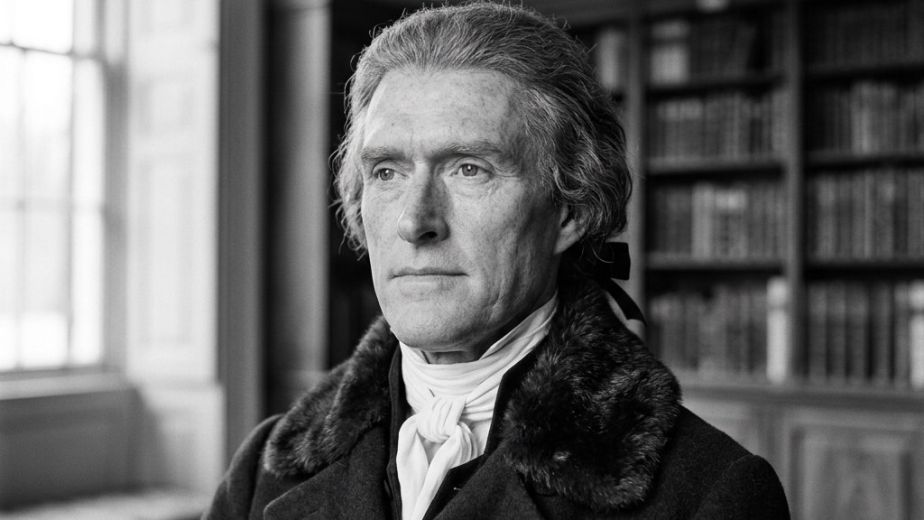
In the spring of 1820, a thirty-two-year-old unsalaried lecturer (Privatdozent) at the University of Berlin announced his first lecture course and scheduled it for the very hour at which Georg Wilhelm Friedrich Hegel gave his main lectures. Hegel had been appointed to Fichte’s chair two years earlier and filled the lecture halls; only a few came to hear Arthur Schopenhauer. After one semester, his teaching career was practically over.
The episode looks like mere defiance, but between the two men stood a substantive question that has lost none of its importance to this day: What is the state, and what may we demand of it? In his Philosophy of Right, which appeared that same year, Hegel called it the “actuality of the ethical Idea.” Schopenhauer had already put his answer into print a year earlier, in one of the most sober images in German philosophy: the image of the muzzle.
At a glance
- Life: February 22, 1788, in Danzig (today Gdańsk, Poland) to September 21, 1860, in Frankfurt am Main
- Work: independent scholar, qualified as a university lecturer in Berlin in 1820, lived in Frankfurt from 1833
- Major works: Die Welt als Wille und Vorstellung (1819, second volume 1844; in English, The World as Will and Representation), Die beiden Grundprobleme der Ethik (1841; in English, The Two Fundamental Problems of Ethics), Parerga und Paralipomena (1851)
- In one sentence: He declared the state to be a mere institution for protection against violence and denied it any right to improve people or to demand their veneration.
A merchant’s son without an office
Schopenhauer grew up as the son of Heinrich Floris Schopenhauer, a merchant and shipowner in Danzig; his mother, Johanna, later became a well-known writer with her own salon in Weimar. At his father’s wish he began training as a merchant, but gave it up in 1807, two years after his father’s death. He studied in Göttingen, where his teacher Gottlob Ernst Schulze pointed him toward Plato and Kant, and in Berlin. In 1813 the University of Jena accepted his dissertation on the principle of sufficient reason. In December 1818 his major work, Die Welt als Wille und Vorstellung (The World as Will and Representation), appeared; for decades it found hardly any readers.
After the failure in Berlin and a flight from cholera in 1831, Schopenhauer withdrew to Frankfurt am Main, where from 1833 he lived on his inherited wealth. This independence meant more to him than comfort. In the Aphorismen zur Lebensweisheit (Aphorisms on the Wisdom of Life), he writes that whoever has enough property from the start is born truly free, namely “master of his own time and powers.” Fame came to him only late, after the Parerga und Paralipomena appeared in 1851 and an article in the London Westminster Review drew attention to him in 1853.
A beast of prey with a muzzle
Schopenhauer develops his theory of the state in the first volume of his major work, in § 62. The starting point is sobering: every person wills himself first, and whoever intrudes into another’s sphere, injures him, enslaves him, or takes from him what he has worked for, commits a wrong. Because everyone learns how painful it is to suffer wrong, people band together. The state thus arises from the well-understood self-interest of all, and, as Schopenhauer stresses, it is “by no means directed against egoism, but only against the disadvantageous consequences which arise from the multiplicity of egoistic individuals.”
From this follows the famous image. Outwardly, a well-functioning state produces the same result as if all people were just, although in truth it is only that no one wants to suffer wrong. Schopenhauer puts it this way: “a beast of prey with a muzzle is as harmless as a graminivorous animal.” The muzzle does not make the animal gentle; it only keeps it from biting, and the state cannot and should not achieve more than that. Only the negative can be enforced, he argues, that is, refraining from wrong, but not charity or love. Consistently, the state would not forbid at all a wrongdoing to which no suffering of wrong corresponded.
Schopenhauer expressly rejects the notion that the state is an institution for promoting morality. A person’s disposition cannot be changed from outside, he holds, and punishment looks forward: it is meant to prevent future wrong rather than to repay past wrong. The philosopher Jean-Claude Wolf has seen in this a liberalism with respect to criminal law, for here the state protects against harm to others and does not presume to educate its citizens.
Schopenhauer is just as clear on property. All morally grounded right of property rests, he says, “simply and solely on work.” Whoever takes from another the fruit of his labor thereby lays hands on that person’s powers, which in substance resembles what a slaveholder does. Property acquired in this way gives the owner a power over the thing like that over his own body, and he can pass it on by exchange or gift. Laws that have no basis in pure right he calls a publicly sanctioned, enforced wrong, and among them he counts every despotism as well as serfdom and corvée labor. The same standard underlies his later judgments in the Parerga: the conquering nations of history, he writes, were “beasts of prey of the human race” who fell upon honestly acquired possessions in order to seize the fruits of other people’s labor, and in the United States he denounced what he called “Negro slavery,” a wrong that in his words cried out to heaven.
Protection from the protector too
In the second volume of his major work, published in 1844, Schopenhauer sharpened this idea. Against Spinoza, who understood right merely as might, he maintains that right exists independently of the state: force can suppress it but never abolish it. “Accordingly the State is nothing more than an institution for protection,” he writes in chapter 47. It is to protect against enemies from outside, to secure private law within, and finally to protect the citizens from those to whom they have entrusted their protection. This third aim, he says, is best achieved by separating the legislative, judicial, and executive powers.
Then comes a sentence that belongs in every textbook on the limits of state power: “If other ends besides that of protection, here explained, are ascribed to the State, this may easily endanger the true end.”
Wilhelm von Humboldt’s early treatise on the limits of state action, which likewise declares security to be the purpose of the state, was published in full only in 1851, the year of the Parerga. The two thinkers arrived at a related result by quite different routes: Humboldt out of confidence in the development of the individual, Schopenhauer out of distrust of human beings.
Against the deification of the state
From this point of view, Hegel’s theory of the state was bound to strike Schopenhauer as a grotesque exaggeration. In the Parerga he concludes from his definition of the state as an institution for protection that one can now clearly see the shallowness of those philosophers who “present the state as the highest aim and the flower of human existence and thereby deliver an apotheosis of philistinism.” He is sharper still in the essay Über die Universitäts-Philosophie (On Philosophy at the Universities). For the Hegelian school, he writes, the state was “the absolutely perfect ethical organism,” and so it taught future civil servants that their whole being belonged to the state, as the life of the bee belongs to the hive.
Schopenhauer links this criticism to an observation about the dependence of thinkers. A philosopher who is paid by the state and for the purposes of the state, he argues, easily comes to declare the state the summit of all human striving. His advice is therefore: “All help offered to philosophy from outside is, by its nature, suspect”; philosophy should be left to go its own way, “without assistance, but also without hindrance.”
His ethics supports this stance. Morally, what counts is the fate of the individual, not that of nations, he writes in the second volume of his major work: “Nations are really mere abstractions; individuals alone actually exist.” He had no room for a philosophy that wanted to dissolve the individual into a whole.
Why he trusted the king more than the people
Schopenhauer was no democrat, and he made no secret of it. Already in § 62 he praises hereditary monarchy, because a family whose welfare is inseparably bound up with that of the country is the most likely to pursue the public good. In the Parerga he calls the monarchical form of government “the one natural to man.” The people, he says, is indeed sovereign, but “a sovereign who is forever a minor,” and like all minors it easily falls into the hands of cunning swindlers, who are therefore called demagogues. He granted that freedom of the press works like a safety valve, but feared that its dangers outweighed its benefits.
This stance followed from the same view of human nature that let him see the state so soberly. Whoever sees a beast of prey in man fears the violence of the crowd as much as the violence of the individual and looks for a fixed point that restrains both. In September 1848 it became clear which side he took when it came to the crunch. When there was fighting in Frankfurt on September 18 and a barricade stood on the bridge in front of his house, he let Austrian soldiers into his apartment who wanted to shoot from his windows and then moved on to the house next door. Their officer, Schopenhauer recounts in a letter of March 2, 1849, to his disciple Julius Frauenstädt, received “the large double opera glass” to spy out the insurgents, whom he called the “sovereign rabble.” In his will of 1852 he named as his sole heir a Berlin fund for Prussian soldiers who had been disabled in the fighting of 1848 and 1849 “for the maintenance and restoration of lawful order,” and for the surviving dependents of those who had fallen.
He also set narrow limits to equality before the state. In his opinion, women should “never become fully of age,” and while he was willing to grant Jews equal civil rights, he wanted them to have no share in government and administration, a position he justified with anti-Jewish clichés.
What friends of liberty can learn from him
The first lesson lies in the muzzle itself. A state that derives its legitimacy solely from protection against violence has no claim to improve its citizens, to examine their convictions, or to direct their lives. Schopenhauer reached this conclusion without any optimism about human nature, and that is exactly what makes it so robust. You do not have to think people are good in order to set narrow limits to the state; it is enough to consider those who govern just as self-interested as everyone else.
The second lesson concerns protection from the protector. Schopenhauer recognized that any power created for protection can itself become a danger, and he therefore called for the separation of powers. His own answer, a hereditary king whose dignity stands above everyone, has not been borne out by history, but he asked the right question.
The third concerns independence of thought. Whoever is paid by the state is easily tempted to praise the state. Schopenhauer’s mockery of professorial philosophy was aimed at the Hegelians of his day, but the observation behind it applies to any scholarship that depends on a funder and is then supposed to judge that funder’s usefulness.
A muzzle is not a shepherd
Schopenhauer did not defend liberty out of enthusiasm, and his political sympathies lay with throne and order. And yet hardly any German philosopher of his time stripped the state of its aura so thoroughly. For him the state is not an ethical organism, not an educator, and not a goal of human striving, but a tool against the wrong that people do to one another. A muzzle is meant to prevent biting; a shepherd, by contrast, decides where the flock goes. How much of a shepherd a state may be, Schopenhauer answered in a passing clause that is easy to overlook: every additional purpose ascribed to it can endanger the true one.
Further reading
- Arthur Schopenhauer: Die Welt als Wille und Vorstellung, vol. I, § 62, and vol. II, chapter 47, “Zur Ethik” (in German); in English: The World as Will and Representation, vol. I, § 62, and vol. II, chapter 47, “On Ethics”
- Arthur Schopenhauer: Parerga und Paralipomena, vol. II, chapter IX, “Zur Rechtslehre und Politik” (in German); in English: Parerga and Paralipomena, vol. II, chapter IX
- Arthur Schopenhauer: Über die Universitäts-Philosophie, in: Parerga und Paralipomena, vol. I (in German); in English: “On Philosophy at the Universities,” in: Parerga and Paralipomena, vol. I
- Jean-Claude Wolf: “Schopenhauers Liberalismus,” in: Schopenhauer-Jahrbuch 78 (1997), pp. 63–86 (in German)
This article is part of our series on thinkers, doers, and historical figures of liberty.
Sources
- Schopenhauer, Arthur: Die Welt als Wille und Vorstellung, vol. I, § 62, text from Projekt Gutenberg-DE: https://projekt-gutenberg.org/authors/arthur-schopenhauer/books/die-welt-als-wille-und-vorstellung-band-i/chapter/64 (in German)
- Schopenhauer, Arthur: Die Welt als Wille und Vorstellung, vol. II, chapter 47, “Zur Ethik,” text from Projekt Gutenberg-DE: https://projekt-gutenberg.org/authors/arthur-schopenhauer/books/die-welt-als-wille-und-vorstellung-zweiter-band/chapter/48 (in German)
- Schopenhauer, Arthur: Parerga und Paralipomena, vol. I, ed. Julius Frauenstädt, 6th edition, F. A. Brockhaus, Leipzig 1888, including “Ueber die Universitäts-Philosophie” (in German; digitized copy: https://archive.org/details/11173019)
- Schopenhauer, Arthur: Parerga und Paralipomena, vol. II, ed. Julius Frauenstädt, 6th edition, F. A. Brockhaus, Leipzig 1888, chapter IX, “Zur Rechtslehre und Politik,” §§ 124–133 (in German; digitized copy: https://archive.org/details/11173020)
- Schopenhauer, Arthur: Aphorismen zur Lebensweisheit, chapter III, “Von dem, was einer hat,” Project Gutenberg eBook 47406: https://www.gutenberg.org/ebooks/47406 (in German)
- Schopenhauer, Arthur: letter to Julius Frauenstädt, Frankfurt am Main, March 2, 1849, in: Eduard Grisebach (ed.): Schopenhauer’s Briefe an Becker, Frauenstädt, v. Doß, Lindner und Asher, Reclam, Leipzig [1894], pp. 155 f. (in German; digitized copy: https://archive.org/details/11603226)
- Schopenhauer, Arthur: will (1852), in: Ludwig Schemann (ed.): Schopenhauer-Briefe, F. A. Brockhaus, Leipzig 1893, pp. 547 ff. (in German; digitized copy: https://archive.org/details/11603225)
- Wicks, Robert: “Arthur Schopenhauer,” in: Stanford Encyclopedia of Philosophy (revised 2021): https://plato.stanford.edu/entries/schopenhauer/
- Liepmann, Hugo: “Schopenhauer, Arthur,” in: Allgemeine Deutsche Biographie 32 (1891), pp. 333–346: https://de.wikisource.org/wiki/ADB:Schopenhauer,_Arthur (in German)
- Wolf, Jean-Claude: “Schopenhauers Liberalismus,” in: Schopenhauer-Jahrbuch 78 (1997), pp. 63–86: https://download.uni-mainz.de/fb05-philosophie-schopenhauer/files/2019/02/1997_Wolf-Jean-Claude.pdf (in German)
- Ziegler, Ernst: “Schopenhauers Freunde und Feinde in den Senilia,” Schopenhauer-Jahrbuch (2011): https://download.uni-mainz.de/fb05-philosophie-schopenhauer/files/2020/03/2011_Ziegler.pdf (in German)
- Humboldt, Wilhelm von: Ideen zu einem Versuch, die Grenzen der Wirksamkeit des Staats zu bestimmen, Trewendt, Breslau 1851 (in German; references in the research file for the article on the Humboldt brothers)
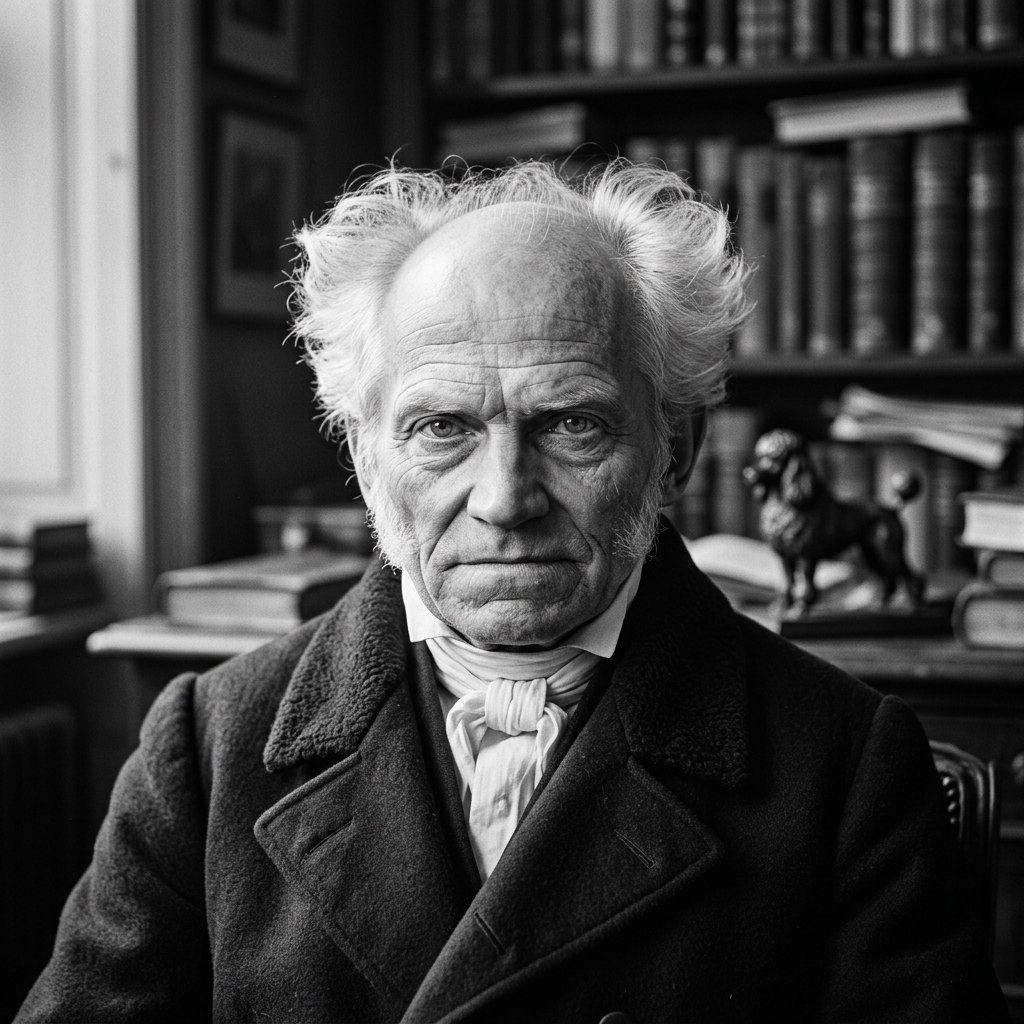
Featured image: Arthur Schopenhauer (AI illustration)