In June 1776, a 33-year-old delegate from Virginia was renting rooms from a Mr. Graaf in Philadelphia. The house was new, built of brick and three stories high, and Thomas Jefferson had taken the second floor, a furnished parlor with a bedroom. It was in this parlor, he recalled almost fifty years later, that he usually wrote, and that was where he wrote that paper as well. His portable writing desk, which today stands in the National Museum of American History in Washington, had been built by the cabinetmaker Benjamin Randolph to Jefferson’s own design.
On June 11, the Continental Congress had appointed a committee of five men to prepare a declaration of independence. Jefferson, its second-youngest member, wrote the draft. With a few changes by John Adams and Benjamin Franklin, it went to Congress on June 28, which shortened it, revised it, and adopted it on the evening of July 4. One passage was dropped entirely: Jefferson’s indictment of the slave trade. It had been struck out, he wrote later, out of deference to South Carolina and Georgia, which wanted to continue that trade. Yet the man who had written it owned slaves himself.
At a glance
- Life: April 13, 1743, Shadwell (Virginia), to July 4, 1826, Monticello (Virginia)
- Offices: legislator in Virginia and delegate to the Continental Congress, governor of Virginia (1779 to 1781), minister to France (1784 to 1789), secretary of state (1790 to 1793), vice president (1797 to 1801), third president of the United States (1801 to 1809)
- Major works: Declaration of Independence (1776), Virginia Statute for Religious Freedom (drafted 1777, enacted 1786), Notes on the State of Virginia (1785), draft of the Kentucky Resolutions (1798)
- Founded: University of Virginia (chartered 1819, classes from 1825)
- In one sentence: He wrote the liberty of the individual into a nation’s founding charter while living off the unfreedom of others.
A planter who collected books
Jefferson was born in 1743 at Shadwell, his parents’ estate in Albemarle County. He studied at the College of William and Mary, read law with George Wythe, and from 1769 sat in the colony’s legislature. That same year he began building Monticello. Through his marriage to Martha Wayles Skelton, he inherited from her father’s estate in 1773 more than 11,000 acres of land, 135 enslaved people, and a mountain of debt.
After serving as governor, minister in Paris, secretary of state, and vice president, he became president in 1801. After British troops burned the Capitol in Washington in 1814, he sold Congress his library of several thousand volumes in 1815, which became the foundation of today’s Library of Congress in all its breadth of subjects. He died on July 4, 1826, exactly fifty years after the Declaration was adopted, on the same day as John Adams.
Rights older than any government
The second paragraph of the Declaration contains an entire political philosophy: “We hold these truths to be self-evident, that all men are created equal, that they are endowed by their Creator with certain unalienable Rights, that among these are Life, Liberty and the pursuit of Happiness. That to secure these rights, Governments are instituted among Men, deriving their just powers from the consent of the governed.” Whenever a government becomes destructive of these ends, it goes on, the people have the right to alter or to abolish it.
The order is decisive. First come the rights, then comes the government, and it is merely a tool for protecting them. John Locke, whose ideas clearly echo here, had spoken of man’s right to preserve his life, liberty, and estate. The Declaration names the pursuit of happiness instead. This formula can be read as both more modest and broader: the state does not promise people happiness, it is only supposed to stay out of their way as they seek it in their own fashion.
Conscience as a free space
Jefferson fought with particular persistence for freedom of belief. In the Notes on the State of Virginia (Query XVII), he made the case for it briefly: the rights of conscience had never been submitted to government, and the legitimate powers of the state extended only to acts that injure others. “But it does me no injury for my neighbour to say there are twenty gods, or no god. It neither picks my pocket nor breaks my leg.” Against error, only reason and free inquiry would help.
He turned this conviction into law. He wrote his bill for religious freedom in 1777; it was introduced in 1779, but the legislature postponed it. Only after the dispute over a tax to support all Christian denominations did James Madison introduce the text again. On January 16, 1786, the Virginia legislature passed it. From then on, no one in Virginia could be compelled to attend a church service or to pay for a church, and no one could suffer any disadvantage on account of his beliefs. As president, Jefferson wrote in 1802 to the Baptists of Danbury, Connecticut, that with the First Amendment to the Constitution the American people had built a wall of separation between church and state.
The earth belongs to the living
In Washington’s cabinet, Jefferson clashed with Treasury Secretary Alexander Hamilton, who wanted a strong federal government resting on a large national debt and a national bank. In a 1791 opinion, Jefferson judged the bank unconstitutional: the Constitution allowed Congress only the powers delegated to it, and a bank was not necessary for exercising them. To take a single step beyond those boundaries, he argued, was to take possession of a boundless field of power.
As early as 1789, he had written to Madison from Paris that the earth belongs in usufruct to the living. From this he concluded that no generation may contract debts greater than it can pay off within its own lifetime.
Newspapers without a government
In 1798, Congress passed the Alien and Sedition Acts, under which critics of the government were also convicted. Jefferson, then vice president, anonymously wrote a draft for the Kentucky legislature. It states that where the federal government assumes powers that have not been delegated to it, its acts are void, and that the rightful remedy is to declare them null. Kentucky adopted the text in a weakened form and without the word for nullification, and only later did it become known that Jefferson had written it.
Freedom of the press had long been close to his heart. If he had to choose between a government without newspapers and newspapers without a government, he wrote to Edward Carrington in 1787, he would not hesitate a moment to prefer the latter. As president, he pardoned the ten people convicted under the Sedition Act who were still in prison.
A wise and frugal government
In his first inaugural address on March 4, 1801, Jefferson described what he meant by good government, in substance: a wise and frugal government that restrains people from injuring one another, otherwise leaves them free to pursue their own paths of industry and improvement, and does not take from the mouth of labor the bread it has earned.
With his Treasury Secretary Albert Gallatin, he put much of this into practice. The army and navy were sharply reduced, most internal federal taxes were abolished, among them the whiskey tax in 1802, and from then on the federal government lived mainly on customs duties and land sales. Although he paid France 15 million dollars for Louisiana, the federal debt fell during his time in office from about 80 to 57 million dollars.
He did not stay entirely true to his principles. He knew that the Constitution made no provision for acquiring foreign territory, and he himself wrote that with the purchase of Louisiana the government had done something beyond the Constitution. The embargo of December 1807, which banned foreign trade in order to avoid war with Great Britain, failed: exports fell from 108 to 22 million dollars, shipping and agriculture suffered badly, and smuggling flourished in New England.
The slaveholder of Monticello
Jefferson called slavery an evil and acted against it more than once. In 1778 he introduced a bill in Virginia against the further importation of slaves, which was passed. His 1784 plan for governing the western territories provided for banning slavery there after 1800, but Congress struck that provision. As president, he urged Congress in 1806 to ban the slave trade at the earliest date the Constitution permitted, calling it a violation of human rights. The ban took effect on January 1, 1808. In the Notes (Query XVIII), he wrote of slavery: “I tremble for my country when I reflect that God is just.”
His own life did not follow these words. Over the course of his life, Jefferson owned more than 600 enslaved people, of whom he freed only a handful; according to Monticello, two during his lifetime and five in his will. With Sally Hemings, a woman he enslaved, he began a sexual relationship in Paris. The Thomas Jefferson Foundation, which runs Monticello, has considered it very likely since 2000 that he was the father of all six of Sally Hemings’s children, and by its own account reaffirmed this assessment in 2018. In the Notes (Query XIV), he suggested, “as a suspicion only,” that Black people were inferior to white people in body and mind, and he considered it impossible for the two to live together in freedom, which is why he wanted to combine emancipation with the removal of those freed. After his death, beginning in January 1827, enslaved people from Monticello were auctioned off to pay his debts of more than 107,000 dollars, about one hundred according to the foundation, and more in later sales.
These facts are part of his portrait. They cannot be explained away by pointing to his times, for he himself formulated the standard by which they must be measured.
What friends of liberty can learn from him
The first lesson is in the second paragraph of the Declaration: rights precede the state, and a government is legitimate only as long as it protects those rights.
Just as enduring is his idea that the state stops where no one is harmed. The neighbor who believes in twenty gods or in none picks no one’s pocket, and this principle reaches far beyond religion.
His letter to Madison is a warning to every government that runs up debts at the expense of future generations, and the Kentucky Resolutions are a reminder that limits on power are easier to defend when several levels of government check one another.
A sentence greater than its author
Jefferson had only three achievements inscribed on his tombstone: the Declaration of Independence, the statute for religious freedom, and the founding of the University of Virginia. He did not mention that he had been president.
In 1859, Abraham Lincoln honored him for having introduced into a merely revolutionary document, in the midst of the struggle for independence, an abstract truth applicable to all men and all times. In 1963, Martin Luther King compared the Constitution and the Declaration of Independence to a promissory note that America had not yet honored for its Black citizens. Both invoked Jefferson to demand what he himself had denied hundreds of people. His sentence thus proved stronger than the circumstances in which it was written, and stronger than the man who wrote it.
Further reading
- Thomas Jefferson: Notes on the State of Virginia (1785), online at the Avalon Project of Yale Law School
- Thomas Jefferson: First Inaugural Address of March 4, 1801, online at the Avalon Project of Yale Law School
- Annette Gordon-Reed: The Hemingses of Monticello: An American Family, W. W. Norton, New York 2008
This article is part of our series on thinkers, doers, and historical figures of liberty.
Sources
- Jefferson, Thomas, et al.: A Declaration by the Representatives of the United States of America, in General Congress Assembled, Philadelphia, July 4, 1776, https://avalon.law.yale.edu/18th_century/declare.asp
- Jefferson, Thomas: A Bill for Establishing Religious Freedom, report of June 12, 1779 (drafted 1777, enacted January 16, 1786), Papers 2, in: The Founders’ Constitution, https://press-pubs.uchicago.edu/founders/documents/amendI_religions37.html
- Jefferson, Thomas: Notes on the State of Virginia, privately printed, Paris 1785; John Stockdale, London 1787 (Queries XIV, XVII, XVIII), https://avalon.law.yale.edu/18th_century/jeffvir.asp
- Jefferson, Thomas: Letter to Edward Carrington, January 16, 1787, Papers 11:48–49, https://press-pubs.uchicago.edu/founders/documents/amendI_speechs8.html
- Jefferson, Thomas: Letter to James Madison, Paris, September 6, 1789, https://press-pubs.uchicago.edu/founders/documents/v1ch2s23.html
- Jefferson, Thomas: Opinion on the Constitutionality of a National Bank, 1791, https://avalon.law.yale.edu/18th_century/bank-tj.asp
- Jefferson, Thomas: Draft of the Kentucky Resolutions, 1798, https://press-pubs.uchicago.edu/founders/documents/v1ch8s41.html
- Jefferson, Thomas: First Inaugural Address, Washington, March 4, 1801, https://avalon.law.yale.edu/19th_century/jefinau1.asp
- Jefferson, Thomas: Letter to the Danbury Baptist Association, January 1, 1802, https://www.loc.gov/loc/lcib/9806/danpre.html
- Jefferson, Thomas: Letter to John Breckinridge, August 12, 1803, https://founders.archives.gov/documents/Jefferson/01-41-02-0139
- Jefferson, Thomas: Sixth Annual Message to Congress, December 2, 1806, https://www.presidency.ucsb.edu/documents/sixth-annual-message
- Jefferson, Thomas: Autobiography, 1821, https://avalon.law.yale.edu/19th_century/jeffauto.asp
- Jefferson, Thomas: Letter to James Mease, September 16, 1825, https://founders.archives.gov/documents/Jefferson/98-01-02-5539
- Locke, John: Second Treatise of Government, 1689, §§ 87 and 123, https://www.gutenberg.org/ebooks/7370
- Lincoln, Abraham: Letter to Henry L. Pierce and others, Springfield, April 6, 1859, https://www.abrahamlincolnonline.org/lincoln/speeches/pierce.htm
- King, Martin Luther: “I Have a Dream” speech, Washington, August 28, 1963, https://www.npr.org/2010/01/18/122701268/i-have-a-dream-speech-in-its-entirety
- Looney, J. Jefferson / Dictionary of Virginia Biography: “Thomas Jefferson (1743–1826),” Encyclopedia Virginia, https://encyclopediavirginia.org/entries/jefferson-thomas-1743-1826/
- Encyclopedia Virginia: “Virginia Statute for Establishing Religious Freedom (1786),” https://encyclopediavirginia.org/entries/virginia-statute-for-establishing-religious-freedom-1786/
- Miller Center, University of Virginia: Thomas Jefferson, Domestic Affairs and Foreign Affairs, https://millercenter.org/president/jefferson
- Thomas Jefferson Foundation (Monticello): Jefferson and Sally Hemings; People Enslaved at Monticello Who Gained Their Freedom; The 1827 Dispersal Sale; Jefferson’s Debt; Spurious Quotations, https://www.monticello.org
- Smithsonian, National Museum of American History: Declaration of Independence Desk, https://www.si.edu/object/nmah_513641
- U.S. House of Representatives: history of the Committee on Ways and Means (House Document 100-244), https://www.govinfo.gov/content/pkg/GPO-CDOC-100hdoc244/pdf/GPO-CDOC-100hdoc244-11.pdf
- Gordon-Reed, Annette: The Hemingses of Monticello: An American Family, W. W. Norton, New York 2008.
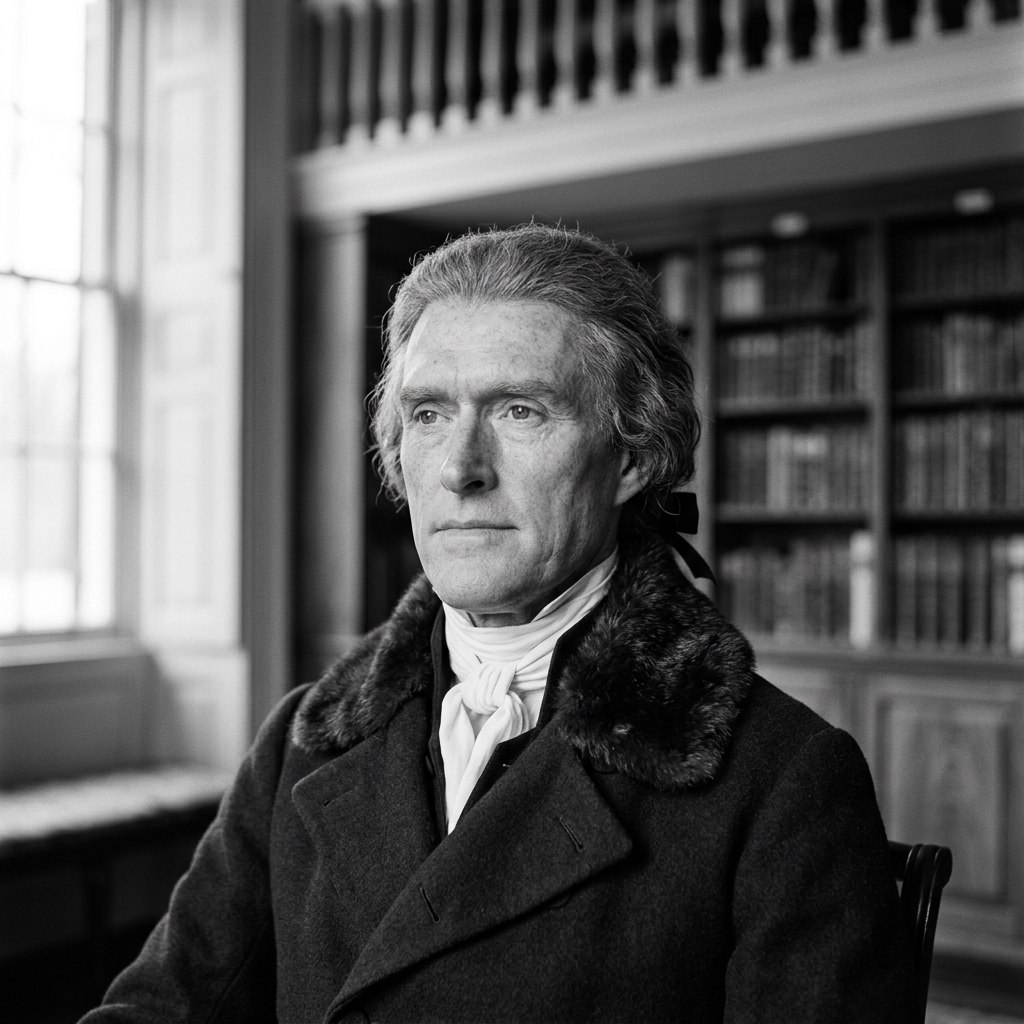
Featured image: Thomas Jefferson (AI illustration)