In 1876, Crown Prince Rudolf of Austria, then seventeen, was given a new teacher of economics. The heir to the throne took notes, and his notebooks survived in the archives until Erich and Monika Streissler published them in 1994. The editors read them as a course in liberal economic policy that relies on individual responsibility and allows the state to intervene only in exceptional cases.
The teacher was Carl Menger, and five years earlier he had published a book that is read today as the founding charter of an entire school of thought. In the Grundsätze der Volkswirthschaftslehre (Principles of Economics), he explained why things have value, how prices arise, and where money comes from, and he explained it from the standpoint of the acting human being. Ludwig von Mises, Friedrich August von Hayek, and many others have built on this foundation.
At a glance
- Life: February 23, 1840, in Neu-Sandez, Galicia (today Nowy Sącz, Poland), to February 26, 1921, in Vienna
- Work: economic journalist and official in the government’s press service; from 1873 professor of political economy at the University of Vienna (until 1903); tutor to Crown Prince Rudolf; from 1900 member of the Herrenhaus, the upper house of the Austrian parliament
- Major works: Grundsätze der Volkswirthschaftslehre (1871), Untersuchungen über die Methode der Socialwissenschaften (1883), Die Irrthümer des Historismus in der deutschen Nationalökonomie (1884), On the Origin of Money (1892)
- In one sentence: He explained value, prices, and money through the decisions of individual people and thereby became the founder of the Austrian School.
A lawyer who wrote market reports
Menger came from an ennobled family in Galicia but dropped the “von” as a young man. He studied law in Vienna and Prague, then worked as a journalist in Lemberg (Lviv) and Vienna, and in 1867 he received his doctorate in law in Kraków. Until 1875 he worked in the press department of the Austrian prime minister’s office, most recently as a ministerial secretary, and he observed the markets for the official Wiener Zeitung.
This work shaped his thinking. As an economic journalist, he had noticed how little the factors that classical theory used to explain prices matched what experienced market participants considered decisive. This observation was the starting point of his own theory of prices. With the Grundsätze, he earned his habilitation, the postdoctoral qualification required to teach at a university, at the University of Vienna in 1872, and in the fall of 1873 he became an associate professor. He turned down offers from Karlsruhe, Basel, and Zurich, and in 1879, after his years with the crown prince, he received the chair of political economy in Vienna.
His bond with Rudolf went beyond the lessons. He accompanied him on journeys in 1877 and 1878, including to England, and according to Rudolf’s biographer Brigitte Hamann, he helped him in 1878 with an anonymous pamphlet that accused the Austrian high nobility of political inertia and economic incompetence.
Value arises in human judgment
The classical economists, from Adam Smith to David Ricardo, had explained the exchange value of goods mainly by the labor and costs embodied in them. Karl Marx built his theory of surplus value on this labor theory of value, according to which the entrepreneur’s profit comes from unpaid labor.
Menger started from a different point. In the third chapter of the Grundsätze, he states, in substance, that value does not adhere to goods and is not one of their properties. It is a judgment that economizing people make about the importance of the goods at their disposal for their lives and their well-being, and it does not exist outside their consciousness. With this, the question of value moves from the workshop into the mind of the person who uses the goods.
Menger shows how this judgment comes about with a ranking of needs. Every person uses a quantity of a good first for the most important purpose, then for the next most important, and so on. If part of the quantity is lost, he gives up the least important of these purposes. The value of each individual portion is therefore measured by the importance of that purpose. An example makes this clear: water flowing in abundance from a rich spring will hardly be valued by anyone, while the same amount on a journey through the desert can decide between life and death, even though nothing about the water itself has changed. Incidentally, the term “Grenznutzen” (marginal utility), under which this idea appears in every textbook today, was coined only in 1884 by Menger’s follower Friedrich von Wieser.
From here, Menger also explains the means of production. He calls them goods of higher order, because they do not satisfy a need directly but help to produce consumer goods. They derive their value from the value of these consumer goods. The path thus runs from the consumer to the factory and not the other way around: costly labor on a good that nobody wants creates no value.
Time, knowledge, and error
At almost the same time, William Stanley Jevons in England (1871) and Léon Walras in Lausanne (1874) arrived at a similar theory of value independently of Menger. This is why people speak of the “marginalist revolution.” Menger’s version, however, has a character of its own that became formative for the Austrian School. He worked without mathematical equations and focused on how economic activity actually unfolds. As early as the first chapter of the Grundsätze, he discusses the fact that all production takes time and that people can make mistakes in the process, because their knowledge of future needs and means is incomplete.
Anyone who thinks this way sees the economy as a process in which people learn, misjudge, and correct their plans. The later work of the Austrians on entrepreneurship, capital, and business cycles builds on this, and Hayek made the limits of knowledge one of the main themes of his work.
How money arises without a lawgiver
Where does money come from? A widespread view traced it back to an agreement or an act of the authorities. Menger gave a different answer as early as the eighth chapter of the Grundsätze, which he developed further in 1892 in the essay On the Origin of Money for English readers and in the article “Geld” (money) in the Handwörterbuch der Staatswissenschaften, a German encyclopedia of the political sciences.
In barter, everyone soon discovers that some goods are easier to pass on than others. Those who act wisely accept such readily salable goods even when they do not need them themselves, because they can later exchange them more easily for what they are actually looking for. The more people proceed in this way, the more sought-after the good becomes, until it establishes itself as a general medium of exchange, without any contract or law having designated it as such.
In the Untersuchungen (Investigations into the Method of the Social Sciences) of 1883, Menger turned this into a general question for the social sciences: “How can it be that institutions which serve the common welfare and are extremely significant for its development come into being without a common will directed toward establishing them?” His answer is institutions that have grown “organically.” Besides money, he counts markets, law, and language among them: orders that emerge from the actions of many people, each pursuing their own purposes. Menger did not deny that deliberately created institutions exist alongside them. But he insisted that the most important foundations of social life cannot be understood without the unplanned ones. Hayek later carried this idea forward under the concept of spontaneous order.
The dispute over method
At the German universities of the time, the Younger Historical School around Gustav Schmoller set the tone. Its representatives distrusted general theory and wanted to understand the economy mainly through detailed historical and statistical studies. In the Untersuchungen, Menger countered that history has its place, but that alongside it there must be theoretical research that looks for general relationships not tied to any one place or era.
Schmoller panned the book in his journal, the Jahrbuch. Menger replied in 1884 with Die Irrthümer des Historismus in der deutschen Nationalökonomie (The Errors of Historicism in German Economics), which he wrote in the form of letters to a friend. Schmoller promptly sent the book back to its author and announced this in a short note in his journal. This marked the beginning of the so-called Methodenstreit, the dispute over method that occupied German-language economics for decades. The German opponents called Menger and his followers “the Austrians” to mark them as outsiders. The name stuck and became the designation of a worldwide school of thought.
In the tradition of Adam Smith
For the hundredth anniversary of Adam Smith’s death, Menger wrote a two-part essay that appeared on January 6 and 8, 1891, in the Neue Freie Presse, one of the major Viennese daily newspapers. In it, he defended Smith and classical economics against the misinterpretations of the Younger Historical School. The economists Erwin Dekker and Stefan Kolev, who translated the text into English in 2016, read it as evidence that Menger saw himself as part of a liberal tradition reaching back to Smith.
Menger was a nineteenth-century liberal who spent a large part of his life in the civil service of the Habsburg monarchy. In 1892 he served on the currency commission of inquiry that prepared Austria-Hungary’s transition to the gold standard, and in 1900 he was appointed to the Herrenhaus for life. For himself, he rejected the label of the Manchester School. It was his successors, above all Mises, who drew the more far-reaching conclusions from his theory.
What friends of liberty can learn from him
The first lesson concerns the modesty that befits all authorities. If the value of a good arises in the judgment of individual people, then no government agency can set it correctly from the outside. In this view, prices reflect the judgments of many individuals, and anyone who shifts them by decree puts his own judgment in place of theirs.
The second lesson concerns order. Money, markets, and law are older than the agencies that administer them today. They emerged from the actions of free people, and that is a strong argument against the notion that a society needs a plan from above for everything important.
The third lesson is methodological. Statistics tell us nothing as long as we have no theory to order them, and Menger insisted that such general relationships exist in the economy. Especially for readers who distrust political promises, this is a useful habit: to ask whether a policy is compatible with what we know about human action.
A quiet legacy
In 1903, Menger retired early from his professorship in order to work on a revised edition of the Grundsätze. He never finished it. His son, the mathematician Karl Menger, published a second edition from his father’s papers in 1923. He could no longer use his father’s library for this, because what is now Hitotsubashi University in Tokyo had bought it in 1922, including many volumes with Menger’s handwritten notes.
In the very year of Menger’s retirement, a young Viennese student picked up the Grundsätze. Ludwig von Mises later recalled that he first read the book around Christmas 1903 and that it was this reading that made him an economist. Since 1929, Menger’s monument has stood in the Arkadenhof, the arcaded courtyard of the University of Vienna.
Menger’s influence rests on a simple shift with far-reaching consequences: he thought about the economy from the standpoint of the human being, of his needs, his limited knowledge, and his decisions. Anyone who asks today why prices know more than any planner and why good money needs no inventor stands on the ground that this reserved Viennese professor prepared.
Further reading
- Carl Menger: Grundsätze der Volkswirthschaftslehre, Wilhelm Braumüller, Vienna 1871 (in German); English: Principles of Economics
- Carl Menger: On the Origin of Money, in: The Economic Journal 2 (1892), pp. 239–255
- Erich W. Streissler and Monika Streissler (eds.): Carl Menger’s Lectures to Crown Prince Rudolf of Austria, Edward Elgar, Aldershot 1994
- Friedrich August von Hayek: introduction to Carl Menger, Principles of Economics, Ludwig von Mises Institute, Auburn 2011
This article is part of our series on thinkers, doers, and historical figures of liberty.
Sources
- Menger, Carl: Grundsätze der Volkswirthschaftslehre. Erster, allgemeiner Theil, Wilhelm Braumüller, Vienna 1871; 2nd edition, ed. by Karl Menger, Vienna 1923 (in German); English: Principles of Economics, translated by James Dingwall and Bert F. Hoselitz, Ludwig von Mises Institute, Auburn 2007/2011.
- Menger, Carl: Untersuchungen über die Methode der Socialwissenschaften, und der Politischen Oekonomie insbesondere, Duncker & Humblot, Leipzig 1883 (in German); English: Investigations into the Method of the Social Sciences, New York University Press 1985.
- Menger, Carl: Die Irrthümer des Historismus in der deutschen Nationalökonomie, Alfred Hölder, Vienna 1884 (in German).
- Menger, Carl: “Die Social-Theorien der classischen National-Oekonomie und die moderne Wirthschaftspolitik,” Neue Freie Presse, January 6 and 8, 1891 (in German); English translation by Erwin Dekker and Stefan Kolev, Econ Journal Watch 13 (3), 2016, pp. 467–489, https://econjwatch.org/articles/the-social-theories-of-classical-political-economy-and-modern-economic-policy
- Menger, Carl: “On the Origin of Money,” in: The Economic Journal 2 (6), 1892, pp. 239–255.
- Menger, Carl: article “Geld,” in: Handwörterbuch der Staatswissenschaften, Jena 1892 (in German).
- Streissler, Erich W.; Streissler, Monika (eds.): Carl Menger’s Lectures to Crown Prince Rudolf of Austria, translated by Monika Streissler and David F. Good, Edward Elgar, Aldershot 1994.
- Schmoller, Gustav: note on Menger’s Irrthümer des Historismus, in: Jahrbuch für Gesetzgebung, Verwaltung und Volkswirtschaft 8 (1884), p. 677 (in German); reprinted in: Journal of Contextual Economics 141 (2021), pp. 341–342.
- Mises, Ludwig von: Notes and Recollections, Liberty Fund, Indianapolis 2013, p. 22.
- Streissler, Erich W.: “Menger, Carl,” in: Neue Deutsche Biographie 17 (1994), pp. 72–74, https://www.deutsche-biographie.de/118580841.html (in German)
- Hayek, Friedrich August von: “Introduction: Carl Menger” (1934), in: Menger, Principles of Economics, Ludwig von Mises Institute, Auburn 2011, pp. 11–36.
- Salerno, Joseph T.: “Biography of Carl Menger: The Founder of the Austrian School (1840–1921),” Mises Institute 2000, https://mises.org/articles-interest/biography-carl-menger-founder-austrian-school-1840-1921
- Caldwell, Bruce: Chronology of the Austrian School, Duke University, https://hope.econ.duke.edu/sites/hope.econ.duke.edu/files/documents/Chronology%20of%20the%20Austrian%20School.pdf
- Dekker, Erwin; Kolev, Stefan: introduction to the translation of Menger’s 1891 essay, https://core.ac.uk/download/72002463.pdf
- “The Legacy of Menger’s Theory of Social Institutions,” Mises Institute, https://mises.org/articles-interest/legacy-mengers-theory-social-institutions
- The Austrian School of Economics, ch. 5: Carl Menger (on Rudolf and the 1878 pamphlet on the nobility, after Brigitte Hamann), https://mises.org/online-book/austrian-school-economics/5-carl-menger-founder-austrian-school
- Austria-Forum (AEIOU): “Menger von Wolfensgrün, Carl,” https://austria-forum.org/af/AEIOU/Menger_von_Wolfensgr%C3%BCn%2C_Karl/Menger_von_Wolfensgr%C3%BCn%2C_Karl_english
- Hitotsubashi University, Center for Historical Social Science Literature: The Digital Library of the Carl Menger Collection, https://chssl.lib.hit-u.ac.jp/?p=21325
- Journal of the History of Economic Thought: review and letter to the editor on Carl Menger’s Lectures to Crown Prince Rudolf of Austria, https://resolve.cambridge.org/core/services/aop-cambridge-core/content/view/C23BFEEC2779FDB1119C20E021CB20BC/S1053837224000269a.pdf
- Econlib: “Carl Menger on Value,” https://www.econlib.org/carl-menger-on-value/
- Stanford Encyclopedia of Philosophy: Karl Marx, https://plato.stanford.edu/entries/marx/
- Wikipedia (en): Carl Menger; Friedrich von Wieser; Methodenstreit (only as a starting point)
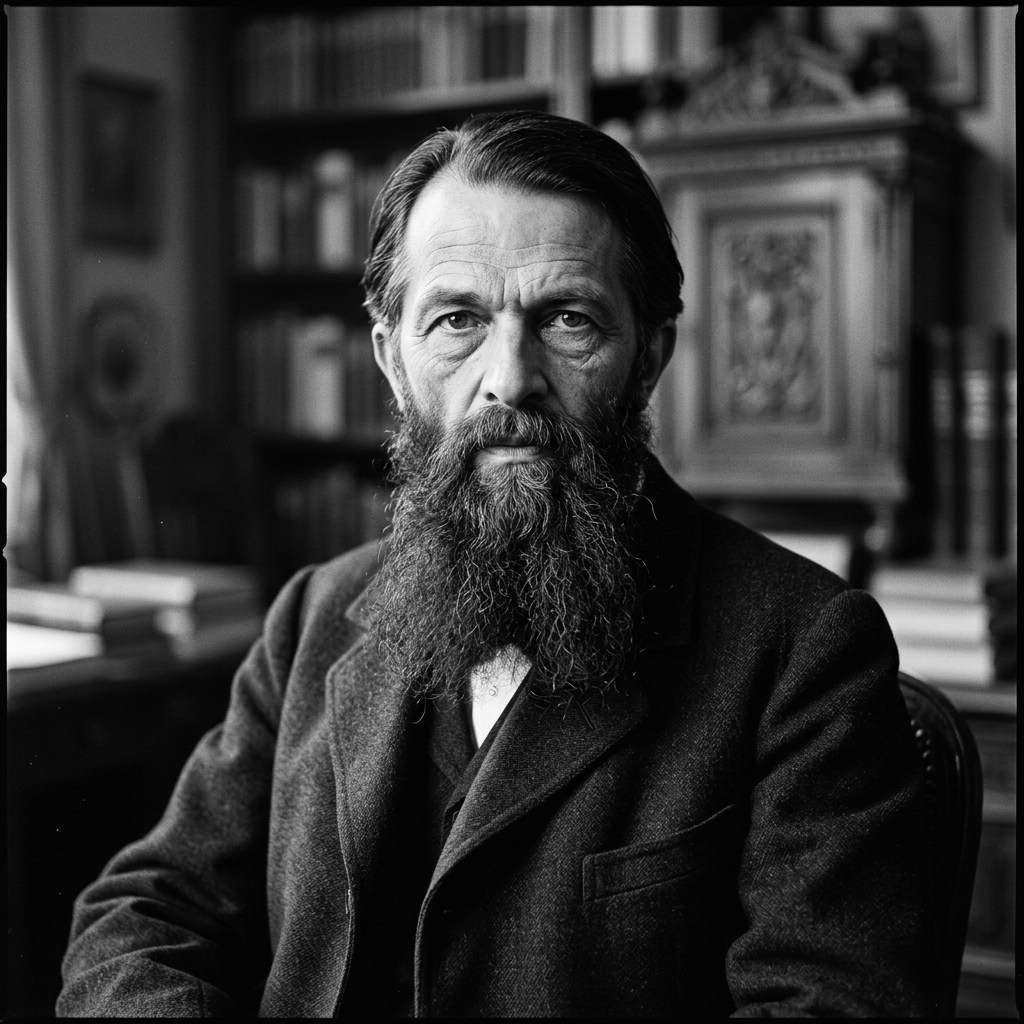
Featured image: Carl Menger (AI illustration)