When Michel de Montaigne set out to build a monument to his friend, he gave a reason for their friendship that is still quoted today: “Par ce que c’estoit luy; par ce que c’estoit moy,” because it was he, because it was I. So it stands in the chapter on friendship, Book I, Chapter 28 of his Essais. Less well known is how this friendship began. Montaigne knew the name Étienne de La Boétie before he ever met him, from a manuscript that, in his words, had long been circulating among thoughtful readers. Its author had written it in his youth, in Montaigne’s words “à l’honneur de la liberté contre les tyrans,” in honor of liberty against tyrants.
This work, the Discours de la servitude volontaire, the Discourse on Voluntary Servitude, asks a question that every generation meets anew. How can a single person rule over thousands and millions when he has no more strength than any one of them? La Boétie’s answer is so simple that it is easy to underestimate: he rules because people obey him.
At a glance
- Life: November 1, 1530, in Sarlat in the Périgord to August 18, 1563, in Germignan near Bordeaux
- Work: jurist and humanist, from 1554 councilor at the Parlement de Bordeaux, the region’s highest court, mediator in the religious conflicts of his time
- Major works: Discours de la servitude volontaire (also Le Contr’un, written in his youth, printed in 1574 and 1576), memorandum on the Edict of January of 1562, sonnets, translations from Xenophon and Plutarch
- Known for: his friendship with Michel de Montaigne
- In one sentence: He recognized that the rule of one person rests on the obedience of the ruled and that it falls when this obedience ends.
A judge from Sarlat
His father Antoine, as deputy to the seneschal of Périgord, was a royal official and died early, so an uncle of the same name, a priest, took over the boy’s upbringing. He studied law in Orléans, where the jurist Anne du Bourg taught and where humanist and Reformation ideas were lively topics of debate. In September 1553 he earned his licentiate there. That same year Henry II appointed him councilor, and in May 1554 he was received into the Parlement de Bordeaux, two years below the legal minimum age.
In Bordeaux, in the late 1550s, he met Montaigne, who like him was a judge. The friendship lasted only a few years. La Boétie supported the policy of Chancellor Michel de L’Hospital, who sought to reconcile Catholics and Protestants, and from 1560 he was entrusted with mediating in the conflicts that led France into the Wars of Religion. In a memorandum on the Edict of January of 1562, he argued for a single, inwardly renewed church rather than the permanent coexistence of two confessions. In August 1563 he fell gravely ill, probably with dysentery, and died a few days later at the age of 32. Montaigne later described these last days in a letter to his father.
A text without a date
No one knows exactly when La Boétie wrote his discourse. In the early editions of the Essais, Montaigne gave his age as eighteen and corrected it to sixteen in his own copy. Later scholars, among them the editor Paul Bonnefon, and Murray Rothbard following him, consider his student years in Orléans around 1552 or 1553 more likely. Some have seen a connection with the revolt against the salt tax that broke out in Bordeaux in 1548 and was bloodily suppressed by the Constable Anne de Montmorency. This cannot be proven, and as early as the 19th century it was objected that the text explicitly praises the kings of France.
The work was printed only after its author’s death. In 1574 excerpts appeared without the author’s name in a Huguenot polemic, the Réveille-matin des François, and shortly afterward the complete text in Simon Goulart’s collection Mémoires de l’estat de France. Montaigne had intended to include the discourse in his Essais. But because it had now been published by people who, in his words, wanted to disturb and change the existing order, he decided against it and put twenty-nine sonnets by his friend in its place.
Where the ruler gets his hands
The discourse begins in astonishment. La Boétie sees countless people serving a single man who, in his words, is usually among the most cowardly and effeminate in the whole nation, and he asks how this can be possible. The ruler has only two eyes, two hands, and one body, no more than the least of his subjects. Everything else is lent to him by the others. In Harry Kurz’s English translation, the decisive question reads: “Where has he acquired enough eyes to spy upon you, if you do not provide them yourselves?” Likewise, the hands that strike and the feet that trample cities belong to those he rules.
From this follows the most famous sentence of the work: “Resolve to serve no more, and you are at once freed.” La Boétie expressly does not ask that the ruler be overthrown or attacked. It is enough to stop supporting him. Then, in Kurz’s translation, “you will behold him, like a great Colossus whose pedestal has been pulled away, fall of his own weight and break into pieces.” The idea is far-reaching because it reverses the question of power. The ruled no longer appear as victims of a superior force, for they themselves carry that force.
Habit, games, and the chain of favorites
If rule rests on obedience, it remains to explain why people obey. La Boétie considers liberty the natural condition. Nature, he says, formed all human beings after the same pattern so that they would recognize one another as companions, indeed as brothers, and therefore all are free by nature. Among the reasons he gives for why they serve nonetheless, three stand out.
He names the first himself. In Kurz’s translation: “custom becomes the first reason for voluntary servitude.” Whoever grows up without liberty takes it for granted. People say they have always been subjects and that their fathers lived this way before them, and a liberty one has never known is hardly missed.
The second cause is distraction. Theaters, games, farces, gladiators, strange animals, medals, and pictures were, he says, the bait of servitude for the ancient peoples, the price of their liberty, and the tools of tyranny. A people that feels well entertained asks less often what it gives up in return, and grows all the more easily accustomed to its situation.
La Boétie calls the third reason the true secret of domination, and here his analysis becomes especially sharp. The ruler, he writes, is protected neither by cavalry nor by infantry nor by weapons. It is always four or five confidants who keep the country in servitude for him. These have six hundred beneath them who profit from them, and the six hundred in turn have six thousand, for whom they secure offices, provinces, or the management of funds. Whoever follows this thread finds in the end hundreds of thousands and millions who are bound to the ruler through this chain and have an interest of their own in his survival. The description recalls what economics worked out much later about interest groups and the distribution of privileges.
A text on the move
After the first printings, the discourse was largely forgotten for a long time. In the 18th century the editor Pierre Coste included it in his editions of the Essais, and in times of political upheaval it was reprinted again and again: in 1789 in a modernized version in Paris, in 1835 by Félicité de Lamennais with a preface of his own, and under Napoleon III in Brussels as a pamphlet against his rule.
It proved especially fruitful for thinkers committed to nonviolence. Murray Rothbard points to Leo Tolstoy, who worked a longer passage from it into his own argument. Gustav Landauer gave La Boétie a central place in his 1907 book Die Revolution, and his translation is still the most widely read German version. The political scientist Gene Sharp based his theory of power, according to which every government depends on the cooperation of the governed, in part on La Boétie’s insight, and in The Politics of Nonviolent Action (1973) he developed a comprehensive doctrine of nonviolent resistance.
It was Murray Rothbard who opened up the work for the libertarian tradition. In 1975 he wrote the introduction to an American edition under the title The Politics of Obedience. He calls the insight that every tyranny rests on general acceptance the core of La Boétie’s thought and sees in him the first theorist of mass nonviolent disobedience. At the same time he notes that La Boétie himself was no anarchist, because he did not extend his critique from tyranny to government as such. Yet it is precisely the general form of his reasoning that allows it to be carried further.
What friends of liberty can learn from him
The first lesson concerns the nature of power. No ruler governs alone; each needs officials, soldiers, taxpayers, and a population that accepts all of this. Anyone who has understood this no longer regards rule as a force of nature. It is a relationship between people that can change when enough of them change their behavior.
The second lesson concerns habit. La Boétie shows that unfreedom sustains itself above all by seeming self-evident. Liberty must therefore also be explained and lived by example, so that people gain an idea of what they are missing.
The third lesson is perhaps the most sober. Anyone who wants to understand why a structure of power endures should ask about those who live off it. The chain of favorites that La Boétie describes binds many people to power through advantages, and every reform must reckon with their resistance.
Finally, La Boétie points to a path that needs no violence. His demand asks no one to harm another; it asks only that each person withdraw his own cooperation, and precisely in this it meets a way of thinking that rejects coercion and relies on voluntary cooperation.
To whom do we lend our hands?
La Boétie left no program for a free society, and as a judge he served the crown of his country until his early death. His discourse nonetheless reaches further than his own life, because it asks a question that can no longer be forgotten. If the power of those who rule consists of the eyes, hands, and means of the ruled, then every individual has a share in it, for good and for ill. That a young man in 16th-century France saw this so clearly makes his work one of the founding texts of liberty-minded thought. It invites you to ask yourself to whom you lend your hands.
Further reading
- Étienne de La Boétie: Von der freiwilligen Knechtschaft des Menschen, translated by Gustav Landauer, freely available at Projekt Gutenberg-DE (in German)
- Étienne de La Boétie: The Politics of Obedience. The Discourse of Voluntary Servitude, translated by Harry Kurz, with an introduction by Murray N. Rothbard, Free Life Editions, New York 1975
- Michel de Montaigne: Essais, Book I, Chapter 28, “Of Friendship”
- Gustav Landauer: Die Revolution, Rütten & Loening, Frankfurt am Main 1907 (in German)
This article is part of our series on thinkers, doers, and historical figures of liberty.
Sources
- La Boétie, Étienne de: Discours de la servitude volontaire, text based on the manuscript, in: J.-F. Payen, Notice bio-bibliographique sur La Boëtie, suivie de La Servitude volontaire, Paris 1853; Project Gutenberg no. 62051, https://www.gutenberg.org/ebooks/62051
- La Boétie, Étienne de: Von der freiwilligen Knechtschaft des Menschen, translated by Gustav Landauer, Projekt Gutenberg-DE (in German), https://www.projekt-gutenberg.org/boetie/knechtsc/knechtsc.html
- La Boétie, Étienne de: The Politics of Obedience. The Discourse of Voluntary Servitude, translated by Harry Kurz, with an introduction by Murray N. Rothbard, Free Life Editions, New York 1975; Mises Institute, https://mises.org/library/book/politics-obedience-discourse-voluntary-servitude
- Le Réveille-matin des François et de leurs voisins, 1574, Internet Archive, https://archive.org/details/lereveillematind1574barn
- Montaigne, Michel de: Essais, Book I, Chapter 28, “De l’amitié,” Bordeaux Copy, Wikisource, https://fr.wikisource.org/wiki/Essais/Livre_I/Chapitre_28
- Pouilloux, Jean-Yves: “La Boétie Étienne de (1530-1563),” Encyclopædia Universalis, https://www.universalis.fr/encyclopedie/etienne-de-la-boetie/
- Rothbard, Murray N.: “The Political Thought of Étienne de La Boétie,” introduction to The Politics of Obedience, 1975; Mises Institute, https://mises.org/articles-interest/political-thought-etienne-de-la-boetie
- Payen, J.-F.: Notice bio-bibliographique sur La Boëtie, Paris 1853 (biography, history of the text’s transmission and printing), https://www.gutenberg.org/ebooks/62051
- Landauer, Gustav: Die Revolution, Rütten & Loening, Frankfurt am Main 1907 (in German), https://openlibrary.org/books/OL38991786M
- Sharp, Gene: The Politics of Nonviolent Action, Porter Sargent, Boston 1973 (reference to La Boétie according to https://en.wikipedia.org/wiki/Gene_Sharp)
- nonviolent-resistance.info: exhibition on La Boétie, timeline, https://nonviolent-resistance.info/exhibitions/eng/boetie/timeline.htm
- Wikipedia (fr): Étienne de La Boétie, https://fr.wikipedia.org/wiki/%C3%89tienne_de_La_Bo%C3%A9tie (dates of life, studies, appointment)
- Wikipedia (en): Étienne de La Boétie, https://en.wikipedia.org/wiki/%C3%89tienne_de_La_Bo%C3%A9tie (memorandum of 1562, reception)
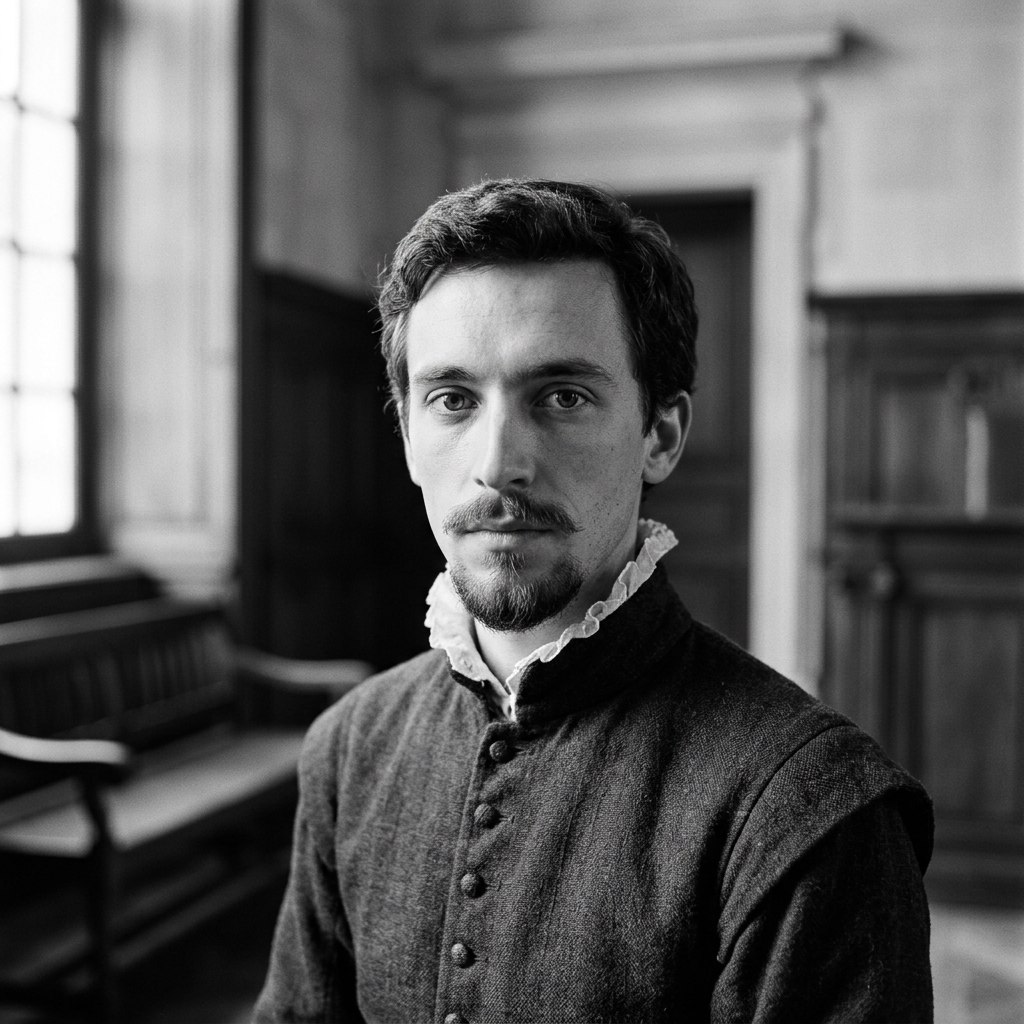
Featured image: Étienne de La Boétie (AI illustration)