In November 1534, a professor of theology in Salamanca wrote to a fellow friar of his order, Miguel de Arcos. The conquerors of Peru and their advocates were justifying their actions against the Inca, and the professor was unwilling to go along with them. Not even for the archbishopric of Toledo, vacant at the time, he wrote in effect, would he vouch for the innocence of these conquerors. The best-known sentence of the letter reads: “I do not understand the justice of the war.”
In January 1539, Francisco de Vitoria presented to the assembled university what he had been thinking through ever since. His lecture De Indis examined the claims of the Spanish Crown point by point and opened with a question that was far from obvious at the time: Did the land in America not already belong to someone?
At a glance
- Life: born around 1483, probably in Burgos (year and place are uncertain); died August 12, 1546, in Salamanca
- Work: Dominican; studied and taught in Paris; from 1526 holder of the first chair of theology at the University of Salamanca
- Major works: Relectiones, including De potestate civili (1528), De Indis and De iure belli (both 1539), printed only after his death (Lyon 1557)
- In one sentence: He grounded property and dominion in human nature rather than in faith and tied every war to a wrong suffered.
From the Convent in Burgos to the Chair in Salamanca
Vitoria entered the Dominican convent of San Pablo in Burgos as a young man and around 1508 went to the College of Saint-Jacques in Paris. There he studied under the Thomist Peter Crockaert, whose commentary on the Summa of Thomas Aquinas he saw through the press in 1512. He spent some fifteen years in Paris as a student and teacher before moving in 1523 to the Colegio de San Gregorio in Valladolid and winning, in 1526, the first chair of theology at Salamanca, the Prima, which he held until his death.
Vitoria himself published next to nothing; what survives are notes taken by his students and the Relectiones, solemn lectures delivered before the whole university. His student Melchor Cano called him a renewer of sacred theology, and Vitoria is regarded as the founder of the tradition known today as the School of Salamanca.
The King, Too, Stands Under the Law
As early as 1528, in the lecture De potestate civili on civil power, Vitoria laid a foundation. For him, the power of the state came from God, but the commonwealth can appoint a king and transfer authority to him. In doing so, Vitoria defended the Spanish monarchy against the republican demands of the Comuneros, who had risen up against Charles V in 1520.
One conclusion he drew explicitly is remarkable: the king’s laws bind the king himself. He compared this to a contract: one is free to decide whether to enter into it, but once one has, one is no longer free to decide whether to be bound by it. A law contrary to the common good would, in his view, be no law at all, and in this idea of a government that is itself subject to law one can see an early building block of the rule of law.
The Inhabitants of America as True Owners
De Indis first asks whether the native inhabitants, before the arrival of the Spaniards, were true masters of their lands and goods, in public as well as in private law, and Vitoria answers with a clear yes. Neither their unbelief nor grave sins deprive them of their property, for dominion over things rests on the rational nature of man and not on grace. He disputes the claim that they lacked reason by pointing to their way of life: in their own fashion they have ordered commonwealths, marriage, authorities, laws, workshops, and barter, and all of this presupposes the use of reason.
Nor does the Aristotelian doctrine of “slaves by nature” justify expropriation: Aristotle, he argues, does not mean civil slavery and does not permit taking their inheritance from the weaker or selling them; at most, a certain right to guide them could be derived from it, a point he returns to later. It would be harsh, he concludes, to deny people who have never done any wrong what is granted even to Saracens and Jews.
Seven Justifications That Do Not Hold
Vitoria rejects seven common justifications of Spanish rule. The emperor is not lord of the whole world. Neither is the pope, and he has no temporal power over the Indians or other unbelievers. Discovery confers a right only to ownerless land, and this land had owners; taken by itself, it entitles the Spaniards no more than it would have entitled the Indians had they discovered Spain.
Nor does a refusal to accept the Christian faith justify war, and the same holds for the sins of the Indians. The declarations of submission that the Spaniards obtained on their arrival are invalid, because fear and ignorance in the face of armed strangers rule out any genuine consent. The appeal to a special gift from God, as once in the case of the Canaanites, he dismisses as unproven prophecy.
Eight Grounds He Accepted
Only with the legal titles that Vitoria considers legitimate is his position complete. The first and most important is the right of natural society and communication. Under the law of nations, the ius gentium, meaning what natural reason has established among all nations according to the Roman Institutes, the Spaniards may travel, stay in the land, and trade, as long as they harm no one. “Man,” says Ovid, as Vitoria cites him in this context, “is not a wolf to his fellow man, but a man” (De Indis III, 3). If the natives refuse this communication, the Spaniards must first try to persuade them; only against force may they defend themselves and, after suffering a wrong, wage war on the orders of their prince. If the Indians attack merely out of understandable fear of armed strangers, they are, according to Vitoria, innocent, and the Spaniards may then defend themselves only with the least possible harm to them. If, on the other hand, the natives remain persistently hostile despite every effort, he allows all the rights of war: plunder, captivity up to enslavement, the deposition of their rulers, always in proportion to the wrong suffered and without invented pretexts for war.
The second title is the right to preach the Gospel. Those who freely allow preaching may be neither attacked nor dispossessed, whether they accept the faith or not; those who prevent it by force may be compelled. Third, the Spaniards may protect baptized Indians whom their rulers try to force back to the old worship. Fourth, if a large part of a people has become Christian, the pope could, for reasonable cause, give it a Christian prince and depose the unbelieving rulers. Fifth, it is permitted to rescue innocents from tyrannical rule, for example from human sacrifice. Sixth, a true and voluntary choice counts, and seventh, aid to allies in their just war, as the Tlaxcalans are said to have requested against the Mexica.
Vitoria expressly offers the eighth title only with hesitation. If the Indians really were as incapable of governing themselves as reports claimed, the Spanish rulers could take over their administration for their benefit, just as one cares for minors. He recounts disparaging descriptions to support this, but ties the whole idea to the condition that it serve the welfare of the Indians and not merely the profit of the Spaniards. In the end he notes that trade could continue even without any title, because exchange requires no subjugation. The Crown could levy a duty on the gold and silver brought in, and since many Indians had already been baptized, the king could not simply abandon the administration.
When a War Is Just
In June 1539 came De iure belli, on the law of war. Its central proposition, in substance, is that there is only one just cause for beginning a war, namely a wrong suffered. Differences of religion do not qualify, nor does the expansion of the empire, nor the glory or advantage of the prince. Nor is every wrong enough; its gravity must be proportionate to the war.
Anyone convinced that a war is unjust may not take part in it, even if his prince commands it. Deliberately killing innocents is never permitted, and children, women, peasants, and in general all who do not fight count as innocent unless the contrary is proven. Their death as an unintended side effect he considered acceptable, except where a few guilty can be struck only at the cost of many innocents. On one point Vitoria stayed entirely within the limits of his time: in war against pagans he held it permissible to carry off even women and children into captivity and slavery, whereas among Christians, by the custom of the law of nations, only ransom could be demanded.
In November 1539, Charles V wrote to the prior of San Esteban, the convent where Vitoria lived, and forbade the professors of the house to discuss the subject further or to publish on it; the target was very likely Vitoria. The emperor nevertheless kept asking him for advice, for example in 1541 on the baptism of adult Indians without prior instruction, and Vitoria’s opinion came down on the side of Bartolomé de las Casas.
A Law of Nations
Vitoria conceived of the world as a community of nations under a law that springs from natural reason. Hugo Grotius invoked him, for instance in Mare liberum (1609), where he defended the freedom of maritime trade for all nations, and in De iure belli ac pacis (1625). The American international lawyer James Brown Scott honored Vitoria in 1934 as the founder of modern international law.
Economists have discovered him too. According to Llewellyn Rockwell, who draws on Marjorie Grice-Hutchinson, Vitoria held the just price to be the one that results from the common estimation of buyers and sellers, and he opposed interference in trade between countries. Murray Rothbard and Jesús Huerta de Soto see the Late Scholastics of Salamanca as forerunners of the Austrian School.
Property That Follows from Being Human
For friends of liberty, what matters first is the universality of rights: in Vitoria, property and dominion over what is one’s own follow from the rational nature of man, regardless of faith and of any alleged feeble-mindedness. Anyone who today starts from the self-ownership of every person finds here a related principle, one that a Spanish theologian defended before his own countrymen in the middle of a war of conquest.
Just as clear is his insight that discovery and power do not create property in inhabited land, and his peace rests on free communication: force is permitted only in response to a wrong suffered, even for one’s own emperor.
A Standard for Every Order
At the center of a world empire, Francisco de Vitoria maintained that the subjugated are owners and bearers of rights just like their conquerors. He spoke as a theologian of his time, accepted grounds for war and rule that hardly anyone would share today, and did not want to see the Spanish administration in America abandoned, yet his standard reaches far beyond his time. His question of whether rights apply to everyone, including strangers and people of other faiths, is one that every order appealing to human dignity can put to itself.
Further reading
- Francisco de Vitoria: Vorlesungen (Relectiones). Völkerrecht, Politik, Kirche, ed. by Ulrich Horst, Heinz-Gerhard Justenhoven, and Joachim Stüben, 2 vols., Kohlhammer, Stuttgart 1995/1997 (in German)
- Francisco de Vitoria: Political Writings, ed. by Anthony Pagden and Jeremy Lawrance, Cambridge University Press, Cambridge 1991
- Marjorie Grice-Hutchinson: The School of Salamanca. Readings in Spanish Monetary Theory 1544–1605, Clarendon Press, Oxford 1952
This article is part of our series on thinkers, doers, and historical figures of liberty.
Sources
- Vitoria, Francisco de: Letter to Miguel de Arcos OP, Salamanca, November 8, 1534; in English in: Political Writings (see below), section “Letters.”
- Vitoria, Francisco de: Relectio de potestate civili, Salamanca 1528.
- Vitoria, Francisco de: Relectio de Indis (January 1539) and Relectio de iure belli (June 1539); first collected edition of the Relectiones: Lyon 1557 (Jacques Boyer), then Salamanca 1565.
- Vitoria, Francisco de: De Indis et De iure belli relectiones, ed. by Ernest Nys, translated by John Pawley Bate, Carnegie Institution, Washington 1917 (Classics of International Law); full text: https://constitution.org/2-Authors/victoria/victoria.txt
- Vitoria, Francisco de: Political Writings, ed. by Anthony Pagden and Jeremy Lawrance, Cambridge University Press, Cambridge 1991.
- Vitoria, Francisco de: Vorlesungen (Relectiones). Völkerrecht, Politik, Kirche, ed. by Ulrich Horst, Heinz-Gerhard Justenhoven, and Joachim Stüben, 2 vols., Kohlhammer, Stuttgart 1995/1997 (in German).
- Grotius, Hugo: Mare liberum, Leiden 1609; De iure belli ac pacis, Paris 1625.
- Nys, Ernest: Introduction to the 1917 edition (biography, the 1541 opinion, reception in Grotius), https://constitution.org/2-Authors/victoria/victoria.txt
- Allemann, Daniel S.: Re-reading Vitoria, in: Rechtsgeschichte (Legal History) (Max Planck Institute for Legal History and Legal Theory), https://rg.lhlt.mpg.de/index.php/rg/article/download/371/2901?inline=1
- Empire and the Right to Preach the Gospel in the School of Salamanca, 1535–1560, in: The Historical Journal, Cambridge University Press, https://cambridge.org/core/journals/historical-journal/article/empire-and-the-right-to-preach-the-gospel-in-the-school-of-salamanca-15351560/7050976189124BB63EBAC05110F49DA5
- Routledge Encyclopedia of Philosophy: Vitoria, Francisco de (c.1486–1546), https://www.rep.routledge.com/articles/biographical/vitoria-francisco-de-c-1486-1546/v-1
- Encyclopaedia Britannica: Francisco de Vitoria, https://www.britannica.com/biography/Francisco-de-Vitoria
- Encyclopedia of Medieval Philosophy (Springer): Francisco de Vitoria, https://dx.doi.org/10.1007/978-1-4020-9729-4_175
- Springer chapter on De potestate civili (laws bind the king), https://rd.springer.com/chapter/10.1007/978-3-319-62998-8_3
- Revista de Filosofía (Universidad del Zulia): article on Vitoria and the Cátedra de Prima of 1526, https://produccioncientifica.luz.edu.ve/index.php/filosofia/article/download/18005/17994
- Correspondencia inédita entre Juan Ginés de Sepúlveda y Miguel de Arcos (on the Arcos letter), https://ihtc.orex.es/3453.pdf
- Scott, James Brown: The Spanish Origin of International Law. Francisco de Vitoria and His Law of Nations, Clarendon Press, Oxford 1934.
- Grice-Hutchinson, Marjorie: The School of Salamanca. Readings in Spanish Monetary Theory 1544–1605, Clarendon Press, Oxford 1952.
- Rothbard, Murray N.: Economic Thought Before Adam Smith, Edward Elgar, Aldershot 1995.
- Huerta de Soto, Jesús: The Austrian School. Market Order and Entrepreneurial Creativity, Edward Elgar, Cheltenham 2008.
- Rockwell, Llewellyn H. Jr.: The True Founders of Economics: The School of Salamanca (The Freeman 1995, Mises Wire 2018), https://mises.org/mises-wire/true-founders-economics-school-salamanca
- Wikipedia (en): Francisco de Vitoria (starting point only), https://en.wikipedia.org/wiki/Francisco_de_Vitoria
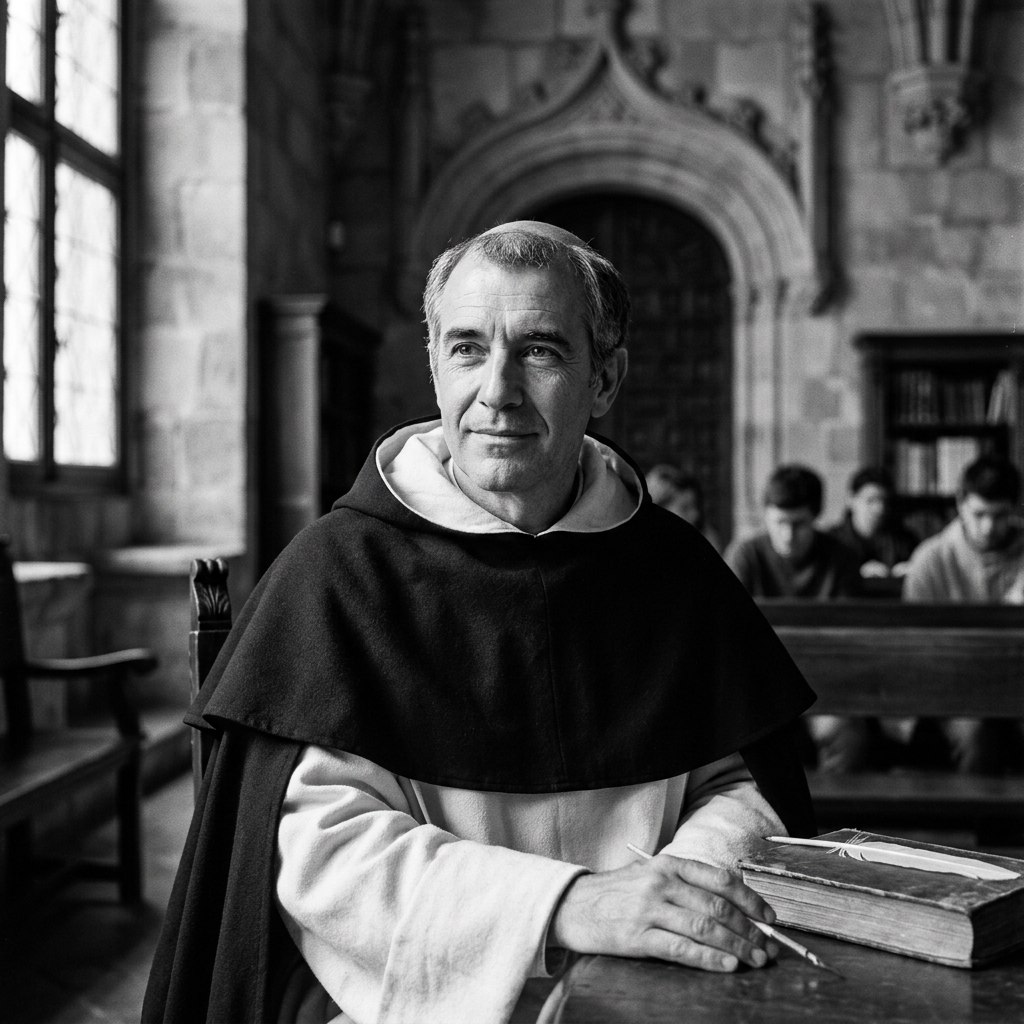
Featured image: Francisco de Vitoria (AI illustration)