In 1244 a young friar from southern Italy was traveling north when armed horsemen stopped him near Acquapendente. They were his own brothers, soldiers in the service of Emperor Frederick II, and they were acting on behalf of their mother, Theodora. The family had planned a career for its youngest son at the wealthy Benedictine abbey of Monte Cassino. But in Naples he had joined the Dominicans, a young mendicant order that preached and studied instead of managing land.
Thomas Aquinas was held for at least a year at the family castle of Roccasecca, and then the family gave in. The man who had pushed through his own path in life against his family became one of the most influential theologians of the Middle Ages. He left behind a doctrine of law according to which even a prince’s command is valid only to the extent that it can stand before reason.
At a glance
- Life: born around 1225 near Aquino, between Rome and Naples; died March 7, 1274, at the Cistercian abbey of Fossanova
- Work: Dominican, master of theology in Paris (1256 to 1259 and 1268 to about 1272), teaching in Orvieto and Rome in between, finally in Naples
- Major works: Summa contra gentiles (around 1259 to 1265), Summa theologiae (from 1265, unfinished), De regno (On Kingship, unfinished)
- In one sentence: He gave the West a doctrine of natural law by which every form of rule must be measured.
A mendicant friar with Aristotle in his baggage
Thomas came from a wealthy noble family and spent his childhood at Monte Cassino. After his release he studied in Paris for three years and in 1248 followed Albertus Magnus to Cologne. Later he twice held the Dominican chair of theology at the University of Paris.
His era was just rediscovering the writings of Aristotle, some of which reached the Latin West by way of Arab commentators. Thomas made the pagan philosopher his most important conversation partner and trusted that reason and faith cannot contradict each other. In December 1273 he stopped writing because, as his secretary Reginald of Piperno reported, everything he had written seemed to him like straw. A few months later he died on his way to the Council of Lyon.
What makes a law a law
In the so-called Treatise on Law, questions 90 to 97 of the first part of the second part of the Summa theologiae, Thomas defines law as “an ordinance of reason for the common good, made by him who has care of the community, and promulgated” (I-II q. 90 a. 4), and each element of this definition sets a condition: a command that is unreasonable, serves only a part of the community, or remains hidden does not meet it.
Above human law stands the natural law, which human beings can know through their reason and whose first precept is that good is to be done and evil avoided (q. 94 a. 2). A human law has the force of law only to the extent that it agrees with the natural law. Thomas cites Augustine here, for whom “that which is not just seems to be no law at all,” and concludes: “if in any point it deflects from the law of nature, it is no longer a law but a perversion of law” (q. 95 a. 2). The later shorthand “An unjust law is no law” captures the sense of this, but those exact words do not appear in his writings.
According to Thomas, a law is unjust, for example, when the ruler imposes burdens that serve his greed or his glory rather than the common good, when he exceeds his authority, or when he distributes burdens unequally. Such laws, Thomas writes, “are acts of violence rather than laws” and do not bind the conscience, unless one obeys them in order to avoid scandal or disturbance (q. 96 a. 4). This is no license for disobedience, but it is a standard before which even the lawgiver must justify himself.
Not every sin belongs before a judge
From a medieval theologian one hardly expects the question: Should human law suppress all vices? Thomas answers no, on the grounds that law is made for a multitude of people, most of whom are not perfectly virtuous (q. 96 a. 2). It should therefore forbid only the more serious vices, from which the majority can abstain, and above all those that harm others and without whose prohibition society could not be maintained, such as murder and theft. Demanding too much of the imperfect, he argues, only leads them to despise the precepts.
In this way Thomas separates what is morally wrong from what the authorities should punish. He bases this on prudence and knowledge of human nature; a right of the individual to live his own life undisturbed was formulated only by later liberals. But the distinction itself is there, and anyone who asks today whether a prohibition protects someone from harm or merely seeks to enforce a virtue is asking a Thomistic question.
This restraint, however, did not extend to matters of faith. According to Thomas, unbelievers who had never accepted the Christian faith were on no account to be compelled to believe, because belief is a matter of the will (II-II q. 10 a. 8). He expressly rejected baptizing the children of Jews against their parents’ will (q. 10 a. 12). But anyone who had once accepted the faith and then, as a heretic, obstinately rejected it was, after being admonished twice by the Church, to be handed over to the secular power and put to death. Thomas justifies this with a comparison: if forgers of money are condemned to death, then all the more so those who corrupt the faith, which gives life to the soul (q. 11 a. 3). In this he was in line with the law of his time, and he knew nothing of freedom of conscience in today’s sense.
When the ruler is the rebel
For Thomas, obedience is owed to the lawful order, not to everyone who wields power. Tyrannical rule is unjust because it serves the ruler’s advantage rather than the common good. Whoever disturbs it is therefore not guilty of sedition, unless the disturbance does greater harm than the tyranny itself. The one truly guilty of sedition, Thomas says, is the tyrant (II-II q. 42 a. 2 ad 3).
In his unfinished treatise on kingship, he calls the rule of a tyrant the worst of all forms of government (De regno I, 4). His advice is cautious: a moderate tyranny should, for a time, rather be endured, and action against a tyrant should come not from the private presumption of individuals but from public authority. But where a people has the right to provide itself with a king, it is not unjust for it to depose him or to restrict his power, and in doing so it does not act unfaithfully (I, 7). Even monarchy, which he considered the best constitution, thus remains bound by law and may be limited.
Property as an order of peace
Thomas defends private property with three reasons, all drawn from the observation of human behavior (II-II q. 66 a. 2). Everyone takes more care of what belongs to him alone than of what is common to all. Human affairs are conducted in a more orderly way when each person is responsible for particular things. And peace is better preserved when everyone is content with what is his, whereas quarrels arise more often where possessions are held in common.
For Thomas, the division of goods is an institution of human reason that supplements natural law but is not prescribed by it (a. 2 ad 1). In their use, the owner should regard his goods as common, that is, be ready to give from them to those in need. In urgent, evident need that cannot be averted in any other way, it is not theft to help oneself to another’s property (a. 7). Thomas thus does not formulate a right to property in John Locke’s sense. But he justifies property as a reasonable order that fosters care, responsibility, and peace, and he regards theft and robbery as grave offenses against justice. He also held slavery to be compatible with the law of nations, which grounded it in usefulness rather than in natural reason (q. 57 a. 3 ad 2).
What makes a price just
When they hear “just price,” many people think of prices that medieval monks wanted to set from above. Thomas does hold that it is unjust to sell a thing for more, or buy it for less, than it is worth. But the just price, he says, is not fixed with precision; it rests on a kind of estimate, and slight deviations do not destroy justice (II-II q. 77 a. 1). In 1958 the economic historian Raymond de Roover concluded that the Scholastics mostly understood the just price to be the price that forms on the open market without fraud or coercion.
In a case already discussed by Cicero, a merchant brings wheat to a region where it is scarce and expensive, knowing that other merchants will soon follow. Must he say so? According to Thomas, he does not act against justice if he sells at the price offered and keeps silent; it would, however, be very virtuous to inform the buyers or to lower the price (q. 77 a. 3 ad 4). He regarded trade itself with mixed feelings, because the desire for gain knows no limit. But a profit is permitted if it serves the upkeep of one’s household, the needy, or the public good, or is sought as payment for one’s labor (q. 77 a. 4). Interest on loans of money, by contrast, he condemned as usury, because the use of money cannot be sold separately from the money itself (q. 78 a. 1).
A legacy carried forward
The late Scholastics of Salamanca lectured on the Summa theologiae, and on that basis Francisco de Vitoria in 1539 affirmed that the native peoples of the Americas, too, held property. In 1877 Lord Acton found in Thomas the earliest exposition of the Whig theory of revolution, but he relied on a loose compilation that does not appear in this form in Thomas’s writings.
In The Ethics of Liberty (1982), Murray Rothbard drew on the Thomistic framework to ground an ethics in human nature. At the same time, he faulted classical natural law theory for having placed the state rather than the individual at the center, and he recast it as a theory of individual rights. In 1980, with Natural Law and Natural Rights, John Finnis renewed natural law in the Thomistic tradition.
A standard above the lawgiver
Thomas Aquinas was a man of the 13th century who considered monarchy the best constitution, prohibited interest, and wanted obstinate heretics handed over to the executioner. He was no champion of individual rights. But he impressed upon the West the conviction that there is a law accessible to reason that no ruler can change at will. Anyone today who judges a law by whether it serves the common good or merely the ambition of those who govern, whether it prevents harm or seeks to enforce virtue, is using distinctions that Thomas sharpened. How much virtue a law may demand before it becomes violence itself is a question he did not answer once and for all, but he posed it in such a way that the philosophy of law has not been able to evade it since.
Further reading
- Thomas Aquinas: Summa theologiae, I-II q. 90–97 (Treatise on Law), Latin and German in the Deutsche Thomas-Ausgabe, vol. 13 (in German)
- Thomas Aquinas: Über die Herrschaft der Fürsten (De regno), translated by Friedrich Schreyvogl, Reclam (in German)
- Jean-Pierre Torrell: Magister Thomas. Leben und Werk des Thomas von Aquin, Herder 1995 (in German; in English: Saint Thomas Aquinas, vol. 1: The Person and His Work, Catholic University of America Press 1996)
- John Finnis: Aquinas. Moral, Political, and Legal Theory, Oxford University Press 1998
This article is part of our series on thinkers, doers, and historical figures of liberty.
Sources
- Thomas Aquinas: Summa theologiae, I-II q. 90–97 (Treatise on Law); II-II q. 10–11 (unbelief, heresy), q. 42 (sedition), q. 57 (right), q. 66 (property, theft), q. 77–78 (buying and selling, usury). Latin text: Corpus Thomisticum, https://www.corpusthomisticum.org/sth2090.html, https://www.corpusthomisticum.org/sth2094.html, https://www.corpusthomisticum.org/sth2095.html
- Thomas Aquinas: Summa Theologica, translated by the Fathers of the English Dominican Province, 2nd edition 1920, online edition New Advent, https://www.newadvent.org/summa/
- Thomas Aquinas: Die Deutsche Thomas-Ausgabe, Latin and German, vol. 13 (Das Gesetz) and vol. 18 (Recht und Gerechtigkeit), Pustet/Styria, Salzburg and Graz 1933 ff. (in German)
- Thomas Aquinas: On Kingship (De regno ad regem Cypri), translated by Gerald B. Phelan, revised by I. Th. Eschmann, ed. Joseph Kenny, https://isidore.co/aquinas/english/DeRegno.htm; in German: Über die Herrschaft der Fürsten, translated by Friedrich Schreyvogl, Reclam, Stuttgart 1971.
- Stanford Encyclopedia of Philosophy: “Thomas Aquinas” (2022), https://plato.stanford.edu/entries/aquinas/
- Catholic Encyclopedia (1912): “St. Thomas Aquinas”, https://www.newadvent.org/cathen/14663b.htm
- Torrell, Jean-Pierre: Magister Thomas. Leben und Werk des Thomas von Aquin, Herder, Freiburg 1995 (in German; in English: Saint Thomas Aquinas, vol. 1: The Person and His Work, Catholic University of America Press, Washington, DC, 1996).
- de Roover, Raymond: “The Concept of the Just Price: Theory and Economic Policy,” Journal of Economic History 18 (1958), pp. 418–434.
- Acton, Lord (John Emerich Edward Dalberg-Acton): “The History of Freedom in Christianity” (1877), in The History of Freedom and Other Essays, Macmillan, London 1907, https://www.gutenberg.org/ebooks/31278
- Craycraft, Kenneth: “Was Aquinas a Whig? St. Thomas on Regime,” https://www.ewtn.com/catholicism/library/was-aquinas-a-whig-st-thomas-on-regime-1211
- Rothbard, Murray N.: The Ethics of Liberty, Humanities Press, Atlantic Highlands 1982.
- Rothbard, Murray N.: Economic Thought Before Adam Smith, Edward Elgar, Aldershot 1995.
- Finnis, John: Natural Law and Natural Rights, Clarendon Press, Oxford 1980.
- Finnis, John: Aquinas. Moral, Political, and Legal Theory, Oxford University Press, Oxford 1998.
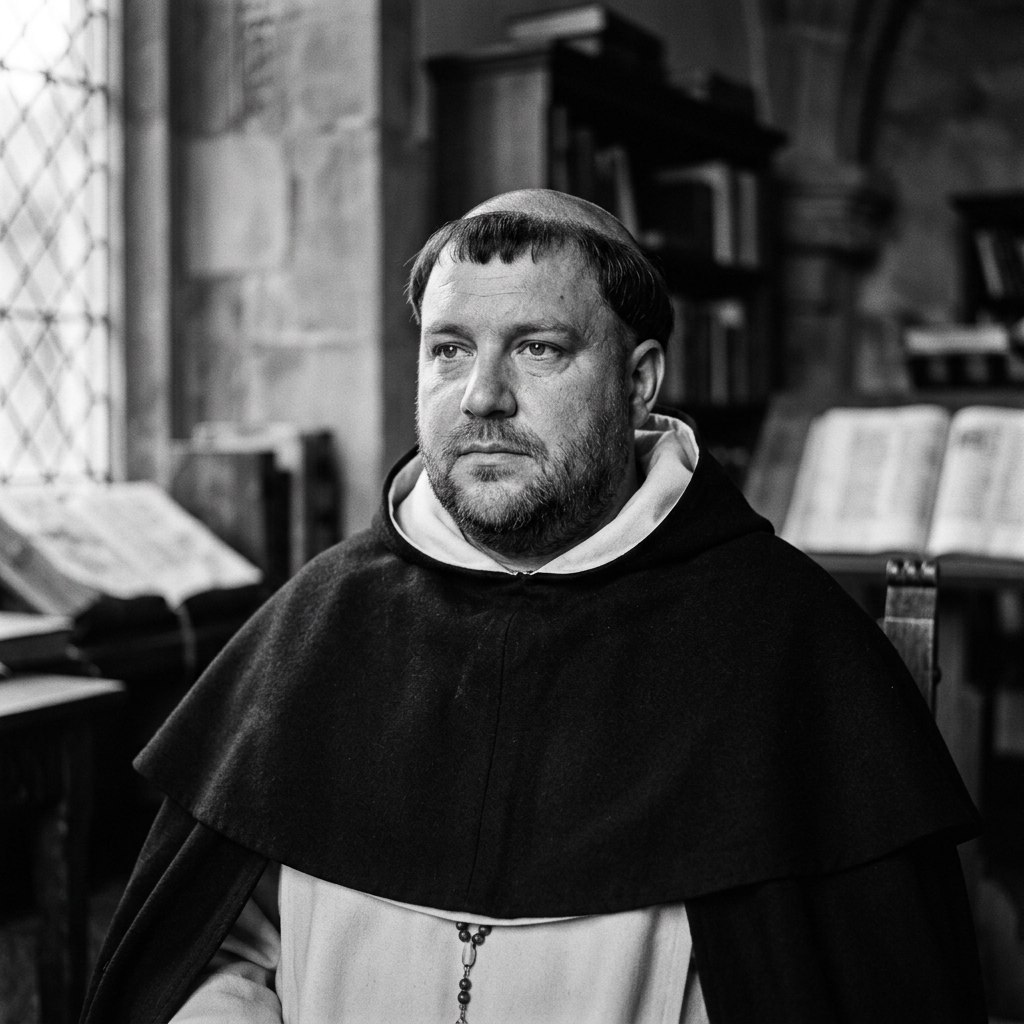
Featured image: Thomas Aquinas (AI illustration)