On August 20, 1672, an enraged mob in The Hague lynched Johan de Witt, the longtime leading statesman of the Dutch Republic, and his brother Cornelis. The Republic was at war, and French troops had invaded the country. In the same city, a quiet scholar lived in rented lodgings, and he wanted to put up a placard at the scene of the crime. It was to bear two Latin words: Ultimi barbarorum, the most extreme of barbarians. His landlord would not let him leave the house and so kept him from becoming a victim of the mob himself.
The scholar was Baruch de Spinoza, and we know of the episode because four years later he told it to Gottfried Wilhelm Leibniz, who wrote it down. Two years before the murder, Spinoza had published a book without his name that declared liberty of thought and speech a condition of a peaceful commonwealth. What happened on that August day showed him how fragile this liberty was.
At a glance
- Life: November 24, 1632, in Amsterdam to February 21, 1677, in The Hague
- Work: Philosopher, earned his living in part by grinding optical lenses, declined a professorship at Heidelberg in 1673
- Major works: Tractatus theologico-politicus (1670, anonymous), Ethics (1677, posthumous), Tractatus politicus (unfinished, posthumous 1677)
- In one sentence: He argued that no state can govern the thoughts of its citizens and that a commonwealth that lets them think freely is more peaceful and more prosperous than one that forces them into silence.
A merchant’s son leaves his community
Spinoza grew up in Amsterdam’s community of Portuguese Jews, whose families had come from Portugal and Spain to escape the Inquisition. His father, Michael, was a respected merchant with an import business. At seventeen the son left school to work in the business, and after his father’s death in 1654 he ran it for a time with his brother Gabriel. At the same time he arrived at views about God, the soul, and Scripture that his community was not willing to accept.
On July 27, 1656, the community’s governing board placed him under a ban, the harshest it ever pronounced, and it was never lifted. No one was allowed to speak or write to him, stay under the same roof with him, come within four cubits of him, or read anything he had written. Spinoza was 23 years old at the time. Around 1660 he moved away from Amsterdam, first to Rijnsburg near Leiden, in 1663 to Voorburg, and finally to The Hague.
He lived modestly; grinding optical lenses brought him an income and also suited his interest in natural science. When his friend Simon de Vries wanted to give him 2,000 guilders, he declined, and when de Vries wanted to make him his heir, Spinoza insisted that the fortune go to de Vries’s brother. From the inheritance he was to receive an annual pension of 500 guilders; he had it reduced to 300 guilders because that was enough for him to live on.
A book with a false imprint
Spinoza named the impetus for his major political work in a letter of 1665 to Henry Oldenburg, the secretary of the Royal Society in London. In essence, he wrote that he wanted to oppose the prejudices of the theologians, defend himself against the charge of atheism, and defend the liberty to philosophize and to say what one thinks, which was threatened by the excessive power of the preachers.
How justified this concern was soon became clear from the fate of a friend from his Amsterdam circle. In 1668 Adriaan Koerbagh published Een Bloemhof, a work critical of religion, under a pseudonym; he was sentenced to ten years in prison and died in the Amsterdam house of correction in October 1669.
The Theological-Political Treatise appeared in 1670 without the author’s name. The title page gave Hamburg as the place of printing; in fact the book was printed by Jan Rieuwertsz in Amsterdam. The subtitle alone announced the program: the liberty to philosophize could be granted without harm to piety and to the peace of the commonwealth, and whoever abolished it would abolish both along with it. One contemporary critic called it a book forged in hell by the devil himself. In July 1674 the Court of Holland banned the treatise together with Thomas Hobbes’s Leviathan and two other works, but the book remained available, including in translation.
The Bible as a human work
Spinoza devotes a large part of the treatise to the Bible. He read it as a collection of historical texts, written by people of their own time with the ideas of that time. Moses, in his view, was not the author of the five books that bear his name; the prophets had been distinguished by a vivid imagination rather than by superior knowledge; and Scripture aimed above all to teach obedience and love of one’s neighbor, not philosophy. It followed that theology and philosophy are separate domains and that no one has the right to dictate the thinking of others in the name of Scripture. Because of this method, Spinoza is regarded as one of the founders of historical-critical biblical scholarship.
In the Ethics, which appeared only after his death, he equated God with nature, in the preface to Part Four with the terse phrase “God or Nature.” Many already regarded him as an atheist during his lifetime.
Thoughts cannot be commanded
The twentieth and final chapter of the treatise bears a heading that echoes a sentence by the Roman historian Tacitus: in a free state, everyone may think what he likes and say what he thinks. Spinoza’s reasoning is sober. If people’s minds were as easy to control as their tongues, he writes at the very beginning, every king would sit safely on his throne. But no one can transfer his right to judge freely to someone else, even if he wanted to, and everyone is, in the English translation by R. H. M. Elwes, “by indefeasible natural right the master of his own thoughts.”
A state that tries to prescribe what is to count as true therefore demands the impossible. All it achieves is that people say something other than what they think, and it fosters flattery and faithlessness. The greedy and the flatterers, who think only of their own advantage, readily comply; resistance comes precisely from those whom a good upbringing and virtue have made freer. Laws against opinions, as Elwes renders it, “affect the generous minded rather than the wicked.” There is hardly a greater misfortune for a state, he writes, than when honorable people are sent into exile like criminals merely because they hold views they cannot hide.
What the state is for
From this follows the most famous idea of the book. The ultimate purpose of the state, Spinoza writes, is not to rule or to keep people in check through fear. It should free everyone from fear, so that each can live as securely as possible and preserve his natural right to exist and to act without harm to himself or others. It must not turn people into beasts or automatons and should allow them to use their reason freely. From this Spinoza draws the conclusion: “In fact, the true aim of government is liberty” (chapter 20, in Elwes’s translation).
For him, therefore, the best form of government is democracy, which he calls in chapter 16 the most natural form and the one most compatible with the liberty of the individual. In it, no one transfers his right so completely that he no longer has a say, and all remain equals, as they were in the state of nature.
Spinoza builds this doctrine on a different foundation from that of the later natural-rights liberals. For him, the right of every being extends as far as its power, and the state, too, rests on the combined power of its citizens. Consistently, he demands obedience in action: whoever considers a law unreasonable may say so and campaign for its repeal, but should obey it as long as it is in force. He lets the authorities determine the outward forms of religion, while inner piety remains free. Precisely because he reasons so soberly in terms of power and advantage, his conclusion carries great weight: even a state that cares only about its own stability does best when it leaves thought free.
Where no one asks about faith
As proof, Spinoza points to his hometown. Amsterdam, he writes, reaps the fruits of this liberty in its great prosperity and in the admiration of all nations. In this flourishing city, people of every nation and every religion live together in the greatest harmony. Before entrusting their goods to someone, people ask only whether he is rich or poor and whether he usually deals honestly; no one asks about religion or creed, and in court these play no role.
A life in keeping with his teaching
How seriously Spinoza took his own freedom became clear in 1673. On behalf of the Elector Palatine Karl Ludwig, the Heidelberg professor Johann Ludwig Fabritius offered him a chair in philosophy, with the assurance of the fullest liberty to philosophize, provided he did not use it to disturb the publicly established religion. Spinoza thanked him and declined on March 30, 1673. The duty of teaching young people would hinder his own work, he wrote, and he did not know within what limits that liberty would have to be kept in order not to disturb religion.
He died on February 21, 1677, at the age of 44, probably of a lung disease that the glass dust from grinding lenses may have aggravated. That same year his friends published his posthumous works, working in secret so that the manuscripts would not be confiscated.
What friends of liberty can learn from him
The most important lesson is the simplest: a government can compel actions, but not judgment. Anyone who tries anyway breeds hypocrites and drives precisely the sincere into opposition.
Just as valuable is the way he argues. Spinoza shows those in power that liberty of thought is in their own interest, because a republic that lets its citizens think freely is more peaceful and more prosperous.
Finally, his life shows that independence is also a matter of how one lives. The historian Jonathan Israel placed him at the center of a radical Enlightenment in Radical Enlightenment (2001), and in 1997 the political scientist Steven B. Smith interpreted him as a forerunner of liberalism.
To think what one likes
As an outcast, without office and without powerful patrons, Spinoza wrote one of the clearest justifications of liberty of thought. He did so without pathos, with arguments that even a suspicious ruler can check, and he paid for it with a life on the margins. The heading of his last chapter describes a good fortune that Tacitus already considered rare: to be allowed to think what one likes and to say what one thinks.
Further reading
- Baruch de Spinoza: Theologisch-politischer Traktat, translated by Carl Gebhardt, edited by Günter Gawlick, Felix Meiner Verlag, Hamburg 1994 (in German); in English: Theological-Political Treatise
- Baruch de Spinoza: Politischer Traktat, translated by Wolfgang Bartuschat, Felix Meiner Verlag, Hamburg 2010 (in German); in English: Political Treatise
- Steven Nadler: Spinoza. A Life, Cambridge University Press, Cambridge 1999 (2nd edition 2018)
- Steven Nadler: A Book Forged in Hell. Spinoza’s Scandalous Treatise and the Birth of the Secular Age, Princeton University Press, Princeton 2011
This article is part of our series on thinkers, doers, and historical figures of liberty.
Sources
- Spinoza, Baruch de: Tractatus theologico-politicus, Amsterdam: Jan Rieuwertsz 1670 (title page with the fictitious imprint “Hamburgi, apud Henricum Künraht”), esp. chs. 16, 19, 20; digitized copy: https://rp-digitalcollections.nypl.org/items/45e8cad0-a449-0134-43c6-00505686a51c
- Spinoza, Baruch de: A Theologico-Political Treatise, translated by R. H. M. Elwes, London 1883; Project Gutenberg #989 to #992, https://www.gutenberg.org/ebooks/992
- Spinoza, Baruch de: Theologisch-politischer Traktat, translated by Carl Gebhardt, ed. Günter Gawlick, Felix Meiner Verlag, Hamburg 1994 (in German).
- Spinoza, Baruch de: Ethik in geometrischer Ordnung dargestellt, translated by Wolfgang Bartuschat, Felix Meiner Verlag, Hamburg 2007 (in German; Part IV, preface).
- Spinoza, Baruch de: Politischer Traktat, translated by Wolfgang Bartuschat, Felix Meiner Verlag, Hamburg 2010 (in German; ch. 11).
- Spinoza, Baruch de: Letters 30 (to Oldenburg, 1665), 47 (Fabritius to Spinoza, February 16, 1673), and 48 (to Fabritius, March 30, 1673); Letters 47/48: https://spinozaweb.org/letters/82 and https://spinozaweb.org/letters/83
- Herem against Spinoza of July 27, 1656, English translation: https://web.mnstate.edu/mouch/spinoza/excomm.html
- Freudenthal, Jakob: Die Lebensgeschichte Spinoza’s in Quellenschriften, Urkunden und nichtamtlichen Nachrichten, Leipzig 1899 (in German; includes Leibniz’s note on “Ultimi barbarorum” and Colerus’s biography of 1705).
- Nadler, Steven: “Baruch Spinoza,” Stanford Encyclopedia of Philosophy, https://plato.stanford.edu/entries/spinoza/
- Steinberg, Justin: “Spinoza’s Political Philosophy,” Stanford Encyclopedia of Philosophy, https://plato.stanford.edu/entries/spinoza-political/
- Nadler, Steven: Spinoza. A Life, Cambridge University Press, Cambridge 1999 (2nd ed. 2018).
- Nadler, Steven: A Book Forged in Hell. Spinoza’s Scandalous Treatise and the Birth of the Secular Age, Princeton University Press, Princeton 2011.
- Nadler, Steven: “Why Spinoza Was Excommunicated,” https://brewminate.com/why-spinoza-was-excommunicated/
- Israel, Jonathan: Radical Enlightenment. Philosophy and the Making of Modernity 1650–1750, Oxford University Press, Oxford 2001.
- Smith, Steven B.: Spinoza, Liberalism, and the Question of Jewish Identity, Yale University Press, New Haven 1997.
- Encyclopaedia Britannica, 11th ed. 1911, article “Spinoza” (pension from the de Vries inheritance), https://kwx.liehendr.com/content/wikisource_en_all_maxi_2022-09/A/Page%3AEB1911_-_Volume_25.djvu/711
- Cambridge Spinoza Lexicon: “De Vries, Simon,” https://www.cambridge.org/core/books/cambridge-spinoza-lexicon/de-vries-simon-1633341667/043D644AA0941F442C48472D0442272B
- Ban on the treatise by the Court of Holland, July 1674: https://www.abrahamicstudyhall.org/e-learning-en/theology-philosophy/tractatus-theologico-politicus-spinoza/ and https://spinozaweb.org/people/350
- Adriaan Koerbagh: https://en.wikipedia.org/wiki/Adriaan_Koerbagh and https://dbnl.org/tekst/bork001nede01_01/bork001nede01_01_0716.php
- Wikipedia (English): Baruch Spinoza, https://en.wikipedia.org/wiki/Baruch_Spinoza (starting point; dates, places of residence, cause of death according to Nadler and Gullan-Whur)
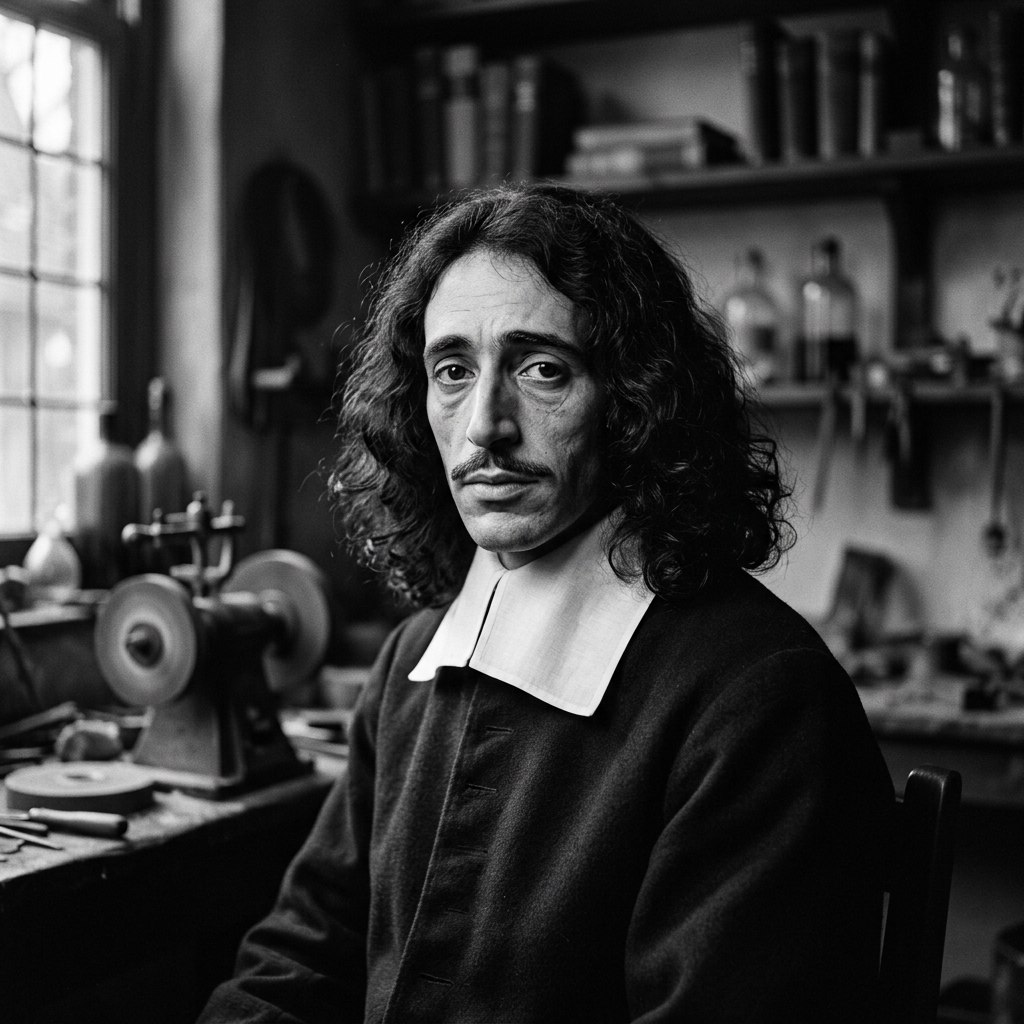
Featured image: Baruch Spinoza (AI illustration)