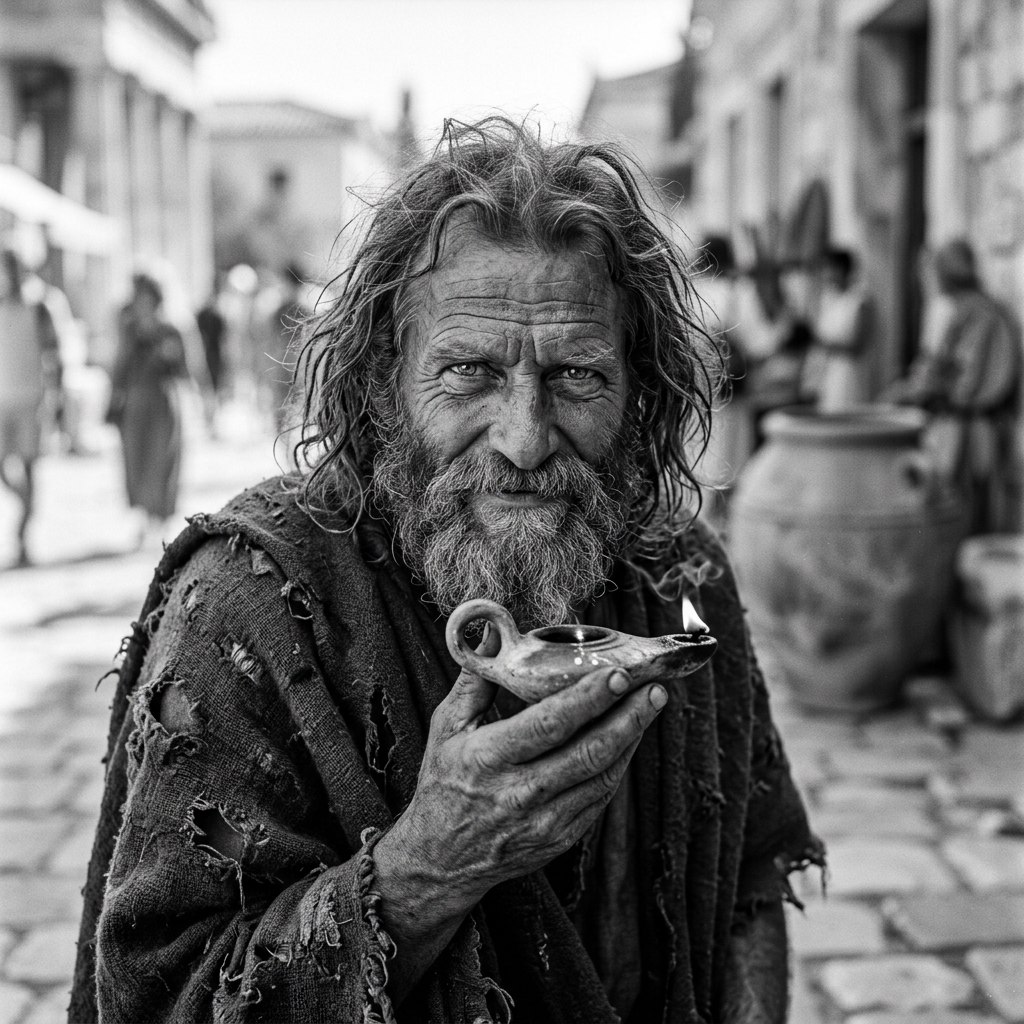
In Corinth, as tradition has it, the young Alexander of Macedon visited an old man who was lying in the sun. Alexander had just taken command of the Greek campaign against Persia, and many of the city’s philosophers had come to wish him well. One had stayed away. Alexander stood before him and asked whether there was any wish he could grant him. The old man replied that Alexander might step a little out of his sun.
The scene appears in Plutarch and in Diogenes Laertius, a biographer of the third century AD, and no one knows whether it really happened that way. It has been told for more than two thousand years because it says something true about its hero. Diogenes of Sinope left behind no theory of the state and no doctrine of property. He demonstrated that a person who desires nothing can stand tall even before the most powerful ruler of his time, and in doing so he gave the idea of liberty one of its oldest thoughts.
At a glance
- Life: c. 410 to c. 323 BC (accounts vary), born in Sinope on the Black Sea, died in Corinth
- Work: philosopher in Athens and Corinth, the archetype of the Cynics
- Writings: none survive; whether he wrote anything at all was already disputed in antiquity
- Main source: Diogenes Laertius, Lives of Eminent Philosophers, Book VI
- In one sentence: He showed by his own life that freedom begins with independence from the expectations of others.
An Exile from Sinope
Almost everything we know about Diogenes comes from the sixth book of Diogenes Laertius, written some 550 years after his death and drawing on older, often contradictory sources. It is best read as a collection of stories that circulated about him; some may be invented, but together they form a coherent picture.
What is certain is that Diogenes came from Sinope, a Greek colony on the southern coast of the Black Sea. According to Laertius, his father Hicesius was a money changer. Tradition holds that Diogenes had to leave the city because its coinage had been adulterated; one source blames the father, another the son. Coin finds have confirmed that coins were indeed tampered with in Sinope; who did it and why remains an open question.
In Athens he is said to have joined Antisthenes, a pupil of Socrates, but scholars today doubt that the two ever met, because their dates hardly fit together. All that is attested is that Diogenes came to Athens and led a life there that caused a stir.
The famous tub was in fact a pithos, a large earthenware storage jar for wine, grain, or oil. According to Laertius, Diogenes slept in it at the Metroon, the sanctuary of the Mother of the Gods, and hardened himself against heat and cold. The wooden barrel of the picture books came only later. One day he is said to have been captured by pirates and sold as a slave, according to Laertius on Crete; some scholars consider the episode invented. Asked what he could do, he reportedly answered that he knew how to govern men and pointed to a buyer who needed a master. This buyer, the Corinthian Xeniades, made him the tutor of his sons. Diogenes died in Corinth at a great age, according to Laertius nearly ninety, and supposedly on the same day that Alexander died in Babylon.
Restamping the Currency
One version of the exile story includes an oracle: Apollo at Delphi had permitted Diogenes to restamp the currency. The Greek word nomisma means coin and, at the same time, whatever is valid by custom. Whether the oracle was ever actually given hardly matters, because it became the motto of his philosophy. Diogenes examined the accepted values of his city like a suspicious money changer and declared many of them counterfeit.
Laertius sums it up by saying that he never granted convention the authority he granted to nature. He mocked noble birth and fame as showy ornaments of vice, and he called the love of money the mother city of all evils. His movement took its name from the Greek word for “doglike.” Diogenes embraced the taunt and turned it into a program. He did everything in full public view, ate breakfast in the marketplace, and said of himself that he fawned on those who gave him something, barked at those who gave nothing, and bit the scoundrels.
For friends of liberty, the value of this idea lies in its refusal to be swayed by convention. What everyone does is not right for that reason alone, and what a society considers honorable can be a fetter that no one notices anymore. Diogenes, however, pushed this scrutiny so far that it also claimed institutions free people would not want to do without. A treatise on the state attributed to him called for women and children to be held in common and declared even the eating of human flesh unobjectionable. Whether he meant this seriously or only wanted to expose taboos can no longer be determined; some ancient authors even doubted that he wrote anything at all. Remarkably, Laertius also attributes to him the statement that no community can exist without law.
Those Who Need Nothing Are Hard to Rule
The Cynics called their goal autarky, self-sufficiency. When Diogenes saw a child drinking from its cupped hands, he is said to have thrown away his cup, because a child had outdone him in simplicity. He compared his own way of life to that of Heracles, who had preferred freedom to everything else. To him, freedom meant needing so little that no one could take anything away from him or promise him anything by which to steer him.
A good four hundred years later, the Stoic Epictetus, himself a freed slave, distilled this thought into a formula. In his discourse on freedom he says that Diogenes was free because he had cast off every handle by which a person can be dragged into slavery. He had let everything hang loosely on him, property, body, and homeland, and so no one could gain power over him.
When people talk about liberty today, they usually mean something else, namely rights that protect a person from the grasp of others. Diogenes was interested in the inner side: in the dependence on recognition, comfort, and favor that makes a person compliant long before a ruler has to coerce him. The two belong together. A citizen who will go along with anything for a post, a grant, or a word of praise is easy to govern, no matter what the constitution says.
The limits of this ideal are just as plain to see. Diogenes lived by begging and thus on the labor of others, and he once even asked a statue for alms, in order, as he said, to practice being refused. According to Laertius, he for a time owned a slave named Manes, who ran away from him; Diogenes let him go, remarking that it would be absurd if Manes could live without Diogenes but Diogenes could not live without Manes. An order in which many people grow prosperous together through exchange and the division of labor was not something he had in view. His freedom was that of an individual who withdraws, not a plan for a free society.
Speaking Freely
Asked what was the most beautiful thing among human beings, Diogenes, according to Laertius, answered: free speech. The Greeks called it parrhesia, the frankness to say everything one holds to be true, even to those who can do one harm. In his late lectures, the French philosopher Michel Foucault interpreted the provocations of Diogenes as a form of this parrhesia.
The best-known stories belong here as well. In broad daylight, Diogenes is said to have walked across the marketplace with a lit lamp, explaining that he was looking for a human being. Popular retellings turned the lamp into a lantern, and later versions have him searching for an “honest” man, of which Laertius says nothing. Plato’s remark that Diogenes was a Socrates gone mad also comes down to us through Laertius.
Seen in this light, the request to step out of the sun is more than a piece of impudence. A man who wants nothing from Alexander can tell him what he thinks, and therein lies an insight that reaches into today’s debates about freedom of expression: a right to free speech is of little use if people fall silent of their own accord out of concern for their careers and reputations.
A Citizen of the World
Asked where he came from, Diogenes replied that he was a citizen of the world, in Greek kosmopolites. According to Laertius, he saw the only true state in one that is as wide as the world. At a time when a Greek defined himself through his city and owed it service, that was a bold answer.
In the Stanford Encyclopedia of Philosophy, the philosophers Pauline Kleingeld and Eric Brown read it above all as a rejection. Diogenes denied that he owed Sinope any special service, and beyond that he had little positive to say about a world community. The idea was only worked out by the Stoics, for whom the cosmos was, as it were, a single city of all rational beings. The path there led through Diogenes’ pupil Crates to Zeno of Citium, the founder of the Stoa. From the Stoa, the line runs all the way to Immanuel Kant, who understood human beings as citizens of the earth with rights of their own.
For friends of liberty, the rejection alone is significant. A person does not belong to his city merely because he was born there, and his dignity does not depend on which community he belongs to. Anyone today who stands up for the liberty to settle wherever one wishes and to trade with people across every border can appeal to this early citizen of the world, even though Diogenes himself hardly gave a thought to trade.
What friends of liberty can learn from him
Most important is probably the insight that power feeds on needs. Those who can do without favors, posts, and handouts are hard to steer. If one applies this to the present, which Diogenes himself never did, then every expansion of what the state hands out increases the number of handles by which people can be grabbed. Add to this his habit of examining what is customary before respecting it, and a skepticism toward rank and titles that becomes anyone who wants to limit power.
He is also a teacher of frankness. Diogenes shows that free speech is an attitude before it becomes a right, and that a free society depends on people who say what they think even when it gains them nothing.
The Shadow Cast by Power
Diogenes was not a political thinker, and it would be wrong to declare him a libertarian. He knew nothing of property as the foundation of liberty or of the market as a peaceful order, and some of what is attributed to him no one would defend today. His contribution is older and simpler. He showed that freedom begins with a person who cannot be bought or intimidated, and that such a person can speak to a king as to an equal.
The scene in Corinth is a reminder that even well-meaning power casts a shadow. Alexander came with an offer, and Diogenes only wanted his light back. Whoever accepts the offer of someone powerful stands a little in that person’s shadow from then on, and this answer can still be held up today against every promise a state makes to its citizens.
Further reading
- Diogenes Laertius: Leben und Meinungen berühmter Philosophen, Book VI, translated by Otto Apelt, Meiner, Hamburg (in German); in English: Lives of Eminent Philosophers, translated by R. D. Hicks, Loeb Classical Library
- Epictetus: Discourses, Book IV, Chapter 1, “About Freedom”
- Klaus Döring: Die Kyniker, 2006 (in German)
- Heinrich Niehues-Pröbsting: Der Kynismus des Diogenes und der Begriff des Zynismus, Fink, Munich 1979 (in German)
This article is part of our series on thinkers, doers, and historical figures of liberty.
Sources
- Diogenes Laertius: Leben und Meinungen berühmter Philosophen, Book VI, ch. 2 (§§ 20–81, Diogenes), translated by Otto Apelt, Felix Meiner Verlag, Hamburg (in German); in English: Lives of Eminent Philosophers, translated by R. D. Hicks, Loeb Classical Library, 1925, online: https://en.wikisource.org/wiki/Lives_of_the_Eminent_Philosophers/Book_VI
- Diogenes Laertius: Lives of Eminent Philosophers, Book VII, §§ 2–4 (Zeno and Crates), English translation by Hicks: https://en.wikisource.org/wiki/Lives_of_the_Eminent_Philosophers/Book_VII
- Plutarch: Alexander 14 (the meeting in Corinth), English translation by Bernadotte Perrin, Loeb Classical Library, 1919: https://lexundria.com/plut_alex/14/prr
- Epictetus: Discourses (Diatribai), Book IV, ch. 1, “About Freedom,” English translation by George Long: https://classics.mit.edu/Epictetus/discourses.4.four.html
- Piering, Julie: “Diogenes of Sinope,” Internet Encyclopedia of Philosophy: https://iep.utm.edu/diogenes-of-sinope/
- Kleingeld, Pauline; Brown, Eric: “Cosmopolitanism,” Stanford Encyclopedia of Philosophy (revised 2019): https://plato.stanford.edu/entries/cosmopolitanism/
- Stanford Encyclopedia of Philosophy: “Epictetus”: https://plato.stanford.edu/entries/epictetus/
- Encyclopaedia Britannica: “Diogenes”: https://www.britannica.com/biography/Diogenes-Greek-philosopher
- Wikipedia (in German): “Diogenes von Sinope” (overview, bibliography): https://de.wikipedia.org/wiki/Diogenes_von_Sinope
- Döring, Klaus: “Diogenes aus Sinope,” in: Grundriss der Geschichte der Philosophie. Die Philosophie der Antike, vol. 2/1, Schwabe, Basel 1998, pp. 280–295 (in German)
- Döring, Klaus: Die Kyniker, 2006 (in German)
- Niehues-Pröbsting, Heinrich: Der Kynismus des Diogenes und der Begriff des Zynismus, Fink, Munich 1979 (in German)
- Foucault, Michel: Fearless Speech, ed. Joseph Pearson, Semiotext(e), Los Angeles 2001
Featured image: Diogenes of Sinope (AI illustration, free interpretation)