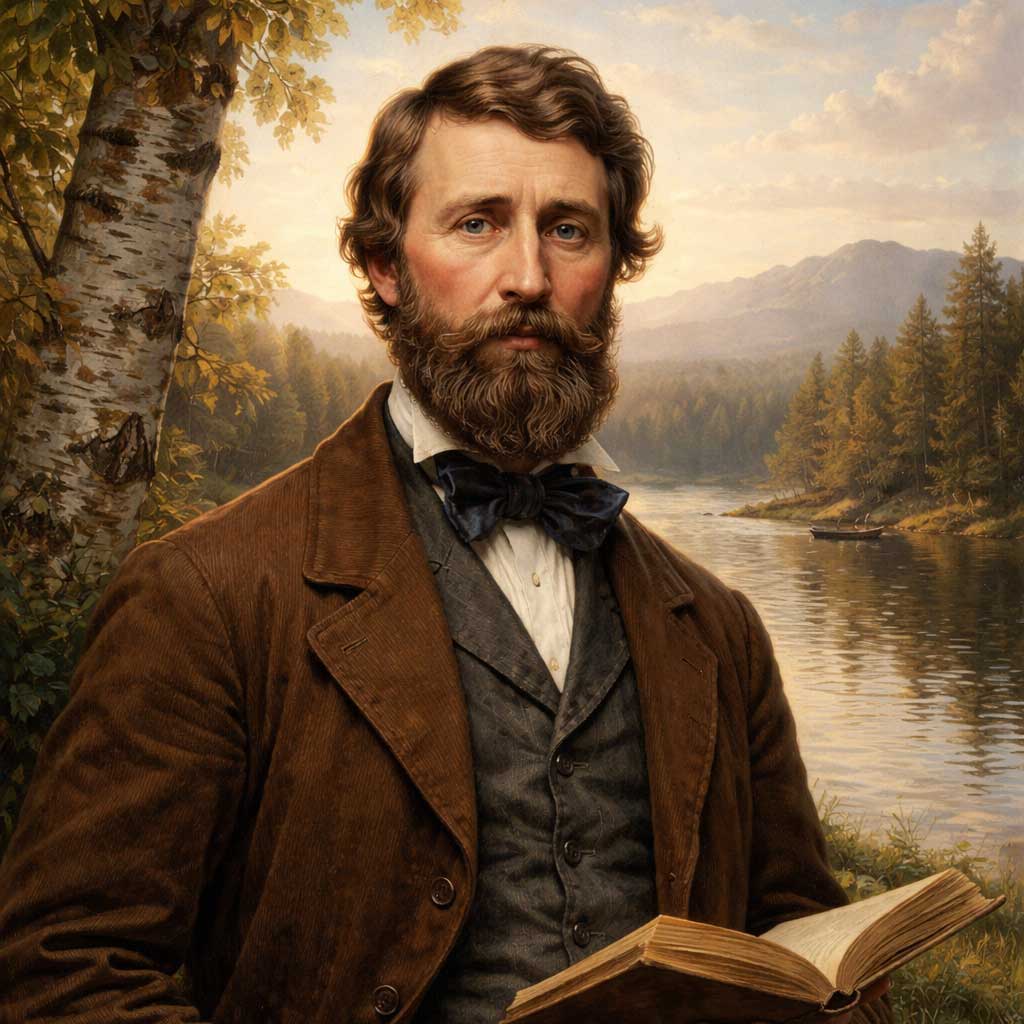
On a summer afternoon in July 1846, a man walked out of the woods at Walden Pond and down into the small town of Concord, Massachusetts, to pick up a mended shoe from the cobbler. On the way, the jailer Samuel Staples stopped him and locked him up, because Henry David Thoreau had not paid his poll tax in years. Soon afterward someone settled the debt, probably his aunt Maria, but Thoreau stayed in the cell overnight and was not released until the next morning. Then he fetched his shoe and, as he later wrote, was back in the woods in time for a huckleberry party on Fair Haven Hill.
This brief episode became a political text whose influence reached far beyond America. It appeared in 1849 under the title Resistance to Civil Government and is known today as Civil Disobedience. Its basic question is simple: may a state demand that a decent person take part in injustice?
At a glance
- Life: July 12, 1817, in Concord, Massachusetts; died there of tuberculosis on May 6, 1862
- Work: essayist, naturalist, land surveyor, and pencil maker in the family business; a representative of New England Transcendentalism in the circle around Ralph Waldo Emerson
- Major works: A Week on the Concord and Merrimack Rivers (1849), Resistance to Civil Government (1849, later Civil Disobedience), Walden; or, Life in the Woods (1854), Slavery in Massachusetts (1854), A Plea for Captain John Brown (1859)
- In one sentence: He insisted that the individual’s conscience belongs to no legislator, and he lived accordingly.
A life of many trades
Thoreau grew up in Concord, where his father made pencils from 1823 on. Over time the business gave the family a secure living, and his older siblings Helen and John used their teachers’ salaries to help pay for their younger brother’s studies at Harvard. After graduating in 1837, Thoreau first taught at the town school and then, together with his brother, at a school of their own, which they had to close in 1841. After that he lived for a while as a handyman in Emerson’s household so that he could write.
He could not live from writing alone. He earned his money in the family business and as a land surveyor for the town and for landowners. He built a machine that ground graphite finely and found a mixture of graphite and clay that produced an even line. Thoreau pencils were the first American pencils that could compete with those made by the German firm Faber. When his Harvard class asked him about his profession in 1847, he listed himself as a schoolmaster, private tutor, surveyor, gardener, farmer, house painter, carpenter, mason, day laborer, pencil maker, sandpaper maker, writer, and sometimes a poetaster, a list that fits poorly with the common image of the unworldly dreamer.
Conscience belongs to no one else
Civil Disobedience opens with a sentence that many friends of liberty know by heart. Thoreau takes up the motto that the best government is the one that governs least and carries it to its conclusion: best of all is the government that does not govern at all, and when people are ready for it, that is the kind of government they will have. Right afterward he makes clear that he is speaking practically, as a citizen. He is not asking for no government at once, but for a better government at once.
At the heart of the essay is the question of conscience. “Must the citizen ever for a moment, or in the least degree, resign his conscience to the legislator? Why has every man a conscience, then?” Thoreau asks. We should be men first, he says, and subjects afterward. Law has never made anyone a whit more just, but through too much respect for it even well-meaning people are made the agents of injustice every day.
What he had in mind were the war against Mexico and slavery. In Walden he gives as the reason for his arrest that he did not recognize the authority of a state that buys and sells men, women, and children like cattle at the door of its senate house. Anyone who does not want to take part in such an injustice, in Thoreau’s view, need not wait until he has won over the majority. Anyone who is more right than his neighbors already constitutes a majority of one.
The tax receipt as a vote
Thoreau met the state face to face, as he himself writes, once a year, namely in the person of the tax collector. That was exactly when he meant to withhold his consent. If a thousand people did not pay their taxes in a given year, he writes, that would not be a violent and bloody measure, whereas paying them would be, because it enables the state to commit violence and shed innocent blood. That, he says, is the definition of a peaceable revolution. When the tax collector asked him what he was supposed to do, Thoreau told him briefly that if he really wished to do something, he should resign his office.
Thoreau drew careful distinctions here. He had never refused to pay the highway tax, he said, because he wanted to be as good a neighbor as he was a bad subject. With the poll tax he was not objecting to any particular item; he simply wanted to withdraw his allegiance from the state. This was no sudden impulse: by his own account, at the time of his arrest he had not paid it for six years.
His account of the night in jail is among the finest pages of the essay. He did not feel confined for a moment, he writes, and the walls, two or three feet thick, struck him as a waste of stone and mortar. The state can lay hold only of a person’s body; it cannot reach his reason or his conscience, because it is armed only with greater physical strength, not with superior wit or honesty. “I was not born to be forced. I will breathe after my own fashion.”
Belonging to no society one has not joined
A smaller incident shows how fundamentally Thoreau thought. The town demanded that he contribute to the support of a minister whose sermons his father attended but he himself never did. Thoreau did not pay and, at the request of the selectmen, submitted a written statement: he, Henry Thoreau, did not wish to be regarded as a member of any incorporated society that he had not joined. The town clerk accepted the paper, and the demand never came again. He would have liked, he adds, to sign off in the same way from all the societies he had never joined, but he could not find a complete list.
This dry sentence contains a whole program, for a membership you never asked for does not bind you. At the end of the essay Thoreau takes the idea to a larger scale: authority requires the consent of the governed, and there will never be a really free and enlightened state until the state comes to recognize the individual as a higher and independent power, from which all its own power and authority are derived. Thoreau imagines a state that calmly accepts it when a few people live aloof from it, do not meddle with it, and still fulfill all the duties of good neighbors.
Two years at Walden Pond
On July 4, 1845, Independence Day, Thoreau moved into a house that he had built himself on the shore of Walden Pond, on land belonging to Emerson. By his own accounting the materials cost him 28 dollars and twelve and a half cents. He lived there for two years and two months, until September 6, 1847, and gave an account of it in Walden. He went to the woods, he writes, because he wished to live deliberately, to front only the essential facts of life, and not to discover, when he came to die, that he had not lived.
The first chapter is titled Economy, and it really is a reckoning. The cost of a thing, Thoreau says, is the amount of life that must be exchanged for it. Thoreau found that with about six weeks of work a year he could cover all the costs of living and keep the rest of his time free for reading, walking, observing, and writing. A man is rich, he says, in proportion to the number of things he can afford to do without. On trade, though, his judgment was harsh. He had learned that trade curses everything it handles, he writes, at the point where he rejects the plan of gathering berries and herbs for sale, because he valued his freedom above all.
You do not have to share this attitude to learn from it. Thoreau preached his model to no one. He would not want anyone to adopt his way of life, he says in Walden, for he wished there to be as many different people in the world as possible, and each should take care to find and follow his own way, not his father’s, his mother’s, or his neighbor’s. If a man does not keep pace with his companions, perhaps it is because he hears a different drummer.
Against slavery
Thoreau avoided organized movements, but slavery would not let him go. At Walden Pond, by his own account, he helped a fugitive slave on his way north. After the Fugitive Slave Act of 1850 obliged Massachusetts, too, to return escaped slaves to their owners, he gave several passionate speeches. In Slavery in Massachusetts in 1854, he wrote that his thoughts were murder to the state and involuntarily went plotting against it.
He went furthest in October 1859, when he defended John Brown before the citizens of Concord. Brown and an armed band had raided the federal armory at Harpers Ferry in order to spark a slave uprising. Thoreau said he shared Brown’s doctrine that a man has a perfect right to interfere by force with the slaveholder in order to rescue the slave. He himself did not wish to kill or to be killed, but he could imagine circumstances in which both would be unavoidable. Anyone who knows Thoreau only as a teacher of nonviolence should know this speech. It shows a man who took the injustice of slavery so seriously that he could justify even violence to end it.
What friends of liberty can learn from him
The first lesson concerns consent. In simple sentences Thoreau set down what became self-evident to many later classical liberals: an obligation you never agreed to does not bind you, and the power of the state derives from the individual. That is why Jeff Riggenbach, writing for the Mises Institute, called him a founding father of American libertarian thought and drew the line to Herbert Spencer, who two years later, in Social Statics, defended the right to ignore the state.
The second lesson is shared responsibility. Thoreau asked less what the state bought with his dollar than what his own allegiance brought about. This idea strengthened Gandhi and Martin Luther King, who read the essay several times as a student at Morehouse College. There, King later wrote, he first came into contact with the theory of nonviolent resistance, fascinated by the idea of refusing to cooperate with an evil system.
The third lesson is perhaps the most personal. Anyone who knows his needs and keeps them small is harder to blackmail, whether by the state or by his own love of comfort. Thoreau lived this out without prescribing it to anyone, and he expressly granted everyone else the right to do things quite differently.
A majority of one
Thoreau died in Concord in May 1862, at the age of 44, in the second year of the Civil War, which would bring slavery to an end. His sentences about conscience are quoted today wherever people refuse to take part in something they consider wrong. His legacy is a question you can ask yourself in any situation, without asking anyone’s permission: why does a person have a conscience if he checks it at the legislator’s door like a coat?
Further reading
- Henry David Thoreau: Resistance to Civil Government (1849), as Civil Disobedience in numerous editions; in German, among others, as Über die Pflicht zum Ungehorsam gegen den Staat
- Henry David Thoreau: Walden; or, Life in the Woods (1854); in German as Walden oder Leben in den Wäldern
- Jeff Riggenbach: Henry David Thoreau: Founding Father of American Libertarian Thought, Mises Institute, 2010
This article is part of our series on thinkers, doers, and historical figures of liberty.
Sources
- Thoreau, Henry David: Resistance to Civil Government, in: Elizabeth P. Peabody (ed.), Aesthetic Papers, Boston 1849; later as Civil Disobedience. Text: Project Gutenberg #71, https://www.gutenberg.org/ebooks/71
- Thoreau, Henry David: Walden; or, Life in the Woods, Ticknor and Fields, Boston 1854. Text: Project Gutenberg #205, https://www.gutenberg.org/ebooks/205
- Thoreau, Henry David: A Yankee in Canada, with Anti-Slavery and Reform Papers, Ticknor and Fields, Boston 1866 (includes “Slavery in Massachusetts,” “Civil Disobedience,” “A Plea for Captain John Brown,” “Life without Principle”). Text: Project Gutenberg #70123, https://www.gutenberg.org/ebooks/70123
- Thoreau, Henry David: A Plea for Captain John Brown, lecture in Concord, October 30, 1859. Text: Project Gutenberg #2567, https://www.gutenberg.org/ebooks/2567
- King, Martin Luther Jr.: The Autobiography of Martin Luther King, Jr., ed. Clayborne Carson, ch. 2, “Morehouse College,” https://kinginstitute.stanford.edu/king-papers/publications/autobiography-martin-luther-king-jr-contents/chapter-2-morehouse-college
- German editions (in German): Über die Pflicht zum Ungehorsam gegen den Staat and Walden oder Leben in den Wäldern (among others, Diogenes, Zurich)
- Witherell, Elizabeth; Dubrulle, Elizabeth: “Life and Times of Henry David Thoreau,” The Writings of Henry D. Thoreau, University of California, Santa Barbara, https://thoreau.library.ucsb.edu/thoreau_life.html
- Stanford Encyclopedia of Philosophy: “Henry David Thoreau,” https://plato.stanford.edu/entries/thoreau/
- Walden Woods Project, Thoreau Log: July 1846 (after Walter Harding, Thoreau’s Incarceration), https://www.walden.org/log-entry/july-1846-concord-mass-2/
- Walden Woods Project: “John Thoreau and Co. Pencils,” https://www.walden.org/what-we-do/library/bibliography-thoreau-contemporaries/john-thoreau-and-co-pencils/
- Walden Woods Project: Thoreau’s Lectures before Walden, Lecture 14, https://walden.org/thoreaus-lectures-before-walden-lecture-14
- Riggenbach, Jeff: “Henry David Thoreau: Founding Father of American Libertarian Thought,” Mises Daily, July 15, 2010, https://mises.org/mises-daily/henry-david-thoreau-founding-father-american-libertarian-thought
- Wikipedia (en): Henry David Thoreau, https://en.wikipedia.org/wiki/Henry_David_Thoreau (dates of life and Walden dates; cross-checked)
- Wikipedia (en): Civil Disobedience (Thoreau), https://en.wikipedia.org/wiki/Civil_Disobedience_(Thoreau) (publication history)