In November 2014, the Janus Forum at Brown University in Providence held a debate on how universities should handle accusations of sexual assault. On the panel sat the writer Jessica Valenti and Wendy McElroy, an author from Canada. Before the event, the university’s president, Christina Paxson, rebutted McElroy in an email to the entire university and scheduled a competing event for the same hour, and students set up a safe space for those who might feel hurt by the debate.
What McElroy then said was less scandalous than the uproar suggested. Rape, she argued, is a serious crime committed by individual perpetrators, often repeat offenders, and she considered campus tribunals that convict on a mere preponderance of the evidence the wrong approach. According to the report in Reason magazine, her closing line was: “Let’s not build justice for women on injustice for men.” The sentence sums up the principle that carries her entire work: equal rights for every human being, man or woman.
At a glance
- Born: 1951, Canadian, lives in rural Canada
- Work: writer and editor, cofounder of the journal The Voluntaryist (1982), research fellow at the Independent Institute, editor of ifeminists.com
- Major works: Freedom, Feminism, and the State (ed., 1982), XXX: A Woman’s Right to Pornography (1995), Individualist Feminism of the Nineteenth Century (2001), Liberty for Women (ed., 2002), The Debates of Liberty (2003), Rape Culture Hysteria (2016), The Satoshi Revolution (in installments from 2017)
- In one sentence: She shows that the liberation of women begins with the principle that every human being belongs to himself or herself.
From the Audiobook Studio to the Archive
Wendy McElroy came to libertarian thought by way of civil liberties. It was Murray Rothbard, she said in a 2011 interview with the Mises Institute, who led her to the economics of the Austrian School. In the summer of 1982 she sat down in Hollywood with Carl Watner and George H. Smith, and the three took up a term that the Englishman Auberon Herbert had popularized in the 19th century: voluntaryism, the doctrine that human society should rest on voluntary cooperation. In October 1982 the first issue of The Voluntaryist appeared, with McElroy as its first editor. The group rejected party politics as a path to liberty and sought, through education, to withdraw from the state the consent on which its power rests.
In the same year she edited the volume Freedom, Feminism, and the State for the Cato Institute, a collection of writings by libertarian women’s rights advocates, and produced an index to Liberty, the forum of the American individualist anarchists that Benjamin Tucker published from 1881 to 1908; in 2003 came her account of the debates held in its pages, The Debates of Liberty.
For about twelve years she also wrote scripts for Knowledge Products, an audiobook publisher in Nashville, among them versions of Mary Wollstonecraft’s Vindication of the Rights of Woman and of La Boétie’s Discourse on Voluntary Servitude. She wrote a weekly column for FoxNews.com, became a research fellow at the Independent Institute and editor of the website ifeminists.com, a project of that institute. On her own website she still comments on world events almost daily.
Two Ways to Understand Equality
McElroy laid out the core of her thinking in 2003 in a lecture at Brown University, which was published in Etica & Politica. Feminism, she says there, is the doctrine that women are equal to men and should be treated as such. What matters is what one means by equality.
For one school, which she calls gender feminism, borrowing a term from the philosopher Christina Hoff Sommers, equality is an end state of society in which power and wealth are fairly distributed. Men and women appear in it as classes with opposing interests, an idea McElroy traces back to Marx; the legal scholar Catharine MacKinnon herself spoke of a “post-Marxist” feminism. Anyone who thinks this way, in McElroy’s view, must restructure institutions such as the market and the family and turns to the coercive power of the state to do so.
Individualist feminism, which McElroy calls ifeminism for short, understands equality as equal protection of the rights of person and property. The fundamental right of every human being is to dispose peacefully of one’s own body and one’s own property; the fundamental duty is to respect the peaceful choices of others, even when one considers them wrong. From this follows a clear task: every privilege and every disadvantage based on sex should disappear from the law, including privileges that favor women. The law, she writes, must become blind to sex and see only individuals.
In this view, justice is a matter of process. Any arrangement to which all parties have consented is just, whether it looks more capitalist or more communal. McElroy illustrates this with her own area of rural Canada, where a busy small town borders a large Amish community and both ways of life are just because both are voluntary. Her most concise formula reads: “Freedom of choice involves taking the gun away.”
Roots in the Movement Against Slavery
According to McElroy’s account, individualist feminism arose in the 1830s out of radical abolitionism, which demanded the immediate abolition of slavery because every human being, whatever the color of his skin, is the owner of himself. Women who fought for the rights of slaves soon discovered that these rights were withheld from them as well. McElroy quotes the abolitionist Abby Kelley as saying that “in striving to strike his irons off, we found most surely that we were manacled ourselves.” These shackles were laws that disadvantaged women in much the same way as they did Black people.
One of the clearest voices of this movement was Sarah Grimké of South Carolina. In July 1837, against a pastoral letter from the Congregational clergy of Massachusetts, she defended the right of women to speak in public. Men and women, she wrote, “were CREATED EQUAL; they are both moral and accountable beings, and whatever is right for man to do, is right for woman.” To such voices McElroy devoted the 2001 volume Individualist Feminism of the Nineteenth Century. In her 2003 lecture she laments that one searches standard reference works in vain for names like Moses and Lillian Harman, Angela and Ezra Heywood, or the physician Gertrude B. Kelly.
A Publisher in Kansas
McElroy tells at length the story of Moses Harman, who published the journal Lucifer, the Light-Bearer in Kansas. The paper openly advocated birth control and insisted that a woman’s self-ownership must apply in all sexual relations, including marriage. According to McElroy, it was among the first periodicals in North America to call forced intercourse within marriage rape. This brought Harman into conflict with the Comstock Act of 1873, which banned sending “obscene” material through the mail, information about contraception included.
In 1887 the editorial staff was arrested over three letters to the editor and indicted on 270 counts. One of the letters described the fate of a woman whose husband had forced her into intercourse despite a fresh surgical wound. Harman’s sixteen-year-old daughter Lillian was already in jail at the time. The year before, she had married Edwin C. Walker in a private ceremony without church or state, and her father had refused to “give her away” to the groom, because she was and remained the owner of herself. Harman’s fight against the Comstock laws dragged on until 1906. He served his last sentence, a year of hard labor, at the age of 75.
For McElroy, Harman belongs in the history of feminism because of his method: he grounded his cause in self-ownership and refused to carry his idea of justice into private relationships by means of state force.
Taking a Woman’s Choice Seriously
If the principle “my body belongs to me” holds, then, according to McElroy, it must hold for every peaceful choice a woman makes, from motherhood to taking part in pornography. For XXX: A Woman’s Right to Pornography, published by St. Martin’s Press in 1995, she talked with performers, attended the industry’s awards ceremony, and interviewed members of a group that campaigned for the rights of prostitutes. The book defends the right of these women to decide for themselves instead of being protected by the state from their own choices.
The flip side of this freedom is responsibility. Individualist feminism, McElroy says, does not ask the state for privileges or protection. This holds even where she herself rejects a choice: she married into a Hispanic family, and anyone who refuses to hire her nieces and nephews because of their background loses her as a customer and as an employee. Force, including the indirect force of a law, she rejects, for the freedom of association that allows others to close their doors also protects her own family’s right to do the same.
Fair Process, Even When It Hurts
In Rape Culture Hysteria (2016), two years after the debate, McElroy challenged the notion that North American society as a whole is a culture of rape. In her conviction, this notion harms men and women alike, as the book’s subtitle already says. Rape, she argues, should be taken seriously as what it is: a serious crime committed by individual perpetrators, to be decided in a fair proceeding.
Money Without Permission
Starting in September 2017, she published the chapters of The Satoshi Revolution week by week on the platform Bitcoin.com; they were later collected as a book with an introduction by Jeffrey Tucker. In it she describes Bitcoin as a way to hold and pass on wealth without the state and without intermediaries. The movement, she warns, should hold fast to Satoshi Nakamoto’s original idea and not seek its salvation in the approval of governments.
What friends of liberty can learn from her
McElroy’s most important insight is that feminism and liberty belong together if one starts with the individual. A woman who may decide for herself needs no guardian, neither a husband nor a government agency.
Equally valuable is her work as a historian of liberty. She has brought the women abolitionists, the individualist anarchists around Benjamin Tucker, and the Harman family out of the archives and shown how many women and men in the 19th century fought for women’s self-determination. And she defends free speech and fair process even when the president of the host university takes a stand against her in advance, and she does so with arguments.
Woman as the Owner of Herself
When Sarah Grimké wrote in 1837 that whatever is right for man is right for woman, it was an attack on the order of her time. Wendy McElroy has carried this sentence into the present and taken it at its word. Her feminism demands that every woman may decide about her own life, and it puts one question to every well-meaning policy: Who gave the state the right to decide for adult women what is good for them?
Further reading
- Wendy McElroy (ed.): Freedom, Feminism, and the State. An Overview of Individualist Feminism, Cato Institute, Washington 1982; 2nd edition, Holmes & Meier for the Independent Institute, 1991
- Wendy McElroy: Individualist Feminism of the Nineteenth Century, McFarland, Jefferson 2001
- Wendy McElroy: “Gender Feminism and Ifeminism: Wherein They Differ,” in: Etica & Politica 2003/2
- Wendy McElroy: The Debates of Liberty. An Overview of Individualist Anarchism, 1881–1908, Lexington Books, Lanham 2003
This article is part of our series on thinkers, doers, and historical figures of liberty.
Sources
- McElroy, Wendy (ed.): Freedom, Feminism, and the State. An Overview of Individualist Feminism, Cato Institute, Washington 1982; 2nd edition, Holmes & Meier for the Independent Institute, 1991.
- McElroy, Wendy: XXX: A Woman’s Right to Pornography, St. Martin’s Press, New York 1995.
- McElroy, Wendy: Individualist Feminism of the Nineteenth Century, McFarland, Jefferson 2001.
- McElroy, Wendy (ed.): Liberty for Women. Freedom and Feminism in the Twenty-First Century, Ivan R. Dee, Chicago 2002.
- McElroy, Wendy: The Debates of Liberty. An Overview of Individualist Anarchism, 1881–1908, Lexington Books, Lanham 2003.
- McElroy, Wendy: “Gender Feminism and Ifeminism: Wherein They Differ,” in: Etica & Politica 2003/2 (lecture at Brown University, September 27, 2003), https://sites.units.it/etica/2003_2/mcelroy.pdf
- McElroy, Wendy: Rape Culture Hysteria. Fixing the Damage Done to Men and Women, Vulgus Press, 2016.
- McElroy, Wendy: The Satoshi Revolution, in installments on Bitcoin.com from September 23, 2017, https://news.bitcoin.com/introduction-to-the-satoshi-revolution-new-book-by-wendy-mcelroy-exclusively-on-bitcoin-com/
- McElroy, Wendy: “Voluntaryism: Some Personal Reminiscences,” The Voluntaryist, https://voluntaryist.com/?p=2315
- McElroy, Wendy: biography, https://www.wendymcelroy.com/bio.htm, and news page, https://www.wendymcelroy.com/news.php (accessed November 6, 2026)
- Grimké, Sarah: letter from Haverhill, July 1837, in: Letters on the Equality of the Sexes, Boston 1838, https://users.wfu.edu/zulick/340/grimkeletter.html
- Mises Institute: Faculty Spotlight Interview: Wendy McElroy, February 3, 2011, https://mises.org/wire/faculty-spotlight-interview-wendy-mcelroy
- Independent Institute: profile of Wendy McElroy, https://www.independent.org/person/wendy-mcelroy/
- ifeminists.net: About, http://www.ifeminists.net/about/
- Soave, Robby: report on the debate at Brown University, Reason, November 19, 2014, https://reason.com/2014/11/19/liberal-feminist-on-rape-alcohol-is-not
- Brown Daily Herald: Janus Forum sexual assault event sparks controversy, November 17, 2014, https://www.browndailyherald.com/article/2014/11/janus-forum-sexual-assault-event-sparks-controversy
- Kirkus Reviews: XXX: A Woman’s Right to Pornography, 1995, https://www.kirkusreviews.com/book-reviews/wendy-mcelroy/xxx/
- Tucker, Jeffrey A.: The Satoshi Revolution by Wendy McElroy, The Daily Economy, February 28, 2020, https://thedailyeconomy.org/article/the-satoshi-revolution-by-wendy-mcelroy/
- Presley, Sharon: Review: Rape Culture Hysteria, Libertarianism.org, 2016, https://libertarianism.org/columns/review-rape-culture-hysteria-fixing-damage-done-men-women-wendy-mcelroy
- Stringham, Edward P.: review of The Debates of Liberty, The Independent Review, https://independent.org/publications/TIR/article.asp?id=222
- WorldCat: Freedom, Feminism, and the State, OCLC 8937344, https://search.worldcat.org/oclc/8937344
- Wikipedia (en): Wendy McElroy, https://en.wikipedia.org/wiki/Wendy_McElroy (overview, list of works)
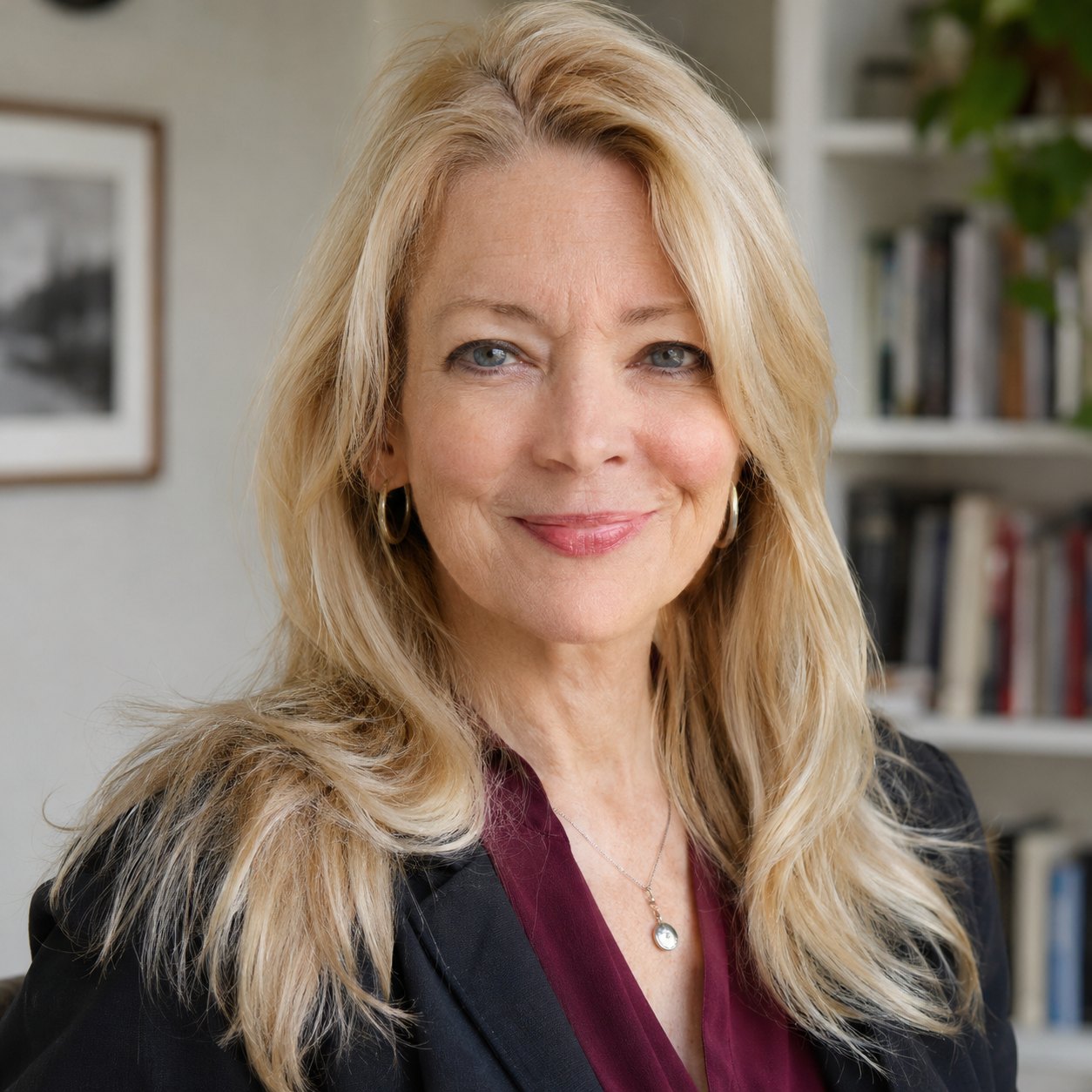
Featured image: Wendy McElroy (AI illustration)