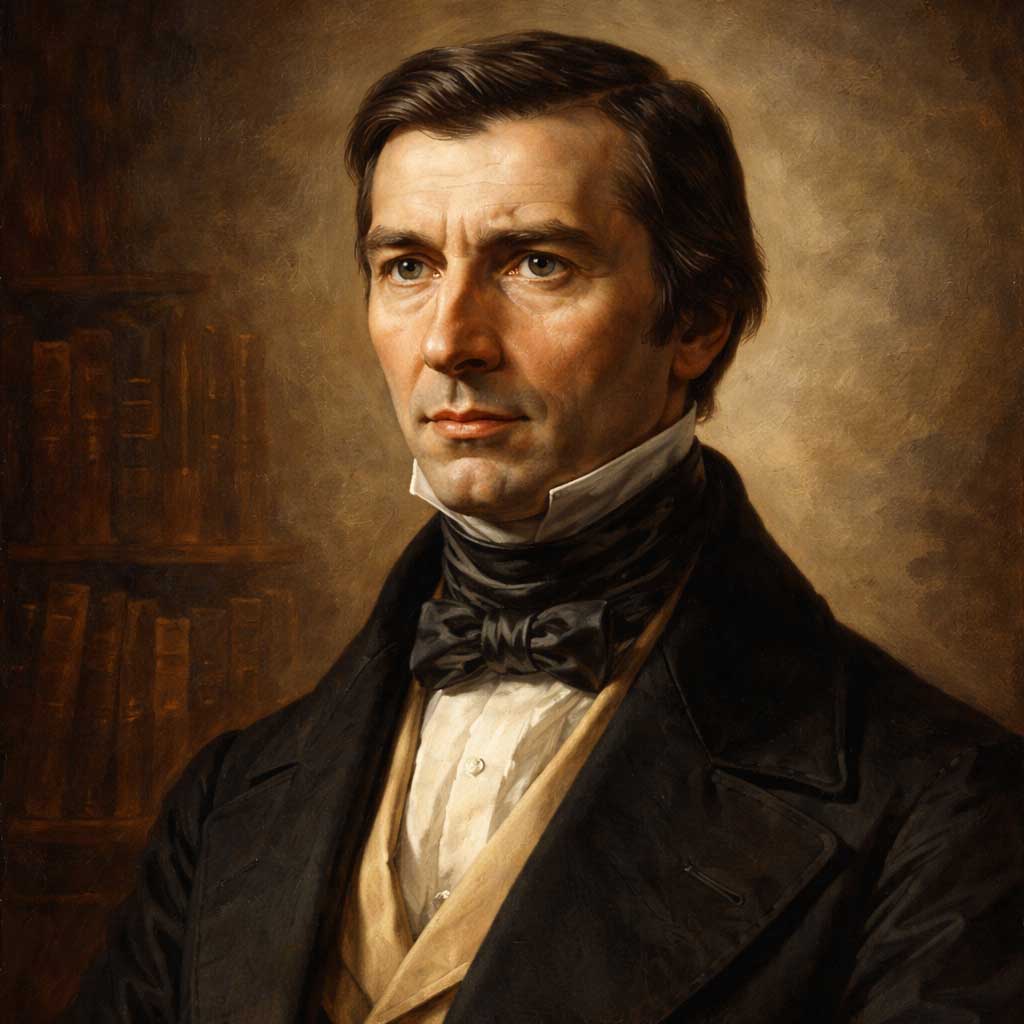
A boy breaks a pane of glass, and the neighbors immediately console his father: after all, somebody has to make a living from misfortune, and what would become of the glaziers if no window ever broke? The glazier comes, repairs the damage for six francs, and rubs his hands. So begins a short story that Frédéric Bastiat published in July 1850, a few months before his death. Then he asks the question that still runs through many debates about stimulus programs and subsidies: What would the father have done with the six francs if the window had stayed whole?
He would have bought new shoes, Bastiat says, or another book for his shelf. Everyone sees the glazier; nobody sees the shoemaker who goes away empty-handed. From this simple observation Bastiat built a method of economic judgment, and he wrote it down in language anyone can understand without prior knowledge.
At a glance
- Life: born in June 1801 in Bayonne, died December 24, 1850, in Rome
- Work: landowner and justice of the peace in Mugron (Landes), co-founder of the first French free trade association, member of the National Assembly from 1848 to 1850
- Major works: Sophismes économiques (1845–1848), L’État (1848), La Loi (1850), Ce qu’on voit et ce qu’on ne voit pas (1850), Harmonies économiques (1850)
- In one sentence: He showed that every benefit handed out by the state is paid for somewhere, and he taught people to look there too.
From the Counting House to the Countryside
Claude-Frédéric Bastiat was born in 1801 in the port city of Bayonne, the son of a merchant. By the age of nine he had lost both parents and was raised by his grandfather and an aunt. In those years the trading town suffered from war and from the Continental System, Napoleon’s attempt to cut off trade with England. Bastiat could see up close what blockades do to a port.
After school in Saint-Sever and Sorèze, he joined his uncle’s counting house in 1818. When his grandfather died in 1825, Bastiat inherited an estate in Mugron, in the Landes department of southwestern France, and withdrew there to farm and to read. His fellow citizens elected him justice of the peace in 1831 and, in 1832, to the general council of the department.
The Sun as an Unfair Competitor
The turning point came from an English newspaper. Through the Globe and Traveller, Bastiat learned of the Anti-Corn Law League, in which Richard Cobden and John Bright were fighting the grain tariffs in England. He decided to attempt something similar in France. In October 1844 the Journal des Économistes published his essay on the influence of French and English tariffs on the future of the two peoples, and it made the provincial landowner known among the economists of Paris.
Next came the Sophismes économiques, short pieces in which Bastiat takes apart the protectionists’ arguments one after another. The most famous is the candlemakers’ petition of October 1845. In it, the manufacturers of candles, lamps, and candlesticks address the Chamber of Deputies and complain of “the intolerable competition of a foreign rival” who supplies light at an unbeatably low price. This rival, they explain, is none other than the sun. The petitioners therefore demand a law ordering all windows, skylights, and curtains to be closed. Anyone who laughs at the text has already understood the argument: if protection from cheap imports increased prosperity, then free sunlight would have to be shut out as well.
In 1845 Bastiat traveled to London and Manchester and met Cobden in person, with whom he had been corresponding since his essay of 1844. The following year he helped found the first French free trade association in Bordeaux and soon afterward moved to Paris. There he ran the central committee as its secretary, edited the weekly Le Libre-Échange, and spoke in Paris and in the provinces. The February Revolution of 1848 ended this campaign before it reached its goal.
A Deputy Without a Voice
In April 1848 the Landes elected him to the Constituent National Assembly, and in May 1849 to the Legislative Assembly. By then a serious illness, usually described as tuberculosis, had already taken his voice, so he could rarely speak from the rostrum. He nevertheless took part in the work of the finance committee, of which he was vice president, and he argued that workers should be allowed to join together and collectively stop work, which the law prohibited at the time. He found no majority for it.
His real weapon remained the pen. In quick succession he wrote pamphlets against the socialist schemes of those years, with titles such as Property and Law, Justice and Fraternity, and Damned Money. He debated Pierre-Joseph Proudhon in public over whether interest is just. The 1911 Encyclopaedia Britannica points out that he took socialism as its most popular advocates presented it and examined their proposals patiently before refuting them.
In September 1848 he published a short piece on the state in the Journal des Débats. He wished, he writes there, that a prize of one million francs could be offered for a good, simple, and intelligible definition of the word, and then he submits his own (here and below, quotations from the French follow established English translations where they exist, and are otherwise our own): “The State is the great fiction through which everybody endeavors to live at the expense of everybody else.” This is not an attack on civil servants. Bastiat describes an expectation that many citizens hold at the same time, namely to get more from the state than they themselves contribute, and that by simple arithmetic can never be fulfilled for everyone.
When the Law Becomes Plunder
In June 1850 La Loi (The Law) appeared, his best-known text. It opens with a reversal that contains the core of classical liberalism: “Life, liberty, and property do not exist because men have made laws. On the contrary, it was the fact that life, liberty, and property existed beforehand that caused men to make laws in the first place.” For Bastiat, the law is the collective organization of the right of self-defense that every individual already has. It may therefore do only what an individual would be allowed to do in defense of his person and his property.
If it is used for anything else, Bastiat speaks of spoliation légale, legal plunder. He describes how to recognize it: “See if the law takes from some persons what belongs to them, and gives it to other persons to whom it does not belong. See if the law benefits one citizen at the expense of another by doing what the citizen himself cannot do without committing a crime.” As examples he lists tariffs, bounties, subsidies, the progressive tax, free public education, the rights to work, to profit, and to wages that were widely demanded at the time, and free credit. The criterion applies to everyone: to the manufacturer who lives off tariffs as much as to anyone who is promised a claim on other people’s money.
He turns just as clearly against the legislators who want to arrange society according to a plan of their own. In paraphrase, Bastiat says they treat people like inert matter that an outside hand can mold into any shape, the way a gardener prunes his trees. For him, by contrast, people are acting beings with their own judgment, and a free society arises from their cooperation without anyone having to design it.
Six Francs and a Pair of Shoes
A month later came Ce qu’on voit et ce qu’on ne voit pas, the essay with the broken window. In the introduction Bastiat sums up his method in a single sentence: the whole difference between a bad economist and a good one is that the first sticks to the visible effect, while the second also takes into account the effects that must be foreseen. A measure never has just one consequence but a whole series of them, and usually the first is pleasant and only the later ones are costly.
In twelve chapters he applies this idea to the questions of his day: to taxes and public works, to subsidies for theaters, to machinery and credit. In the chapter on Algeria he takes aim at the speakers who demand fifty million francs for ports, roads, and settlers in the new colony and who look only at where the money goes, never at where it comes from. What economists today call opportunity cost, the benefit you give up when you use resources in another way, is already there in essence.
Harmony Instead of a Blueprint
Bastiat wanted to be more than a fighter against errors. In his last years he worked on the Harmonies économiques, whose first volume appeared in early 1850. Its guiding idea is that people’s interests, left to themselves, tend toward harmonious combinations and toward a growing predominance of the common good.
For him this confidence had a religious foundation. La Loi ends with the call, after so many failed systems, to finally try liberty, the liberty that “is an acknowledgment of faith in God and His works.” He was unable to complete the second volume of the Harmonies. In the fall of 1850 his illness forced him to travel to Italy, and he died on December 24 in Rome, where he was buried in San Luigi dei Francesi.
A Long Afterlife
About a century later, Joseph Schumpeter called him “the most brilliant economic journalist who ever lived” while denying him the rank of a theorist. Henry Hazlitt considered this verdict unfair, like blaming an apple tree for not bearing bananas. In 1946 Hazlitt himself had published Economics in One Lesson, a book built entirely on Bastiat’s method and applying it to the economic policy of the 20th century; its second chapter is simply titled “The Broken Window.”
In the United States, Leonard Read, the founder of the Foundation for Economic Education, had La Loi newly translated by Dean Russell. According to the foundation, about half a million copies of the 1950 edition were sold. Friedrich August von Hayek wrote an introduction to a selection of Bastiat’s essays and in it praised the insight that economic policy must not be judged by its immediate effects alone.
What friends of liberty can learn from him
The first lesson is one of method. Anyone who wants to judge a new subsidy, a funding program, or a tariff should ask about the six francs: Where does the money come from, and what would have happened to it otherwise? That takes no degree, only the willingness to consider what does not appear in the photo of the opening ceremony.
The second lesson concerns the law. Bastiat’s test for a law is simple and strict at the same time: Is the state allowed to do something that would be forbidden to every individual as a wrong? This question exposes privileges for businesses just as well as promises made at the expense of third parties, no matter which political camp they come from.
The third lesson is one of tone. Bastiat wrote for citizens, not for fellow specialists, and he took his opponents seriously enough to state their arguments accurately before refuting them.
A Body of Work from Six Years
Barely more than six years passed between his first essay in the Journal des Économistes and his death in Rome, and during the last of those years he was seriously ill. What he wrote in those years is still read and reprinted today, because the temptations he described have remained: the wish for protection from competition, the hope for a state that gives to all and takes from no one, and the tendency to look only at what is seen. Anyone who has read his short texts once will afterward see, behind many political promises, the shoes that were never bought.
Further reading
- Frédéric Bastiat: Ce qu’on voit et ce qu’on ne voit pas (1850), in: Œuvres complètes, vol. 5; English: What Is Seen and What Is Not Seen
- Frédéric Bastiat: La Loi (1850), in: Œuvres complètes, vol. 4; English: The Law, translated by Dean Russell, Foundation for Economic Education 1950
- Frédéric Bastiat: Sophismes économiques (1845–1848); English: Economic Sophisms, with an introduction by Henry Hazlitt, FEE 1962
- Henry Hazlitt: Economics in One Lesson, 1946
This article is part of our series on thinkers, doers, and historical figures of liberty.
Sources
- Bastiat, Frédéric: “De l’influence des tarifs français et anglais sur l’avenir des deux peuples,” Journal des Économistes, October 1844.
- Bastiat, Frédéric: “Pétition des fabricants de chandelles …,” Journal des Économistes, October 1845; Sophismes économiques, first series, ch. VII; Œuvres complètes vol. 4, p. 57, http://bastiat.org/fr/petition.html
- Bastiat, Frédéric: “L’État,” Journal des Débats, September 25, 1848; Œuvres complètes vol. 4, p. 327, http://bastiat.org/fr/l_etat.html
- Bastiat, Frédéric: La Loi, Paris, June 1850; Œuvres complètes vol. 4, p. 342, http://bastiat.org/fr/la_loi.html
- Bastiat, Frédéric: Ce qu’on voit et ce qu’on ne voit pas, Paris, July 1850; Œuvres complètes vol. 5, p. 336, http://bastiat.org/fr/cqovecqonvp.html
- Bastiat, Frédéric: Harmonies économiques, Paris 1850 (vol. 1).
- Bastiat, Frédéric: The Law, translated by Dean Russell, Foundation for Economic Education, Irvington-on-Hudson 1950.
- Bastiat, Frédéric: Economic Sophisms, with an introduction by Henry Hazlitt, Foundation for Economic Education 1962.
- Encyclopaedia Britannica, 11th edition (1911), vol. 3, article “Bastiat, Frédéric,” https://en.wikisource.org/wiki/1911_Encyclop%C3%A6dia_Britannica/Bastiat,_Fr%C3%A9d%C3%A9ric
- Concise Encyclopedia of Economics (Econlib): “Frédéric Bastiat,” https://www.econlib.org/library/Enc/bios/Bastiat.html
- Hazlitt, Henry: “Bastiat the Great” (introduction to Economic Sophisms, FEE 1962), Mises Institute, https://mises.org/library/bastiat-great
- Hazlitt, Henry: Economics in One Lesson, Harper & Brothers, New York 1946.
- Institut Coppet: short biography of Frédéric Bastiat, in: Ce qu’on voit et ce qu’on ne voit pas, https://www.coppetinstitute.org/EL/Bastiat-Ce-qu-on-voit.pdf
- Schumpeter, Joseph A.: History of Economic Analysis, Oxford University Press, New York 1954, p. 500 (quoted in Hazlitt and Econlib).
- Wikipedia (en): Frédéric Bastiat, https://en.wikipedia.org/wiki/Fr%C3%A9d%C3%A9ric_Bastiat (starting point; family details from Georges de Nouvion, Frédéric Bastiat. Sa vie, ses œuvres, ses doctrines, Paris 1905)
- Foundation for Economic Education: The Law (Russell translation), https://store.fee.org/products/the-law
Featured image: Frédéric Bastiat