When Aristotle died in Chalcis on Euboea in 322 BC, he left a will, which the ancient biographer Diogenes Laertius preserved. In it he provides for his family and settles the fate of his slaves. Ambracis is to be free; Tycho, Philo, and Olympius with his child are to receive their freedom as soon as his daughter marries; and none of the servants who waited on him may be sold. The young ones among them are to be freed when they reach the proper age and deserve it.
The document suits a thinker whom friends of liberty have to look at twice. Aristotle wrote the oldest surviving detailed critique of Plato’s community of property, and he placed the rule of law above the rule of men. The same man declared that some people are destined by nature to serve, and wrote that no citizen may believe he belongs to himself.
At a glance
- Life: 384 BC in Stagira in northern Greece to 322 BC in Chalcis on Euboea
- Work: twenty years at Plato’s Academy in Athens, from 343 BC tutor to the young Alexander of Macedon, from 335 BC head of his own school at the Lyceum
- Major works: Politics, Nicomachean Ethics, Metaphysics, writings on logic and biology
- In one sentence: He defended private property and the rule of law, but subordinated the individual to the city and considered slavery natural.
A physician’s son from Macedon
Aristotle was born in 384 BC in Stagira, a small town on the Chalcidice peninsula. His father, Nicomachus, was a physician at the Macedonian royal court. At about seventeen, the son went to Athens to study at Plato’s Academy and stayed there until his teacher’s death in 347. He then spent several years in Assos on the coast of Asia Minor and on the island of Lesbos, where he worked with Theophrastus.
Around 343, King Philip II brought him to Pella to teach the thirteen-year-old Alexander. Little is known about these lessons. In 335, Aristotle returned to Athens and taught in a public exercise ground dedicated to Apollo Lyceus, hence the name Lyceum. His students were called Peripatetics, probably after a covered walkway on the grounds. The ancient catalog of his writings lists among his works a collection of the constitutions of 158 cities. When Alexander died in 323 and the mood in Athens turned against everything Macedonian, Aristotle, fearing for his safety, withdrew to Chalcis, where he died the following year.
What belongs to all is cared for by none
In the second book of the Politics, Aristotle examines his teacher’s design. In the Republic, Plato had proposed that the ruling class of his ideal state should have no private property and no families of their own, so that they would think only of the whole. Aristotle considers the very goal mistaken. The more a city becomes a unity, he argues, the more it turns into a household and finally into a single human being, and at that point it ceases to be a city (Politics II 2, 1261a16-22).
Then comes the sentence that is still quoted today. In Benjamin Jowett’s English translation, it reads: “that which is common to the greatest number has the least care bestowed upon it” (II 3, 1261b33-34). Everyone thinks more about what is his own and less about what is shared (1261b34-35).
In the fifth chapter of the same book, he adds further reasons. Where possessions and labor are held in common, quarrels arise, because each person believes he contributes more and receives less than the others; separate responsibilities spare people such reproaches (II 5, 1263a8-28). He regards the pleasure of calling something one’s own as natural, because love of self is natural, and only selfishness deserves blame. Finally, he points out that a virtue would disappear if everything belonged to everyone, for generosity is possible only where a person has something of his own to dispose of, for “liberality consists in the use which is made of property” (II 5, 1263b13-14).
He sums up his solution this way: “It is clearly better that property should be private, but the use of it common” (II 5, 1263a38-39). He does not mean compulsory sharing. As an example he cites the Spartans, who use one another’s slaves, horses, and dogs as if they were their own, and he relies on friendship and generosity among owners. In a later book he even explicitly advises sparing the wealthy in democracies and redistributing neither their property nor its income (V 8, 1309a14-17).
Law instead of whim
Aristotle also asked who should rule in a city, the best man or the best law. His answer in the third book is clear: “he who bids the law rule may be deemed to bid God and Reason alone rule” (III 16, 1287a28-30). Whoever lets a man rule, by contrast, adds the element of the beast, for desire and passion lead astray even the best when they rule (1287a30-32).
For most cities, he considered an order with a broad middle class the most stable, because where the middle is numerous there is the least sedition and division (IV 11, 1296a7-9). This is not yet a doctrine of fundamental rights, but it is the idea that power must be bound by rules.
Happiness as one’s own activity
In the Nicomachean Ethics, Aristotle defines human happiness, in substance, as activity of the soul in accordance with virtue (Nicomachean Ethics I 6, 1098a16-18), that is, as something one does rather than a state one receives. According to his teaching, virtues such as courage or justice are acquired through habituation, through repeated action (II 1, 1103a14-26). This places responsibility for the good life with the person who acts. Aristotle did not, however, derive from this any freedom from the state: precisely because virtue requires practice, the community should guide that practice.
Where it does not fit
For Aristotle, man is by nature a being that lives in the polis, and in his order of rank the city comes before the individual: “the state is by nature clearly prior to the family and to the individual” (I 2, 1253a25-26). Rights of the individual against the community, as later natural law theory formulated them, play no central role in this teaching. This is clearest in the case of education, which he wants to be public and the same for all, rather than each father teaching his children as he sees fit. On this he writes: “Neither must we suppose that any one of the citizens belongs to himself, for they all belong to the state” (VIII 1, 1337a27-29).
The doctrine of natural slavery appears in the first book. There are people, he says, who by nature belong to another, because they share in reason only to the extent of perceiving it in others without possessing it themselves: “he who can be, and therefore is, another’s … is a slave by nature” (I 5, 1254b20-21). The slave lacks the deliberative faculty entirely; the woman has it, but without authority (I 13, 1260a12-14), and the man is to lead her by nature (I 12, 1259b1-3).
The historical context explains some of this, but not all. Slavery was everywhere in the Greek world, yet Aristotle himself reports contemporaries who considered it contrary to nature, because it rested only on law and force (I 3, 1253b20-23). He concedes that not everyone enslaved in war is a slave by nature (I 6, 1255a3-b15), and he recommends holding out freedom to all slaves as a reward (VII 10, 1330a32-33). His will shows that he partly put this into practice with his own slaves. Yet he held on to the doctrine itself, and it had a long afterlife: in the 16th century, the Spanish humanist Juan Ginés de Sepúlveda, who had translated the Politics into Latin, invoked it to justify the subjugation of the inhabitants of the Americas. In Valladolid in 1550 and 1551, Bartolomé de Las Casas opposed him before a royal council.
Aristotle was also far removed from the market. He distinguished the acquisition that supplies a household with what it needs from the art of moneymaking, which he calls chrematistics and which accumulates money for its own sake. This, he says, knows no limit and is therefore blameworthy, and he censures retail trade because the trader gains not from nature but from other people (I 10, 1258a38-b2). He judges lending at interest most harshly, for money was invented for exchange, and interest, “the birth of money from money,” is therefore the most unnatural of all forms of acquisition (I 10, 1258b7-8). That both sides can gain in a voluntary exchange because they value the goods differently is something he does not consider in this passage. Consistently, he wanted to deny the citizens of the best state the life of artisans or traders, for such a life is “ignoble, and inimical to virtue” (VII 9, 1328b39-41). Others were to do the work, so that the citizens would have leisure for politics.
What friends of liberty can learn from him
The critique of Plato’s common property is the part of Aristotle’s work that has aged best. It rests on experience: people take care of what belongs to them, they quarrel less when responsibilities are clear, and they can only give away what is theirs. Thomas Aquinas defended the right to own property in his Summa theologiae (II-II, question 66, article 2) with three reasons that correspond in substance to the Politics: more care for what is one’s own, better order when responsibilities are clear, and more peace.
His understanding of generosity is just as instructive. For Aristotle, sharing is a virtue of the owner, and where everything is held in common, the opportunity to do good of one’s own free will is missing. From this one can draw a serious objection to any policy that seeks to replace willingness to help with redistribution. Then there is his praise of law: the idea that rule should be bound by general rules, because even the best rulers have passions, anticipates a basic principle of the rule of law.
Finally, the ethics has a value of its own. A happiness that lies in one’s own activity and is acquired through practice cannot be handed out. Ayn Rand wrote in the afterword to Atlas Shrugged (1957): “The only philosophical debt I can acknowledge is to Aristotle,” and added that she emphatically disagreed with many parts of his philosophy, showing that one can learn from him without adopting his political program.
The question he did not ask
Aristotle defended the ownership of things against the grasp of well-meaning authorities, but he explicitly rejected the idea that a human being belongs to himself. In his view, citizens belong to the state and slaves to their masters. His best arguments, however, can be turned against his own conclusions: if people take care of what belongs to them, and generosity can be practiced only where a person has something of his own to dispose of, why should that not apply first of all to one’s own body and one’s own life? Aristotle did not ask this question, and it remains the best reason to read him today, attentively and with disagreement.
Further reading
- Aristotle: Politik, translated by Eckart Schütrumpf, Felix Meiner Verlag, Hamburg 2012 (in German)
- Aristotle: Nikomachische Ethik, translated by Ursula Wolf, Rowohlt, Reinbek 2006 (in German)
- Aristotle: Politik, translated by J. H. v. Kirchmann, Leipzig 1880, in the public domain at Projekt Gutenberg (in German)
- Fred Miller: Aristotle’s Political Theory, Stanford Encyclopedia of Philosophy
This article is part of our series on thinkers, doers, and historical figures of liberty.
Sources
- Aristotle: Politics, translated by Benjamin Jowett, Oxford 1885, in the public domain: http://classics.mit.edu/Aristotle/politics.html (source of all English quotations from the Politics). German edition: Politik, translated by J. H. v. Kirchmann, Philosophische Bibliothek vol. 7, Verlag der Dürr’schen Buchhandlung, Leipzig 1880, in the public domain at Projekt Gutenberg (in German): https://projekt-gutenberg.org/authors/aristoteles/books/aristoteles-politik/ (Kirchmann rearranges the books, the article cites by Bekker numbers)
- Aristotle: Politics, translated by H. Rackham, Loeb Classical Library, Harvard University Press 1944, Perseus Digital Library: https://www.perseus.tufts.edu/hopper/text?doc=Perseus:text:1999.01.0058 (used to check the Bekker references)
- Aristotle: Politik, translated by Eckart Schütrumpf, Felix Meiner Verlag, Hamburg 2012 (in German).
- Aristotle: Nikomachische Ethik, translated by Ursula Wolf, Rowohlt, Reinbek 2006 (in German; I 6, 1098a16-18; II 1, 1103a14-26). English edition: Nicomachean Ethics, translated by W. D. Ross, Oxford 1925, in the public domain: http://classics.mit.edu/Aristotle/nicomachaen.html
- Diogenes Laertius: Lives of the Eminent Philosophers, Book V (Aristotle, will V 11-16, catalog of writings V 22-27), English translation by R. D. Hicks, 1925: https://en.wikisource.org/wiki/Lives_of_the_Eminent_Philosophers/Book_V
- Thomas Aquinas: Summa theologiae II-II q. 66 a. 1-2: https://www.newadvent.org/summa/3066.htm
- Rand, Ayn: Atlas Shrugged, Random House, New York 1957, afterword “About the Author.”
- Shields, Christopher: Aristotle, Stanford Encyclopedia of Philosophy: https://plato.stanford.edu/entries/aristotle/
- Miller, Fred: Aristotle’s Political Theory, Stanford Encyclopedia of Philosophy: https://plato.stanford.edu/entries/aristotle-politics/
- Juan Ginés de Sepúlveda, overview (starting point): https://en.wikipedia.org/wiki/Juan_Gin%C3%A9s_de_Sep%C3%BAlveda
- Bryn Mawr Classical Review 2004.07.27 (on Sepúlveda’s Democrates secundus): https://bmcr.brynmawr.edu/?p=24022
- Saint-Andre, Peter: Aristotle and Rand (on the wording of the Rand quotation): https://stpeter.im/writings/rand/aristotle-rand.html
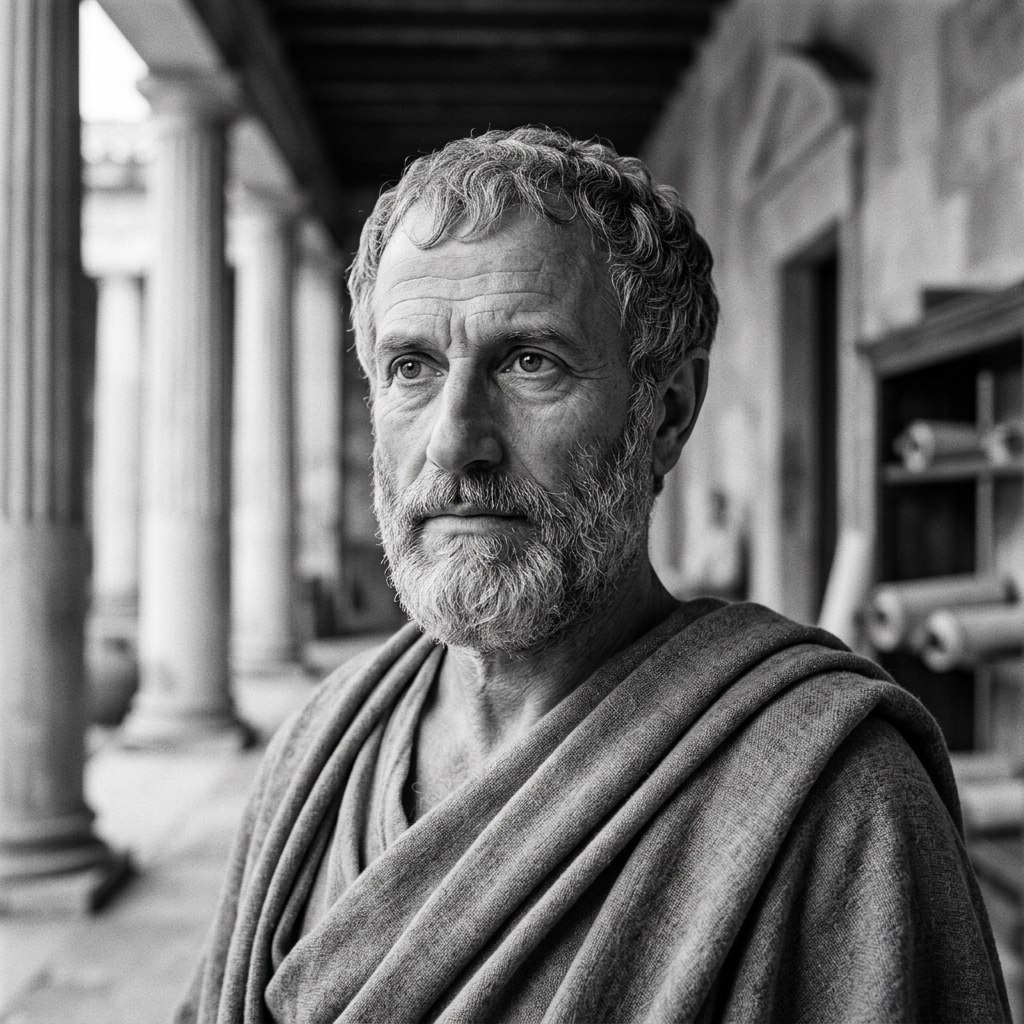
Featured image: Aristotle (AI illustration)