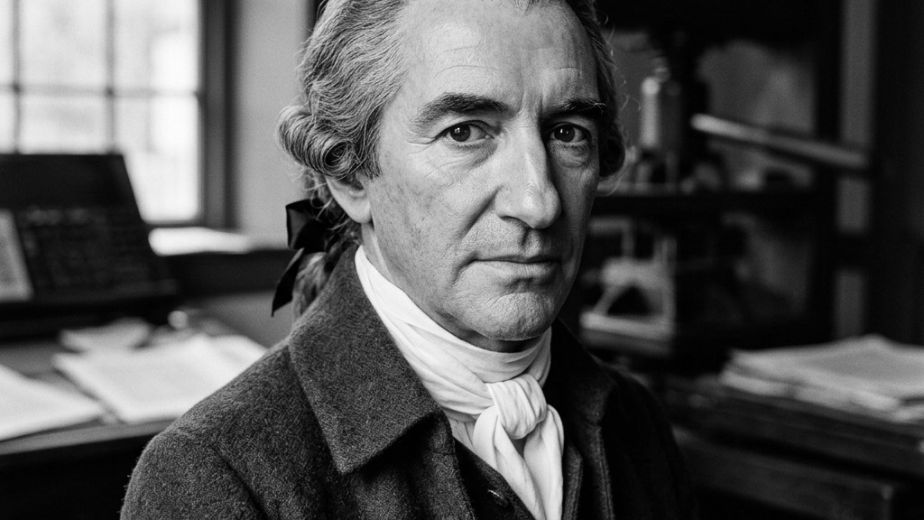
In 1845 the first volume of Kosmos (in English, Cosmos) appeared, the work in which Alexander von Humboldt set out to draft a physical description of the entire world. At the end of this portrait of nature, he hands the floor to someone else. He quotes a long passage from the linguistic work of his brother Wilhelm, who had died ten years earlier, on the idea of treating all of humanity “without reference to religion, nation, or color” as a single tribe. Then Alexander writes: “With these words, which draw their charm from the depths of feeling, let a brother be permitted to close this general description of the natural phenomena of the universe.”
The two brothers took very different paths. For friends of liberty they are interesting for two reasons: as a young man, Wilhelm wrote one of the most thorough arguments for a narrowly limited state that exist in the German language, and Alexander led a life that shows what a person can achieve with his own means and an independent mind.
At a glance
- Wilhelm von Humboldt: born June 22, 1767, in Potsdam; died April 8, 1835, in Tegel near Berlin
- Alexander von Humboldt: born September 14, 1769, in Berlin; died May 6, 1859, in Berlin
- Work: Wilhelm as a political thinker, diplomat, founder of the University of Berlin, and linguist; Alexander as an explorer, geographer, and naturalist
- Major works: Wilhelm: Ideen zu einem Versuch, die Grenzen der Wirksamkeit des Staats zu bestimmen (written 1792, printed in full 1851; in English, The Limits of State Action), Über die Kawi-Sprache auf der Insel Java (On the Kawi Language on the Island of Java, 1836 to 1840); Alexander: the account of his travels in the Americas (from 1805), Essai politique sur l’île de Cuba (Political Essay on the Island of Cuba, 1826), Kosmos (1845 to 1862)
- In one sentence: Wilhelm confined the state within the bounds of security, and Alexander showed how far a free person can go beyond those bounds.
Two brothers from Tegel
The brothers grew up in a wealthy Prussian noble family whose country estate, Tegel near Berlin, remained a center of life for both of them. Both studied in Frankfurt an der Oder and in Göttingen. Wilhelm then entered state service as a trainee jurist at the Kammergericht, Berlin’s high court, but left it again in 1791 after only about a year. That same year he married Caroline von Dacheröden and withdrew to her family’s estates. There, in Burgörner near Hettstedt, he wrote the book that is the main subject here, finishing it by May 1792.
Alexander studied at the Freiberg Mining Academy, became senior mining official (Oberbergmeister) for Ansbach and Bayreuth in 1792, founded a mining school in Steben at his own expense, and at the end of 1796 likewise left state service.
A book that had to wait almost sixty years
The Ideen zu einem Versuch, die Grenzen der Wirksamkeit des Staats zu bestimmen was finished in 1792, but at the time only individual parts appeared, in the Berlinische Monatsschrift and in Schiller’s journal Thalia. Humboldt set the full text aside, according to the English Cambridge edition partly because he expected trouble with the Prussian censors. The book was not printed in full until 1851, in Breslau, sixteen years after its author’s death.
After that its influence came quickly: in 1854 an English translation appeared in London under the title The Sphere and Duties of Government, and five years later John Stuart Mill placed a sentence from it at the head of his essay On Liberty as its motto. It speaks of the absolute importance of human development in its richest diversity. In the third chapter, Mill calls the German a man equally eminent as a scholar and as a politician, and adopts his two conditions of human development, “freedom, and a variety of situations.”
Man as an end in himself
Humboldt starts with the individual, not with the state. The second chapter contains the sentence on which everything else rests: “The true end of Man, or that which is prescribed by the eternal and immutable dictates of reason, and not suggested by vague and transient desires, is the highest and most harmonious development of his powers to a complete and consistent whole. Freedom is the grand and indispensable condition which the possibility of such a development presupposes.” Development (in German, Bildung) here means the unfolding of all of a person’s capacities into a coherent personality.
Alongside freedom he sets a second condition, which he calls “a variety of situations.” “Even the most free and self-reliant of men is thwarted and hindered in his development by uniformity of position.” This is the core of his critique of the state: whoever makes the lives of citizens uniform deprives them of a precondition of their development, even with the best of intentions.
Security, and nothing else
From this view of human beings follows Humboldt’s verdict on the state’s care for welfare. As he observes, every state institution for the welfare of the citizens bears the government’s stamp, and “however wise and salutary such a spirit may be, it invariably superinduces national uniformity, and a constrained and unnatural manner of action.”
At the end of the third chapter, Humboldt draws from this the first principle of his book: “the State is to abstain from all solicitude for the positive welfare of the citizens, and not to proceed a step further than is necessary for their mutual security and protection against foreign enemies; for with no other object should it impose restrictions on freedom.” By “mutual security” he means protecting the citizens from one another. In the fourth chapter he explicitly declares security, internal and external, to be the purpose of the state.
The following chapters show how far this idea reaches. On education, Humboldt writes: “national education seems to me to lie wholly beyond the limits within which political agency should properly be confined.” The reason is the same as before: in all state education the spirit of the government prevails, and it gives a person a certain civic mold. Religion, too, lies for him “beyond the sphere of the State’s activity,” and he considers it harmful to try to improve morals that violate no one’s rights. In the chapter on civil law he holds that a contract by which a person makes himself the mere means of another deserves no protection, such as “every contract which ends in the slavery of the person contracting.”
On war, Humboldt remains a child of his time and credits it with a character-forming effect. Yet the state should not bring it about, and Humboldt rejects standing armies because they “carry war, so to speak, into the very bosom of peace.”
The reformer in state service
Part of this book’s story is that its author later held high office himself. In 1802 Wilhelm went to Rome as Prussian resident at the Vatican. In 1809, as Prussia reorganized itself after its defeat by Napoleon, he took over the section for religious affairs and education in the Ministry of the Interior, and in 1810 he founded the University of Berlin. The author who had rejected state education now built a state education system.
He took his basic conviction with him. In a memorandum on the organization of Berlin’s institutions of higher learning, he names “solitariness and freedom” as their guiding principles. The state, he argues, should always remain aware that “the matter itself would proceed infinitely better without it” and that “it is always an impediment as soon as it interferes.” These are the words of an agency head who wants to set narrow limits on his own agency from the very start.
Later Wilhelm represented Prussia as envoy in Vienna and at the Congress of Vienna. In 1819 the king brought him into the cabinet, where he worked on a constitution based on the estates. The plans failed: in September the Carlsbad Decrees, with their censorship and surveillance, took effect, and on the last day of the year he was dismissed. After that he devoted himself to the study of language in Tegel.
Alexander: freedom as a way of life
Alexander von Humboldt wrote no theory of the state, but his life is a good example of what Wilhelm meant. When his mother died in November 1796, he inherited some 85,000 thalers. With this fortune he paid for his great expedition himself. In March 1799 he obtained permission in Madrid to travel and conduct research throughout the Spanish colonial empire. He set out in June, and when he returned to Bordeaux in August 1804, he had explored large parts of South America, Cuba, and Mexico.
On this journey Alexander saw slavery up close, and he never made his peace with it. In his Essai politique sur l’île de Cuba of 1826 he devoted a separate chapter to it. When an English edition appeared in New York in 1856 whose editor, John S. Thrasher, a supporter of slavery, had left out precisely this chapter, the 86-year-old protested publicly in a Berlin newspaper. He declared that he attached greater importance to this very part than to all the astronomical observations, magnetic measurements, and statistical data, and his statement was reprinted in numerous American newspapers. According to the Neue Deutsche Biographie, the standard German biographical dictionary, he also supported a Prussian law against slavery; such a law was passed in 1857.
In Kosmos he put his conviction into words that remain remarkably clear today: “While we maintain the unity of the human species, we at the same time repel the depressing assumption of superior and inferior races of men. There are nations more susceptible of cultivation, more highly civilized, more ennobled by mental cultivation than others, but none in themselves nobler than others. All are in like degree designed for freedom.” That he included these sentences in a work of natural science shows how closely, for him, the observation of nature and the judgment of human beings belonged together.
In fairness, it must be said that Alexander, too, depended on the crown. He was chamberlain to the Prussian king and drew a pension, and in 1827 the court called him back to Berlin for good. In the winter of 1827/28 he gave public lectures, sixteen of them at the Sing-Akademie for a broad audience. Kosmos grew out of them.
An argument that starts with the human being
Wilhelm offers a case for liberty that starts with the human being. He defends the limited state because people can become what they have it in them to be only in freedom and amid a variety of life situations. This idea complements the economic arguments of later liberals, and through Mill it entered the English-speaking liberal tradition. If you ask today whether the state should educate children, steer lifestyles, or cultivate opinions, you will find in Humboldt a well-considered answer that is more than two hundred years old.
Just as instructive is Humboldt’s insight that even well-meant care has its price. It produces uniformity and weakens the citizens’ ability to manage their affairs themselves and together with others.
Alexander, for his part, shows what an individual can accomplish who pays for his research out of his own fortune, and that respect for the dignity of all people can grow out of careful observation.
A work his brother brings to a close
That Alexander let the first volume of his life’s work end with Wilhelm’s words says a great deal about the brothers. In that passage Wilhelm speaks of the goal of treating all of humanity as one whole that exists for the “free development of inner strength.” It is the same idea with which, as a young man, he had drawn the limits of the state, now extended to all of humanity. Together the brothers remind us that the question of the limits of the state is ultimately a question of how much room a person has to become what he has it in him to be.
Further reading
- Wilhelm von Humboldt: Ideen zu einem Versuch, die Grenzen der Wirksamkeit des Staats zu bestimmen, Reclam, Stuttgart 1995 (in German); in English: The Limits of State Action, ed. J. W. Burrow, Cambridge University Press
- Alexander von Humboldt: Kosmos. Entwurf einer physischen Weltbeschreibung, vol. 1, Cotta, Stuttgart and Tübingen 1845 (in German); in English: Cosmos: A Sketch of a Physical Description of the Universe
- John Stuart Mill: On Liberty (1859), chapter III
- Andrea Wulf: Alexander von Humboldt und die Erfindung der Natur, C. Bertelsmann, Munich 2016 (in German); English original: The Invention of Nature: Alexander von Humboldt’s New World (2015)
This article is part of our series on thinkers, doers, and historical figures of liberty.
Sources
- Humboldt, Wilhelm von: Ideen zu einem Versuch, die Grenzen der Wirksamkeit des Staats zu bestimmen (written 1792; partial publication 1792 in the Berlinische Monatsschrift and in Schiller’s Thalia; complete edition ed. Eduard Cauer, Eduard Trewendt, Breslau 1851); cited from Projekt Gutenberg-DE (based on: Reclam, Stuttgart 1995), https://projekt-gutenberg.org/authors/friedrich-wilhelm-christian-karl-ferdinand-freiherr-von-humboldt/books/wirksamkeit-des-staats/chapter/1 (in German)
- Humboldt, Wilhelm von: The Sphere and Duties of Government, translated by Joseph Coulthard, John Chapman, London 1854; Online Library of Liberty, https://oll.libertyfund.org/titles/589
- Humboldt, Wilhelm von: Über die innere und äußere Organisation der höheren wissenschaftlichen Anstalten in Berlin (1809/10), German History in Documents and Images, https://germanhistorydocs.org/de/das-heilige-roemische-reich-1648-1815/wilhelm-von-humboldts-abhandlung-ueber-die-innere-und-aeussere-organisation-der-hoeheren-wissenschaftlichen-anstalten-in-berlin-1810 (in German); English translation by Thomas Dunlap: https://germanhistorydocs.org/en/the-holy-roman-empire-1648-1815/wilhelm-von-humboldt-s-treatise-quot-on-the-internal-and-external-organization-of-the-higher-scientific-institutions-in-berlin-quot-1810
- Humboldt, Alexander von: Kosmos. Entwurf einer physischen Weltbeschreibung, vol. 1, Cotta, Stuttgart and Tübingen 1845 (end of the portrait of nature, with a quotation from W. v. Humboldt, Über die Kawi-Sprache auf der Insel Java, vol. III, p. 426); cited from Projekt Gutenberg-DE, https://projekt-gutenberg.org/authors/friedrich-wilhelm-heinrich-alexander-freiherr-von-humboldt/books/kosmos-erster-band/chapter/16 (in German)
- Humboldt, Alexander von: Essai politique sur l’île de Cuba, Paris 1826
- Humboldt, Alexander von: statement against the Thrasher edition, Berlin, July 1856, in English as “Humboldt and the Americans” in The Globe and Traveller, London, July 29, 1856; digital edition of the University of Bern, https://humboldt.unibe.ch/text/1856-Insel_Cuba-03-neu
- Mill, John Stuart: On Liberty, London 1859 (motto and ch. III); Project Gutenberg, https://www.gutenberg.org/files/34901/34901-h/34901-h.htm
- Masur, Gerhard; Arens, Hans: “Humboldt, Wilhelm von,” in: Neue Deutsche Biographie 10 (1974), with the ADB article by Alfred Dove (1881), https://www.deutsche-biographie.de/sfz35962.html (in German)
- “Humboldt, Alexander von,” in: Neue Deutsche Biographie, https://www.deutsche-biographie.de/sfz35959.html (in German)
- Burrow, J. W.: Editor’s Introduction, in: Wilhelm von Humboldt: The Limits of State Action, Cambridge University Press, https://core-prod.cambridgecore.org/core/books/limits-of-state-action/editors-introduction/521A51771134118FB698C74F01FA7983
- Humboldt Digital Library / University of Chicago Press: Thrasher’s edition The Island of Cuba (1856) and Humboldt’s protest, https://press.uchicago.edu/sites/humboldt/1_7_thrasher.html
- Seibert: article on the Marcellino case and the Prussian law of 1857, Revista de História (Universidade de São Paulo), https://revistas.usp.br/revhistoria/article/view/235869
- Quote Investigator: “The Most Dangerous Worldview is the Worldview of Those Who Have Not Viewed the World” (misattribution to A. v. Humboldt), July 4, 2026, https://quoteinvestigator.com/2026/07/04/not-worldview/
- Texas A&M University Library catalog: first edition, Breslau 1851, https://libcat.library.tamu.edu/Record/in00003853929/Description
- Wulf, Andrea: Alexander von Humboldt und die Erfindung der Natur, C. Bertelsmann, Munich 2016 (recommended reading, not used as a source; in German)