In 399 BC, a seventy-year-old man stood in Athens before a court made up of citizens of his city. The charge was impiety: he was corrupting the young and did not recognize the city’s gods but was introducing new divine beings. Socrates could have pleaded for leniency, as was customary. Instead he told the judges what he would answer if they let him go on condition that he stop philosophizing: “Men of Athens, I honour and love you; but I shall obey God rather than you, and while I have life and strength I shall never cease from the practice and teaching of philosophy” (Plato, Apology 29d, translated by Benjamin Jowett).
A few weeks later he drank the hemlock. Ever since, he has been regarded as the archetype of a person who does not surrender his judgment to the majority. He was not a libertarian in today’s sense; you will find no theory of property, markets, or human rights in him. What he left to the idea of liberty is something more fundamental: the conviction that every claim may be examined, including those of the powerful, and that one’s own conscience knows a limit that no assembly can move.
At a glance
- Life: 469 to 399 BC, Athens (deme of Alopece)
- Background: son of the stonemason Sophroniscus and the midwife Phaenarete, married to Xanthippe, three sons
- Work: philosopher in conversation on the streets and squares of Athens, hoplite at Potidaea, Delium, and Amphipolis, member of the Council in 406 BC
- Works: no writings of his own; known through Plato, Xenophon, and Aristophanes
- In one sentence: He taught that a life without examination is not worth living, and he paid for this teaching with his life.
A stonemason’s son in the Agora
Socrates was born in Athens in 469 BC, the son of the stonemason Sophroniscus; his mother, Phaenarete, later became a midwife. As a heavily armed foot soldier he went on campaign several times in the Peloponnesian War. At Potidaea he saved the wounded Alcibiades, and during the retreat from Delium his composure was praised. He held public office only once, as a member of the Council.
He spent most of his life in conversation, and he took no money for it. In the Apology, he calls his poverty as a witness that he never asked for a fee (31b–c), and in this he deliberately set himself apart from the Sophists, the paid itinerant teachers of his time.
What we can know about him
Socrates left behind not a single line. Everything we know about him comes from three contemporaries, and each of them had his own purposes. In 423 BC the comic playwright Aristophanes put him on stage in The Clouds as the eccentric head of a “Thinkery” who investigates the heavens and the underworld and teaches his pupils to make wrong into right. Plato has Socrates himself refer to this caricature in court (Apology 19c). The officer and writer Xenophon, in his Memorabilia, portrayed a pious adviser with practical wisdom and explicitly defended him against the charges. Finally, Plato, his most important student, made him the main character of most of his dialogues.
Plato is the richest source and at the same time the most difficult, because in his later works Socrates clearly voices Plato’s own doctrines. Scholars therefore rely above all on the early dialogues: the Apology, the speech of defense in court, and the Crito, the conversation in prison. Aristotle was born only some fifteen years after Socrates’ death and relied largely on Plato. The historian of philosophy William Guthrie concluded from this that there will always be a “Socratic problem.” What follows is above all the Socrates of Plato’s early dialogues, supplemented by Xenophon.
The art of shaking certainties
His mission began, as the Apology tells it, with a pronouncement of the oracle. His friend Chaerephon had asked at Delphi whether anyone was wiser than Socrates, and the answer was: no one (21a). Socrates wanted to refute this and questioned politicians, poets, and craftsmen who were considered wise. He found people who believed they knew many things they did not know. He was wiser than they, he said, in only one respect: “I neither know nor think that I know” (21d). The familiar formula “I know that I know nothing” is a later sharpening of this sentence and does not appear in that form in Plato.
The Greeks called his method elenchus, examination by refutation. Socrates kept asking questions until a seemingly secure definition of courage, piety, or justice became entangled in contradictions. He compared himself to a spur that the god had attached to the city as to a large, noble horse that, precisely because of its size, tends toward sluggishness (30e).
From this follows the sentence that has probably had the greatest influence. Daily conversation about virtue, he said, is the greatest good for a human being, and “the unexamined life is not worth living” (38a). It contains a demand that every individual must make of himself and that no authority can take off his hands.
Against the Assembly and against the Thirty
Twice Socrates also acted, and both times against those in power. In 406 BC his tribe (phyle), the district unit, held the presidency of the Council when the popular Assembly wanted to condemn the generals of the naval battle of Arginusae in a single trial, because they had not recovered the dead after the battle. This was against the law, which required a separate trial for each man. Socrates was the only one of the presiding members who opposed it, even though speakers were already threatening to have him arrested (32b–c).
Two years later, after the defeat by Sparta, Athens was ruled by the Thirty, an oligarchy led by Critias. They ordered Socrates and four others to bring in a certain Leon of Salamis for execution. The four went; Socrates went home, and that, as he says, would probably have cost him his life had the regime not fallen soon afterward (32c–d). Xenophon also reports that the leading figures of the Thirty, Critias and Charicles, forbade him to talk with young men, because he had compared them to a herdsman who thins out his own herd (Memorabilia I.2.31–38).
From these experiences he draws a remarkable conclusion in the Apology. An inner divine sign, he says, always kept him from going into politics, and rightly so: no one who opposes a crowd in order to prevent injustice can survive for long. Therefore “he who will fight for the right, if he would live even for a brief space, must have a private station and not a public one” (31c–32a). Justice appears here as a matter for the individual, one that can hardly be preserved close to power.
The trial
After the fall of the Thirty, the returning democrats declared an amnesty for political acts in 403 BC. Political charges were thus ruled out, and so the young poet Meletus, supported by Anytus and Lycon, brought a religious charge. That Critias and Alcibiades, who had done the city great harm, had belonged to his circle still resonated; Xenophon reports that the accuser reproached him with precisely this (Memorabilia I.2.12 ff.).
In court, Socrates refused to beg the judges or to arouse pity (34c–35b). After the narrow guilty verdict he was allowed, as was customary under Athenian law, to propose a penalty himself. He first asked for what was due to a benefactor of the city, namely “maintenance in the Prytaneum,” an honor that, in his own words, he deserved far more than the citizen who had won the prize at Olympia in the horse or chariot race (36d). Then he offered one mina of silver, and finally, at the urging of Plato, Crito, and other friends, thirty minae, for which they were willing to stand surety (38b). The judges chose death. Because no one could be executed during a sacred mission to Delos, he remained in prison for about thirty more days.
Why he did not flee
The Crito is set in this period. His friend Crito has raised money for an escape and offers him a safe refuge with friends in Thessaly (45a–c). Socrates declines and justifies this first with a principle he says he has often defended: one must never deliberately do wrong, not even in retaliation for wrong suffered (49a–d).
Then he lets the Laws of Athens speak for themselves. They brought him into being, raised him, and educated him, they say, and one owes the fatherland more reverence than one’s parents. The fatherland is “either to be persuaded, or if not persuaded, to be obeyed” (51b–c). At the same time, the Laws point out that any Athenian who is displeased with them “may go where he pleases and take his goods with him” (51d). Whoever stays has consented by his conduct. Socrates had seventy years to go to Sparta or Crete, whose order he liked to praise, and he never did (52e). If he dies now, then as one who has suffered wrong, “a victim, not of the laws, but of men” (54c).
Friends of liberty often read this dialogue with unease, because it seems to grant the state an obedience that the Apology refuses. Scholars disagree on how far the contradiction goes. In Socrates and the State (1984), the philosopher Richard Kraut argued that the choice between persuading and obeying leaves room for disobedience as long as one defends it with reasons. Others consider the Crito stricter; still others think Socrates merely puts the speech into the mouths of the Laws to calm the distraught Crito. What is certain is that Socrates in prison does not retract what he said in court. He refuses an act he considers wrong and openly accepts the consequences. It also remains remarkable that this early text already grounds the obligation to an order in the freedom to leave it, an idea reminiscent of John Locke’s later doctrine of tacit consent.
What friends of liberty can learn from him
The first lesson concerns freedom of thought. In the famous second chapter of On Liberty (1859), John Stuart Mill writes: “Mankind can hardly be too often reminded that there was once a man named Socrates, between whom and the legal authorities and public opinion of his time, there took place a memorable collision.” The authorities condemned him to death for impiety. For Mill this was proof that even the conviction of a majority can be mistaken and that whoever suppresses an opinion may be suppressing the truth. In The Open Society and Its Enemies, Karl Popper portrayed Socrates, for similar reasons, as the model of a critical attitude that is aware of the limits of its own knowledge.
Alongside this stands the primacy of conscience. Socrates defied an unlawful popular Assembly just as he defied a tyranny, and he did so without violence, openly, and at the risk of his life. The Leon episode is an early example of state authority to command meeting its limit in the conscience of the individual, even if some scholars see in it loyalty to proper procedure rather than a revolt against the order itself.
Less comfortable is the fact that examination never stops and spares no side. Socrates was not simply a supporter of Athenian democracy: according to Xenophon, the accuser charged that he had mocked the filling of offices by lot, since no one would choose a helmsman or a flute player by lot either (Memorabilia I.2.9). His respect was for understanding, not for numbers, and he demanded of everyone, himself included, that they expose their own certainties to the questions of others.
A spur for every age
Socrates drafted no constitution and described no order of liberty. He did something that precedes every such order: he insisted that a single human being, with his questions and his conscience, can carry more weight than the decision of a majority. At the end of his defense speech he took leave of the judges by saying that it was time to go, he to die and they to live, and which of the two had the better lot in store, only the god knew (42a, paraphrased). Whether a society tolerates its uncomfortable questioners has since been a test by which every free order must be measured, and Athens failed it in 399, although it had let Socrates ask his questions for decades before.
Further reading
- Plato: Apologie des Sokrates and Kriton, translated by Friedrich Schleiermacher, freely available at zeno.org; bilingual edition from Reclam, Stuttgart (in German)
- Xenophon: Erinnerungen an Sokrates, translated by Rudolf Preiswerk, Reclam, Stuttgart (in German)
- John Stuart Mill: Über die Freiheit, chapter 2, Reclam, Stuttgart (in German); English original: On Liberty (1859)
- Karl R. Popper: Die offene Gesellschaft und ihre Feinde, vol. 1: Der Zauber Platons, Mohr Siebeck, Tübingen 2003 (in German); English original: The Open Society and Its Enemies, vol. 1: The Spell of Plato (1945)
This article is part of our series on thinkers, doers, and historical figures of liberty.
Sources
- Plato: Apology, translated by Benjamin Jowett, Project Gutenberg no. 1656, https://www.gutenberg.org/ebooks/1656 (quotations); German edition: Des Sokrates Verteidigung, translated by Friedrich Schleiermacher (1805), in: Platon: Sämtliche Werke, vol. 1, Berlin [1940], pp. 7–37 (in German); http://www.zeno.org/Philosophie/M/Platon/Des+Sokrates+Verteidigung (cited: 19b–c, 21a–d, 24b, 29d, 30e, 31b–32d, 34c–35b, 36a–d, 38a–b, 42a)
- Plato: Crito, translated by Benjamin Jowett, Project Gutenberg no. 1657, https://www.gutenberg.org/ebooks/1657 (quotations); German edition: Kriton, translated by Friedrich Schleiermacher (1805), ibid. (in German); http://www.zeno.org/Philosophie/M/Platon/Kriton (cited: 45a–c, 49a–d, 50a–54d)
- Xenophon: Memorabilia, translated by H. G. Dakyns, Project Gutenberg no. 1177, https://www.gutenberg.org/files/1177/1177-h/1177-h.htm (I.1.1; I.2.9–10; I.2.12 ff.; I.2.31–38); German: Erinnerungen an Sokrates, translated by Rudolf Preiswerk, Reclam, Stuttgart (in German)
- Aristophanes: The Clouds (first performed 423 BC)
- John Stuart Mill: On Liberty (1859), chapter 2, Project Gutenberg no. 34901, https://www.gutenberg.org/files/34901/34901-h/34901-h.htm
- Debra Nails / Sara Ahbel-Rappe: “Socrates,” Stanford Encyclopedia of Philosophy, https://plato.stanford.edu/entries/socrates/
- “Socrates,” Internet Encyclopedia of Philosophy, https://iep.utm.edu/socrates/
- Karl R. Popper: Die offene Gesellschaft und ihre Feinde, vol. 1: Der Zauber Platons, Mohr Siebeck, Tübingen 2003 (in German; English original The Open Society and Its Enemies, vol. 1: The Spell of Plato, 1945)
- Richard Kraut: Socrates and the State, Princeton University Press, Princeton 1984
- Overview of scholarship on the tension between the Apology and the Crito: Peitho (Adam Mickiewicz University, Poznań), https://pressto.amu.edu.pl/index.php/peitho/article/download/7840/7842/15490; Isaac: “Socrates and the Public Laws of Athens,” Aporia (BYU), https://aporia.byu.edu/pdfs/isaac-socrates_and_the_public_laws_of_athens.pdf; Gary Young, PhilPapers, https://api.philpapers.org/rec/YONSTC
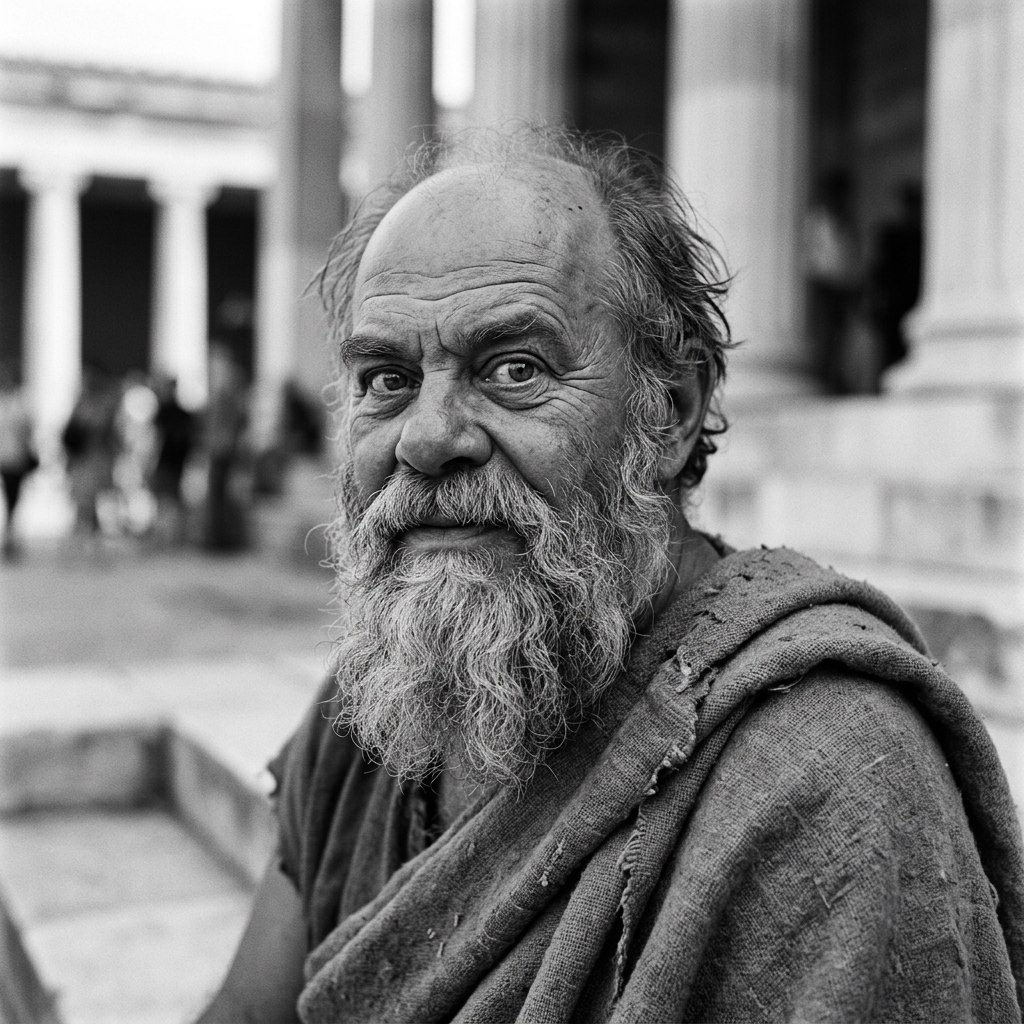
Featured image: Socrates (AI illustration)