On June 22, 1633, in the Dominican convent of Santa Maria sopra Minerva in Rome, a man of almost seventy knelt before the cardinals of the Inquisition. Galileo Galilei had been found “vehemently suspected of heresy,” and now he read out an abjuration: he cursed and detested the error that the sun stands still and the earth moves. His Dialogue Concerning the Two Chief World Systems was banned, and he himself was sentenced to imprisonment at the Church’s discretion and to recite the seven penitential psalms once a week for three years.
Most people know the scene with a postscript. As he rose, Galileo is said to have muttered “Eppur si muove,” “and yet it moves.” But the phrase first appears only in 1757, in a book printed in London by the Italian writer Giuseppe Baretti, more than a century after Galileo’s death. His student and first biographer, Vincenzo Viviani, does not mention it. A painting that shows the phrase and supposedly dates from the 1640s is, according to the research of the astrophysicist Mario Livio, probably much younger. Galileo does not need this legend. What he actually wrote matters more to the history of liberty than any defiant half sentence.
At a glance
- Life: February 15, 1564, in Pisa, to January 8, 1642, in Arcetri near Florence
- Work: Mathematician, physicist, and astronomer; professor in Pisa and Padua, from 1610 Chief Mathematician and Philosopher to the Grand Duke of Tuscany
- Major works: Sidereus Nuncius (1610), Letter to the Grand Duchess Christina (1615), Il Saggiatore (1623), Dialogo sopra i due massimi sistemi del mondo (1632), Discorsi e dimostrazioni matematiche intorno a due nuove scienze (1638)
- In one sentence: He insisted that questions about nature are settled by observation and proof, not by any authority, and spent the last years of his life under arrest for it.
A Mathematician Between University and Court
Galileo enrolled in medicine at Pisa in 1581 but left the university without a degree and turned to mathematics. In 1589 he received a post there as a lecturer, and in 1592 a chair in Padua, which belonged to the Republic of Venice. With Marina Gamba, whom he never married, he had three children. His two daughters, who as illegitimate children had little prospect of marriage, he placed while still young girls in the Poor Clares convent of San Matteo in Arcetri; the elder took her vows in 1616 as Suor Maria Celeste, the younger a year later.
In 1609 Galileo heard of a Dutch telescope. He had not invented the instrument, but he improved it to the point where he could use it to search the sky. In March 1610 his Sidereus Nuncius, the “Starry Messenger,” appeared in Venice: the moon had mountains and valleys, the Milky Way consisted of countless stars, and four moons circled Jupiter. Galileo called these moons the Medicean Stars and dedicated the book to Cosimo II de’ Medici. The calculation paid off, for that same year the Grand Duke brought him to Florence as court mathematician and philosopher, with a professorship that carried no teaching duties. Anyone who sees mere flattery in this misunderstands how scholars earned their living at the time. In hindsight the move had its price, because it meant leaving the Republic of Venice, which acted with comparative independence toward Rome. In Florence, toward the end of 1610, he also observed the phases of Venus, which could not be reconciled with the old picture of the world in which everything revolves around the earth.
How One Goes to Heaven
His most important contribution to the idea of liberty is found not in any work of astronomy but in a letter. When opponents objected that the motion of the earth contradicted the Bible, he wrote in 1613 to his student Benedetto Castelli, and in 1615 he worked the idea out into a long letter to the Grand Duchess Christina of Lorraine, the mother of his employer. In it he distinguishes two paths to truth. Scripture and nature both come from God and therefore cannot contradict each other. But where nature is concerned, one should begin with sense experience and with conclusive demonstrations, because the Bible speaks of natural things in the language of the common people.
He borrowed the letter’s best-known sentence from a high-ranking churchman, who according to a marginal note was Cardinal Cesare Baronio: the intention of the Holy Spirit is to teach us “come si vadia al cielo, e non come vadia il cielo.” In Stillman Drake’s English, the point is “how one goes to heaven, not how heaven goes.” Elsewhere Galileo writes, in substance, that he does not feel obliged to believe that the same God who gave us senses, reason, and judgment wants us to forgo their use.
Galileo was not demanding religious freedom in the later sense, nor was he attacking the Church. He wrote as a believing Catholic who wanted to keep his Church from making a mistake. Yet that is precisely where the explosive force lies. Whoever accepts that there are questions which only observation and proof can settle draws a line at which every authority must stop, whether it appeals to Scripture, to Aristotle, or to an office. What is true about the world is then discovered and can be checked by anyone, instead of being decreed from above. This is an early form of what liberals would later call freedom of science.
The Church did not follow him in this. In March 1616 the book of Copernicus was suspended “until corrected,” and Cardinal Robert Bellarmine admonished Galileo not to defend the doctrine of the earth’s motion. An alleged stricter injunction, held against him in 1633, survives only in a record without seal or signature.
A Book Written in Mathematics
In Il Saggiatore, “The Assayer,” of 1623, we find the passage that is still regarded as the program of modern natural science. Philosophy, Galileo writes in substance, is written in the great book that lies continually open before our eyes, the universe, and this book is written in the language of mathematics; its letters are triangles, circles, and other geometric figures. Whoever does not learn this language wanders about as if in a dark labyrinth.
The work was a polemic against the Jesuit Orazio Grassi, and on the actual question, of all things, Galileo was wrong: he took comets to be phenomena below the moon. His mockery of opponents, especially sharp here, won him few friends among the Jesuits. A denunciation of the book to the Inquisition had no consequences at the time.
A Dialogue for Everyone Who Can Read
With the Dialogo, whose printing was completed in Florence in February 1632, Galileo addressed a broad audience. He wrote in Italian instead of Latin and had three men argue over four days: the Copernican Salviati, the open-minded layman Sagredo, and the Aristotelian Simplicio. Formally the book weighed both world systems; in reality it made the case for Copernicus. In this way Galileo brought a question that scholars and theologians had until then decided among themselves before a reading public, and that in itself had a liberal streak.
Two things proved his undoing. His main proof of the earth’s motion, the explanation of the tides, was wrong and failed to convince even then. And the Pope’s favorite argument, that God could have arranged the world in any way he pleased so that it appears to us as we see it, Galileo put, at the end, into the mouth of Simplicio, of all people, the character who had come off worse for four days. Pope Urban VIII felt exposed. In the summer of 1632 sales were stopped, and Galileo had to answer to the Inquisition in Rome.
No Dungeon, No Torture, Still an Injustice
The trial is surrounded by images that do not hold up. Galileo was never in a dungeon. In Rome he first stayed with the Tuscan ambassador at the Villa Medici, and during the interrogations he was lodged in rooms of the Holy Office. On June 21, 1633, during the “rigorous examination,” he was threatened with torture, but in the judgment of most historians this was a formality required by the procedure, and it was not carried out. The day after the sentence, his imprisonment was commuted to house arrest. He lived first with the Archbishop of Siena, Ascanio Piccolomini, and from December 1633 at his country house in Arcetri, near his daughters’ convent, where he was allowed to receive visitors only with restrictions.
The famous experiment of dropping objects from the Leaning Tower of Pisa also belongs more to legend. It is reported only by Viviani, who knew Galileo only in his last years, while Galileo himself never mentions it.
That reality was milder than the myth does not change the core. An old man was forced to declare publicly false what, to the best of his knowledge, he held to be true, and his book could no longer be read. That is the injustice, and it remains one even though Galileo did not end at the stake like Giordano Bruno. He is sometimes reproached for recanting instead of dying, but a duty to martyrdom is hard to justify.
A Manuscript Travels to Leiden
In Arcetri Galileo wrote his major work in physics, the Discorsi on two new sciences, the strength of materials and the science of motion, with the law of falling bodies and the parabolic path of projectiles. The book could not be published in Italy. Through the French ambassador François de Noailles the manuscript made its way out of the country, and in 1638 the house of Elzevir printed it in Leiden in the Netherlands, where the bans of the Inquisition did not apply. By then Galileo had gone blind.
In the summer of 1638, by his own account, a young Englishman traveling in Italy visited him: John Milton. Six years later, when he urged the English Parliament in Areopagitica to abolish prior censorship, Milton wrote of having found and visited “the famous Galileo, grown old, a prisoner to the Inquisition, for thinking in astronomy otherwise than the Franciscan and Dominican licensers thought.” With that, the case became an argument for freedom of speech while Galileo was still alive.
What Remains of the Trial
Galileo died in Arcetri on January 8, 1642. More than three centuries later, Pope John Paul II had the case reexamined; a commission worked from 1981 on, and on October 31, 1992, before the Pontifical Academy of Sciences, the Pope spoke of the error of the theologians of the time and of a “tragica reciproca incomprensione,” a tragic mutual misunderstanding. He did not thereby formally annul the sentence, but he stated that it had not been irreversible.
Galileo was not a political thinker of liberty. He wrote not a line about property, trade, or the limits of state power; he served a princely court and sought the favor of cardinals. His contribution lies in another field, one no less important for liberty. He showed that knowledge comes from testing that anyone can repeat, and that an authority which prescribes results does not thereby change the world. Anyone who sees today how agencies, committees, or an agitated public try to decide which research findings may be spoken can read in Galileo why this does not succeed in the long run, and in Milton why one should not even try.
Further reading
- Galileo Galilei: Dialog über die beiden hauptsächlichen Weltsysteme, das ptolemäische und das kopernikanische, edited by Roman Sexl and Karl von Meyenn, Teubner, Stuttgart 1982 (in German)
- Galileo Galilei: Sidereus Nuncius. Nachricht von neuen Sternen, edited by Hans Blumenberg, Suhrkamp, Frankfurt am Main 2002 (in German)
- Albrecht Fölsing: Galileo Galilei. Prozess ohne Ende, Piper, Munich 1983 (in German)
- John L. Heilbron: Galileo, Oxford University Press, Oxford 2010
This article is part of our series on thinkers, doers, and historical figures of liberty.
Sources
- Galilei, Galileo: Sidereus Nuncius, Venice 1610; German: Sidereus Nuncius. Nachricht von neuen Sternen, ed. Hans Blumenberg, Suhrkamp, Frankfurt am Main 2002 (in German); English: The Sidereal Messenger, translated by Edward Stafford Carlos, London 1880, https://gutenberg.org/files/46036/46036-h/46036-h.htm
- Galilei, Galileo: Letter to the Grand Duchess Christina of Lorraine (1615); English in: Stillman Drake (ed. and trans.): Discoveries and Opinions of Galileo, Doubleday, New York 1957, pp. 175–216
- Galilei, Galileo: Il Saggiatore, Rome 1623
- Galilei, Galileo: Dialogo sopra i due massimi sistemi del mondo, Florence 1632; German: Dialog über die beiden hauptsächlichen Weltsysteme, ed. Roman Sexl and Karl von Meyenn, Teubner, Stuttgart 1982 (in German)
- Galilei, Galileo: Discorsi e dimostrazioni matematiche intorno a due nuove scienze, Elzevir, Leiden 1638
- Sentence and abjuration of June 22, 1633, English translation: Documents in the Case of Galileo, https://hti.osu.edu/sites/hti.osu.edu/files/documents_in_the_case_of_galileo_0.pdf
- Milton, John: Areopagitica, London 1644
- John Paul II: Address to the Pontifical Academy of Sciences, October 31, 1992, https://www.vatican.va/content/john-paul-ii/it/speeches/1992/october/documents/hf_jp-ii_spe_19921031_accademia-scienze.html
- Machamer, Peter; Miller, David Marshall: “Galileo Galilei,” Stanford Encyclopedia of Philosophy, https://plato.stanford.edu/entries/galileo/
- Fölsing, Albrecht: Galileo Galilei. Prozess ohne Ende, Piper, Munich 1983 (in German)
- Heilbron, John L.: Galileo, Oxford University Press, Oxford 2010
- Encyclopaedia Britannica: “Galileo’s Copernicanism,” https://www.britannica.com/biography/Galileo-Galilei/Galileos-Copernicanism
- Museo Galileo: itinerary “The Trial,” https://brunelleschi.imss.fi.it/itineraries/itinerary/TheTrial.html
- Museo Galileo: Discorsi e dimostrazioni matematiche intorno a due nuove scienze (1638), https://www2.museogalileo.it/en/library-and-research-institute/projects/meet-galileo/38-works/470-discorsi-e-dimostrazioni-matematiche-intorno-a-due-nuove-scienze-1638.html
- Livio, Mario: “Did Galileo Truly Say, ‘And Yet It Moves’? A Modern Detective Story,” Scientific American, 2020, https://www.scientificamerican.com/blog/observations/did-galileo-truly-say-and-yet-it-moves-a-modern-detective-story/
- Physics World: “The legend of the leaning tower,” https://physicsworld.com/a/the-legend-of-the-leaning-tower/
- Universidad de Navarra, Ciencia, Razón y Fe: the Galileo case, https://en.unav.edu/web/ciencia-razon-y-fe/lo-que-deberiamos-saber-sobre-galileo
- Arcangeli: paper on the Lettera a Cristina di Lorena, SISRI, https://sisri.pusc.it/doc/arcangeli.pdf
- Linda Hall Library: Suor Maria Celeste, https://www.lindahall.org/about/news/scientist-of-the-day/suor-maria-celeste/
- Italian Art Society: June 22, 1633, https://www.italianartsociety.org/2020/06/on-this-day-22-june-in-1633-galileo-galilei-was-forced-to-recant-his-theory-that-the-earth-orbited-the-sun/
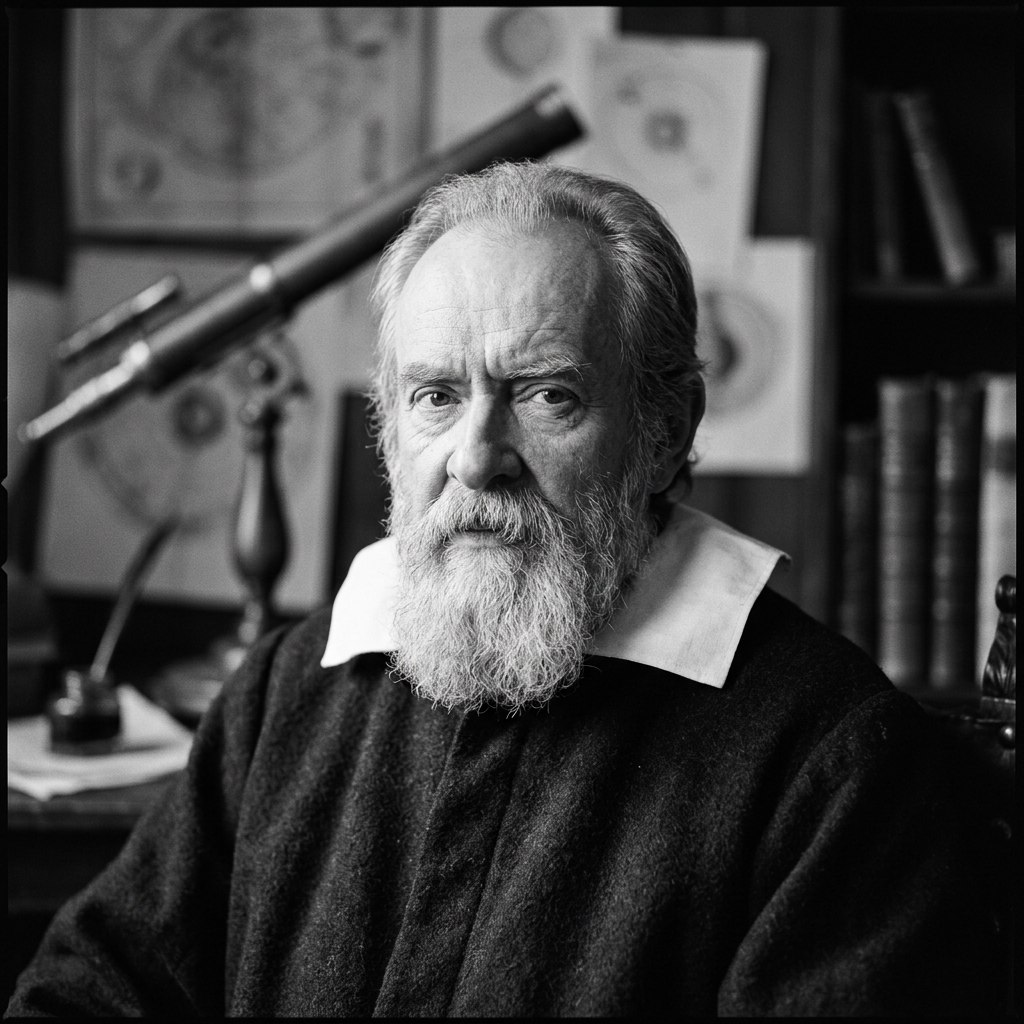
Featured image: Galileo Galilei (AI illustration)