A shepherd boy tending his father’s sheep in the Mugello, the hill country north of Florence, draws one of the animals on a smooth slab of stone. The painter Cimabue happens by, marvels at the picture, and asks the poor father to let him take the boy as an apprentice. For centuries this is how Giotto’s life story has begun, and in all likelihood it is invented.
It first appears in the Commentarii of the sculptor Lorenzo Ghiberti, completed around 1447/48 and thus more than a hundred years after Giotto’s death, and Giorgio Vasari made it famous in 1550 in his Lives of the artists. The art historians Michael Viktor Schwarz and Pia Theis, who collected and edited all known documents on Giotto’s life, consider it a legend modeled on an older child-prodigy tale about another painter. Nor is there any evidence that Cimabue was his teacher. The documents tell a more sober story, and one that offers more to a history of liberty: it concerns a craftsman’s son who became famous through skill, worked for bankers, kings, and his native city, and on the side rented out a house and a loom, bought land, and sued tenants who fell behind on their payments. His frescoes contain no political program, but his life does show what was possible around 1300 in a city of burghers where craftsmen and merchants shared in government through their guilds.
At a glance
- Life: c. 1267 (uncertain) to January 8, 1337, in Florence
- Work: Painter, mosaicist, and architect in Florence, Rome, Assisi, Padua, Naples, and Milan; in 1330 familiare (member of the royal household) of King Robert of Naples, in 1334 chief architect of the cathedral and the city fortifications in Florence
- Major works: Frescoes of the Arena Chapel in Padua (consecrated 1305), the Navicella mosaic and the Stefaneschi Altarpiece for Old St. Peter’s, the painted crucifix of Santa Maria Novella, the Ognissanti Madonna, the Bardi and Peruzzi Chapels in Santa Croce, the campanile in Florence (begun 1334)
- In one sentence: He told the sacred stories as events between human beings and, as the son of a blacksmith, rose to become a celebrated citizen of his city.
A blacksmith’s son from Santa Maria Novella
According to the documents, Giotto was the son of the blacksmith Bondone, who was living in the parish of Santa Maria Novella in Florence by 1295 at the latest; his brother Martino was also a blacksmith and in 1297 an officer of his guild. The blacksmiths belonged to the middle guilds, which had shared in the government of the city since 1282. Giotto, then, did not come from a poor farmhouse but from an urban family of craftsmen rooted in its guild. His year of birth is uncertain; a rhymed chronicle from the later 14th century suggests about 1267. He is reliably connected with the Mugello only from 1315 on, and then as a landowner.
The famous “O” is likewise a legend. Vasari relates that Giotto gave a pope’s messenger nothing but a perfect circle drawn freehand as a sample of his skill. The anecdote was probably spun out of a proverbial saying, and the great papal commission said to have followed it demonstrably never happened in that form.
Famous in his own lifetime
Contemporaries attest to how highly Giotto was actually regarded. While the painter was still alive, the chronicler Riccobaldo of Ferrara listed his works in Assisi, Rimini, and Padua, and in 1312 a Florentine citizen called him an “egregium pictorem,” an excellent painter, in his will. In the eleventh canto of the Purgatorio, written in the 1310s, Dante has an illuminator of manuscripts say: “Credette Cimabue ne la pittura / tener lo campo, e ora ha Giotto il grido,” in Longfellow’s translation: “In painting Cimabue thought that he / Should hold the field, now Giotto has the cry.” The passage is about the transience of earthly fame, and precisely for that reason it shows what Giotto’s name already stood for at the time.
Which works established this fame is partly disputed. Secure attributions include the Navicella mosaic and the altarpiece that Cardinal Jacopo Stefaneschi commissioned for Old St. Peter’s. A document from before 1309 proves that Giotto worked in Assisi, but whether the famous St. Francis cycle in the Upper Church is by him remains an open question. Ever since Friedrich Rintelen raised doubts in 1912, many scholars, especially outside Italy, have disputed Giotto’s authorship, while Italian art history has largely defended it.
A banker, a chapel, and a blue sky
The Arena Chapel in Padua was built by a private individual. Enrico Scrovegni, a wealthy merchant and banker, bought the site of the ancient amphitheater in February 1300 and built a family oratory with a burial place there, which was consecrated on March 25, 1305. In Enrico’s father Reginaldo, Dante’s commentators have recognized the Paduan usurer whose purse, in the seventeenth canto of the Inferno, bears a blue sow, the family’s heraldic animal. Whether the son founded the chapel partly to atone for his father’s business, as one often reads, or above all wanted to display his standing in the city remains an interpretation that scholars argue over.
Giotto covered the walls with the life of Mary and of Christ in tiers of narrative panels, above them a deep blue vault with golden stars, and on the entrance wall the Last Judgment. The figures have bodily weight, they turn toward one another, and their faces speak. In the Lamentation of Christ, mourners bend over the dead man, two figures sit in the foreground with their backs to the viewer, and in the air angels wail with contorted faces. Many have seen in this a new view of the individual human being who knows pain, doubt, and tenderness; that is an interpretation from a later vantage point. Closer to Giotto’s own task is to see him as a storyteller who made the sacred stories compelling by giving his figures dignity and an inner life.
Also remarkable is who paid. Besides churches, religious orders, and princes, Giotto worked for citizens: for Scrovegni in Padua, in Florence for the banking and merchant families Bardi and Peruzzi, whose chapels in Santa Croce he painted, and for the lay confraternity of Santa Maria Novella, which may have been the donor of his great painted crucifix.
The painter as businessman
Giotto ran a workshop with assistants, among them, on a permanent basis, the painter Taddeo Gaddi. Alongside this he invested his money. In 1301 he owned a house in Florence, which he rented out in 1305. In 1311 he and four other men stood surety for a debt of 500 gold florins, which they took over and collected themselves. Schwarz and Theis explain the absence of any mention of interest by the Church’s ban on usury, since such arrangements were not put in writing. From 1315 on, Giotto acquired plots of land in the Mugello, leased them out, quarreled with a notary over four parcels, and sued a tenant who failed to pay his dues.
The best-known document dates from September 4, 1312. Giotto rented a French loom worth ten lire to a home weaver named Bartolus Rinuccii for six months, at twenty soldi a month. From this the historian Robert Davidsohn calculated an annual return of 120 percent on the capital invested. Schwarz and Theis point out that this is the earliest known evidence of the French weaving technique with which Florence was then improving its cloth, and that the idea may have been good enough to earn the weaver something as well. It remains a high price all the same.
Giotto did not become truly rich from such dealings. The dowry of his daughter Chiara in 1326 was barely higher than the one his brother’s wife had once brought into the blacksmith’s family. Schwarz and Theis call him a small- and medium-scale capitalist. Socially, however, he rose considerably. Around 1315 the Florentine painters joined the guild of physicians and apothecaries, one of the seven major guilds, to which Dante also belonged, and when it drew up a new membership list in 1320, Giotto stood at the head of the painters.
A song against the praise of poverty
A poem has come down to us under Giotto’s name that is seldom read. It begins with the line “Molti son que’ lodan povertate,” many are those who praise poverty, and contradicts them. Involuntary poverty, it says, leads onto the path of sin, makes judges unjust, and gives rise to violence, theft, and lies; “mancando roba par che manchi senno,” where possessions are lacking, good sense seems to be lacking too. Even poverty chosen freely does not deserve the name of a virtue, and where Christ praises poverty, his words call for careful interpretation. The song describes the most zealous preachers of poverty as hypocrites, wolves passing themselves off as lambs.
Whether Giotto is the author is doubted. Schwarz and Theis consider him to be and date the poem to the period after 1323, when Pope John XXII rejected the radical demands for poverty made by part of the Franciscan order. They read in it the idea that moderate possessions give a person freedom of decision. It would be the confession of a man who owned houses and fields and was not ashamed of it, even though he named two of his children Francesco and Chiara.
The city brings its painter home
In 1328 King Robert of Anjou brought Giotto to Naples. There he directed the decoration of two chapels in the Castel Nuovo, of which almost nothing survives, was received into the royal household as a familiare in 1330, and was granted a lifelong pension in 1332.
Soon afterward his native city wanted him back. On April 12, 1334, the priors of the guilds of Florence, the Gonfaloniere of Justice, and the Council of Twelve passed a resolution that in places reads like an advertisement. The commune’s buildings, it said, ought to proceed honorably, and that could only succeed if an experienced and famous man directed them. In the whole world, it was said, no one could be found better able to do this than “magistro Giotto Bondonis de Florentia pittore,” and he must be received in his native city as a great master. Giotto became chief architect of the cathedral and the city walls. On July 18, 1334, the foundation stone was laid for the campanile he had designed; the tower was not completed until 1359, by his successors, and not entirely according to his plan.
On behalf of the commune, Giotto also traveled to Azzone Visconti, the lord of Milan. He died on January 8, 1337. The chronicler Giovanni Villani, for whom he was the greatest master of painting of his time, reports that the commune buried him with great honor in Santa Reparata, the predecessor of today’s cathedral.
What the documents and the pictures tell
To make Giotto a champion of individual rights would be an anachronism. The “discovery of the world and of man,” too, with which Jacob Burckhardt described the Renaissance in 1860 and which people like to project back onto Giotto, is a view from the 19th century. What his life shows is more modest and for that very reason credible. A blacksmith’s son gained renown through skill, merchants and bankers paid for great art, and a government of guild representatives courted a painter because he brought honor to their city. He himself was artist and entrepreneur at once and moved in a world of exchange with all its harshness, from the high rent to the lawsuit against the tenant in arrears.
His pictures add something to this that no document records. The two mourners who sit on the ground with their backs to the viewer in the Lamentation show no face, and yet it is precisely they who draw the eye to the dead man, as if one were sitting there with them. Anyone who stands under the blue vault in Padua today needs to know little about the chapel’s theological program to see that every figure here grieves, marvels, or doubts in its own way. These pictures were paid for by the son of that Paduan whom Dante’s commentators recognized among the usurers of Hell.
Further reading
- Michael Viktor Schwarz, Pia Theis: Giottus Pictor. Band 1: Giottos Leben. Mit einer Sammlung der Urkunden und Texte bis Vasari, Böhlau, Vienna 2004 (in German, freely available through the FWF, the Austrian Science Fund); in English: Giotto the Painter. Volume 1: Life, Böhlau 2023
- Dante Alighieri: The Divine Comedy, Purgatorio, Canto XI
- Max Imdahl: Giotto. Arenafresken. Ikonographie, Ikonologie, Ikonik, Fink, Munich 1980 (in German)
This article is part of our series on thinkers, doers, and historical figures of liberty.
Sources
- Documents on Giotto’s life (notarial records, Neapolitan chancery registers, council resolution of April 12, 1334, loom contract of September 4, 1312), edited in: Schwarz/Theis, Giottus Pictor, vol. 1 (see below), source collection I a–I f.
- Giotto (attributed): Chancon giotti pintori de florentia (“Molti son que’ lodan povertate”), text in Schwarz/Theis, vol. 1, source I f 1.
- Dante Alighieri: Divina Commedia, Purgatorio XI, 94–96; Inferno XVII, 64–75, text: https://it.wikisource.org/wiki/Divina_Commedia
- Giovanni Villani: Nuova Cronica (laying of the campanile’s foundation stone, Giotto’s death and burial), quoted in Schwarz/Theis, source II a 1.
- Giovanni Boccaccio: Decameron, VI, 5.
- Cennino Cennini: Il libro dell’arte, ch. 1.
- Lorenzo Ghiberti: I Commentarii, Book II (c. 1447/48).
- Giorgio Vasari: Le vite de’ più eccellenti pittori, scultori e architettori, Florence 1550 and 1568, life of Giotto.
- Schwarz, Michael Viktor; Theis, Pia: Giottus Pictor. Band 1: Giottos Leben. Mit einer Sammlung der Urkunden und Texte bis Vasari, Böhlau, Vienna/Cologne/Weimar 2004 (in German), open access: https://e-book.fwf.ac.at/o:148 (in English: Giotto the Painter. Volume 1: Life, Böhlau 2023)
- Boskovits, Miklós: Giotto di Bondone, in: Dizionario Biografico degli Italiani, vol. 55, Rome 2001, https://www.treccani.it/enciclopedia/giotto-di-bondone_(Dizionario-Biografico)/
- Davidsohn, Robert: Geschichte von Florenz, vols. I–IV, Berlin 1896–1927, here vol. IV, 2, pp. 94 f. (in German; loom contract, quoted in Schwarz/Theis)
- Imdahl, Max: Giotto. Arenafresken. Ikonographie, Ikonologie, Ikonik, Fink, Munich 1980 (in German)
- Burckhardt, Jacob: Die Kultur der Renaissance in Italien, Basel 1860 (in German); in English: The Civilization of the Renaissance in Italy
- Wikipedia (en): Giotto, https://en.wikipedia.org/wiki/Giotto (overview of research on Assisi, starting point only)
- Wikipedia (en): Scrovegni Chapel, https://en.wikipedia.org/wiki/Scrovegni_Chapel (construction and consecration dates, state of research on the foundation, starting point only)
- Italy Heritage: Cappella degli Scrovegni, https://www.italyheritage.com/learn-italian/movies/giotto-cappella-scrovegni.htm (atonement thesis and opposing view)
- Rossetti, Dante Gabriel (trans.): Giotto, canzone “Of the Doctrine of Voluntary Poverty,” in: The Early Italian Poets, London 1861, pp. 431–433, https://rossettiarchive.iath.virginia.edu/docs/1-1861.rad.html
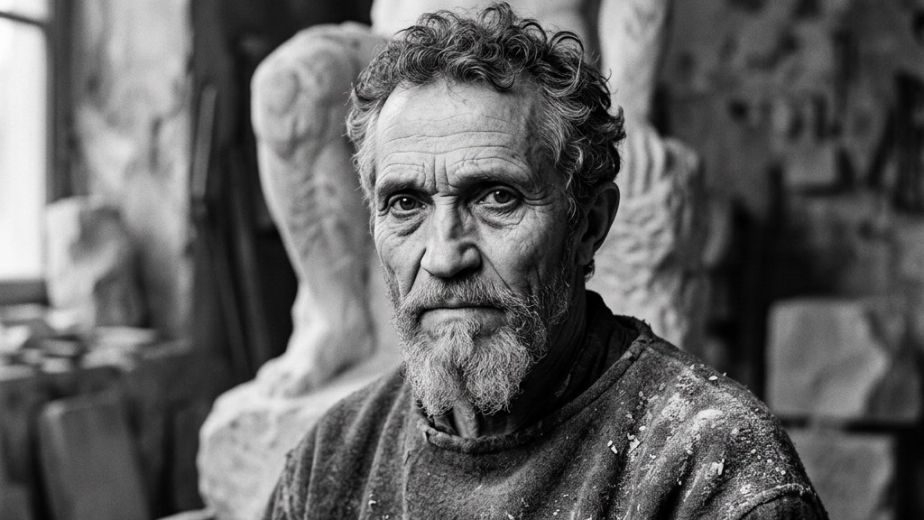
Featured image: Giotto di Bondone (AI illustration, free interpretation)