In the winter of 1400/1401, Timur’s army lay before Damascus. The conqueror from Central Asia had defeated the Egyptian relief army, and inside the city the notables argued over whether to surrender. A scholar living in Cairo, in his late sixties, who had come to Syria with a delegation, finally had himself lowered by ropes over the city wall and walked into the camp of the man before whom half of Asia trembled. Timur received him, questioned him about the lands of the West, and kept him at his side for several weeks.
Abd ar-Rahman ibn Khaldun described this encounter himself in his autobiography, with the composure of a man who had seen many rulers come and go. A good two decades earlier, in a remote castle in North Africa, he had written a book that set out to explain why empires rise and why they fall. One of his answers was that their rulers at some point take too much.
At a glance
- Life: May 27, 1332, in Tunis to March 17, 1406, in Cairo
- Work: secretary, envoy, and minister at courts in Tunis, Fez, Granada, and Bougie; from 1384 on, chief judge of the Maliki school of law in Cairo several times over
- Major work: Muqaddima, the introduction to his world history Kitab al-ʿIbar (first version 1377, later revised)
- Other work: at-Taʿrif, his autobiography with the account of Timur
- In one sentence: As early as the 14th century, he described how the tax burden, trading by the state, and arbitrary attacks on property undermine the prosperity of a society.
A life in the service of changing masters
The Banu Khaldun family came from Seville and had left the city before it fell to Castile in 1248. By way of Ceuta it reached Tunis, where it produced scholars and officials. As a young man, Ibn Khaldun lost his parents and a large part of his relatives to the Great Plague around the middle of the century. At about twenty he entered court service and began a career that took him across the Maghreb and as far as Andalusia.
In Fez he drafted decrees for the Marinid sultan Abu Inan, until in 1357 he was suspected of taking part in a conspiracy and imprisoned for nearly two years. Later he served Muhammad V of Granada, who in 1364 sent him as an envoy to King Pedro of Castile in Seville. Pedro offered to keep him in his service and promised him his family’s old estates. Ibn Khaldun declined. In Bougie, today’s Béjaïa, he ran the affairs of a Hafsid prince as his minister.
In 1375 he withdrew with his family to the castle of Qalʿat Ibn Salama in what is now Algeria, where a tribe protected him. There, within a few months, he wrote the Muqaddima. He saw it as the foundation of a new science, the study of ʿumran, that is, of human social life, its forms, and its culture. In 1382 he went to Egypt, taught in Cairo, and from 1384 on was appointed chief Maliki judge six times. He never held the office for long, partly because he took action against bribery and judgments handed down as favors, and made enemies by doing so. In that same year, 1384, his wife and children died when their ship sank off Alexandria.
Low rates, high revenue
The best-known economic chapter of the Muqaddima opens with two sentences, quoted here in Franz Rosenthal’s English translation (1958): “It should be known that at the beginning of the dynasty, taxation yields a large revenue from small assessments. At the end of the dynasty, taxation yields a small revenue from large assessments.” (Muqaddima, ch. III, sec. 36)
Ibn Khaldun explains the process precisely. A young dynasty still lives in the simplicity of its origins and is content with the levies that religious law provides for. When the burdens are low, he writes, the subjects have the energy and the desire to undertake things. They work and undertake more, and as their prosperity grows, so does the revenue.
Over time the luxury and expense of the court grow. The rulers raise the individual levies, and when that is not enough, as the following section says, they must invent new kinds of taxes; even pilgrims were made to pay (ch. III, sec. 37). Whoever sees the fruit of his effort taken from him loses his drive. Business shrinks, revenue falls, and the rulers respond with still higher rates. Ibn Khaldun draws the conclusion himself: the strongest incentive for the flourishing of civilization, he says, is to lower the individual levies as far as possible.
Twentieth-century economists have seen in this passage an anticipation of what is now called the Laffer curve, after Arthur Laffer. The name is modern, and so is the image of a curve, for Ibn Khaldun thought in terms of the life story of dynasties and knew nothing of marginal tax rates. But the basic insight stands out clearly in his work: there is a point at which higher levies bring in less, because they stifle the very activity they live on.
When the ruler becomes a merchant
A section of its own bears the heading that commercial activity on the part of the ruler harms his subjects and ruins the tax revenue (ch. III, sec. 38). Ibn Khaldun describes how a ruler who is running short of money hits upon the idea of doing business himself to fill his treasury. He considers this a great mistake.
His reasoning is remarkably sober. The ruler commands far more means than any farmer or merchant, who already compete fiercely with one another. He can acquire goods at the lowest price and force the seller to give way. When he sells, on the other hand, he is satisfied only with the highest prices. The merchants give up, the farmers grow poor, and with them the source of the taxes dries up. Anyone who recommends such business to the ruler, he says, should not be given a hearing.
Ibn Khaldun also knew where prosperity comes from. In the fifth chapter he defines profit this way: “Profit is the value realized from human labor.” (ch. V, sec. 1, after Rosenthal) At the very beginning of the work he notes that the individual does not have enough strength to provide himself alone with what he needs, and that human beings therefore depend on cooperation (ch. I, First Prefatory Discussion). For him, prosperity arises where many people work and supply one another with their products, and it decays where the fruits of that work are taken from them.
Injustice ruins civilization
Perhaps the most important section for friends of liberty comes shortly afterward and bears the heading: “Injustice brings about the ruin of civilization.” (ch. III, sec. 41) Ibn Khaldun begins with a thought that runs through the whole book: attacks on people’s property take away their incentive to acquire property. Whoever must expect to have what he has earned taken from him stops working, and then the civilization of a country declines.
Then he widens the concept. Injustice, he says, should not be understood only as the confiscation of money or possessions. Injustice is also done by whoever compels another to do forced labor, raises unjustified claims against him, or imposes duties on him that religious law does not require. He expressly counts forced labor among the greatest injustices, and anyone who knows his fifth chapter understands why: for him, labor is the source of all profit.
One observation about the perpetrators is especially clear. Injustice in this sense, he writes, can be committed only by persons who cannot be touched, that is, by those who have power and authority. With that, a scholar who had himself served at many courts names without beating around the bush where the most dangerous threat to property lies: with those whom no one judges.
A thinker of his time, not a modern in disguise
Anyone who honors Ibn Khaldun should not dress him up in modern clothes. He was not an economist in today’s sense, nor a sociologist; neither discipline existed yet. In his 2018 biography, the historian Robert Irwin reminded readers that he was a Maliki jurist who thought in the categories of his world and also took the supernatural seriously.
Among these categories is that he considered rule unavoidable. Because people press upon one another, he argues, every community needs a restraining force from its own midst, and that is precisely the meaning of royal authority (ch. I, First Prefatory Discussion). His criticism was aimed at greedy, immoderate rule, not at rule as such. His central concept is ʿasabiyya, the cohesion of a group, which carries a tribe to power and weakens amid the comforts of city life. A dynasty, therefore, as a rule lasts no more than three generations, by his reckoning about 120 years (ch. III, sec. 12).
It is precisely this sobriety that gives his findings weight. Ibn Khaldun described the consequences of high levies and state business as someone who had seen at many courts how rulers dealt with the property of their subjects, and he recorded what followed from it.
What friends of liberty can learn from him
The first lesson concerns the connection between the tax burden and prosperity. Long before Adam Smith, Ibn Khaldun saw that high levies dry up the very source from which they flow. Later readers recognized this: the economist Joseph Spengler paid tribute to him in 1964 in a study of the economic thought of Islam, Jean Boulakia called him a fourteenth-century economist in the Journal of Political Economy in 1971, and Arthur Laffer cites him as an early witness. At a press conference on October 1, 1981, Ronald Reagan invoked his observation about taxes at the beginning and at the end of a dynasty.
The second lesson concerns the state as entrepreneur. A ruler who engages in trade is no ordinary competitor, because he sets the rules himself and can use coercion. What Ibn Khaldun writes about the sultan who crowds out farmers and merchants reads like an early warning against state enterprises and monopolies.
The third lesson is the most fundamental. For Ibn Khaldun, secure property is the precondition of all civilization, and the seizure of the subjects’ property by the powerful is injustice in the full sense, even when it is disguised as a levy, a service obligation, or a forced purchase. This insight comes from Islamic legal and historical scholarship, and it shows that the idea that arbitrary attacks on property destroy prosperity is not a peculiarly European invention.
Advice older than any fiscal policy
In 1934 the historian Arnold Toynbee called the Muqaddima, in substance, the greatest work of its kind ever created by any human mind in any time or place. One need not go along with this superlative to see what the book achieves. A man who had served sultans, sat in prison, and negotiated with the founder of a world empire described, more than six centuries ago, how the greed of rulers destroys the foundations of their own power.
His observations concerned the dynasties of the Maghreb, but they can be applied to any commonwealth that lives off the work of its citizens. They put to every government that wants to raise its revenue a question that Ibn Khaldun thought through in his castle in North Africa: How much can you take from people before they stop creating anything that could be taken from them?
Further reading
- Ibn Khaldun: The Muqaddimah. An Introduction to History, translated by Franz Rosenthal, 3 vols., Princeton University Press, Princeton 1958
- Ibn Chaldun: Die Muqaddima. Betrachtungen zur Weltgeschichte, translated by Alma Giese, C. H. Beck, Munich 2011 (in German)
- Robert Irwin: Ibn Khaldun. An Intellectual Biography, Princeton University Press, Princeton 2018
- Walter J. Fischel: Ibn Khaldun and Tamerlane. Their Historic Meeting in Damascus, 1401 A.D., University of California Press, Berkeley 1952
This article is part of our series on thinkers, doers, and historical figures of liberty.
Sources
- Ibn Khaldun: The Muqaddimah. An Introduction to History, translated by Franz Rosenthal, 3 vols., Princeton University Press (Bollingen Series XLIII), Princeton 1958; cited by chapter and section (I, First Prefatory Discussion; III.12; III.36; III.37; III.38; III.41; V.1), wording checked against the online edition https://www.muslimphilosophy.com/ik/Muqaddimah/. Quotations in the article follow Rosenthal’s English.
- Ibn Chaldun: Die Muqaddima. Betrachtungen zur Weltgeschichte, translated by Alma Giese, C. H. Beck, Munich 2011 (in German).
- Ibn Khaldun: at-Taʿrif (autobiography), account of Timur in: Walter J. Fischel, Ibn Khaldun and Tamerlane. Their Historic Meeting in Damascus, 1401 A.D. (803 A.H.), University of California Press, Berkeley 1952.
- Irwin, Robert: Ibn Khaldun. An Intellectual Biography, Princeton University Press, Princeton 2018 (reviews: https://arabnews.com/node/1320681, https://www.meforum.org/middle-east-quarterly/book-reviews/robert-irwin)
- Toynbee, Arnold J.: A Study of History, vol. III, Oxford University Press, London 1934, pp. 321–328
- Spengler, Joseph J.: “Economic Thought of Islam: Ibn Khaldun,” in: Comparative Studies in Society and History 6 (1964), no. 3
- Boulakia, Jean David C.: “Ibn Khaldun: A Fourteenth-Century Economist,” in: Journal of Political Economy 79 (1971), no. 5
- Laffer, Arthur B.: “The Laffer Curve: Past, Present, and Future,” Heritage Foundation Backgrounder no. 1765, 2004
- “Ibn Khaldûn,” in: Renaissance and Reformation Reference Library (Gale), https://www.encyclopedia.com/history/encyclopedias-almanacs-transcripts-and-maps/ibn-khaldun
- Encyclopaedia Britannica: Ibn Khaldūn, https://www.britannica.com/biography/Ibn-Khaldun
- Wikipedia (en): Ibn Khaldun, https://en.wikipedia.org/wiki/Ibn_Khaldun (introduction, biography)
- Cato Institute: “The Muslim Thinker Who Inspired Reagan,” https://www.cato.org/commentary/muslim-thinker-who-inspired-reagan (Reagan press conference of October 1, 1981)
- Reagan Library: Daily Diary, October 1981, https://reaganlibrary.archives.gov/public/digitallibrary/dailydiary/1981-10.pdf
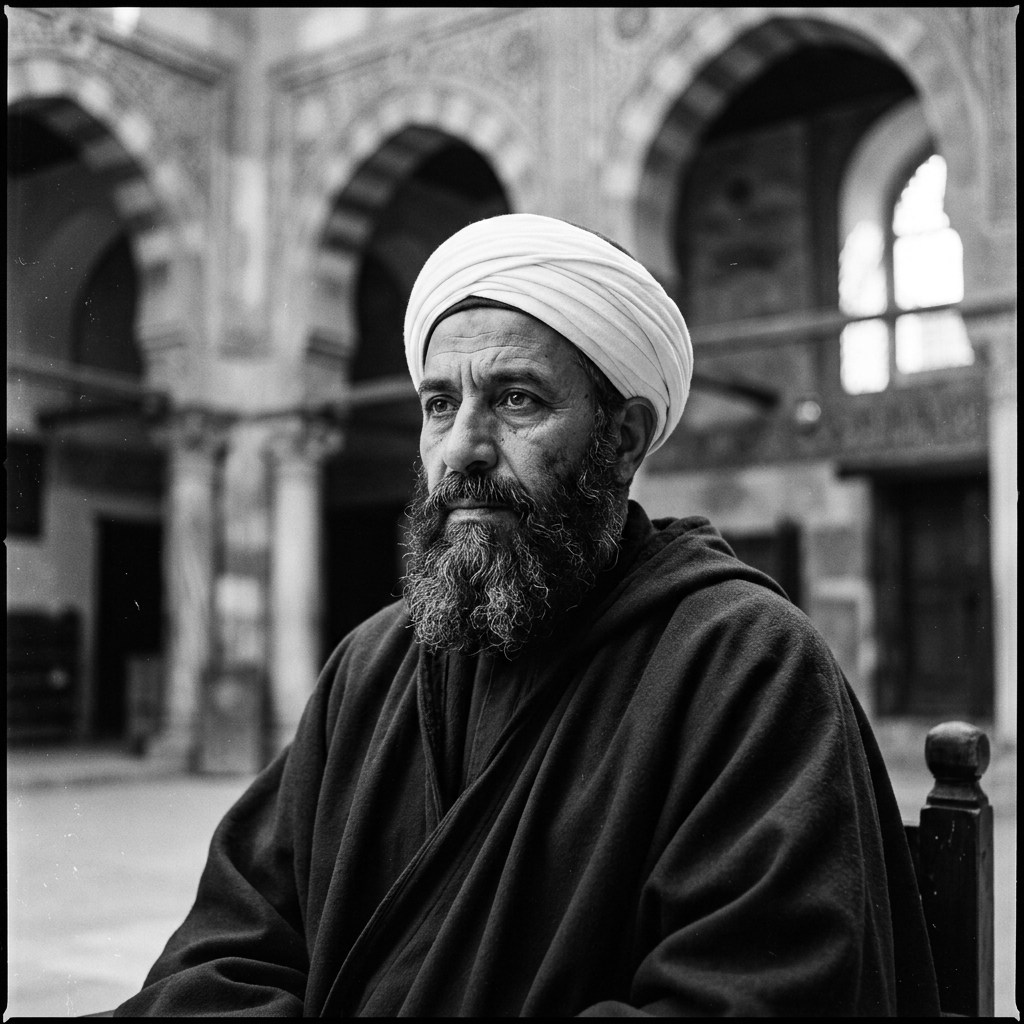
Featured image: Ibn Khaldun (AI illustration, free interpretation)