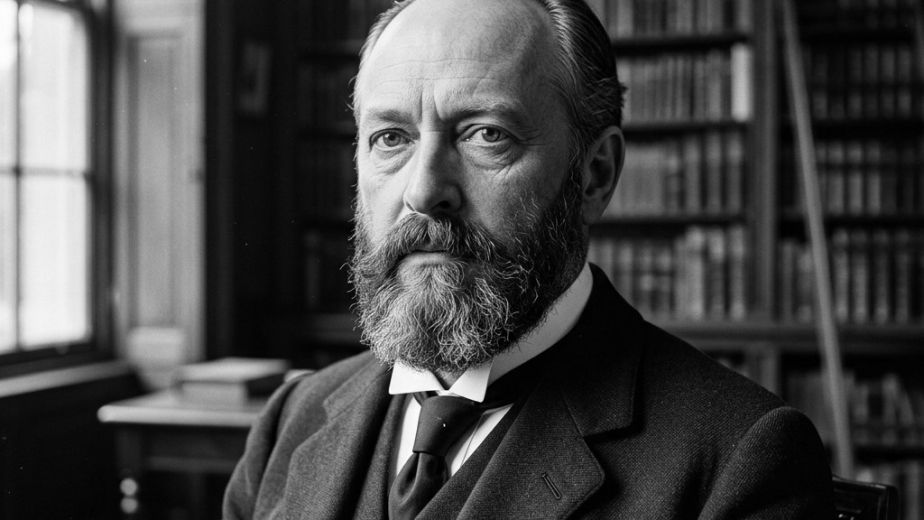
On the evening of May 22, 2026, at a hotel in Münster, the German Friedrich A. von Hayek Society awarded its Hayek Medal to Ron Paul. The former U.S. congressman joined by video from the United States, and the laudatory speech was given by one of the Society’s vice chairs, the economist Karl-Friedrich Israel. He used it to deliver a message to moderates and radicals alike within his own camp, which he afterward also published in writing. Its core sentence: “If it were not for the principled uncompromising libertarian, the moderate classical liberal would be lost.”
The statement fits his work. Israel belongs to the Austrian School of economics, the school of thought around Carl Menger, Ludwig von Mises, and Friedrich August von Hayek that explains money, prices, and interest in terms of individual action. He upholds its principles without compromise, yet at the same time tests them with the tools of empirical economic research and publishes in academic journals that by no means belong to the Austrian camp.
At a glance
- Work: teaches economics at the Université Catholique de l’Ouest (UCO) in Angers, France (as of 2026)
- Education: studied in Berlin (Humboldt University), Paris (ENSAE), and Oxford; doctorate in Angers in 2017; habilitation in 2023 at the Université Paris 1 Panthéon-Sorbonne
- Earlier positions: Senior Researcher at the Institute for Economic Policy at Leipzig University, interim professorship at Saarland University, teaching at the Berlin School of Economics and Law
- Network: Fellow of the Ludwig von Mises Institute, one of the vice chairs of the Hayek Society (as of May 2026), associate researcher at the Liberales Institut in Zurich, co-organizer of the Austrian Economics Meeting Europe
- Key works: The Fiat Money Illusion (2021), Two Views on Neutral Money (2020, with Joseph T. Salerno and Carmen Elena Dorobat), Alternative Measures of Price Inflation (2024, with Gunther Schnabl), Der Zins: Vom historischen Missverständnis zur staatlichen Manipuliermasse (2020, in German)
- In one sentence: He uses numbers to test what the Austrian School teaches about money and central banks.
Mathematics at Oxford, monetary theory in Angers
Israel studied economics, applied mathematics, and statistics at Humboldt University of Berlin, at ENSAE, the French graduate school of statistics in Paris, and at the University of Oxford. A paper he wrote at Oxford in 2013 dealt with a problem in probability theory, the distribution of minimum spanning trees in complete graphs, and this mathematical training shows in his later essays on price indices and the costs of central banks.
He received his doctorate in 2017 from the Université d’Angers with a dissertation on the costs and benefits of central banks. The Ludwig von Mises Institute in Auburn, Alabama, where he had previously been a Research Fellow, congratulated him publicly. His other positions include the Institute for Economic Policy at Leipzig University, where he worked as a Senior Researcher, teaching at the Berlin School of Economics and Law, and an interim professorship of economic policy at Saarland University. In 2023 he completed his habilitation, the advanced postdoctoral qualification, at the Sorbonne in Paris with a thesis on the neutrality of money and the unintended consequences of monetary policy. Today he teaches at the Catholic University of the West in Angers and writes in German, English, and French.
The bill for paper money
The classic argument for unbacked paper money is that it is cheaper than gold, which has to be mined, stored, and guarded. Israel took this argument at its word and did the math.
In his essay The Fiat Money Illusion, published in 2021 in the journal The World Economy, he compares the operating expenses of four major central banking systems with the estimated costs of a simple gold standard. He grants that the cost argument has a kernel of truth but reaches a clear conclusion: the Eurosystem, the Bank of England, the Bank of Japan, and the U.S. Federal Reserve spend more than a fractional-reserve gold standard would cost. Even full gold backing of the M1 money supply, that is, of cash and demand deposits, would be of a similar order of magnitude. The Eurosystem and the Bank of Japan are especially expensive: relative to economic output, their operating expenses are more than twice as high as those of the Fed and the Bank of England.
By his findings, the supposed savings of paper money turn out to be an illusion, and a monetary order backed at least partly by gold could be the cheaper one even by this standard. What stands out is how he arrives at this result: here Israel argues from the operating expenses of central banks, a field on which economists of other schools can also check his numbers.
Who profits from new money
As early as the 18th century, the banker Richard Cantillon described how new money does not reach everyone at the same time and therefore shifts income and wealth. The Austrian School took up this idea. Israel has studied how such shifts can be measured today, and for this he chose a country that turned to zero interest rates and bond purchases earlier than most industrialized nations: Japan.
In a study with Sophia Latsos, published in 2020 in Applied Economics, he analyzed previously unused data from the Japan Household Panel Survey. Expansionary monetary policy narrowed the wage gap between men and women, because women worked more, but widened the gap between workers with and without a university degree. A second study, with Tim Florian Sepp and Nils Sonnenberg, looked at household saving between 1993 and 2017. Monetary expansion widened the disparities: households without a university-educated member saved less, while households with graduates offset the disadvantages or even benefited.
What the inflation rate does not show
A second major theme is how to measure the loss of money’s value. The official consumer price index captures what a household spends on bread, rent, or electricity. What it does not capture are the prices of houses and stocks, the very things you have to buy in order to build something of your own.
Together with the economist Gunther Schnabl, Israel presented alternative measures of inflation for Germany since the introduction of the euro in The World Economy in 2024. The authors combine the Harmonized Index of Consumer Prices with price indices for stocks and real estate and with a measure of the cost of public services. Their starting finding: since the 1980s, inflationary pressure has shown up disproportionately outside the markets for consumer goods. In the least favorable of their scenarios, real economic growth and real median wages in Germany over the past decade were actually negative.
In a series of articles for the American online magazine The Daily Economy, he presented these ideas to a broad audience in late summer 2026. There he explains why taxes, government consumption, and asset prices are missing from inflation statistics and why the recent inflation has favored those who already owned property while making the way harder for those trying to move up.
Interest as the price of time
How thoroughly Israel works as a historian of ideas is shown by his essay on interest, which appeared in 2019 in the edited volume Explosive Geldpolitik published by the Liberales Institut and in 2020 as a separate paper of the institute. In it he traces the critique of interest from Aristotle through the theologians of the Middle Ages to Marx and shows the misunderstandings on which it rested. Only the Austrian School, he argues, understood the credit market as part of the market for savings and put time preference at the center, that is, the fact that people value a good today more highly than the same good tomorrow.
Keynesianism, by contrast, once again looks at interest in isolation, as a mere equilibrium price in the money market, and thereby turns it into a political lever. “It became a tool for state manipulation,” Israel writes of interest in recent history; monetary policy, he says, pushed it step by step toward zero. His conclusion appears right on the first page: “A stable and prosperous economy in the long run needs a free credit market without interest-rate manipulation by central bank policy.”
Menger, Mises, and neutral money
Part of his research is devoted to the history of his own school, and here he is especially precise. Together with Joseph T. Salerno and Carmen Elena Dorobat, he showed in 2020 that Hayek’s concept of neutral money goes back largely to Friedrich von Wieser and not to Menger and Mises. The tradition of Menger and Mises rejects the idea of neutral money both as an analytical tool and as a standard by which monetary orders could be measured. In a comparative study of Menger and Wieser in 2022, he set out how Wieser replaced an ambiguous distinction of Menger’s with an objective aggregate exchange value of money and in doing so arrived at a more confident view of active monetary policy, a view that becomes questionable, however, if Menger’s theory of value is correct.
Anyone who believes money can be neutral trusts the central bank to steer the money supply so that no one wins and no one loses. Anyone who assumes, with Menger and Mises, that every increase in money produces winners and losers will distrust such promises. In 2026, Israel wrote the entries on Ludwig von Mises, Murray Rothbard, and the central bank for the Encyclopedia of Law and Economics.
Teacher and bridge builder
Beyond his research, Israel also teaches outside his university. He has spoken at Mises University in Auburn on central banks, inflation, and problems of measurement, at the Austrian Academy on interest theory and cheap money, and at the summer university of the Institute for Economic Studies Europe. With colleagues from UCO, he organized the tenth Austrian Economics Meeting Europe in Angers in May 2026.
Alongside his academic articles, he writes regularly for a wider audience, for example for the Mises Institute and the analysis service GIS. At the end of October 2026, in Mises Wire, he defended Say’s law against the common shorthand that supply creates its own demand, a formula that, by his account, goes back to Keynes and does Say an injustice.
What friends of liberty can learn from him
The first lesson concerns method. Israel shows that you do not have to water down the principles of the Austrian School in order to work with numbers. Whoever examines the costs of central banks or the saving rates of households can persuade critics by their own standards.
The second lesson concerns statistics. A low inflation rate is not yet proof of stable money if the loss of money’s value shows up in houses, stocks, and taxes. Whoever understands this also understands why many people feel poorer despite official wage gains.
The third lesson concerns how we deal with one another. In his laudatory speech for Ron Paul, he described moderate liberals and principled libertarians as dependent on each other: only the uncompromising make the position of the moderates visible, and both sides should acknowledge their role.
Good money adds up
In the end, his work revolves around the simple question of what the money we use costs us. The answer lies in the expenses of central banks as well as in the prices of houses, which have moved further out of reach for many people trying to move up. Karl-Friedrich Israel has assembled this answer piece by piece, with the patience of a mathematician and the convictions of a liberal. Anyone who wants to know whether good money is merely a nice idea or a demand that can be verified will find reasons for confidence in his work.
Further reading
- Karl-Friedrich Israel: Der Zins: Vom historischen Missverständnis zur staatlichen Manipuliermasse, LI-Paper, Liberales Institut, Zurich 2020 (in German)
- Karl-Friedrich Israel: The Fiat Money Illusion. On the Cost-Efficiency of Modern Central Banking, in: The World Economy 44 (6), 2021
- Karl-Friedrich Israel and Gunther Schnabl: Alternative Measures of Price Inflation and the Perception of Real Income in Germany, in: The World Economy 47 (2), 2024
- Pierre Bessard and Olivier Kessler (eds.): Explosive Geldpolitik. Wie Zentralbanken wiederkehrende Krisen verursachen, Edition Liberales Institut, Zurich 2019 (in German)
This article is part of our series on thinkers, doers, and historical figures of liberty.
Sources
- Israel, Karl-Friedrich: The Costs and Benefits of Central Banking. Modern Monetary Economics along a Methodological Dividing Line, doctoral dissertation, Université d’Angers, 2017.
- Israel, Karl-Friedrich; Hülsmann, Jörg Guido: “Die Österreichische Schule als Gegenprogramm zur Standardökonomik,” in: List Forum für Wirtschafts- und Finanzpolitik 44, 2019 (in German).
- Israel, Karl-Friedrich: “Der Zins: Vom historischen Missverständnis zur staatlichen Manipuliermasse,” in: Pierre Bessard, Olivier Kessler (eds.): Explosive Geldpolitik. Wie Zentralbanken wiederkehrende Krisen verursachen, Edition Liberales Institut, Zurich 2019; as LI-Paper, Liberales Institut, February 2020, https://www.libinst.ch/publikationen/LI-Paper-Israel-Zins-staatliche-Manipuliermasse.pdf (in German)
- Salerno, Joseph T.; Dorobat, Carmen Elena; Israel, Karl-Friedrich: “Two Views on Neutral Money: Wieser and Hayek versus Menger and Mises,” in: The European Journal of the History of Economic Thought 27 (5), 2020, pp. 682–711.
- Israel, Karl-Friedrich; Latsos, Sophia: “The Impact of (Un)Conventional Expansionary Monetary Policy on Income Inequality: Lessons from Japan,” in: Applied Economics 52 (40), 2020, pp. 4403–4420.
- Israel, Karl-Friedrich: “The Fiat Money Illusion: On the Cost-Efficiency of Modern Central Banking,” in: The World Economy 44 (6), 2021, pp. 1701–1719.
- Israel, Karl-Friedrich; Sepp, Tim Florian; Sonnenberg, Nils: “Japanese Monetary Policy and Household Saving,” in: Applied Economics 54 (21), 2022, pp. 2373–2389.
- Israel, Karl-Friedrich: “The Monetary Theories of Carl Menger and Friedrich von Wieser: A Comparative Study,” in: The European Journal of the History of Economic Thought 29 (5), 2022, pp. 855–876.
- Israel, Karl-Friedrich: La monnaie neutre et les conséquences inattendues de la politique monétaire, habilitation thesis (HDR), Université Paris 1 Panthéon-Sorbonne, 2023.
- Israel, Karl-Friedrich; Schnabl, Gunther: “Alternative Measures of Price Inflation and the Perception of Real Income in Germany,” in: The World Economy 47 (2), 2024, pp. 618–636.
- Israel, Karl-Friedrich: entries “Mises, Ludwig von,” “Rothbard, Murray,” and “Central Bank,” in: Encyclopedia of Law and Economics, Springer 2026.
- Israel, Karl-Friedrich: “Ron Paul Wins the Hayek Medal 2026: A Message to Moderate Classical Liberals and Hardcore Libertarians,” Mises Institute, Power & Market, May 27, 2026, https://mises.org/power-market/ron-paul-wins-hayek-medal-2026-message-moderate-classical-liberals-and-hardcore-libertarians
- Israel, Karl-Friedrich: articles on inflation measurement in The Daily Economy (AIER), August 20, September 9, and September 21, 2026, https://thedailyeconomy.org/article/article-author/karl-friedrich-israel/
- Israel, Karl-Friedrich: “The Strawman That Won’t Die: Say’s Law at the Hoover Institution,” Mises Wire, October 30, 2026, https://mises.org/mises-wire/strawman-wont-die-says-law-hoover-institution
- Ludwig von Mises Institute: profile of Karl-Friedrich Israel, https://mises.org/profile/karl-friedrich-israel
- Ludwig von Mises Institute: “Congratulations Dr. Karl-Friedrich Israel,” December 14, 2017, https://mises.org/power-market/congratulations-dr-karl-friedrich-israel
- Friedrich A. von Hayek-Gesellschaft: program of the Hayek Days 2026, May 22–23, 2026, in Münster, https://hayek.de/wp-content/uploads/2026/05/Programm-Hayek-Tage-2026.pdf (in German)
- American Institute for Economic Research: profile page of Karl-Friedrich Israel, https://aier.org/people/karl-friedrich-israel/
- IES Europe: speaker page of Karl-Friedrich Israel, https://ies-europe.org/speaker/karl-friedrich-israel-3/
- IREF Europe: “10th Austrian Economics Meeting Europe,” Angers, May 28–30, 2026, https://en.irefeurope.org/meetings-and-seminars/article/10th-austrian-economics-meeting-europe/
- GIS Reports: expert page of Karl-Friedrich Israel, https://www.gisreportsonline.com/e/israel-karl-friedrich/
- RePEc/IDEAS: author page of Karl-Friedrich Israel, https://ideas.repec.org/e/pis196.html
- Google Scholar: profile of Karl-Friedrich Israel, https://scholar.google.com/citations?user=16vndwcAAAAJ
- University of Bern, BORIS: Bessard, Kessler (eds.): Explosive Geldpolitik, 2019 (in German), https://boris.unibe.ch/138582/
Featured image: Background edited