In the late summer of 1499, Ludovico Sforza, known as il Moro, left Milan ahead of the advancing French, and the city fell to King Louis XII of France. Leonardo da Vinci had served the duke for seventeen years. In the spring of 1500, Ludovico attempted to return, was taken prisoner by the French at Novara, and was never released. On the inside of the cover of a small notebook now known as Paris Manuscript L, Leonardo wrote, probably in that year, a sober sentence: the duke, he wrote, “has lost the state, property and liberty,” and none of his works had been completed for him.
The loss of liberty here most likely refers quite concretely to the duke’s captivity, and the second half of the sentence reveals how closely an artist’s works were tied to the fate of his lord. Leonardo makes a poor champion of political liberty, and anyone who casts him as one does him violence. His notebooks show a different kind of independence: that of a man who let no one dictate to him in matters of knowledge, even though he always depended on the powerful for his bread.
At a glance
- Life: April 15, 1452, in Anchiano near Vinci to May 2, 1519, in Amboise
- Work: Painter, sculptor, engineer, military architect, and natural scientist in Florence, Milan, Rome, and France
- Patrons: Ludovico Sforza, Cesare Borgia, the Republic of Florence, the French rulers of Milan, Giuliano de’ Medici, King Francis I
- Major works: The Last Supper (Milan, 1495 to 1498), Mona Lisa (begun around 1503), designs for The Battle of Anghiari, several thousand pages of notebooks, including the Codex Atlanticus
- In one sentence: He called himself a disciple of experience and trusted his own eye more than any authority.
A notary’s son without Latin
Leonardo was born on April 15, 1452, the illegitimate son of the Florentine notary ser Piero da Vinci and a woman named Caterina. We know the hour of his birth because his grandfather Antonio recorded it in a family note, written into an old notarial book. He never attended a university, he learned Latin only as an adult, and he received his training in the workshop of the sculptor and painter Andrea del Verrocchio in Florence. There, painting and sculpture were learned as a craft, not as a scholarly discipline.
How little protection a young man without rank had became clear in 1476, when an anonymous denunciation accused him and several others of sodomy. In June, all of them were acquitted, perhaps because one of the accused was a relative of the Medici.
“Omo sanza lettere”
Scholars apparently held his lack of learning against him, and Leonardo answered them with pride in his notes. He was well aware, he wrote on a sheet of the Codex Atlanticus (fol. 327v), that some presumptuous people believed they could find fault with him because he was an “omo sanza lettere,” a man without learning. His reply: “Gente stolta!”, foolish people. His subjects, he said, “are to be dealt with by experience rather than by words,” and experience “has been the mistress of those who wrote well. And so, as mistress, I will cite her in all cases.” On a neighboring sheet (fol. 323r), he calls the scholars who adorn themselves with the labors of others “vaunters and declaimers of the works of others.”
He put the idea most concisely in a sentence found on folio 76r of the Codex Atlanticus in its old numbering: “Chi disputa allegando l’autorità, non adopra lo ‘ngegno, ma più tosto la memoria.” In Richter’s translation: “Any one who in discussion relies upon authority uses, not his understanding, but rather his memory.” In Paris Manuscript B (fol. 4v), he warns against following the teachings of those theorists whose reasoning is not confirmed by experience. He described himself as a disciple of experience.
These sentences should not be read as contempt for tradition. Leonardo expressly defended the “antichi inventori,” the ancient inventors, against commentators who carped at them out of intellectual laziness (Manuscript F, fol. 27v). What he rejected was the habit of holding a statement to be true because a famous name stood beneath it. Testing against the thing itself, against water, the flight of birds, the dissected body, was to have the last word.
A job application full of weapons
Around 1482, Leonardo went to Milan. A draft survives of the letter in which he offered his services to Ludovico Sforza, who was then ruling Milan on behalf of his young nephew and became duke himself in 1494 (Codex Atlanticus, fol. 1082r). The text is unusual: in nine points, Leonardo promises light bridges, mines, guns, warships, and covered wagons that were to drive into the enemy ranks with their artillery and scatter any force, however large. Only in the tenth point does he turn to times of peace, to buildings and water conduits, then to sculpture and painting, and at the very end to the bronze equestrian statue for Ludovico’s father.
Whether Leonardo composed the unsigned draft himself is disputed. Anyone who wanted a place at a princely court had to offer what a prince needed, and in the years before the Italian Wars, what he needed above all were fortresses and cannons.
In Milan, Leonardo went on to paint The Last Supper and worked for years on the enormous bronze horse. It was never cast. In November 1494, Ludovico gave the bronze set aside for it to his father-in-law, Ercole d’Este, who had it cast into cannons, and after 1499, French soldiers used the clay model as a target. How precarious life at court was, even in good years, is shown by a draft letter to Ludovico: “I had to feed 6 men for 56 months, and have had 50 ducats.”
Tanks, helicopters, and other legends
Such promises and sketches gave rise to his reputation as the inventor of the tank, the helicopter, and the bicycle. None of this stands up to scrutiny. The drawing of a covered fighting vehicle in the British Museum shows a machine that men were to move by turning cranks, and the gears are arranged so that the drives would block each other. Whether that was an oversight or a safeguard against imitators, no one knows. The famous aerial screw in Paris Manuscript B (fol. 83v) is a bold idea, but not a flying machine: no human being could have produced enough power to drive it. Finally, the bicycle sketch in the Codex Atlanticus surfaced only in 1974, after the restoration, and most experts consider it a later addition. Almost none of these machines were built, and Leonardo’s achievement lies in the precision with which he broke machines down into gears, levers, and springs.
In the service of Cesare Borgia
After Ludovico’s fall, Leonardo traveled by way of Mantua and Venice to Florence, looking for a lord who would once again give him security and standing. Isabella d’Este, the Marchioness of Mantua, wanted a picture from him, but her agent reported in April 1501 that Leonardo was occupied mainly with geometry and was “impacientissimo al pennello,” thoroughly weary of the brush.
On August 18, 1502, Cesare Borgia, the son of Pope Alexander VI, appointed him his “Architetto et Ingegnero generale.” Carrying a letter patent, Leonardo traveled through the conquered Romagna, inspected fortresses in Urbino, Pesaro, Rimini, and Cesena, and drew a town plan of Imola that holds an important place in the history of cartography. Borgia was one of the most ruthless men of power of his time; Niccolò Machiavelli, who was with him at the same time as envoy of the Republic of Florence, later made him the model example in The Prince. We know of no objection by Leonardo to this service.
In early 1503, Leonardo returned to Florence and now worked for the republic, here too as a military engineer: during the war against Pisa, he inspected a fortress and planned to divert the Arno in order to cut the city off from the sea. The republic eventually commissioned him to paint the mural The Battle of Anghiari in the Hall of the Great Council, and Machiavelli signed the contract as a witness.
Leonardo was nonetheless not indifferent to what weapons do. In the Codex Leicester (fol. 22v), he writes that he will not describe or divulge his method of staying underwater for a long time, “by reason of the evil nature of men, who would use them for assassinations at the bottom of the sea by destroying ships, and sinking them, together with the men in them.” In an anatomical manuscript in Windsor (Manuscript A, fol. 2r), he calls it a most wicked thing to take a human life. And in a draft on the art of fortification, he writes: “To preserve Nature’s chiefest boon, that is freedom, I can find means of offence and defence, when it is assailed by ambitious tyrants” (Manuscript B, fol. 100r). What he meant, as the historian Romain Descendre shows, was probably the independence of a city against outside attackers, which could exist even under a good and just lord, and not the liberty of the citizen.
From court to court
Leonardo’s life can be told as a list of employers: Sforza, Borgia, the Republic of Florence, from 1506 the French rulers of Milan, from 1513 Giuliano de’ Medici in Rome, where he lived in the Belvedere of the Vatican and complained in a draft letter that a German mirror maker had hindered his anatomical work by disparaging it to the pope. As early as 1503, he had even offered the Ottoman sultan Bayezid II a bridge across the Golden Horn.
After Giuliano’s death in 1516, he accepted an invitation from King Francis I to come to France. By May 1517 at the latest, he was living at the château of Cloux near Amboise and drew a pension of 1,000 scudi a year, with another 300 for his pupil Francesco Melzi. He died there on May 2, 1519. The story that he died in the king’s arms, as Giorgio Vasari tells it, is a legend.
One can describe this wandering as dependence, and that is what it was: Leonardo had no fortune that would have made him independent. But it also shows one advantage of Italy’s fragmentation. Because many courts and city-states competed for talented minds, a man with rare abilities could move on when a lord fell or failed to pay, and none of them had him entirely in his grip.
Intellect against memory
What Leonardo leaves to the cause of liberty concerns knowledge first of all. His remark about appeals to authority, which draw on memory instead of intellect, fits any debate in which claims are to be shielded by titles, majorities, or offices. He did not reject tradition in the process; he wanted to see it tested, and he took seriously anyone who looked closely, including the man without Latin.
What his life story shows is less comfortable. Intellectual independence and material dependence existed side by side in him throughout his life, and that came at a price. The bronze for the equestrian statue became cannons, the clay model became a target, and the works intended for the duke fell along with him. How free art and research are depends, after all, also on who pays and how many potential payers there are.
The goldfinch in the cage
In his bestiary in Paris Manuscript H, Leonardo recorded a small fable, following older models: the goldfinch brings its captive young a poisonous herb, and beneath it stands the exclamation “Prima morte che perdere libertà!”, in Richter’s translation “Death rather than loss of liberty.” Vasari, for his part, reports that Leonardo bought birds at the market, took them out of their cages, and let them fly away, “restituendoli la perduta libertà,” restoring to them their lost liberty. Whether it really happened cannot be verified, for Vasari wrote decades later and was fond of collecting anecdotes. Still, the fact that posterity imagined Leonardo this way, as someone who opens cages, fits what his notebooks show: a mind that no doctrine could lock up, even though he himself was never entirely free.
Further reading
- Leonardo da Vinci: Tagebücher und Aufzeichnungen, edited and translated by Theodor Lücke, List, Leipzig 1940 (many later editions; in German)
- Edmondo Solmi (ed.): Leonardo da Vinci. Frammenti letterari e filosofici, Barbèra, Florence 1900
- Charles Nicholl: Leonardo da Vinci. Die Biographie, S. Fischer, Frankfurt am Main 2006 (in German; English original: Leonardo da Vinci: The Flights of the Mind, Allen Lane, London 2004)
- Martin Kemp: Leonardo da Vinci. The Marvellous Works of Nature and Man, Oxford University Press, Oxford 2006
This article is part of our series on thinkers, doers, and historical figures of liberty.
Sources
- Leonardo da Vinci: Codex Atlanticus, Milan, Biblioteca Ambrosiana, fol. 323r (formerly 117r-b), 327v (formerly 119v-a), old numbering 76r, fol. 1082r (formerly 391r-a, draft of the letter to Ludovico Sforza), digital facsimile: https://www.leonardodigitale.com/
- Leonardo da Vinci: Paris Manuscripts B (fol. 4v, 83v, 100r), F (fol. 27v), H (bestiary), and L (inside of the cover), Paris, Institut de France
- Leonardo da Vinci: Codex Leicester, fol. 22v, Seattle, collection of Bill Gates
- Leonardo da Vinci: Anatomical Manuscript A, fol. 2r, Windsor, Royal Collection; town plan of Imola, Windsor RL 12284
- Edmondo Solmi (ed.): Leonardo da Vinci. Frammenti letterari e filosofici, Barbèra, Florence 1900, https://www.gutenberg.org/ebooks/67931
- Jean Paul Richter (ed.): The Literary Works of Leonardo da Vinci, London 1883 (edition: The Notebooks of Leonardo da Vinci), §§ 1114, 1150, 1159, 1316, 1340, 1344, 1345, 1351–1353, 1414, https://www.gutenberg.org/ebooks/5000
- Leonardo da Vinci: Tagebücher und Aufzeichnungen, edited and translated by Theodor Lücke, List, Leipzig 1940 (in German)
- Giorgio Vasari: Vita di Lionardo da Vinci, in Le vite de’ più eccellenti pittori, scultori e architettori, Florence 1568, https://it.wikisource.org/wiki/Trattato_della_pittura_(Leonardo_da_Vinci)/Vita
- Pietro C. Marani: Leonardo da Vinci, in Dizionario Biografico degli Italiani, vol. 64, Istituto della Enciclopedia Italiana, Rome 2005, https://www.treccani.it/enciclopedia/leonardo-da-vinci_(Dizionario-Biografico)/
- Romain Descendre: Leonardo da Vinci, in Enciclopedia machiavelliana, Istituto della Enciclopedia Italiana, Rome 2014, https://www.treccani.it/enciclopedia/leonardo-da-vinci_(Enciclopedia-machiavelliana)/
- Museo Galileo, Florence: biography of Leonardo (Valentina Cupiraggi, 2008), https://brunelleschi.imss.fi.it/itineraries/itinerary/BiographyOfLeonardoVinci.html
- Museo Galileo, Florence: online exhibition on the bicycle sketch in the Codex Atlanticus, https://brunelleschi.imss.fi.it/biciclette/eleonardo.html
- Charles Nicholl: Leonardo da Vinci. Die Biographie, S. Fischer, Frankfurt am Main 2006 (in German; English original: Leonardo da Vinci: The Flights of the Mind, Allen Lane, London 2004)
- Martin Kemp: Leonardo da Vinci. The Marvellous Works of Nature and Man, Oxford University Press, Oxford 2006
- History Hit: Did Leonardo da Vinci Invent the First Tank?, https://www.historyhit.com/did-leonardo-da-vinci-invent-the-first-tank/
- Wikipedia (en): Gran Cavallo, https://en.wikipedia.org/wiki/Gran_Cavallo (citing Wallace 1972 and Arasse 1998; bronze used for cannons in 1494, clay model used as a target)
- Quote Investigator: Simplicity Is the Ultimate Sophistication, https://quoteinvestigator.com/2015/04/02/simple/
- Wikiquote (en): Leonardo da Vinci, sections “Disputed” and “Misattributed,” https://en.wikiquote.org/wiki/Leonardo_da_Vinci
- Encyclopaedia Britannica: Ludovico Sforza, https://www.britannica.com/biography/Ludovico-Sforza (captured at Novara in 1500, died at Loches in 1508)
- Historisches Lexikon der Schweiz (Historical Dictionary of Switzerland): Sforza, Ludovico, https://hls-dhs-dss.ch/de/articles/029255 (in German)
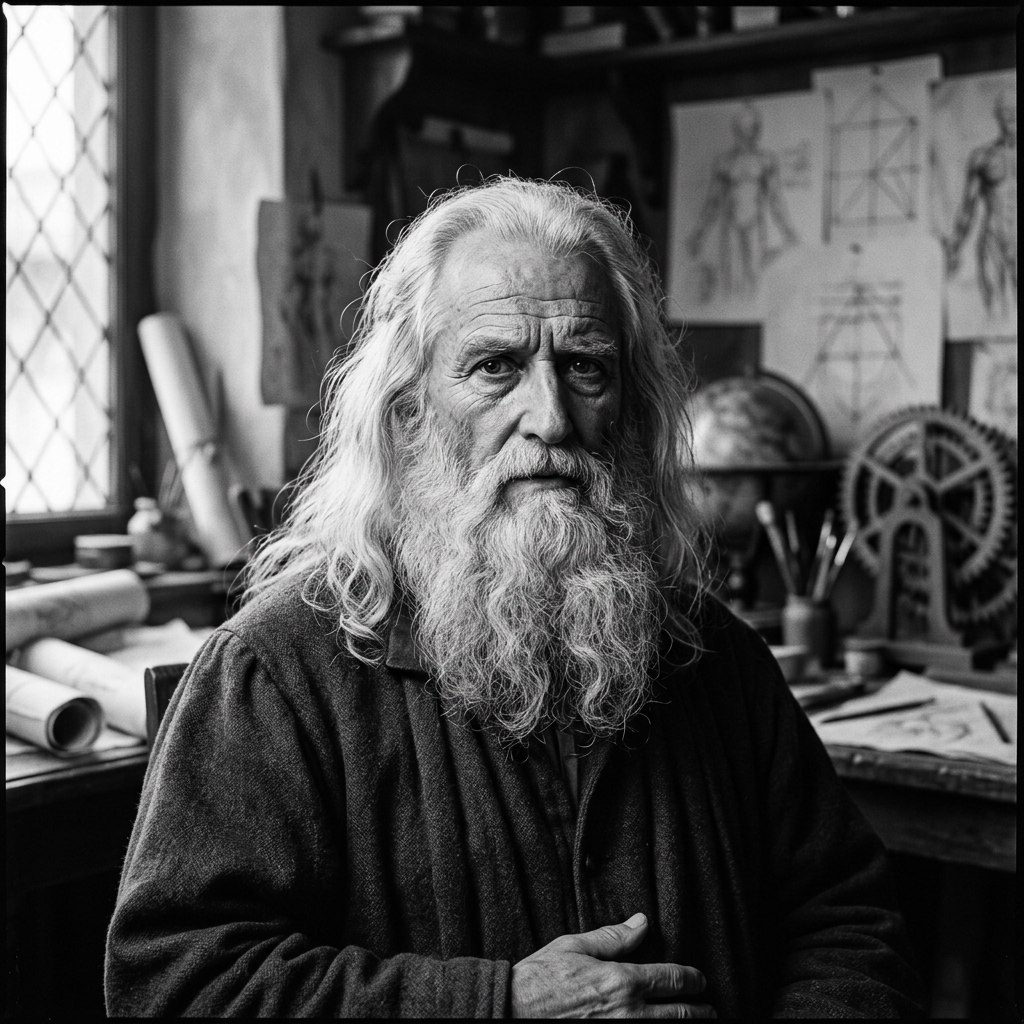
Featured image: Leonardo da Vinci (AI illustration)