On October 3, 1810, the French minister of police, Savary, wrote to a woman writer who was staying in the countryside far from Paris to oversee the printing of her new book. “Your last work is not French,” the letter said, and it went on to say that the air of this country did not seem to agree with her (our translation). Gendarmes seized the entire first printing of ten thousand copies and had it pulped. The author was to leave France within twenty-four hours and, at her request, was granted about a week.
The book was called De l’Allemagne, On Germany, and it described the poetry, philosophy, and religion on the far side of the Rhine. What troubled the police about it is stated in Savary’s letter itself: France, it said, was not yet reduced to looking for its models among the peoples she admired. A book that praised a spirit other than that of the Empire already counted as an attack. Three years later, Germaine de Staël had the letter printed in the preface to the London edition and so made it public.
At a glance
- Life: April 22, 1766, in Paris to July 14, 1817, in Paris
- Background: daughter of the Genevan banker and French finance minister Jacques Necker and the salonnière Suzanne Curchod
- Work: writer, political thinker, center of the Coppet circle on Lake Geneva
- Major works: De la littérature (1800), Delphine (1802), Corinne ou l’Italie (1807), De l’Allemagne (destroyed 1810, London 1813), Considérations sur les principaux événements de la Révolution française (1818), Dix années d’exil (1821)
- In one sentence: She defended constitutional government and free speech against the Terror and against the emperor alike, and paid for it with more than ten years of exile.
Growing Up Among Books and Conversation
Anne-Louise-Germaine Necker grew up in a house frequented by the scholars and writers of Paris. Her mother, Suzanne Curchod, ran a well-known salon; her father, Jacques Necker, was a wealthy banker from Geneva. In June 1777 he took charge of French finances as director general; because he was a Protestant, he was not allowed to hold the title of controller general. On July 11, 1789, three days before the storming of the Bastille, the king dismissed him, and shortly afterward he was recalled.
In January 1786, at nineteen, the daughter married the Swedish envoy Erik Magnus von Staël-Holstein, who was some seventeen years her senior. The marriage made her a baroness. In 1788 she published Letters on the Works and Character of J. J. Rousseau, and from then on she wrote without pause: essays, stories, novels, and political writings.
Between the Terror and the Emperor
She welcomed the Revolution of 1789 in the hope of a constitution that would protect rights and limit power. When the violence in Paris escalated in September 1792, she fled to Switzerland. There, in 1794, she met Benjamin Constant, with whom she remained politically and personally bound for many years. After the end of the Reign of Terror she returned to Paris and once again made her salon a place where the future of the Republic was argued over.
Napoleon Bonaparte, who seized power in 1799, did not tolerate this kind of public opinion for long. In October 1803 he banished Madame de Staël from the vicinity of Paris. She spent most of the following years of her exile at Coppet, her father’s château on Lake Geneva. The ban lasted until the emperor’s fall in 1814, and she wrote a book of its own about this period, Ten Years’ Exile, which appeared only after her death.
A Court Without a Crown
The place of exile became one of the liveliest intellectual centers in Europe. At Coppet, alongside Constant, gathered the Genevan historian and economist Jean-Charles-Léonard Simonde de Sismondi, the writer Amable de Barante, Karl Viktor von Bonstetten of Bern, and the German translator and critic August Wilhelm Schlegel. Scholars speak of the Coppet circle, a loose and often traveling network whose fixed core was formed by Staël, Constant, and Sismondi. They argued about constitutions, religion, history, and literature, and they did so in several languages.
Madame de Staël herself was constantly on the move. Between December 1803 and April 1804 she traveled through Germany. In Weimar she met Goethe and Schiller, who recorded his impressions of her in a letter of December 21, 1803. In Berlin she engaged Schlegel as tutor to her children, and in the fall of 1804 she set out with him for Italy. This journey gave rise to the novel Corinne ou l’Italie (1807), the story of a celebrated woman poet in Rome.
When the surveillance became unbearable, she secretly left Coppet on May 23, 1812. Because the French ports were closed to her, she took the long route through Vienna and Poland to Russia, traveled on by way of Kiev, Moscow, and Saint Petersburg, and reached London via Stockholm in 1813. There, in the same year, De l’Allemagne finally appeared.
Liberty Is What Is Ancient
Her political legacy is the book she worked on until the end: the Considerations on the Principal Events of the French Revolution, published in 1818, a year after her death. Right in the second chapter of the first part, she puts forward a thesis addressed to the defenders of the old privileges: “It is of importance to repeat to those who are the advocates of rights founded on the past, that it is liberty which is ancient, and despotism which is modern” (Part I, Chapter II).
She grounds this in history. In the medieval states of Europe, she argues, the power of kings was limited, and for centuries the French, like the English, struggled to obtain “that liberty confirmed by law, which alone can ensure to a people peace, emulation, and prosperity” (ibid.). In this reading, absolutism appears as a break with an older European tradition of limited rule. Those who defend liberty therefore need not feel like subversives; they are carrying on something older than the absolute power of the crown.
For the future, she placed her hope in a constitution that guarantees rights and binds the government to the law. Her model was England. In the sixth part of the Considerations she devotes several chapters to English history, to prosperity, and to “liberty and public spirit among the English”; there she describes at length the rights an accused person enjoys before a jury and praises freedom of the press because it allows public spirit to grow. The Liberty Fund edition of the Considerations, edited in 2008 by the political scientist Aurelian Craiutu, has made this work accessible again in the English-speaking world.
Free Institutions, Free Literature
As early as 1800, in De la littérature, she had examined a connection that the full title already names: literature is considered “in its relations with social institutions” (our translation). Religion, customs, and laws shape what a society writes and reads, and a free order produces a different literature than a despotism does. The Routledge Encyclopedia of Philosophy emphasizes that she combined this with a philosophy of history that rested its hopes on the perfectibility of human beings.
She devoted a chapter of this book to women who write and the resistance they meet. She wished for lawmakers who would concern themselves with the education of women. Already in 1796, in her treatise on the influence of the passions, she had observed, in substance, that nature and society had placed one half of humanity at a disadvantage. She herself, as a woman, passed public judgment all her life, in books as in the salon.
Against the Trade in Human Beings
Her love of liberty did not stop at the borders of Europe. The story Mirza, written around 1786 and printed in 1795, is set in Senegal and tells a love story against the background of the slave trade. Its main characters come from two hostile peoples of Senegambia, and scholars read the story as an attempt to win readers over to the abolition of the slave trade and of slavery. The Histoire de Pauline, which begins in the colony of Saint-Domingue, today’s Haiti, also belongs in this context.
In London she met William Wilberforce, the leading champion of the British abolition movement. In 1814, when the monarchs were gathered in Paris after the victory over Napoleon, she addressed the signatories of the Peace of Paris with an Appel aux souverains, an appeal to the sovereigns. The abolition of the slave trade, she suggested, could become these rulers’ monument. She also wrote a preface to a French translation of a work by Wilberforce. In it she answers, in substance, those who declare their abuses to be the keystone of the social order that they are only the keystone of their own advantages. Her son Auguste de Staël carried this commitment forward and fought for the abolition of slavery until his death in 1827.
What friends of liberty can learn from her
The first lesson concerns independence. Madame de Staël held no office and had no party and no troops. She had a name, a fortune, friends, and her pen, and with these means she remained, for a ruler at the height of his power, a nuisance he could not silence. Anyone thinking about freedom of speech today finds in her an example of what a single person can achieve who will not let her judgment be taken from her.
Her historical thesis is just as relevant. If liberty is the original condition and central power the later one, the burden of proof shifts: whoever wants to expand power must justify it, and whoever recalls limited rule is defending an inheritance. A related idea underlies Alexis de Tocqueville’s 1856 book on the Ancien Régime, which shows how the French monarchy hollowed out the old liberties of the provinces and towns.
Finally, the Coppet circle shows how ideas grow. Liberal thought arose there in conversation across borders of country and language, among people who contradicted, read, and encouraged one another. Benjamin Constant, the best-known liberal of this circle, belonged to its fixed core for years.
A Voice That Endured
Napoleon could have a printing pulped, banish a woman from Paris, and have her friends watched. The book appeared in London all the same, and with it his police minister’s letter as evidence of how a regime treats books whose spirit is foreign to it. Madame de Staël died in Paris on July 14, 1817, the anniversary of the storming of the Bastille. Her work invites you to a question every generation must ask anew: How much independence of judgment are you willing to defend when those in power would rather you kept silent?
Further reading
- Germaine de Staël: Considerations on the Principal Events of the French Revolution, ed. Aurelian Craiutu, Liberty Fund, Indianapolis 2008
- Germaine de Staël: Über Deutschland, Insel, Frankfurt am Main 1985 (in German)
- Biancamaria Fontana: Germaine de Staël. A Political Portrait, Princeton University Press, Princeton 2016
- Aurelian Craiutu: A Virtue for Courageous Minds. Moderation in French Political Thought, 1748–1830, Princeton University Press, Princeton 2012
This article is part of our series on thinkers, doers, and historical figures of liberty.
Sources
- Staël, Germaine de: Lettres sur les ouvrages et le caractère de J.-J. Rousseau, Paris 1788.
- Staël, Germaine de: Mirza, Histoire de Pauline, in: Recueil de morceaux détachés, Lausanne/Paris 1795.
- Staël, Germaine de: De l’influence des passions sur le bonheur des individus et des nations, Lausanne 1796.
- Staël, Germaine de: De la littérature considérée dans ses rapports avec les institutions sociales, Maradan, Paris 1800.
- Staël, Germaine de: Corinne ou l’Italie, Paris 1807.
- Staël, Germaine de: De l’Allemagne, John Murray, London 1813 (with the préface of October 1, 1813, and Savary’s letter of October 3, 1810), Project Gutenberg No. 66924, https://gutenberg.org/cache/epub/66924/pg66924-images.html; German edition: Über Deutschland, Insel, Frankfurt am Main 1985 (in German).
- Staël, Germaine de: Appel aux souverains réunis à Paris pour en obtenir l’abolition de la traite des nègres, London 1814, https://ebooks.mpdl.mpg.de/ebooks/Record/EB000973264
- Staël, Germaine de: Considérations sur les principaux événements de la Révolution française, Delaunay, Paris 1818; Part I, ch. II, and Part VI, chs. II to VII, from Wikisource, https://fr.wikisource.org/wiki/Considérations_sur_…_la_Révolution_Française/Première_partie/II; English: Considerations on the Principal Events of the French Revolution, ed. Aurelian Craiutu, Liberty Fund, Indianapolis 2008.
- Staël, Germaine de: Dix années d’exil, ed. Auguste de Staël, Paris 1821.
- Encyclopaedia Britannica: Germaine de Staël, https://www.britannica.com/biography/Germaine-de-Stael (with the section “Banishment from Paris”)
- Musée protestant: Germaine de Staël (1766-1817), https://museeprotestant.org/en/notice/germaine-de-stael-1766-1817-2/
- Encyclopedia.com: Staël, Germaine de, https://www.encyclopedia.com/social-sciences/encyclopedias-almanacs-transcripts-and-maps/stael-germaine-de-introduction
- Leopold, David: Staël-Holstein, Anne-Louise-Germaine, Mme de, in: Routledge Encyclopedia of Philosophy, https://www.rep.routledge.com/articles/biographical/stael-holstein-anne-louise-germaine-mme-de-1766-1817/v-1
- Historical Dictionary of Switzerland (Historisches Lexikon der Schweiz): Groupe de Coppet, https://hls-dhs-dss.ch/fr/articles/016051 (in French)
- Blog of the APA: Germaine de Staël’s Philosophy and Politics, November 17, 2022, https://blog.apaonline.org/2022/11/17/germaine-de-staels-philosophy-and-politics/
- Fabula: Madame de Staël, Dix années d’exil (escape in 1812, route, first edition 1821), https://www.fabula.org/actualites/122687/madame-de-stael-dix-annees-d-exil.html
- Online Library of Liberty: Madame de Staël on how liberty is ancient and despotism is modern, https://oll.libertyfund.org/quote/556
- Encyclopedia.com: Jacques Necker, https://www.encyclopedia.com/people/history/french-history-biographies/jacques-necker
- Fontana, Biancamaria: Germaine de Staël. A Political Portrait, Princeton University Press, Princeton 2016.
- Craiutu, Aurelian: A Virtue for Courageous Minds. Moderation in French Political Thought, 1748–1830, Princeton University Press, Princeton 2012.
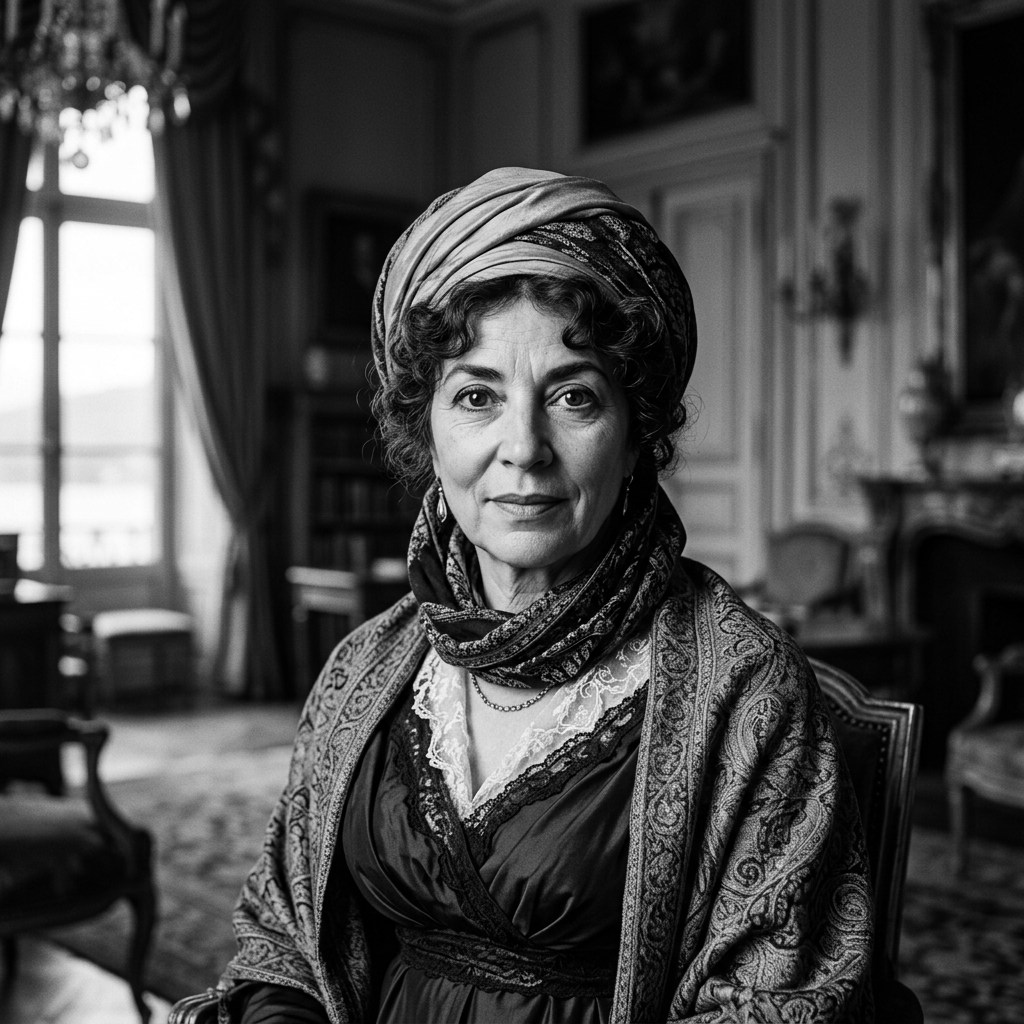
Featured image: Madame de Staël (AI illustration)