Summary
Germany’s constitution, the Basic Law, forbids the German state to censor. Article 5 is unambiguous: “There shall be no censorship.” Yet what the state may not do officially, it increasingly has done for it: by a tightly woven network of state-funded associations, reporting centers, fact-checkers and “civil society” alliances that flag unwelcome opinions, report them, pillory them in public and, when in doubt, hand them over to public prosecutors. The Australian civil liberties activist Andrew Lowenthal was the first to map this web systematically, identifying more than 330 actors. The complex is funded largely through federal programs such as “Demokratie leben!” (“Live Democracy!”), whose budget has grown from 40.5 million euros in 2015 to around 200 million euros. Its impact is amplified by the media infrastructure of the party state, above all the stake held by the Social Democratic Party (SPD) in the Madsack media group and its RedaktionsNetzwerk Deutschland. This article traces the architecture of the system, takes the arguments of its defenders seriously and explains why an order that seeks to pursue expressions of opinion “below the threshold of criminal liability” is taking the road toward tyranny.
The Anatomy of a Shadow Apparatus
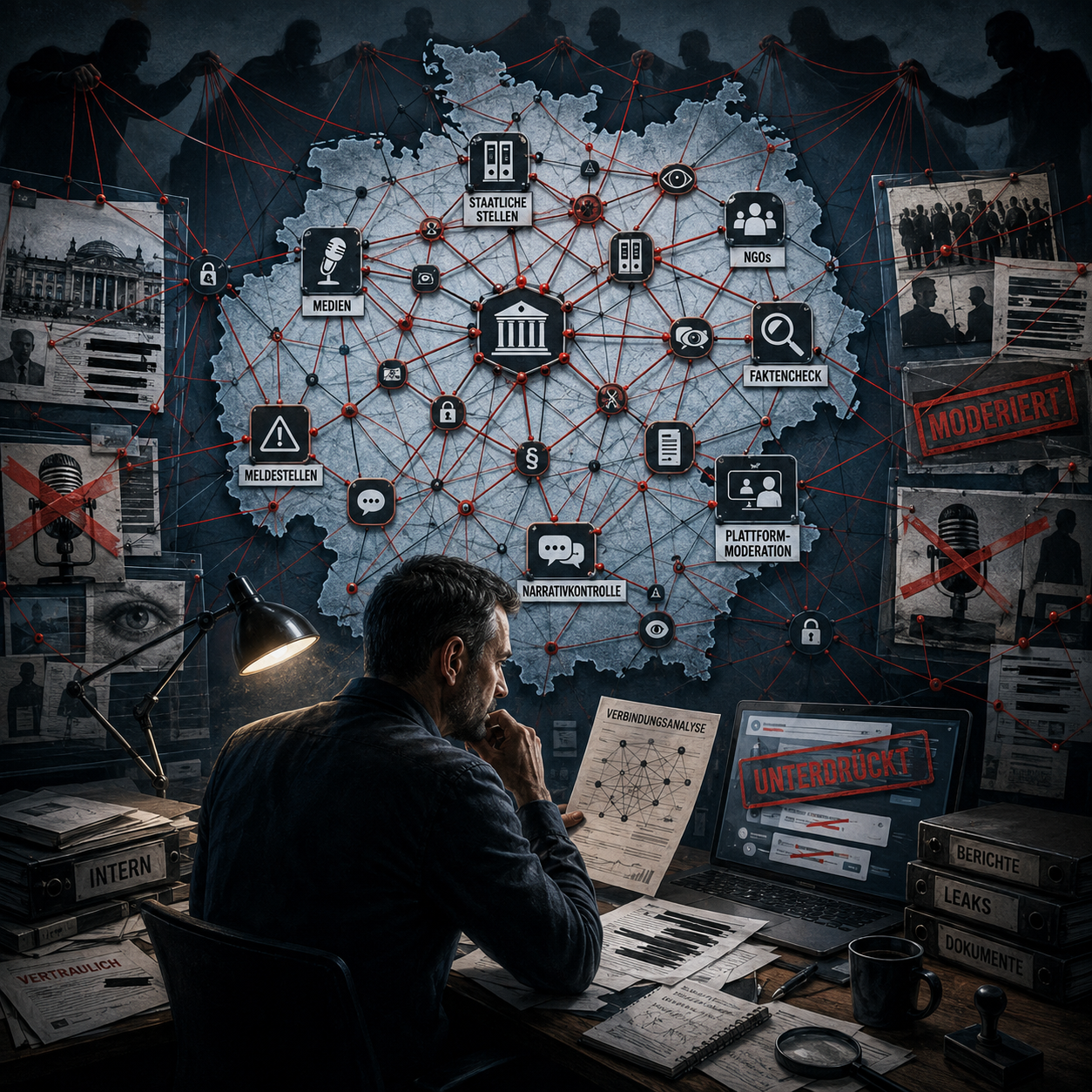
Anyone who wants to understand how opinion is steered in Germany in 2026 will look in vain for a ministry of censorship. What they find instead is a web that defies every classic category: government agencies that fund NGOs, NGOs that run reporting centers, reporting centers that supply platforms and public prosecutors, foundations that write studies on “disinformation,” and fact-checkers who define what is to count as true. The Australian journalist and civil liberties activist Andrew Lowenthal, who had previously worked on the analysis of the Twitter Files, mapped this system with his initiative liber-net in months of research. The result is sobering: more than 330 government agencies, NGOs, academic centers, think tanks, foundations and networks involved to varying degrees in monitoring and regulating online content, plus a database of more than 420 grants and subsidies for content control.1
Lowenthal speaks of a well-organized, well-funded and interconnected system that shapes, on an industrial scale, how people perceive the world and act politically. Berlin, he says, is the NGO capital of Europe, and many actors inside their epistemic bubble no longer even recognize how political and contested their work is: what they regard as true or false is often just their opinion.2 The American author Michael Shellenberger coined the term “Censorship Industrial Complex” for such structures. The German version, according to the conclusion of the liber-net study, surpasses in its density anything previously documented in the United States. Between 2020 and 2023 alone, almost 60 million euros reportedly flowed into content control projects, and censorship funding has risen by several hundred percent since 2020.3
Alongside this, a whole body of literature on the phenomenon has emerged. In his book “Der NGO-Komplex,” the journalist Björn Harms describes the circular economy between “civil society,” politics and the media: the state funds associations, the associations deliver studies and campaigns, politicians cite the associations, and the media spread their messages as the voice of society.4 The sleight of hand lies in the word itself: a nongovernmental organization that could not exist without government money is not a nongovernmental organization but an outsourced arm of the executive.
“Demokratie leben!”: The Financial Engine
The centerpiece of the funding is the federal program “Demokratie leben!” run by the Family Ministry. It started in 2015 with a budget of 40.5 million euros, grew to 182 million euros in each of 2023 and 2024, and reached around 200 million euros in 2025. For 2026 the draft budget even provides 209 million euros, while the third funding period, running until 2032, is to sustain around 580 projects.5 The program has thus increased fivefold within a decade, without any independent evaluation ever demonstrating that the republic has become more democratic as a result. Measured by the usual standards of assessing political success, one would have to conclude the opposite: the more money flowed into “democracy promotion,” the louder grew the complaints about the supposed threat to democracy. One might be forgiven for recognizing Parkinson’s law of bureaucracy here: the apparatus creates the demand that justifies its existence.
What matters is not only the sum but the selection logic. The ministry decides which projects are funded.6 Those who fit the ideological grid get funded, and this grid is not a neutral one. The “fight against the right” has become the universal vehicle with which almost any measure can be justified. Those, on the other hand, who call for less state, who criticize taxes, regulation or migration policy, who in other words make the overreaching state itself the topic, quickly find themselves on the other side of the funding logic: not as recipients but as objects of observation.
The Party State and Its Press: The Madsack Case
A censorship complex needs amplifiers. This is where a peculiarity of the German party state comes into play, one that would be hardly conceivable in any other Western democracy: a governing party is at the same time a media entrepreneur. Through its wholly owned holding company, the Deutsche Druck- und Verlagsgesellschaft (DDVG), the SPD holds 23.1 percent of the Madsack media group, making it the group’s largest limited partner. Madsack in turn, through the RedaktionsNetzwerk Deutschland (RND), supplies more than 60 daily newspapers, with a combined circulation of 2.3 million copies and a reach of around 6.8 million readers a day, with national and international content.7 So what the RND writes lands on the breakfast table of millions of citizens who take their local paper for an independent publication, and of course in its social media channels as well.
Now, it would be dishonest to claim that party headquarters dictates the headlines in Hanover, where Madsack is based. That is not how influence works, and it never has been. The former SPD treasurer Inge Wettig-Danielmeier once described the mechanism herself: even where the party holds only 30 or 40 percent, as a rule nothing can happen without it, and the party reserves for itself influence over the business plan and the appointment of management.8 Whoever has a say in management indirectly has a say in the editor-in-chief, and whoever has a say in the editor-in-chief shapes the climate in which journalists are hired, topics are set and interpretations are established. No phone calls from the Willy-Brandt-Haus, the SPD’s headquarters in Berlin, are needed when the incentive structure ensures from the outset that certain questions are never asked in the first place. It is precisely this structure that makes the Madsack complex the ideal echo chamber for the campaigns of the NGO complex: the state-funded associations supply the studies and the scandals, the editorial network carries them across the country, and the party that co-finances both reaps the power to define the political narrative.
Censorship Through the Back Door
What does the practical work of this complex look like? Precisely not the classic prior censorship that the Basic Law forbids. It consists of a tiered system of soft and hard sanctions: reporting centers record “incidents” even below any criminal threshold and keep registers of disfavored statements. Fact-checkers attach warning labels to dissenting positions, which throttles their algorithmic reach. Campaign organizations pressure employers, event organizers and platforms to cut ties with flagged individuals. And wherever a criminal-law lever can be found, complaints are passed on to public prosecutors, who then, with house searches over insult offenses, produce the very headlines whose disciplining effect reaches far beyond the individual case. Even the Anwaltsblatt, the journal of the German Bar Association and certainly no organ of fundamental opposition, warns of “private pillories with an official seal” and sees the separation of roles between sovereign state power and civil society discourse, which the rule of law requires, becoming blurred when organizations are strengthened in a buffer zone between criminal sanction and social ostracism.9
The insidious thing about this architecture is its deniability: each individual actor can claim not to be engaged in censorship. The reporting center is only reporting, the fact-checker is only checking, the association is only warning, the platform is only moderating, and the state is only funding. Taken together, however, they create a climate in which citizens calculate, before every statement, what it might cost them. Elisabeth Noelle-Neumann described this mechanism as the spiral of silence: people fall silent not only once they are punished but as soon as they fear social isolation. A system that systematically cultivates this fear no longer needs a censorship authority. It has moved censorship into people’s heads.
“Below the Threshold of Criminal Liability”: The Decisive Breach of Taboo
That this is not a misreading by malicious critics has been documented by leading representatives of the party state themselves. Federal Interior Minister Nancy Faeser (SPD) declared, in the context of her action plan against right-wing extremism, that whoever mocks the state must reckon with a strong state, and that even statements irrelevant under criminal law could be “detrimental to the welfare of the state.” Family Minister Lisa Paus (Greens) announced that the Democracy Promotion Act and the program “Demokratie leben!” would also be used to take action against statements that lie “below the threshold of criminal liability.”10 It is worth letting the full weight of this sentence sink in: a minister announces that the state will target lawful behavior. Not crimes, but opinions that “just barely” fall under freedom of expression are to become the object of state-funded countermeasures.
Criticism from constitutional lawyers was not long in coming. The Augsburg constitutional law scholar Josef Franz Lindner made clear that opinions expressed below the threshold of criminal liability enjoy the protection of fundamental rights, and that opinions critical of the state and the government, or unwelcome to politicians, are also protected by freedom of expression; it is a violation of fundamental rights, he said, to seek to prohibit disfavored opinions by invoking a vague concept such as “endangering the welfare of the state.”11 His colleague Arnd Diringer called the plans grossly unconstitutional and completely unacceptable. The defense attorney Gerhard Strate recalled that since the Lüth decision of 1958, the Federal Constitutional Court has consistently protected not only objective, nuanced statements but expressly also pointed and polemical exaggeration.12 The constitution this government claims to defend thus stands diametrically opposed to its plans.
What the System’s Defenders Say
It would be too cheap to dismiss this development as a mere conspiracy of power-hungry functionaries. The defenders of democracy promotion have arguments that must be taken seriously. First, they point to real threats: the program “Demokratie leben!” arose in response to the series of murders committed by the NSU, a neo-Nazi terrorist cell, and the murder of the politician Walter Lübcke by a right-wing extremist showed that verbal radicalization can turn into physical violence. A state that remained idle here would violate its duty to protect its citizens. Second, they argue from the idea of a democracy able to defend itself: the Weimar Republic collapsed partly because it granted its enemies every freedom, and prevention is in any case milder than repression. Third, civil society engagement against extremism is genuinely legitimate, they say; the fact that the state supports citizens who work against antisemitism or the glorification of violence does not make them censors. And fourth, as even Lowenthal concedes, by no means all of the organizations he mapped engage in active censorship; some devote themselves to research, public education or local educational projects.13
Why These Objections Do Not Hold
Each of these arguments contains a kernel of truth, and none of them justifies the existing system. One at a time. Against political violence, criminal law is what helps, and only criminal law: whoever plans attacks, threatens people or calls for violence belongs in court, not in a prevention statistic. The existence of criminals, however, gives the state no claim to manage the lawful range of opinion of all other citizens. This is exactly the line the complex crosses when it pursues statements “below the threshold of criminal liability.” The appeal to Weimar, moreover, turns the historical lesson on its head: the Basic Law’s democracy able to defend itself does so through party bans by the Constitutional Court and through judicially supervised proceedings, not through an extralegal apparatus that can destroy people’s social existence without indictment, without defense and without verdict. A system of pillories is not the mild precursor of the rule of law but a way around it.
The civil society legitimacy argument founders on the economics of the complex. Civil society is what citizens build voluntarily with their own money and their own time. Organizations that depend to a substantial degree on the ministries’ drip are not civil society but contractors, and they are subject to the same incentives as any bureaucracy that Buchanan and Tullock described: they maximize budget and jurisdiction, and their business model requires that the danger they fight never shrinks. That is why the definitional boundary of “extremism” moves inexorably inward, until even the call for less state, for lower taxes or for controlled migration is filed under “delegitimization.” And the fact that not every one of the 330 organizations censors exonerates the system no more than the existence of harmless departments exonerates an overreaching apparatus: what matters is the architecture, not the convictions of each individual clerk. A structure that seamlessly links reporting, flagging, the media pillory and referral to prosecutors is, as a structure, the problem.
Soft Despotism and Those Who Complete It
Almost two hundred years ago, Alexis de Tocqueville described what unfreedom in a democracy would look like: not as a tyranny of dungeons but as a gentle, solicitous despotism that softens souls, wears down the will and turns citizens into a herd of timid animals whose shepherd is the government. The NGO complex is the contemporary fulfillment of this prophecy. It locks no one up. It merely ensures that the employee thinks twice before sharing a post, that the scientist would rather not ask a research question, that the innkeeper would rather not rent out a hall, and that the local journalist would rather not begin an investigation. Once this state of affairs is reached, the Basic Law’s formal ban on censorship becomes a facade: the sentence “There shall be no censorship” remains true, because censorship no longer needs to take place.
Herein lies the real warning. Tyranny does not begin with camps but with lists. It begins where the state registers lawful behavior, where ministers announce that they will punish opinions below the threshold of criminal liability, and where a governing party is at once the sponsor of the accusers, the co-owner of the amplifiers and the beneficiary of the intimidation. A society that accepts this does not become unfree overnight. It becomes unfree report by report, grant by grant, silence by silence.
Conclusion
The German NGO complex is not an accident but a system with a recognizable logic: the party state finances for itself a “civil society” that disciplines its critics, and with the Madsack-RND group it commands the media infrastructure to multiply those interpretations millions of times over. The remedy is as easy to name as it is hard to achieve: full transparency of all state payments to associations and campaign organizations, an end to state funding of political opinion work, the separation of party and press, and a return to the principle that the state may neither register nor combat lawful speech. Whoever wants to promote democracy need not pay associations that monitor citizens. They must once again trust citizens to manage without assisted thinking. Anything else is not democracy promotion but its gradual dismantling.
Notes
- liber-net: The Censorship Network. Regulation and Repression in Germany Today, 2025, https://liber-net.org/germany/
- Neue Zürcher Zeitung: interview with Andrew Lowenthal, January 2026 (in German), https://www.nzz.ch/international/deutschland-hatte-grosse-fortschritte-bei-demokratie-und-meinungsfreiheit-gemacht-nun-scheint-es-in-eine-andere-richtung-zu-gehen-ld.1919496
- Berliner Zeitung: “Zensurnetzwerk” Deutschland. Wie die Regierung mit NGOs die Meinungsfreiheit untergräbt, November 2025 (in German), https://www.berliner-zeitung.de/article/zensurnetzwerk-deutschland-bundesregierung-ngos-meinungsfreiheit-10006771
- Björn Harms: Der NGO-Komplex. Wie die Politik unser Steuergeld verprasst, Langen Mueller Verlag 2025 (in German), https://www.amazon.de/NGO-Komplex-Politik-unser-Steuergeld-verprasst/dp/3784437397
- Deutscher Bundestag: Haushalt 2026, Einzelplan 17 (in German), https://www.bundestag.de/presse/hib/kurzmeldungen-1105732; BMBFSFJ: Infopapier “Demokratie leben!”, Start der 3. Förderperiode (in German), https://www.bmbfsfj.bund.de/resource/blob/254622/c0f9da0d567aa4bf0dc32aa019c69b33/infopapier-bundesfo-rderprogramm-demokratie-leben-dritte-fo-rderperiode-data.pdf
- Federal program “Demokratie leben!”: program description (in German), https://www.demokratie-leben.de/dl/programm
- Wikipedia: Deutsche Druck- und Verlagsgesellschaft (in German), https://de.wikipedia.org/wiki/Deutsche_Druck-_und_Verlagsgesellschaft
- Achgut: Das rote Medien-Imperium, 2019 (in German), https://www.achgut.com/artikel/das_rote_medien_imperium
- Anwaltsblatt: Private Pranger mit Hoheitssiegel (in German), https://anwaltsblatt.anwaltverein.de/de/themen/recht-gesetz/gastkommentar-rechtsstaatliche-grenzen
- Nordkurier: Faeser und Haldenwang attackieren die Meinungsfreiheit, February 2024 (in German), https://www.nordkurier.de/politik/regierungs-attacken-auf-die-meinungsfreiheit-2288755
- Berliner Zeitung: Staatsrechtler Lindner zu den Zensurplänen der Ampel-Regierung, February 2024 (in German), https://www.berliner-zeitung.de/politik-gesellschaft/zensurplaene-der-ampel-regierung-staatsrechtler-auch-abstossende-meinungen-sind-ein-grundrecht-li.2187727
- Gerhard Strate: Meinungen unterhalb der Strafbarkeitsgrenze, NJW-aktuell 10/2024 (in German), https://strate.net/wp-content/uploads/2024/07/Kolumne_Strate_NJW_aktuell_H_10_2024.pdf
- Gerechtigkeitspartei: Das Zensurnetzwerk. Wie Deutschlands Meinungsfreiheit systematisch untergraben wird (in German), https://gerechtigkeitspartei.de/artikel/das-zensurnetzwerk-wie-deutschlands-meinungsfreiheit-systematisch-untergraben-wird