Summary
Year after year, German cities collect billions of euros in fines, warning fees (small fixed fines for minor offenses, known in German as Verwarnungsgelder), and parking charges. Officially, these instruments serve road safety and the orderly management of scarce parking space. In reality, however, both empirical research and the incentive structure of municipal budgets show that a hidden tax is being levied here: a levy that never has to be enacted as a tax, debated as a tax, or justified as a tax, because it hides behind the moral shield of the rule violation. Whoever pays is considered to have only himself to blame, and whoever has only himself to blame deserves no sympathy and certainly no political representation. It is precisely this construction that makes hidden taxation so convenient, and it is precisely why it deserves a sober analysis.
A Tax That Must Not Be Called One
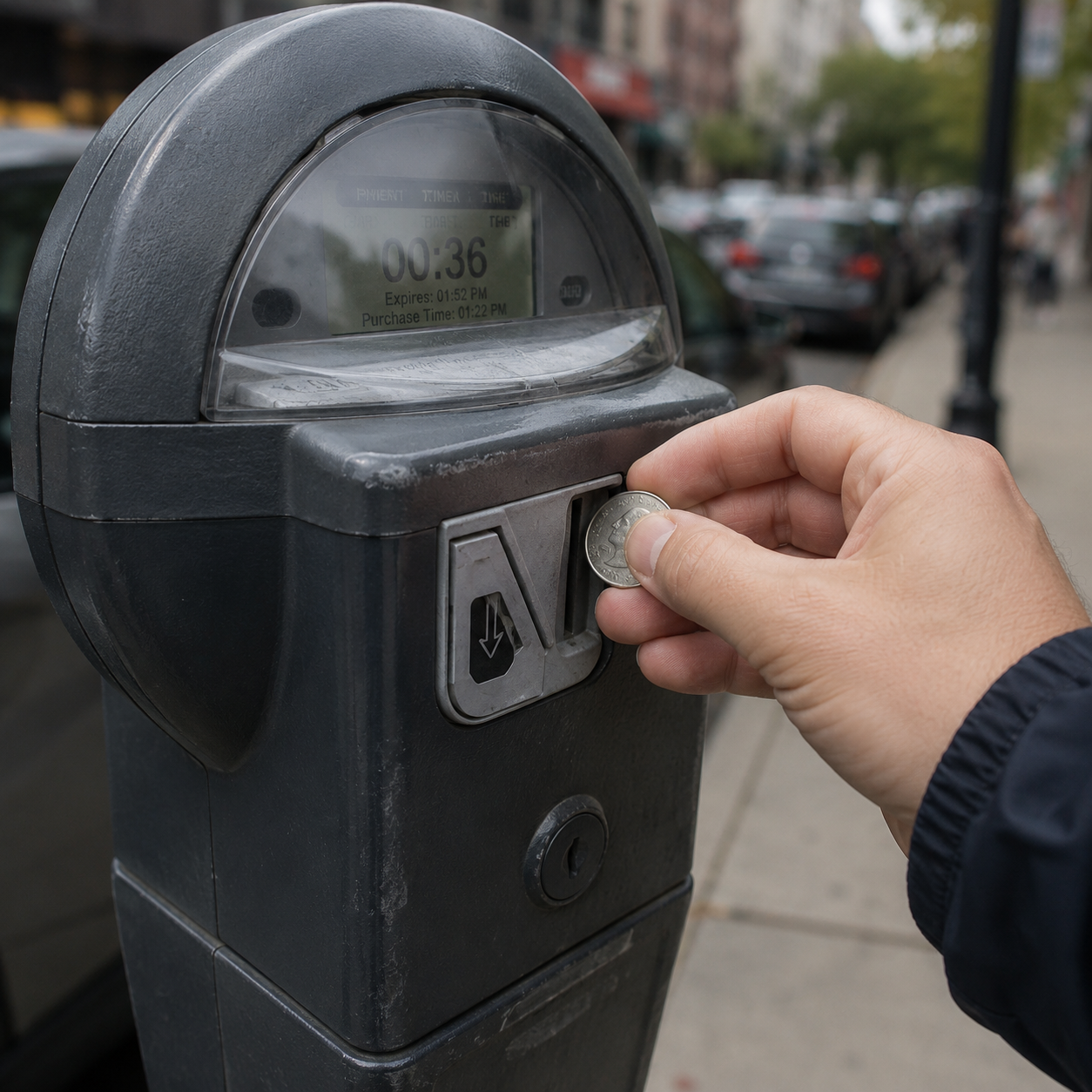
In his famous essay on what is seen and what is not seen, Frédéric Bastiat showed that the real art of political economy lies in recognizing the hidden effects of a measure, not just the obvious ones.1 Applied to municipal levies, this means: what is seen is the speed camera on the arterial road, what is seen is the parking meter in front of the house, what is seen is the official justification of safety and protecting residents. What is not seen is the fiscal function these devices actually perform: they are sources of revenue that flow into the general budget and plug holes there that would be politically more costly to plug through ordinary tax increases.
The conceptual trick lies in the labeling. By definition, a tax is a levy without any claim to a specific service in return, collected to finance the state in general. A fine, by contrast, is supposed to be a sanction, and a fee is supposed to pay for a service. But as soon as the revenue from sanctions and fees is firmly built into budget planning, as soon as municipalities count on this revenue, fund staff with it, and close deficits with it, the sanction functionally turns into a tax. In its survey of the 150 largest cities, the German Bar Association (Deutscher Anwaltverein, DAV) found that 26 of the 36 cities it evaluated channel their speed camera revenue entirely into the general city budget rather than earmarking it for road safety.2 Whoever operates a safety measure whose proceeds vanish into the general budget is in truth conducting fiscal policy by other means.
The Scale of the Phenomenon
The sums involved are anything but marginal. In 2024, Berlin took in around 112 million euros in traffic fines and warning fees, Hamburg a good 82 million, and Cologne about 44 million.3 Germany’s state capitals together collected around 355 million euros in a single year from parking fees, parking fines, and residential parking permits alone.4 Nationwide, municipalities are likely to take in several billion euros a year from the combination of parking management and traffic enforcement.
Particularly revealing is what happened after the federal schedule of traffic fines (the Bußgeldkatalog) was tightened in November 2021: within a year, the speed camera revenue of the surveyed cities more than doubled on average, from around 58 to around 135 million euros, and the number of so-called speed camera millionaires (cities taking in more than a million euros a year from speed cameras) rose from 17 to 26 cities.2 Note the logic: if the goal were road safety, a successful sanctions policy would have to lead to falling revenue over time, because violations would decline. Rising revenue that is firmly planned in advance, on the other hand, reveals that the violation is not being prevented but farmed. From a fiscal point of view, the speeder is not a problem but a customer.
Public Choice: Why the Municipality Sets Up Speed Cameras
Economic research shows that this is not a polemical insinuation but an empirically well-documented pattern. The public choice school around James Buchanan and Gordon Tullock taught us to model politicians and administrations not as selfless stewards of the common good but as actors with their own interests who respond to incentives like everyone else.5 William Niskanen added that bureaucracies systematically tend toward budget maximization.6
For traffic enforcement, this connection has by now been precisely demonstrated. Using data from Massachusetts, Michael Makowsky and Thomas Stratmann showed that the probability of actually receiving a ticket at a traffic stop rises significantly when the town in question is under fiscal pressure, for instance after a failed vote on tax increases; out-of-towners, who do not vote in the next local elections, are hit especially often.7 Thomas Garrett and Gary Wagner demonstrated for counties in North Carolina that the number of tickets issued rises significantly when local revenue dropped sharply in the previous year.8 Road safety does not change with the state of the budget; enforcement behavior very much does. This proves that the intensity of sanctions follows not the level of danger but the need for money, and that is exactly the definition of a tax.
The Moral Camouflage
Why does this hidden taxation work so smoothly in political terms? Because it comes equipped with a moral immunization against which no one affected can defend himself without putting himself in the wrong. “If you drive too fast, tough luck,” people say, or: “If you don’t want to get caught by a speed camera, just follow the rules.” For parking, the formula is: “We need the parking space for the residents,” or more generally: “Public space is a scarce good.”
These sentences are rhetorically brilliant because they turn a debate about the levy into a debate about the person who has to pay it. Whoever questions the amount, the distribution, or the purpose of the revenue is not refuted but morally disqualified: after all, he is defending speeders and illegal parkers. This creates a category of tax that cannot have a lobby, because its payers are by definition rule breakers, and no one publicly takes the side of rule breakers. It is the same pattern of thought we know from tobacco and alcohol taxes in another context: the levy targets a minority whose behavior society disapproves of, and can therefore be raised with almost no resistance. The difference lies solely in the packaging, not in the function.
Yet the concrete design betrays the fact that the safety rhetoric is a pretext. If prevention were the goal, speed cameras would be set up to be as visible as possible, announced in advance, and marked with clear signs, because the visible speed camera lowers speeds while the hidden one merely collects money. Instead, measuring devices tend to be placed where traffic is heavy and speed limits change abruptly, that is, where the yield is maximized, not necessarily where accidents happen. And if the goal in parking were the orderly management of scarce space, the revenue would have to go into creating parking space or into transportation infrastructure; in fact, it disappears into the general budget, while in many places the supply of parking is deliberately reduced, which further increases the willingness to pay and thus the revenue. The state creates the scarcity it then goes on to farm.
The Strongest Counterargument
Intellectual honesty demands that we take the other side’s best argument seriously, and it is indeed a weighty one. It goes like this: scarce parking space and excessive speed impose real costs on third parties. Whoever parks in a densely built-up city center takes up twelve square meters of public space that are no longer available to others; a price of zero leads to cruising for parking, long-term parkers, and chronic overuse, in other words to the classic tragedy of the commons. The market economist in particular ought to recognize that scarce goods should have a price. And whoever drives past an elementary school at sixty kilometers per hour externalizes a risk onto children who cannot protect themselves against it by contract. A sanction that internalizes these external costs would therefore not be a tax but a correction well founded in economic theory. Seen this way, parking fees would simply be market prices and fines simply compensation for liability.
Why the Argument Still Does Not Hold
In its abstract form, the argument is correct, and a libertarian disputes neither the legitimacy of prices for scarce goods nor the need to sanction endangering third parties. It fails, however, on three points of concrete implementation.
First, a price presupposes a legitimate owner who faces competition. But the municipality is not one owner among others; it is a coercive monopolist that built the spaces with the taxpayers’ money of the very citizens it is now asking to pay a second time, and that can at the same time exclude private competition and alternative uses by ordinance. A monopoly price with no alternative is not a market price but a levy. The test is simple: a private parking garage operator who overprices loses customers to the competition; a municipality that controls all street space and simultaneously restricts supply loses nothing; it gains.
Second, the size of the sanction follows not the damage but the yield. If fines internalized external costs, they would have to be measured against the concrete danger, and the revenue would have to go to those actually harmed, or at least to preventing danger. In fact, not a cent goes to an accident victim, not a cent is earmarked, and empirical research shows that the density of enforcement fluctuates with the state of the budget, not with the level of danger.7 A sanction whose intensity depends on the financial needs of the one imposing it has left the ground of justice; it is fiscal policy.
Third, the construction corrupts the rule of law itself. If the state profits from rule violations, it has an institutional interest in rules being broken, and more than that: an interest in designing rules so that they will be broken. Implausibly low speed limits, short traffic light cycles, and confusing parking zone regulations are, under this incentive structure, not glitches but business models. A polity that regards its citizens as a source of revenue for contrived violations destroys the very trust in the rules that it invokes in its rhetoric.
Conclusion: The Price of Camouflage
One can argue about the right level of taxes, and the libertarian will always argue on the side of the citizen. But a minimum condition for any levy that is even remotely legitimate is honesty: it must be named, enacted, and owned as what it is. Hidden taxation through speed cameras and parking meters violates precisely this condition. It escapes democratic control because it does not appear as a tax; it escapes criticism because it morally discredits those who pay it; and it escapes moderation because its yield grows with the strictness of the rules. Where the state lives off the misconduct of its citizens, it will not want to abolish that misconduct but to cultivate it. The principle at stake, therefore, is not whether one may drive too fast or park illegally. It is whether the state may use its coercive power as a hidden instrument of revenue. The answer of liberty is no, because a levy that has to hide knows that it would never win open consent.
Sources
- Bastiat, Frédéric: Ce qu’on voit et ce qu’on ne voit pas, Paris 1850 (English: What Is Seen and What Is Not Seen).
- Arbeitsgemeinschaft Verkehrsrecht des Deutschen Anwaltvereins (DAV), the traffic law working group of the German Bar Association: Bilanz nach einem Jahr Bußgeldkatalog: Blitzereinnahmen 2022 mehr als verdoppelt, survey of the 150 largest German cities, Berlin, November 14, 2023 (in German).
- Der Spiegel: survey on the fines and warning fees of the ten largest German cities for 2024, April 2025 (in German).
- Welt am Sonntag: survey of the revenue of Germany’s state capitals from parking fees, parking fines, and residential parking permits for 2022, August 2023 (in German).
- Buchanan, James M. / Tullock, Gordon: The Calculus of Consent. Logical Foundations of Constitutional Democracy, Ann Arbor 1962.
- Niskanen, William A.: Bureaucracy and Representative Government, Chicago 1971.
- Makowsky, Michael D. / Stratmann, Thomas: Political Economy at Any Speed: What Determines Traffic Citations?, in: American Economic Review, vol. 99, no. 1 (2009), pp. 509–527.
- Garrett, Thomas A. / Wagner, Gary A.: Red Ink in the Rearview Mirror: Local Fiscal Conditions and the Issuance of Traffic Tickets, in: The Journal of Law and Economics, vol. 52, no. 1 (2009), pp. 71–90.