
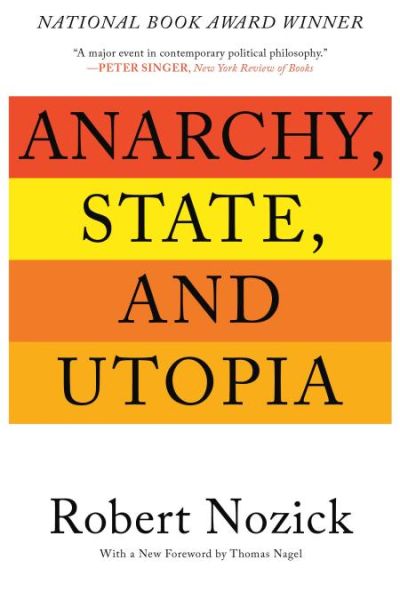
Anarchy, State, and Utopia
The philosophical answer to Rawls: how much state can be justified at all?
- Level
- Specialist
- Published
- 1974
- Publisher
- Basic Books
- ISBN
- 9780465051007
What it is about
Robert Nozick’s book, published in 1974, is regarded as one of the most influential political works of the twentieth century. Starting from the question of whether the state can be justified at all, Nozick develops a rigorous theory of individual rights: every person has inalienable rights over their own person and the fruits of their labor, which no collective and no majority may simply override.
At its core is a critique of John Rawls’s influential theory of justice. Where Rawls sees redistribution as a requirement of fairness, Nozick counters that justice is not a pattern to be imposed from above but the result of voluntary exchanges and transfers between people. His famous Wilt Chamberlain argument shows that any attempt to maintain a particular pattern of distribution over time inevitably leads to restrictions on liberty.
Nozick argues for a “minimal state,” limited to protection against force, theft, and fraud. Anything beyond that, in his view, violates the rights of individuals. For him, utopia is not a centrally planned ideal but a framework within which different communities can live according to their own ideas.
The book is for anyone who sees political philosophy not as an academic exercise but as serious reflection on liberty and coercion. The argument is demanding but precise; readers who engage with it are rewarded with one of the clearest cases for individual self-determination in the history of ideas.
Did you enjoy the book? The author and publisher will appreciate a short review, for example with the retailer you bought it from.
More about the author: Robert Nozick: Anarchy, State, and Utopia