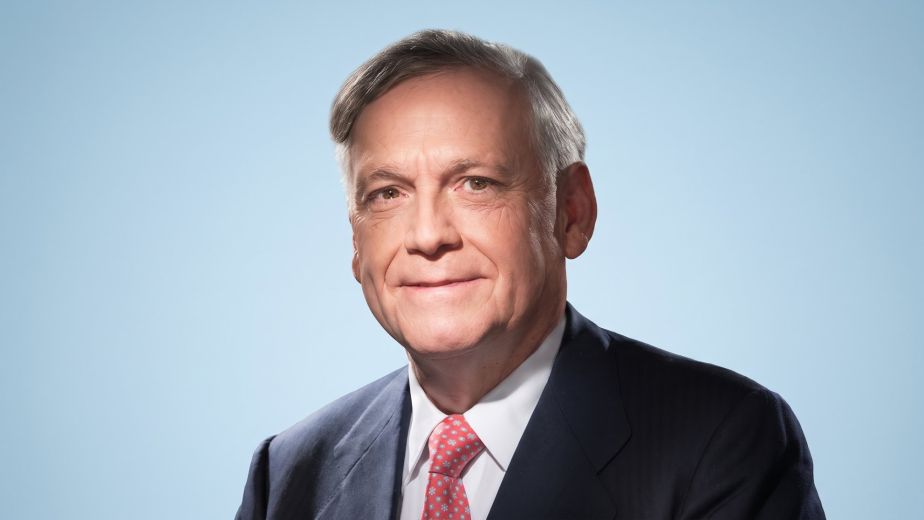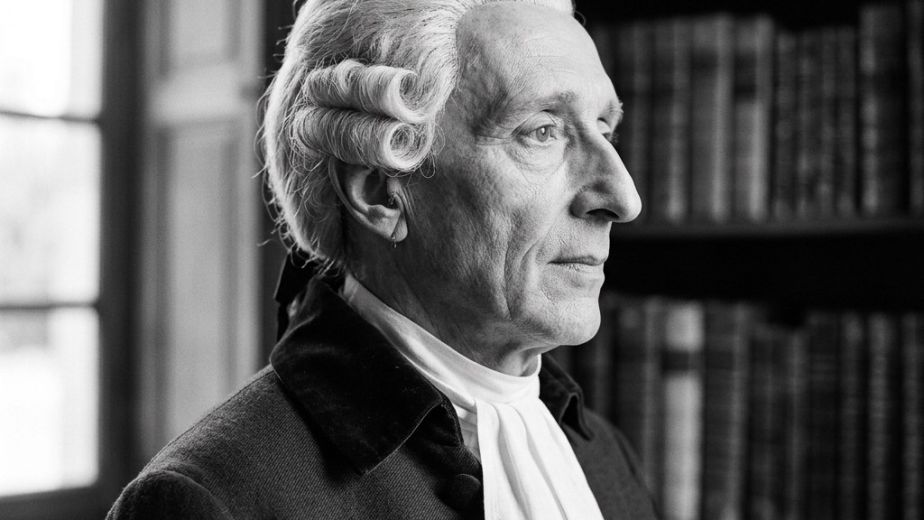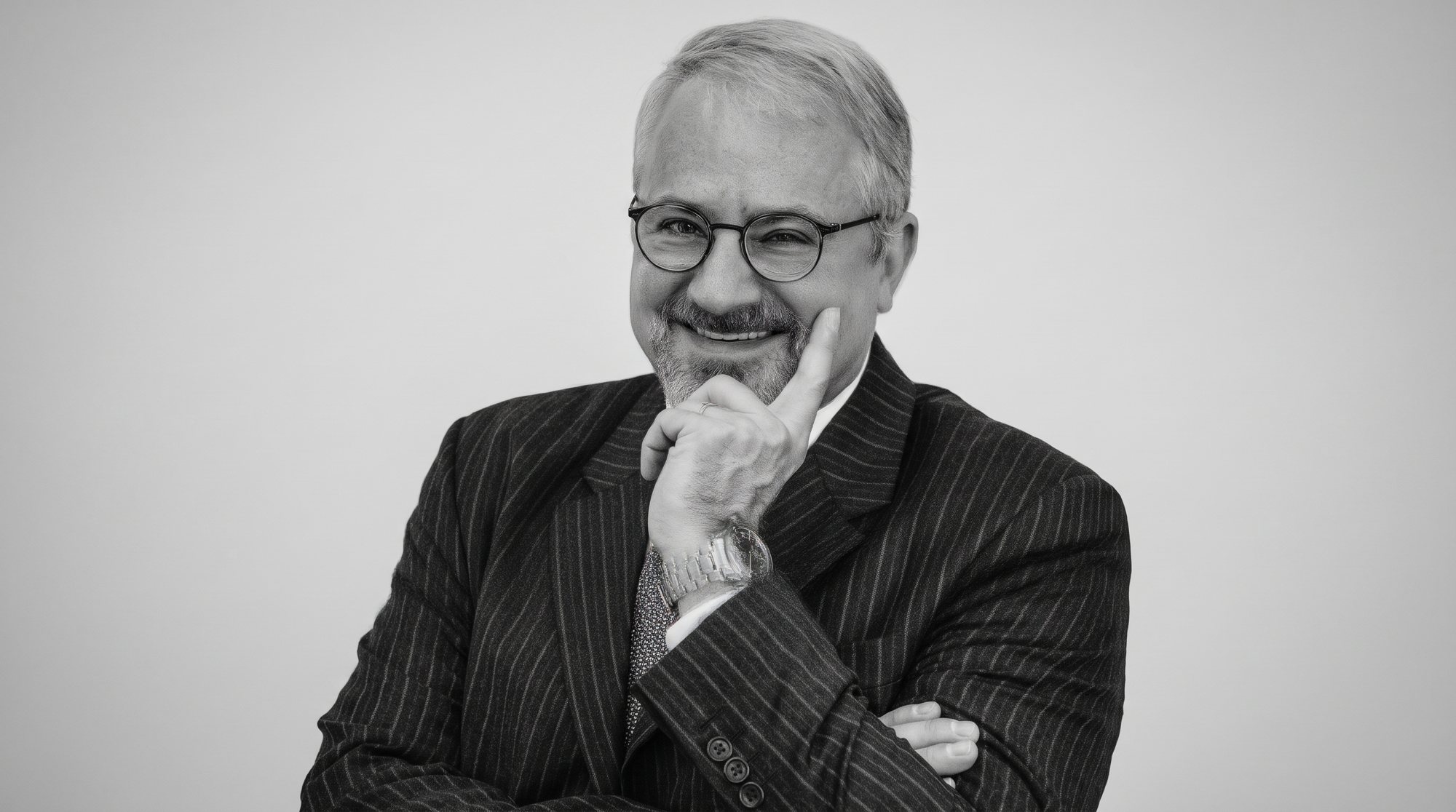
In September 2025, Alessandro Fusillo opened his talk before the Property and Freedom Society in Bodrum, Turkey, with a story that Augustine tells in the fourth book of his City of God. Alexander the Great asks a captured pirate what he means by making the sea unsafe. The pirate answers, in substance, that he does with one small ship the same thing the king does with a whole fleet; it is only for that reason that he is called a robber and the other an emperor.
For Fusillo, this anecdote is more than a punch line. It sums up the question that shapes his thinking: What distinguishes law from mere power, and who has the authority to make law? That the answer here comes from a practicing lawyer, who holds that law is older than the state, gives his voice a weight of its own in Europe’s libertarian movement.
At a glance
- Profession: Attorney admitted to the bar in Italy, Spain, and Germany, and since 2002 also before Italy’s highest courts (cassazionista)
- Education: Law degree with honors from La Sapienza University in Rome, then assistant in civil procedure
- Work: President of the Movimento Libertario (according to Radio Erre in May 2025), regular speaker at the Property and Freedom Society since 2021, author of the website Difendersi ora and of the weekly show FUSILLO live
- Writings: Afterword to Murray N. Rothbard, Contro l’egalitarismo (2023), contribution to the new Italian edition of Hans-Hermann Hoppe’s Democrazia: il dio che ha fallito (2024), guest article in the Swiss magazine Schweizer Monat (2025)
- In one sentence: A trial lawyer who draws on the knowledge of the jurist and the historian to show that law is discovered, not commanded.
From a lecture hall in Rome to law offices in three countries
Fusillo studied law at La Sapienza University in Rome, graduated with honors, and then worked as an assistant in civil procedure. So says his website, which also lists the further stages of his career: in 1998 he founded a law firm with offices in Rome, Berlin, and Madrid, and since 2002 he has been admitted as a cassazionista, which means he may appear before the Court of Cassation and Italy’s other highest courts. He is also admitted to the bar in Spain and in Germany. He speaks fluent German, English, and Spanish and reads Latin and ancient Greek. In an interview in June 2025, he said that he is half German and also has offices in Berlin and Munich.
By his own account, he came to libertarian thought only as an established lawyer, around 2007 and 2008, through the writings of Ludwig von Mises, Murray Rothbard, and Hans-Hermann Hoppe. An important role was played by the journalist Leonardo Facco, whom the American website LewRockwell.com called the father of the Italian libertarian movement in 2021 and who founded the Movimento Libertario. Fusillo later took over the leadership of this association himself; Radio Erre introduced him as its president in May 2025. Speaking with the commentator Jose Niño in 2025, he described its members as “hardcore libertarians, strictly aligned with the Mises-Rothbard line.”
When injustice becomes law
For years, one sentence has accompanied Fusillo as the motto of his law firm: when injustice becomes law, resistance becomes duty. This stance showed most clearly during the years of the COVID measures. Fusillo published videos and information sheets explaining to citizens how they could fight fines for violating the mask mandate or the penalties imposed on unvaccinated people over fifty. In May 2021, on the website Come Don Chisciotte, he announced a criminal complaint against the Italian government and a joint emergency lawsuit against the vaccination mandate for healthcare workers. Before the Italian Constitutional Court, the criticism of this mandate did not succeed; in February 2023 the court declared it constitutional. In 2025, Radio Erre called him one of the most critical voices against the authoritarian tendencies of recent years and emphasized that he had always opposed the pandemic restrictions.
What ancient Rome reveals about the modern state
Since 2021, Fusillo has spoken every year at the conference of the Property and Freedom Society, which was founded in May 2006 on the initiative of Hans-Hermann Hoppe and has met in Bodrum ever since. By now his talks form a small legal history of liberty. In 2021 the subject was state-making as war-making, using Italy as the example; in 2023, the state of emergency as an unlawful instrument of rule; in 2024, liberalism, anarchism, and fascism in the history of modern Italy.
Perhaps the richest was his 2022 talk on Roman law. In it, Fusillo presented the Swiss political theorist Carl Ludwig von Haller (1768–1854), who rejected the theory of the social contract. He distinguished two legacies of Rome. Roman private law remains the foundation of the civil codes of continental Europe to this day. It arose, and here Fusillo builds on the Italian legal philosopher Bruno Leoni, from the work of jurists and judges who discovered rules in individual cases instead of enacting them at a ruler’s command. Roman public law, by contrast, with its concepts of res publica and societas civilis, encouraged the notion that the state belongs to the people and may therefore do anything. Augustus, Fusillo argues with Haller, had already used republican terminology to pass off military rule as a republic, and through this language the idea of the social contract made its way to Hobbes, Locke, and Rousseau.
Pirates, principles, and a community without territory
The 2025 talk approached the subject from an unexpected angle. The pirates of the Caribbean, Fusillo argued according to Sebastian Wang’s report, were more than criminals. They gave themselves their own rules, the pirate articles, elected their captains and could remove them again, set a quartermaster beside them as a counterweight, and agreed on the shares of the plunder in advance. Similar experiences with enclosures and forced recruitment later also shaped the colonists who rose up against the British Crown. Fusillo explicitly did not want to hold up the often violent sea robbers as role models; but they showed, he said, that the state is not the only source of law.
That same year, participants in Bodrum signed the Universal Principles of Liberty, a concise summary of libertarian principles based on the non-aggression principle and natural law, initiated by the Birtawil project and inspired by Hoppe. They are meant to found a community of free people that is not tied to any territory, and in October 2025 Fusillo announced an Italian version.
The law as a crutch for paper money
His most recent essays address questions that concern everyone. In May 2026 he examined the so-called nominalist principle, found in Article 1277 of the Italian Civil Code: a monetary debt is discharged at its face value, no matter how much purchasing power the money has lost in the meantime. The loss is borne by the creditor, for instance the saver who lent out his money. Fusillo sees in this rule a quiet support for state paper money. He states his conclusion this way: “Una valuta non manipolabile è la condizione di possibilità di un contratto pecuniario propriamente detto,” that is, a currency that cannot be manipulated is the precondition for a genuine monetary contract. He names gold or bitcoin as examples.
In June 2026 he wrote about artificial intelligence programs meant to supply courts with predictions about people’s future behavior. The old maxim da mihi factum, dabo tibi ius (give me the facts, and I will give you the law), he argues, refers to acts already committed, not to probabilities. “La distinzione tra fatto e previsione non è tecnica ma ontologica,” he states: the difference between an act and a prediction is not a technical question; it concerns the very nature of the matter.
When it became known in the spring of 2026 that Germany’s amended Military Service Act required men between 17 and 45 to obtain a permit from the Bundeswehr, Germany’s armed forces, for stays abroad of more than three months, he wrote an essay titled Carne da cannone per le nuove guerre, Cannon Fodder for the New Wars. Germany’s defense minister later clarified that no one currently needs such a permit. Fusillo’s principle remains unaffected: “La coscrizione militare è una forma di schiavitù,” military conscription is a form of slavery.
A purist in the dispute over Milei
Fusillo does not shy away from disputes even among the like-minded. At the 2024 conference, he sat on the panel with David Dürr, Antony Müller, Philipp Bagus, and Hans-Hermann Hoppe on the question of what to make of Argentina’s president Javier Milei. Bagus defended Milei; Fusillo was among the skeptics. In December 2025 he set out his view in German in Schweizer Monat. Both libertarian camps, he writes, welcome the cuts in civil service jobs, the closing of several ministries, and the deregulation. He then follows the objections of the purists, which Hoppe had summarized in Bodrum in 2024: Milei unconditionally supports Israel’s conduct of the war in the Gaza Strip, which contradicts the non-aggression principle; the central bank has not been closed; the money supply has grown faster than under his Peronist predecessors; and currency controls and high taxes remain in place. Fusillo sees Milei’s thinking as rooted rather in the neoclassical tradition of the Chicago School. His verdict is brief: “Javier Milei is not a libertarian revolutionary and not an outsider with a bold master plan. He is a politician like any other.” (Our translation from the German.) One need not share this verdict to recognize the standard by which Fusillo measures every government that comes to power with the promise of liberty.
From legal brief to legal philosophy
Fusillo’s most important idea concerns law itself. Whoever distinguishes, as he does, between private law that has grown over time and public law that has been decreed loses the fear of the idea that a society can find its own rules. Civil law, with which people conclude contracts and settle disputes every day, owes its existence, in his account, to the work of many generations of jurists and judges, and it is older than any present-day government.
Then there is his practice. Fusillo shows that libertarian convictions need not stay in seminar rooms. He translates them into legal briefs, information sheets, and broadcasts that help citizens in Italy know their rights. His weekly show FUSILLO live had already reached its 199th episode by August 2026.
Finally, his view across borders is worth noting. A jurist who is at home in three legal systems and who speaks in Bodrum about Augustine, Haller, and the pirates is a reminder of how European the idea of liberty is. With Bruno Leoni, whose book Freedom and the Law appeared in 1961, Italy produced a major legal thinker of liberty, and Fusillo carries this tradition forward with the tools of an attorney.
Law that can be found
Fusillo places his trust less in political programs than in people’s ability to recognize law when they are allowed to, just as Roman jurists, merchants, and even the crew of a pirate ship have done. The pirate in Augustine’s story spoke an uncomfortable truth, and Fusillo takes it as a mission: the size of a power does not make its actions more just. Whether a law discovers what is right or merely exercises power: that is the question Alessandro Fusillo has been asking for years, with expertise and persistence.
Further reading
- Alessandro Fusillo: Javier Milei trat als libertärer Revolutionär an – und entpuppt sich als ganz normaler Politiker, Schweizer Monat, December 9, 2025 (in German)
- Alessandro Fusillo: Il Principio Nominalistico e la Moneta Fiat, Difendersi ora, May 19, 2026 (in Italian)
- Murray N. Rothbard: Contro l’egalitarismo, with an afterword by Alessandro Fusillo, Liberilibri 2023 (in Italian)
- Property and Freedom Podcast, episode 244: Alessandro Fusillo, Roman Law Reconsidered (PFS 2022)
This article is part of our series on thinkers, doers, and historical figures of liberty.
Sources
- Fusillo, Alessandro: “Javier Milei trat als libertärer Revolutionär an, und entpuppt sich als ganz normaler Politiker,” Schweizer Monat, December 9, 2025 (in German), https://schweizermonat.ch/javier-milei-trat-als-libertaerer-revolutionaer-an-und-entpuppt-sich-als-ganz-normaler-politiker/
- Fusillo, Alessandro: “Il Principio Nominalistico e la Moneta Fiat: Il Diritto come Stampella della Truffa Monetaria,” Difendersi ora, May 19, 2026 (in Italian), https://www.difendersiora.it/2026/05/19/il-principio-nominalistico-e-la-moneta-fiat-il-diritto-come-stampella-della-truffa-monetaria/
- Fusillo, Alessandro: “Intelligenza Artificiale e Giustizia Predittiva,” Difendersi ora, June 22, 2026 (in Italian), https://www.difendersiora.it/2026/06/22/intelligenza-artificiale-e-giustizia-predittiva-la-negazione-del-da-mihi-factum-dabo-tibi-ius-e-il-pericolo-della-confusione-tra-fatto-e-previsione/
- Fusillo, Alessandro: “Carne da cannone per le nuove guerre,” Difendersi ora, April 7, 2026 (in Italian), https://www.difendersiora.it/2026/04/07/carne-da-cannone-per-le-nuove-guerre-di-alessandro-fusillo/
- Fusillo, Alessandro: list of articles, https://www.difendersiora.it/articoli/ ; self-description “Chi siamo,” https://www.difendersiora.it/chi-siamo/ (in Italian)
- Fusillo, Alessandro: “State-Making as War-Making: The Case of Italy” (PFS 2021), Property and Freedom Podcast 226, https://propertyandfreedom.org/as_paf_podcast/pfp226-fusillo-state-making-as-war-making-the-case-of-italy-pfs-2021/
- Fusillo, Alessandro: “Roman Law Reconsidered” (PFS 2022), Property and Freedom Podcast 244, https://propertyandfreedom.org/paf-podcast/pfp244-fusillo-roman-law-reconsidered-pfs-2022/
- Fusillo, Alessandro: “The State of Emergency: The Government’s Illegal Tool of Domination” (PFS 2023), Property and Freedom Podcast 255, https://propertyandfreedom.org/paf-podcast/pfp255-fusillo-state-of-emergency-pfs-2023
- Fusillo, Alessandro: “Liberalism, Anarchism, Fascism: A Brief Look at the Modern History of Italy” (PFS 2024), https://propertyandfreedom.org/2024/10/alessandro-fusillo-liberalism-anarchism-fascism-a-brief-look-at-the-modern-history-of-italy-pfs-2024
- Dürr, Müller, Fusillo, Bagus, Hoppe: “Roundtable: What to Make of Milei” (PFS 2024), Property and Freedom Podcast 279, https://propertyandfreedom.org/as_paf_podcast/pfp279-durr-et-al-roundtable-milei-pfs2024/
- Fusillo, Alessandro: “The Pirates of the Caribbean as Forebears of the Libertarians and of the American Revolution” (PFS 2025), Property and Freedom Podcast 299, https://propertyandfreedom.org/as_paf_podcast/pfp299-fusillo-pirates-caribbean-forebears-pfs-2025/
- Kinsella, Hoppe, Iglody, DiLorenzo, Barr, Fusillo: “Roundtable Discussion: Rothbard at 100” (PFS 2026), Property and Freedom Podcast 360, https://propertyandfreedom.org/as_paf_podcast/pfp360-roundtable-discussion-rothbard-at-100-pfs-2026/
- Rothbard, Murray N.: Contro l’egalitarismo, with an afterword (postfazione) by Alessandro Fusillo, Liberilibri 2023; Hoppe, Hans-Hermann: Democrazia: il dio che ha fallito, with a contribution by Alessandro Fusillo, Liberilibri 2024 (details according to https://www.liberilibri.it/autori/fusillo-alessandro/) (in Italian)
- Interview with Jose Niño, El Niño Speaks, June 2025, transcript at https://propertyandfreedom.org/2025/06/fusillo-italy-populist-right-javier-milei/
- Interview with Come Don Chisciotte, May 5, 2021 (in Italian), https://comedonchisciotte.org/cdc-incontra-avv-alessandro-fusillo-governo-denunciato-per-strage/
- “FUSILLO live,” YouTube, e.g., episode 199 (August 26, 2026), https://www.youtube.com/watch?v=Uy1oSHnKu6A
- Katz, Ira: “A Rare Breed: Alessandro Fusillo,” LewRockwell.com, September 6, 2021, https://www.lewrockwell.com/2021/09/ira-katz/a-rare-breed-alessandro-fusillo/
- Radio Erre: “Contro la deriva autoritaria: intervista senza filtri all’avvocato Alessandro Fusillo,” May 14, 2025 (in Italian), https://radioerre.media/2025/05/14/contro-la-deriva-autoritaria-unintervista-senza-filtri-allavvocato-alessandro-fusillo/
- Il Truffone, episode IT132: “Tra eventi e conferenze: il percorso libertario di un avvocato,” December 4, 2019 (in Italian), https://iltruffone.com/it132-tra-eventi-e-conferenze-il-percorso-libertario-di-un-avvocato/
- Wang, Sebastian: “Pirates, Liberty and Revolution: Alessandro Fusillo in Bodrum,” Libertarian Alliance, September 19, 2025, https://libertarianism.uk/2025/09/19/pirates-liberty-and-revolution-alessandro-fusillo-in-bodrum/
- Kinsella, Stephan: “Fusillo on the Universal Principles of Liberty and Liberland,” October 2, 2025, https://propertyandfreedom.org/2025/10/fusillo-on-the-universal-principles-of-liberty-and-liberland/
- Property and Freedom Society: About, https://propertyandfreedom.org/about/
- Koll, Sascha: “Inhaltlich frei: Property and Freedom Society,” Freiheitsfunken, April 11, 2024 (in German), https://freiheitsfunken.info/2024/04/11/21912-inhaltlich-frei-property-and-freedom-society
- Corte costituzionale: Sentenza 14/2023 (vaccination mandate for healthcare workers) (in Italian), https://www.cortecostituzionale.it/scheda-pronuncia/2023/14
- Legal Tribune Online: “Genehmigungspflicht für Auslandsaufenthalte wehrfähiger Männer,” 2026 (in German), https://www.lto.de/recht/hintergruende/h/wehrdienst-wehrpflicht-genehmigung-ausland-maenner-gesetz-bundeswehr
- beck-aktuell: Pistorius on the permit requirement for long trips abroad, April 8, 2026 (in German), https://www.beck-aktuell.de/heute-im-recht/rechtspolitik-gesetzgebung/pistorius-wehrdienst-genehmigung-lange-reisen-ausland-2026-04-08
- Thomas Jefferson Foundation: “When injustice becomes law, resistance becomes duty (Spurious Quotation),” https://www.monticello.org/encyclopedia/when-injustice-becomes-law-resistance-becomes-duty-spurious-quotation
- Liberty Fund, Online Library of Liberty: Bruno Leoni, Freedom and the Law (1961), https://oll.libertyfund.org/title/leoni-freedom-and-the-law-1961-ed
Featured image: Background edited