
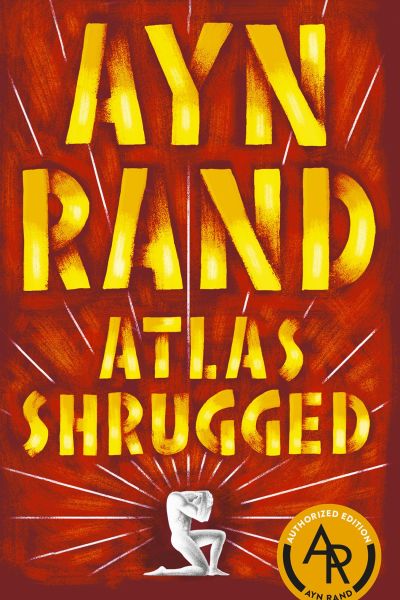
Atlas Shrugged
An economy collapses and its best minds vanish without a trace: Ayn Rand's novel of the century asks what happens when the creators leave the stage.
- Level
- Beginner
- Published
- 1957
- Publisher
- Signet
- ISBN
- 0451191145
What it is about
America in the near future: factories stand idle, trains run late, and the country’s ablest entrepreneurs, engineers, and thinkers vanish into thin air one after another. No one knows where they go or why. Dagny Taggart, vice president of a major railroad, fights to keep her company alive and runs into a question that can no longer be pushed aside: Who is John Galt?
Ayn Rand tells this story as a thriller, but her real concern is philosophical. She asks what role the creative individual plays in a society that increasingly takes his contribution for granted or even meets it with suspicion. For Rand, work, achievement, and reason are not a burden but an expression of human greatness, and the novel shows what is at stake when these values are systematically undermined.
The characters are deliberately drawn larger than life: heroes who stand by their convictions without compromise, and antagonists who hide their own mediocrity behind moral appeals. That makes Atlas Shrugged a reading experience that polarizes, and it is designed to. Rand did not set out to give a balanced portrayal but to cast a worldview, which she called Objectivism, in the form of a novel.
Readers interested in the connection between economics, ethics, and political philosophy will find an unusual entry point here: not a treatise but a story with real pull. The book suits anyone willing to engage with a decidedly partisan but rigorously thought-out perspective.
Did you enjoy the book? The author and publisher will appreciate a short review, for example with the retailer you bought it from.