
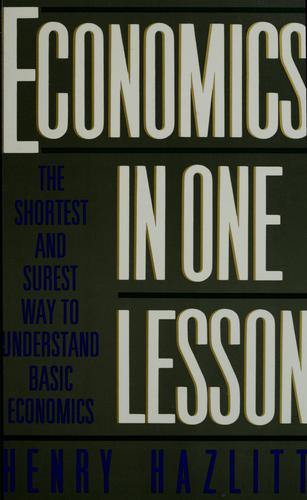
Economics in One Lesson
The Shortest and Surest Way to Understand Basic Economics
Bastiat’s idea applied to all of economic policy: if you look only at the visible consequences, you are almost always wrong.
- Level
- Beginner
- Published
- 1946
- Publisher
- Crown Currency
- ISBN
- 9780517548233
What it is about
Henry Hazlitt’s 1946 book is slim but remarkably far-reaching. Its starting point could hardly be simpler: most economic fallacies arise because people look only at the immediate effects of a policy and forget what happens elsewhere at the same time. Hazlitt calls this the “lesson” of economics, and he applies it rigorously to dozens of everyday questions.
Whether the subject is tariffs, minimum wages, government make-work programs, or price controls, Hazlitt walks the reader through the visible and the invisible effects of each measure. What benefits one group costs another, and this second group is often so scattered that its loss simply never comes up in public debate. This habit of thinking in connections is not an ideology but a method.
The book builds on Frédéric Bastiat, whose image of the “broken window” Hazlitt expanded into a complete course. The style is clear and free of jargon, and the examples are chosen so that they remain understandable decades after the book first appeared.
Anyone who wants to understand how economic thinking works, and who is willing to question familiar conclusions, will find a reliable introduction here. The book is written for everyone who has never studied economics but still wants to take part in the conversation, and to do so on solid ground.
Did you enjoy the book? The author and publisher will appreciate a short review, for example with the retailer you bought it from.
More about the author: Henry Hazlitt: Economics in One Lesson