
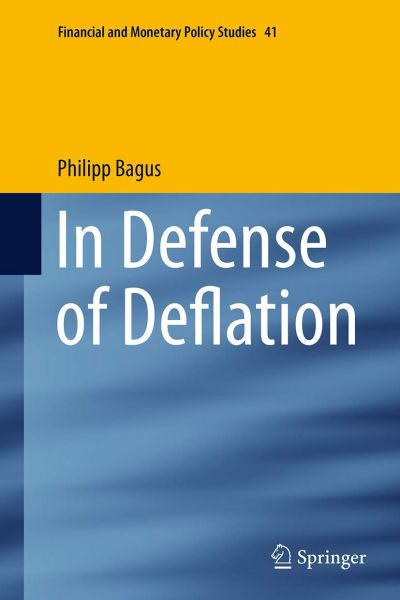
In Defense of Deflation
Deflation is seen as an economic bogeyman. Philipp Bagus turns the tables and asks who actually benefits from this fear.
- Level
- Advanced
- Published
- 2015
- Publisher
- Springer
- ISBN
- 9783319366760
What it is about
Few terms make economists and central bankers as uneasy as deflation. Falling prices are seen as the harbinger of recession, mass unemployment, and economic stagnation. Philipp Bagus, an economics professor and representative of the Austrian School, takes this conviction at its word and subjects it to a thorough examination.
His central argument: not all deflation is alike, and the blanket condemnation of falling prices lumps together fundamentally different phenomena. Bagus distinguishes between deflation that arises from real growth in productivity and deflation triggered by a contraction of credit or by government intervention. The former, he argues, is a sign of economic health: it returns purchasing power to the population without anyone having to pay for it.
Two historical case studies deepen the theoretical analysis: the growth of the American economy after the Civil War, which was accompanied by falling prices, and the credit deflation in Germany during the Great Depression. Both episodes show how differently deflation can play out, and how important it is to know its causes before drawing political conclusions.
The book is aimed at readers who are willing to question common assumptions about monetary policy. It presupposes a basic interest in economics but avoids unnecessary jargon. Anyone who wants to understand why central banks systematically favor inflation, and what interests might lie behind this, will find here a tightly argued, well-documented basis for forming their own judgment.
Did you enjoy the book? The author and publisher will appreciate a short review, for example with the retailer you bought it from.