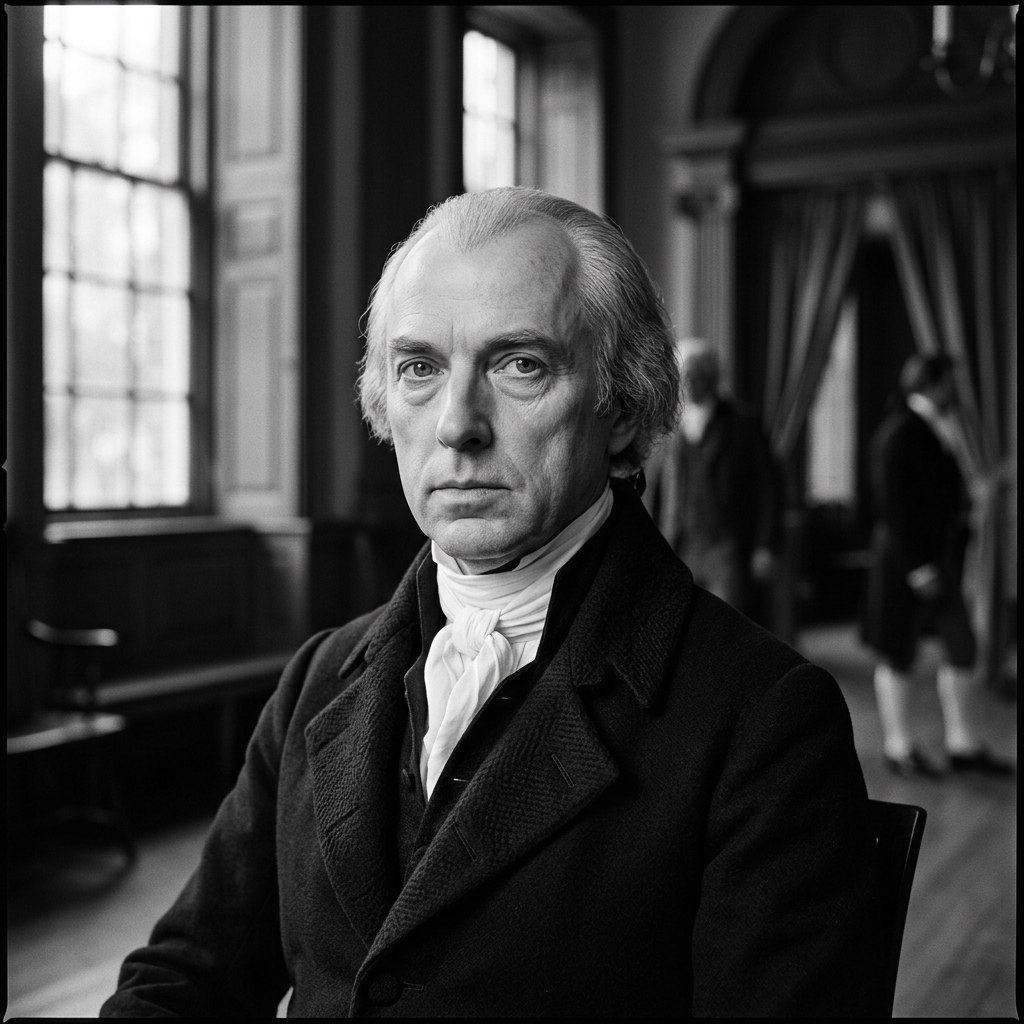
On January 10, 1794, the U.S. House of Representatives debated aid for French refugees who had arrived destitute in Baltimore after the uprising on Saint-Domingue. A congressman from Virginia objected. The government of the United States, as the records report him, was a definite government, confined to specified objects, and charity was not among the duties of the legislature. He could not find the article of the Constitution that allowed Congress to spend the money of its constituents on charitable purposes.
In the end, the refugees received help anyway. In February, Congress appropriated $15,000, booked as an advance on the debts the United States owed France. Yet this small episode contains the whole political theory of James Madison: whoever delegates power must name it, and what is not named does not belong to the government.
At a glance
- Life: March 16, 1751, in Belle Grove near Port Conway (Virginia), to June 28, 1836, in Montpelier (Virginia)
- Offices: Constitutional Convention 1787, member of the House of Representatives 1789 to 1797, Secretary of State 1801 to 1809, fourth President of the United States 1809 to 1817
- Major works: Memorial and Remonstrance against Religious Assessments (1785), 29 essays in The Federalist (1787/88), draft of the Bill of Rights (1789), Property (1792), Virginia Resolutions (1798)
- In one sentence: He built the government so that it is obliged to control itself.
A sickly reader from Virginia
Madison came from a wealthy planter family in Orange County whose plantation, Montpelier, lived off the labor of enslaved people. He was sickly from childhood, read all the more for it, and studied at the College of New Jersey, today’s Princeton, where he graduated in 1771. The college’s president, the Scotsman John Witherspoon, introduced him to the Scottish Enlightenment, and Madison read Hume, Adam Smith, Francis Hutcheson, and Montesquieu.
In the 1780s, he was among those who wanted to replace the weak confederation of states under the Articles of Confederation with a real constitution. For the Philadelphia Convention of 1787, he brought along the Virginia Plan, which became the basis for deliberations, and he took notes on the debates day after day. Afterward, together with Alexander Hamilton and John Jay, writing under the name “Publius” in the essays of The Federalist, he argued for its ratification, introduced the Bill of Rights in the First Congress, served Thomas Jefferson as Secretary of State, and governed for eight years as President. When he died in 1836, he was the last living signer of the Constitution.
Liberty instead of toleration
Madison made his first contribution to liberty by changing a phrase. For Virginia’s Declaration of Rights of 1776, George Mason had proposed that religion should enjoy “the fullest toleration.” Madison saw to it that the text spoke instead of the free exercise of religion. Toleration is granted by an authority that can also withdraw it, while the free exercise of religion is a right that every person brings with him.
How seriously he meant this became clear in 1785, when Virginia wanted to introduce a tax to pay Christian teachers. In his petition Memorial and Remonstrance, Madison stated that religion can be directed only by reason and conviction, not by force. Who does not see, he asked, that the same authority that can force a citizen to contribute just three pence of his property to a church can also force him to conform to any other church? The tax failed, and in January 1786 Virginia passed Jefferson’s Statute for Religious Freedom instead.
Ambition against ambition
Madison wrote the most famous sentence of his political theory in the 51st essay of The Federalist: “If men were angels, no government would be necessary. If angels were to govern men, neither external nor internal controls on government would be necessary.” But because men rule over men, he argued, the difficulty lies in first enabling the government to control the governed and then obliging it to control itself.
His answer relies on self-interest rather than virtue. “Ambition must be made to counteract ambition,” he writes, and each office should have the means and the motive to resist encroachments by the others. The three branches hold one another in check, and between the federal government and the states runs a second boundary, which Madison called a double security for the rights of the people. In No. 47 he had already stated that the accumulation of all powers in the same hands, whether of one, a few, or many, and whether hereditary or elective, may justly be called tyranny. The qualification matters, because it expressly includes the elected majority.
The majority as a danger
Already in No. 10, Madison had warned against “factions,” by which he meant a group of citizens, whether a majority or a minority, united by a common passion or interest directed against the rights of others. He saw the most common and durable source of such groups in the unequal distribution of property.
He deliberately chose not to remove the causes. That could be done only by abolishing liberty, and liberty, he said, is to faction what air is to fire. Madison therefore addressed the effects. In a small republic, a single group easily finds the majority it needs to oppress a minority; in a large republic with many interests, that becomes difficult.
Few and defined powers
In No. 45 of The Federalist, he called the powers of the federal government “few and defined” and those of the states “numerous and indefinite.” In No. 62, which is usually attributed to him, he warned that it is of little use to the people that they choose their own lawmakers if the laws are so voluminous that they cannot be read, or so incoherent that they cannot be understood.
He acted by this standard for decades. In 1791, he fought Hamilton’s national bank in Congress, because an authorization to make all “necessary and proper” laws must not grant unlimited discretion. In 1798, he wrote the Virginia Resolutions against the Alien and Sedition Acts, with which Congress under President John Adams had, among other things, made sharp criticism of the government a crime. And on March 3, 1817, his last full day in office, he vetoed a bill that would have built roads and canals with federal funds. He did not dispute how useful such routes would be, but the power was not among the enumerated powers of Congress.
This path was not without breaks. After the War of 1812 against Great Britain, which left the federal government deeply in debt, Madison signed the charter of the Second Bank of the United States in April 1816. As he had already written in a veto message of 1815, he regarded the constitutional question as settled by the repeated recognition of such a bank. In doing so, he accepted an institution that he himself had considered unconstitutional in 1791.
A property in one’s rights
Madison formulated his concept of liberty most clearly in a short newspaper essay of March 29, 1792. Under the title Property, he distinguished two meanings of property. In the narrow sense, it means land, goods, and money; in the broader sense, everything to which a person attaches value and has a right. Among these he counted a person’s opinions and their free communication, his religious beliefs, the safety and liberty of his person, and the free use of his faculties. Just as a man is said to have a right to his property, he wrote, he may equally be said to have a property in his rights.
A strict standard followed from this. Only a government that impartially secures to every person what is his is just. A government that protects houses and fortunes but interferes with conscience, opinions, and choice of occupation deserved no praise in Madison’s eyes, for he called conscience the most sacred of all property rights.
Rights that need not be enumerated
Madison was at first skeptical of a list of fundamental rights. In No. 48 of The Federalist, he spoke of “parchment barriers” that could not be relied on against the encroaching spirit of power. But the opponents of the Constitution insisted on such a list, and Madison took on the task himself. In June 1789 he introduced his draft in Congress, and on December 15, 1791, ten amendments took effect.
Two of them deserve special attention. The Ninth makes clear that the enumeration of certain rights shall not be construed to deny or disparage other rights retained by the people. The Tenth reserves all powers not delegated to the federal government to the states or to the people. Madison himself considered a third proposal the most valuable on the entire list: the states, too, should not be allowed to violate freedom of conscience, freedom of the press, or trial by jury. The House of Representatives adopted a version of it; the Senate struck it.
What friends of liberty can learn from him
Madison’s most important lesson is a method. He designs institutions for people as they are and assumes that officeholders have the same self-interest as everyone else. James Buchanan, Nobel laureate and cofounder of public choice theory, said in a 1995 interview that he and Gordon Tullock had merely applied the tools of economics to American politics, just as Madison had envisioned. Friedrich August von Hayek devoted a chapter of its own to American constitutional thought in The Constitution of Liberty (1960).
The second lesson concerns democracy. Majorities can violate rights just as kings can, and anyone who wants to secure liberty therefore needs limits that no majority may cross either. The third lies in the Ninth Amendment: rights are the citizen’s starting point, not a favor granted by the state. In Restoring the Lost Constitution (2004), the legal scholar Randy Barnett derived from it a “presumption of liberty,” under which every intervention must justify itself, not liberty.
The full picture includes the fact that Madison denied many people the self-ownership he described so clearly. At any given time, more than a hundred enslaved people lived at Montpelier. At the Convention, he thought it wrong to admit in the Constitution the idea that there could be property in men, yet in 1834 he sold sixteen people to a relative in Louisiana to pay off debts, and in his will he freed no one. From 1833 on, he was president of the American Colonization Society, which sought to resettle freed people in Africa.
Where is that written?
Madison did more to limit power than almost any other statesman of his time, and he knew from his own experience how hard it is to keep these limits while in office. His remark of 1794 about charity with other people’s money contains a question that can be put to any government, no matter how good its intentions: where is it written that it may do this? As long as angels do not govern, we will need that question.
Further reading
- Alexander Hamilton, James Madison, and John Jay: The Federalist Papers, especially Nos. 10, 47, and 51
- James Madison: Memorial and Remonstrance against Religious Assessments (1785) and Property (1792), both in The Founders’ Constitution, University of Chicago Press
- Friedrich August von Hayek: The Constitution of Liberty, chapter 12
- Randy E. Barnett: Restoring the Lost Constitution. The Presumption of Liberty, Princeton University Press, Princeton 2004
This article is part of our series on thinkers, doers, and historical figures of liberty.
Sources
- Hamilton, Alexander; Madison, James; Jay, John: The Federalist, J. and A. McLean, New York 1788, Nos. 10, 45, 47, 48, 51, 62 (text: Avalon Project, Yale Law School, https://avalon.law.yale.edu/subject_menus/fed.asp).
- Madison, James: Memorial and Remonstrance against Religious Assessments, June 20, 1785, in: The Papers of James Madison 8:298–304; The Founders’ Constitution, https://press-pubs.uchicago.edu/founders/documents/amendI_religions43.html
- Madison, James: Notes of Debates in the Federal Convention, August 25, 1787, Avalon Project, https://avalon.law.yale.edu/18th_century/debates_825.asp
- Madison, James: The Bank Bill, speech in the House of Representatives, February 2, 1791, in: Papers 13:376–78; The Founders’ Constitution, https://press-pubs.uchicago.edu/founders/documents/a1_8_18s9.html
- Madison, James: Property, in: National Gazette, March 29, 1792, Papers 14:266–68; The Founders’ Constitution, https://press-pubs.uchicago.edu/founders/documents/v1ch16s23.html
- House of Representatives debate on the refugees from Saint-Domingue, January 10, 1794, in: Elliot’s Debates, vol. 4, https://constitution.org/1-Constitution/je/je4_cong_deb_14.htm; Annals of Congress, 3rd Congress, 1st Session, p. 153.
- House of Representatives, debate on the amendments, August 17, 1789, Annals 1:754–55; The Founders’ Constitution, https://press-pubs.uchicago.edu/founders/documents/amendIXs8.html
- Madison, James: veto message on the bank bill, January 30, 1815, American Presidency Project, https://www.presidency.ucsb.edu/node/205143
- Madison, James: veto message on the Bonus Bill, March 3, 1817, American Presidency Project, https://www.presidency.ucsb.edu/documents/veto-message-246
- Madison, James: to Louis-André Pichon, June 12, 1801, Founders Online, https://founders.archives.gov/documents/Madison/02-01-02-0387
- Miller Center, University of Virginia: James Madison: Life in Brief, https://millercenter.org/president/madison/life-in-brief
- Encyclopedia Virginia: James Madison (1751–1836), https://encyclopediavirginia.org/entries/madison-james-1751-1836/
- Encyclopedia Virginia: The Enslaved Community at Montpelier, https://encyclopediavirginia.org/entries/the-enslaved-community-at-montpelier/
- Encyclopedia Virginia: Madison’s Amendments to the Declaration of Rights (1776), https://encyclopediavirginia.org/primary-documents/madisons-amendments-to-the-declaration-of-rights-may-29-june-12-1776/
- White House Historical Association: Slavery in the James Madison White House, https://www.whitehousehistory.org/slavery-in-the-james-madison-white-house
- Cornell Legal Information Institute, Constitution Annotated, Amdt1.2.2.7, https://www.law.cornell.edu/constitution-conan/amendment-1/constitutional-convention-ratification-and-the-bill-of-rights
- Federal Reserve History: The Second Bank of the United States, https://www.federalreservehistory.org/essays/second-bank-of-the-us
- Federal Reserve Bank of Minneapolis: Interview with James Buchanan (1995), https://www.minneapolisfed.org/article/1995/interview-with-james-buchanan
- Hayek, Friedrich August von: The Constitution of Liberty, University of Chicago Press, Chicago 1960, ch. 12 (German translation: Die Verfassung der Freiheit).
- Barnett, Randy E.: Restoring the Lost Constitution. The Presumption of Liberty, Princeton University Press, Princeton 2004.
Featured image: James Madison (AI illustration)