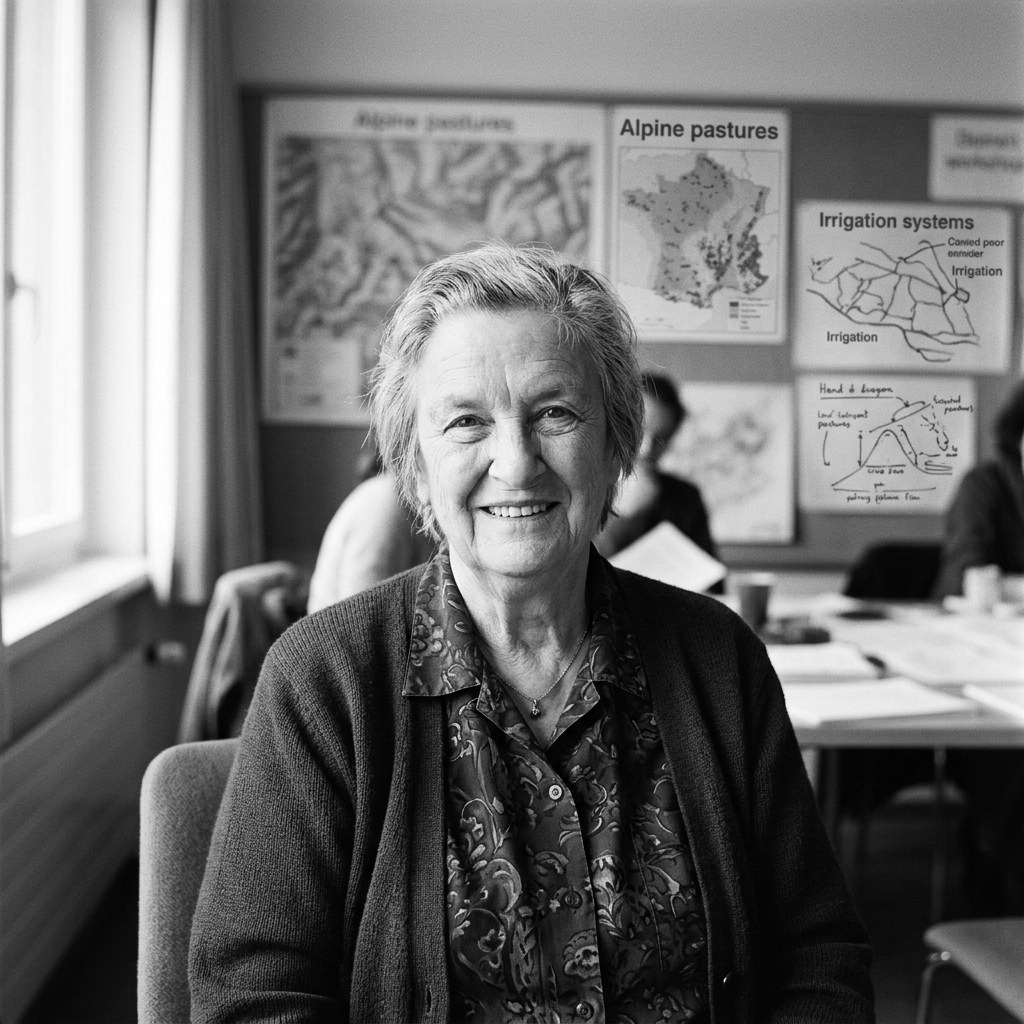
In 1517 the citizens of Törbel, a mountain village in the Swiss canton of Valais, wrote down a rule for their shared summer pasture. No citizen could send more cows to the alpine meadow than he could feed through the winter with his own hay. Anyone who broke the rule paid a stiff fine to a local official, the Gewalthaber, who was allowed to keep half of it and therefore had good reason to watch closely. When the anthropologist Robert Netting studied the village in the 1970s, the rule was still in force.
In her major work Governing the Commons of 1990, Elinor Ostrom placed this case alongside irrigation communities in Spain and the Philippines, village forests in Japan, and groundwater basins in California. From such examples grew an insight that has changed how we think about shared resources: people who share a resource are by no means doomed to ruin it, and they do not need a guardian to keep it. In 2009 Ostrom became the first woman to receive the Nobel Prize in economics.
At a glance
- Life: August 7, 1933, in Los Angeles to June 12, 2012, in Bloomington, Indiana
- Work: political scientist at Indiana University (from 1965, professor from 1974), co-founder with Vincent Ostrom of the Workshop in Political Theory and Policy Analysis in 1973, president of the Public Choice Society (1982 to 1984) and of the American Political Science Association (1996 to 1997)
- Award: Nobel Prize in economics 2009, shared with Oliver E. Williamson
- Major works: Governing the Commons (1990; German edition Die Verfassung der Allmende, 1999), Understanding Institutional Diversity (2005), Nobel lecture Beyond Markets and States (2009)
- In one sentence: Through field studies and experiments she showed that people can preserve shared resources over the long term on their own.
A poor child at a rich school
Elinor Clair Awan grew up as an only child in a poor household. Her mother made sure she could attend the prestigious Beverly Hills High School, and Ostrom later recalled that being a poor kid among rich kids had been a challenge, but that it gave her a different view of the future. She paid for her studies at the University of California, Los Angeles, with part-time jobs in the library and the bookstore, and she graduated after three years with honors and without debt.
Because working women in 1954 were expected to know shorthand, she learned it through a correspondence course, and the skill later served her well when taking field notes. After a few years in the workforce she returned to the university. Looking back, she described her first conversations about a doctorate in economics as discouraging, and so she earned her PhD in political science, the discipline she considered her own for the rest of her life.
Water beneath Los Angeles
For her dissertation, completed in 1965, Ostrom studied the West Basin, a groundwater basin beneath seventeen suburbs of Los Angeles. Too many wells had pumped too much water, and salt water was seeping in from the coast. A large number of private and public water producers had to find a common way to save the basin. Ostrom later wrote that, without knowing it, she had already been studying a commons problem.
The formula that made this problem famous did not yet exist. Only in 1968 did the biologist Garrett Hardin publish his essay on the tragedy of the commons in the journal Science. A pasture open to all, he argued, will inevitably be overused, because each herder pockets the gain from an additional animal alone but shares the damage with everyone. Hardin saw only two ways out: divide the resource up and privatize it, or place it under government control.
Eighty metropolitan areas and their police
By then the Ostroms were living in Bloomington. Vincent Ostrom had been appointed to a professorship at Indiana University in 1965; Elinor started there as a visiting lecturer and rose to full professor. In 1973 the two founded the Workshop in Political Theory and Policy Analysis. They chose the name deliberately, because Vincent regarded scholarship as a kind of craft.
In 1961, together with Charles Tiebout and Robert Warren, Vincent Ostrom had introduced the concept of polycentricity. It describes an order with many centers of decision-making that are formally independent of one another and yet can form a working whole, because they compete, make contracts, and settle disputes with one another. The prevailing view at the time considered the many municipalities, special districts, and agencies of American metropolitan areas to be chaos and recommended consolidating them.
In the 1970s Elinor Ostrom and her colleagues tested this assumption on the police. They studied 80 metropolitan areas and found little duplication of responsibilities. The supposition that many small agencies performed worse was not borne out. Areas with numerous independent police departments for patrol work were in fact more efficient, while for background services such as radio communications and crime labs, a few large providers proved their worth. Small and medium-sized cities, she found, can keep a better eye on performance and costs, and dissatisfied citizens can vote with their feet.
What herders actually do
In Governing the Commons Ostrom took issue with both camps that had drawn their conclusions from Hardin’s essay. One relied on central control, the other on privatization, and both assumed that the right order had to be imposed from outside. Ostrom considered both answers too sweeping. Instead of a single solution to a single problem, she wrote, there are many solutions for many different problems, and finding the right rules is hard, slow work that requires knowledge of time and place.
Then she let the cases speak. In Valencia, for centuries, the Tribunal de las Aguas, a water court of the farmers, has met every Thursday morning in front of the Apostles’ Door of the cathedral and decided disputes over irrigation water without lawyers and in front of many onlookers. In the Japanese villages of Hirano, Nagaike, and Yamanoka, the inhabitants regulated the use of their common land for generations, and in the Philippines farmers organized their irrigation in the zanjera communities.
Look closely and you will find no open pastures in Hardin’s sense in these commons. In Törbel the written records go back to 1224. In 1483 the inhabitants formed an association to better regulate the alpine meadow, the forest, and the wasteland; an inventory from 1507 recorded the boundaries of the common lands, and an outsider who bought land in the village did not thereby acquire any right to the alpine meadow. The rights holders themselves decided whom to admit. Meadows, gardens, fields, and vineyards belonged to individual families. As Netting emphasized, the people of Törbel had known the advantages and drawbacks of private and communal ownership for at least five centuries and chose the fitting form for each kind of land. What remained common was mainly the alpine meadow, the forest, and the wasteland, and the land kept its productivity for centuries.
Eight rules from many centuries
From her cases Ostrom derived eight design principles that characterize long-enduring common-pool resources. First come clear boundaries, both of the resource and of the circle of those entitled to use it. The rules fit local conditions, and those affected by them have a say in changing them. Monitoring is done by the users themselves or by monitors who are accountable to them. Violations are met with graduated sanctions, disputes can be settled quickly and cheaply on the spot, and larger systems are organized in several nested layers.
Ostrom phrased the seventh principle to say that the right of users to devise their own institutions is not challenged by external government authorities. Self-governance thrives, in other words, where the state lets it be. Ostrom herself called her list tentative. Twenty years later Michael Cox and two colleagues reviewed 91 studies that had tested her principles and found them well supported empirically.
Talking helps
Ostrom distrusted convenient models, and so she also tested her findings in the laboratory. In experiments with her colleagues Roy Gardner and James Walker, anonymous participants who were not allowed to talk to one another clearly overused a shared resource. But as soon as they were allowed to confer, overuse fell and joint returns rose, even though no one could enforce their promises and game theory predicted the opposite. Participants even spent their own money to punish rule breakers.
Large-scale studies of irrigation systems in Nepal and of forests in many countries also called into question the assumption that governments are, as a rule, better at organizing and protecting resources than their users. She knew, however, that many groups have failed, and she warned against any simple recipe, whether it was called nationalization, privatization, or decentralization.
A prize for a political scientist
In 2009 she received the Nobel Prize in economics for her analysis of economic governance, especially the commons. The prize went to a scholar who saw herself as a political scientist and who worked with field studies, collections of cases, and experiments. She gave her share of the prize money to a university foundation that supports the Workshop. Looking back on her years as department chair from 1980 to 1984, she said in a 2010 interview: “I purposely kept my salary at zero because our junior faculty were… we weren’t competitive, you know?”
In her Nobel lecture she summed up half a century of research. Humans, she said, have more complex motivation and more capacity to solve social dilemmas than the older theory of the rational individual assumed. From this she concluded: “a core goal of public policy should be to facilitate the development of institutions that bring out the best in humans.” Elinor Ostrom died in Bloomington in June 2012; her husband Vincent followed her seventeen days later.
What friends of liberty can learn from her
The most important lesson concerns spontaneous order. Ostrom showed in case after case that people find workable rules without a plan from above if they are left alone to do so, and that these rules often work better than the regulations of distant agencies, because they rest on the knowledge of those who live on the spot. The editors of a volume on the Austrian School and the Bloomington School, Paul Dragoș Aligica, Paul Lewis, and Virgil Storr, see this as the great common ground of the two traditions: an understanding of the limits of centralization and of the ability of diverse, many-layered orders to make use of local knowledge. Anyone who has read Friedrich August von Hayek will recognize the idea.
Her view of property is just as instructive. In her major work Ostrom quoted Aristotle, who had observed in the second book of the Politics that what is common to the greatest number receives the least care. Her successful commons show how people take this warning to heart. They have firm boundaries, a defined circle of rights holders, the right to exclude outsiders, and penalties for rule breakers. Ostrom described property as a bundle of distinct rights, from access and use to exclusion and sale. Seen in this light, communal property is a form of property that free people choose when it suits them better than dividing things up.
The people in the village
Throughout her life Elinor Ostrom collected reality, case by case, and drew her conclusions from observation rather than from models. She showed that farmers in the Valais, irrigators in Valencia, and water users in California can manage their shared resources more wisely than the textbooks gave them credit for, and that to do so they need the right to run their own affairs. Anyone who wants to make decisions about forests, fisheries, or water today will find in her work the question that Törbel has answered since 1517: Who knows better how many cows an alpine meadow can bear, the people in the village or an agency in a distant capital?
Further reading
- Elinor Ostrom: Governing the Commons, Cambridge University Press 1990 (German edition: Die Verfassung der Allmende. Jenseits von Staat und Markt, Mohr Siebeck, Tübingen 1999)
- Elinor Ostrom: Beyond Markets and States. Polycentric Governance of Complex Economic Systems, Nobel lecture 2009, in: American Economic Review 100 (2010), pp. 641 to 672
- Paul Dragoș Aligica and Peter J. Boettke: Challenging Institutional Analysis and Development. The Bloomington School, Routledge, London 2009
This article is part of our series on thinkers, doers, and historical figures of liberty.
Sources
- Ostrom, Elinor: Governing the Commons. The Evolution of Institutions for Collective Action, Cambridge University Press, Cambridge 1990 (full text: https://archive.org/details/governing-the-commons); German edition: Die Verfassung der Allmende. Jenseits von Staat und Markt, Mohr Siebeck, Tübingen 1999 (in German).
- Ostrom, Elinor: “Beyond Markets and States. Polycentric Governance of Complex Economic Systems,” Prize Lecture, Stockholm, December 8, 2009, https://www.nobelprize.org/uploads/2018/06/ostrom_lecture.pdf; printed in: American Economic Review 100 (2010), no. 3, pp. 641–672.
- Ostrom, Elinor: Understanding Institutional Diversity, Princeton University Press, Princeton 2005.
- Ostrom, Elinor: “A Diagnostic Approach for Going beyond Panaceas,” in: Proceedings of the National Academy of Sciences 104 (2007), no. 39, pp. 15181–15187.
- Ostrom, Elinor; Gardner, Roy; Walker, James: Rules, Games, and Common-Pool Resources, University of Michigan Press, Ann Arbor 1994.
- Ostrom, Elinor: autobiography for the Nobel Foundation, 2009, https://www.nobelprize.org/prizes/economic-sciences/2009/ostrom/biographical/
- McCay, Bonnie J.; Bennett, Joan: Elinor Ostrom 1933–2012. A Biographical Memoir, National Academy of Sciences, Washington 2014, https://www.nasonline.org/wp-content/uploads/2024/06/ostrom-elinor.pdf
- Netting, Robert McC.: “What Alpine Peasants Have in Common. Observations on Communal Tenure in a Swiss Village,” in: Human Ecology 4 (1976), pp. 135–146 (quoted in Ostrom 1990); Netting, Robert McC.: Balancing on an Alp, Cambridge University Press, Cambridge 1981.
- Hardin, Garrett: “The Tragedy of the Commons,” in: Science 162 (1968), pp. 1243–1248.
- Cox, Michael; Arnold, Gwen; Villamayor Tomás, Sergio: “A Review of Design Principles for Community-based Natural Resource Management,” in: Ecology and Society 15 (2010), no. 4, art. 38, https://www.ecologyandsociety.org/vol15/iss4/art38/
- Aligica, Paul Dragoș; Lewis, Paul; Storr, Virgil H. (eds.): The Austrian and Bloomington Schools of Political Economy (Advances in Austrian Economics 22), Emerald, Bingley 2017.
- Aligica, Paul Dragoș; Boettke, Peter J.: Challenging Institutional Analysis and Development. The Bloomington School, Routledge, London 2009.
- Indiana Daily Student: “Ostrom accepts Nobel Prize in Stockholm,” December 2009, https://www.idsnews.com/article/2009/12/ostrom-accepts-nobel-prize-in-stockholm (donation of the prize money)
- Wikipedia (en): Elinor Ostrom, https://en.wikipedia.org/wiki/Elinor_Ostrom (starting point only; place of death, year of marriage, death of Vincent Ostrom)
Featured image: Elinor Ostrom (AI illustration)