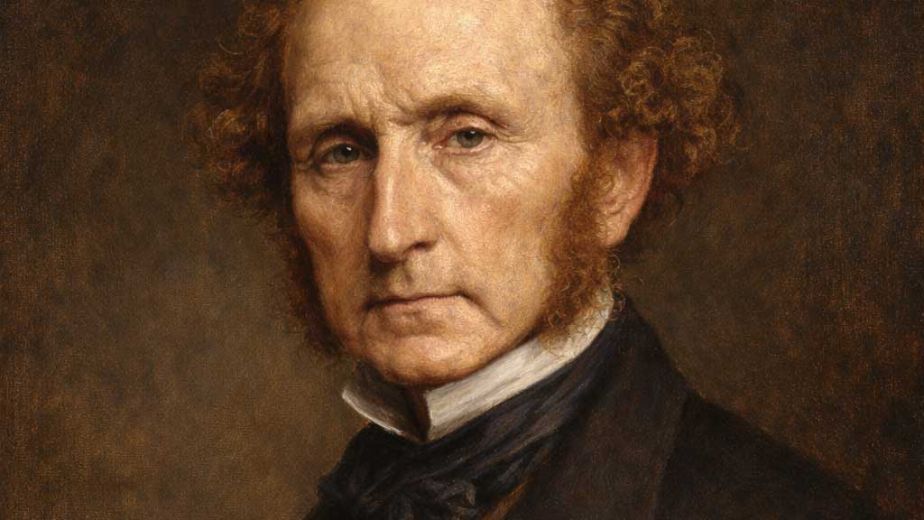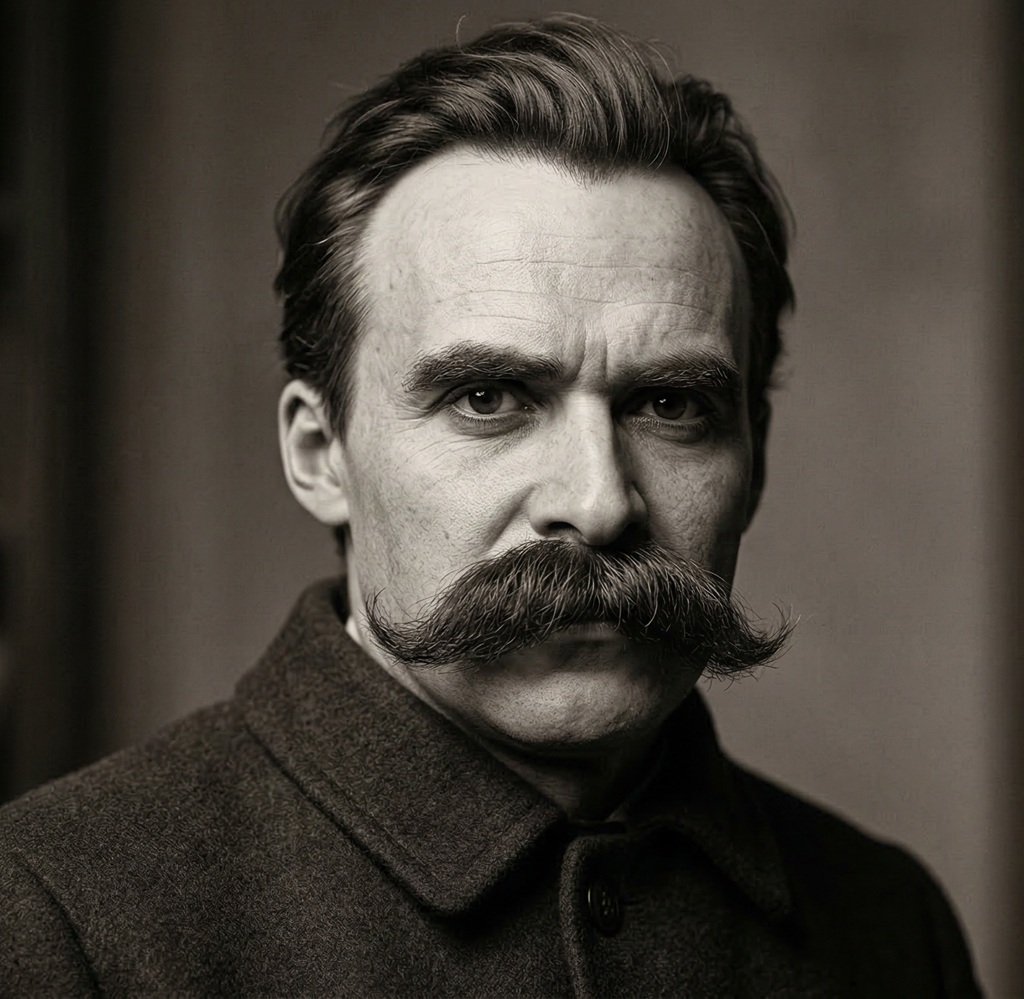
When Friedrich Nietzsche went to Basel in 1869 to become, at 24, professor of Greek language and literature, he gave up his Prussian citizenship. Under Swiss law he was from then on considered stateless, and so one of the most influential German thinkers traveled on a passport issued by the Basel authorities. At first this was not a political statement, but it fits a body of work in which the state rarely comes off well.
Anyone who takes him for an early libertarian on that account is making it too easy, however. The same Nietzsche who called the state an idol also wrote that liberal institutions, as soon as they are attained, become the worst enemies of freedom, and that injustice lies not in unequal rights but in the claim to equal ones.
At a glance
- Life: October 15, 1844, in Röcken near Lützen, to August 25, 1900, in Weimar
- Work: Professor of classical philology in Basel (1869 to 1879), then an independent writer without an academic post; collapse in Turin in January 1889
- Major works: Human, All Too Human: A Book for Free Spirits (Menschliches, Allzumenschliches. Ein Buch für freie Geister, 1878), Daybreak (Morgenröthe, 1881), Thus Spoke Zarathustra (Also sprach Zarathustra, 1883 to 1885), Beyond Good and Evil (Jenseits von Gut und Böse, 1886), Twilight of the Idols (Götzen-Dämmerung, 1889), The Antichrist (Der Antichrist, printed 1895)
- Citation style: following the Kritische Studienausgabe (KSA), the critical study edition by Giorgio Colli and Mazzino Montinari, by work and section; the German quotations follow Nietzsche’s spelling (such as “heisst,” “nöthig,” “Cultur”)
- In one sentence: A radical critic of the state, herd morality, and nationalism who understood freedom as a privilege of the strong and rejected equality before the law.
A professor without citizenship
Nietzsche grew up as a pastor’s son in the Prussian Province of Saxony, studied theology and philology in Bonn, then only philology in Leipzig, and there discovered the philosophy of Schopenhauer. According to the Stanford Encyclopedia of Philosophy, he was the youngest person ever to receive such a position when he was appointed. In the war of 1870 (the Franco-Prussian War) he volunteered as a medical orderly and returned early after falling ill.
His health remained poor: in 1876 he took leave, in 1879 he gave up his professorship and lived without a post, alternately in Venice, Nice, Sicily, and Sils-Maria; in this decade he wrote almost all the books for which he is read today. In January 1889 he collapsed in Turin; he spent his last eleven years mentally incapacitated in the care of his mother and sister, finally in Weimar.
Demanding reasons instead of faith
The ideal that still wins Nietzsche sympathy among friends of liberty today appears in the subtitle of his 1878 book: A Book for Free Spirits. What he means by it he explains in Human, All Too Human (MA 225): “He is called a free spirit who thinks differently from what, on the basis of his origin, environment, his class and office, or on the basis of the prevailing views of the age, would have been expected of him.” What matters most about the free spirit, he says, is not being right but breaking free from tradition, and what sets him apart from the fettered spirits is that he demands reasons where the others demand faith. He tested this attitude on almost everything his age held sacred, from Christianity to morality.
The coldest of all cold monsters
The best-known passage for critics of the state is in the first part of Zarathustra, in the chapter “On the New Idol,” and it is often quoted inaccurately. In the original it reads: “State is the name of the coldest of all cold monsters. Coldly it tells lies too; and this lie crawls out of its mouth: ‘I, the state, am the people.’” Creators, Zarathustra says, created the peoples, whereas destroyers “set traps for many and call them state.” Toward the end comes the much-quoted sentence: “Where the state ends, there only begins the human being who is not superfluous.”
Anyone who reads the whole speech, however, learns whom the state is made for: “Far too many are born: for the superfluous the state was invented!” Nietzsche’s objection to the state, then, is that it attracts the masses and puts the great individuals in their service; Zarathustra says nothing in the entire speech about violated rights of the individual.
Private contractors instead of government
Strikingly close to libertarian ideas comes a long aphorism in Human, All Too Human titled “Religion and Government” (MA 472). There Nietzsche describes how the state loses its aura of reverence along with religious faith and how distrust of everything that governs grows. At the end, he says, comes the “abolition of the concept of the state,” the “abolition of the antithesis ‘private and public’”: private associations would take over the business of the state step by step, and even the task “which is meant to protect private persons against private persons” will “at the very last someday be taken care of by private contractors.” His pointed conclusion reads: “modern democracy is the historical form of the decay of the state.”
This is not a program. Nietzsche does expect a “more expedient invention” than the state, but he considers it presumptuous “to set one’s hand to the plow already now,” and hopes that the state will survive for “a good while” yet. In the very next section (MA 473) he calls socialism “the fanciful younger brother of an almost defunct despotism,” because it craves a fullness of state power such as only despotism ever had and seeks to remake the individual into an organ of the community. In Daybreak (M 179) there is then a heading that sounds like a libertarian motto: “As little state as possible!” The reasoning, however, is aristocratic: politics and business are work “for the lesser minds,” and whoever wants to make society “safe from thieves and fireproof” and devotes the best talents to that end squanders “the most precious thing, the spirit.”
Culture against the state and the empire
Nietzsche also met the new German Empire without patriotic emotion. In Twilight of the Idols he fears that “Deutschland, Deutschland über Alles” (“Germany, Germany above all”) was the end of German philosophy, for power makes people stupid (GD, What the Germans Lack 1). A little later he writes: “Culture and the state […] are antagonists” (ibid. 4).
He turned just as clearly against the political antisemitism of his time. In Beyond Good and Evil (JGB 251) he proposes “to expel the antisemitic loudmouths from the country,” even though the section itself speaks in the racial categories of the 19th century. He rejected his sister’s husband, the antisemitic agitator Bernhard Förster, above all for this reason.
Freedom as a privilege
This is where the closeness ends. Nietzsche’s freedom is a quality of the few, whom the many are meant to serve, and not a right belonging to every human being. In Beyond Good and Evil (JGB 257) he writes: “Every elevation of the type ‘man’ has so far been the work of an aristocratic society,” one that believes in order of rank “and needs slavery in some sense or other.” A healthy aristocracy, according to the following section (JGB 258), accepts with a good conscience the sacrifice of untold numbers of people who for its sake are pushed down to become slaves and instruments.
Equality before the law, the core of every liberal order, he interprets as a symptom of decline. In The Antichrist (AC 57) he writes: “The injustice never lies in unequal rights; it lies in the claim to ‘equal’ rights…” He regards the democratic movement as an inheritance of Christianity (JGB 202) and as a “form of decay” of man, his “reduction to mediocrity” (JGB 203).
He settles accounts with liberalism in Twilight of the Idols under the heading “My conception of freedom” (GD, Skirmishes of an Untimely Man 38): “Liberal institutions cease to be liberal as soon as they are attained,” and further: “Liberalism: in other words, herd-animalization…” Freedom, he says, consists in having “the will to self-responsibility,” but also in being ready “to sacrifice human beings to one’s cause.” As long as liberal institutions are still being fought for, they do promote freedom “in a powerful way”; but it is the fight that does this, not the institution. The section culminates in the sentence “The free man is a warrior.”
This cannot be dismissed as mere period color, for a generation earlier John Stuart Mill had defended the equal liberty of every individual in On Liberty (1859). Brian Leiter concludes in the Stanford Encyclopedia that Nietzsche left no worked-out political philosophy, but did hold clearly illiberal convictions. The reasons behind the criticism of the state are opposites: libertarians reject the state because it violates the rights of every individual; Nietzsche despised it because it gives the many too much weight.
A major work that does not exist
An honest picture also includes what does not come from Nietzsche. After his collapse his sister Elisabeth Förster-Nietzsche took over his literary estate. Widowed after Bernhard Förster’s death, she had returned from Paraguay in 1893, and in 1894 she founded the Nietzsche Archive. The Neue Deutsche Biographie, the German national biographical dictionary, states that for almost forty years she managed the estate “autocratically” and destroyed important original letters.
Her most consequential work is The Will to Power. Nietzsche had planned a book with this title but abandoned the plan in 1888 and carried parts of the material over into Twilight of the Idols and The Antichrist. From his notebooks, his sister and Heinrich Köselitz, who called himself Peter Gast, nevertheless put together a supposed major work, with 483 numbered entries in 1901 and 1,067 in 1906. Mazzino Montinari later showed that of the 374 fragments Nietzsche himself had numbered for the project, they left out 104 and reproduced 137 others incompletely or in altered form. In the 1950s Karl Schlechta also made public that Elisabeth had forged letters to fake a special closeness between herself and her brother.
Through the archive, Nietzsche eventually found his way into National Socialist propaganda. Hitler visited the house in 1933 and 1934 and came to the funeral of Nietzsche’s sister in 1935. Anyone who wants to quote Nietzsche should therefore turn to the Kritische Studienausgabe by Colli and Montinari and avoid sentences from The Will to Power. The line “Die Freiheit, die ich meine” (“The freedom that I mean”), for example, comes from a song by Max von Schenkendorf; Nietzsche himself ironically headed a section of Twilight of the Idols “Freedom that I do not mean…” (GD, Skirmishes 41).
What friends of liberty can learn from him
There is most to learn from Nietzsche as a reader and doubter. The free spirit of Human, All Too Human is a model for anyone who will not settle for what origin, class, and the spirit of the age expect of him, and who asks for reasons where others demand obedience. His view of the state as an idol that pretends to be the people sharpens our sense for the self-glorification of politics, and his prediction in MA 472 touches, as we read it, on an idea that Gustave de Molinari formulated in 1849 and Murray Rothbard developed in the 20th century: that security could be a service offered by private providers. Nietzsche himself mentions neither of them, and his motive was a different one. Finally, there is something to learn from his skepticism toward nationalism and political antisemitism at a time when both were gaining ground in Germany.
Where the state ends
Nietzsche’s famous sentence about the human being who begins where the state ends sounds like liberty for all. But what he meant was freedom for those he did not consider superfluous. Anyone arguing against the state today can share his distrust but has to find the reasons elsewhere: in thinkers for whom every human being, including the average one, belongs to himself. Whether a conception of liberty that expressly excludes the many can hold up is the question Nietzsche leaves his libertarian readers.
Further reading
- Friedrich Nietzsche: Menschliches, Allzumenschliches (Human, All Too Human) and Also sprach Zarathustra (Thus Spoke Zarathustra), in: Sämtliche Werke. Kritische Studienausgabe, ed. by Giorgio Colli and Mazzino Montinari, vols. 2 and 4, dtv/de Gruyter, Munich/Berlin 1980 (in German)
- Friedrich Nietzsche: Digitale Kritische Gesamtausgabe (digital critical edition), nietzschesource.org (freely accessible, in German)
- Domenico Losurdo: Nietzsche, der aristokratische Rebell. Intellektuelle Biographie und kritische Bilanz, Argument, Hamburg 2009 (in German; English edition: Nietzsche, the Aristocratic Rebel: Intellectual Biography and Critical Balance-Sheet, translated by Gregor Benton, Brill, Leiden 2019)
- H. L. Mencken: The Philosophy of Friedrich Nietzsche, Luce, Boston 1908
This article is part of our series on thinkers, doers, and historical figures of liberty.
Sources
- Nietzsche, Friedrich: Sämtliche Werke. Kritische Studienausgabe in 15 Bänden (KSA), ed. by Giorgio Colli and Mazzino Montinari, dtv/de Gruyter, Munich/Berlin 1980 (2nd edition 1988) (in German). Used: KSA 2 (Menschliches, Allzumenschliches, MA 225, 472, 473), KSA 3 (Morgenröthe, M 179), KSA 4 (Also sprach Zarathustra I, “Vom neuen Götzen”), KSA 5 (Jenseits von Gut und Böse, JGB 202, 203, 251, 257, 258), KSA 6 (Götzen-Dämmerung, Was den Deutschen abgeht 1 and 4, Streifzüge eines Unzeitgemässen 38 and 41; Der Antichrist 57).
- Nietzsche, Friedrich: Digitale Kritische Gesamtausgabe Werke und Briefe (eKGWB), ed. by Paolo D’Iorio, based on the Kritische Gesamtausgabe by Colli and Montinari, http://www.nietzschesource.org/ (wording of all quotations checked here, e.g., http://www.nietzschesource.org/eKGWB/Za-I-Goetzen, /eKGWB/MA-472, /eKGWB/M-179, /eKGWB/JGB-257, /eKGWB/GD-Streifzuege-38, /eKGWB/AC-57) (in German).
- Mencken, H. L.: The Philosophy of Friedrich Nietzsche, Luce, Boston 1908 (3rd edition 1913), https://www.gutenberg.org/ebooks/49316
- Mill, John Stuart: On Liberty, John W. Parker, London 1859, https://www.gutenberg.org/ebooks/34901
- Molinari, Gustave de: “De la production de la sécurité,” Journal des Économistes, February 1849; English: https://mises.org/library/production-security
- Rothbard, Murray N.: For a New Liberty, Macmillan, New York 1973, https://mises.org/library/book/new-liberty-libertarian-manifesto
- Stanford Encyclopedia of Philosophy: “Friedrich Nietzsche,” https://plato.stanford.edu/entries/nietzsche/
- Leiter, Brian: “Nietzsche’s Moral and Political Philosophy,” Stanford Encyclopedia of Philosophy, https://plato.stanford.edu/entries/nietzsche-moral-political/
- Deutsches Historisches Museum, LeMO: biography of Friedrich Nietzsche, https://www.dhm.de/lemo/biografie/friedrich-nietzsche (in German)
- Selow, Edith: “Förster-Nietzsche, Elisabeth,” Neue Deutsche Biographie 5 (1961), p. 273, https://www.deutsche-biographie.de/11853419X.html (in German)
- Büttner, Stefan: “Schlechta, Karl,” Neue Deutsche Biographie 23 (2007), pp. 31 f., https://www.deutsche-biographie.de/ppn101117132.html (in German)
- Klassik Stiftung Weimar: Nietzsche und der Nationalsozialismus (brochure, 2024), https://publikationen.klassik-stiftung.de/servlets/MCRFileNodeServlet/ksw_derivate_00001054/KSW_Broschuere_2024_Nietzsche-NS_d.pdf (in German)
- Montinari, Mazzino: « La volonté de puissance » n’existe pas, Éditions de l’éclat, Paris 1996 (figures from German Wikipedia, “Der Wille zur Macht,” https://de.wikipedia.org/wiki/Der_Wille_zur_Macht)
- Losurdo, Domenico: Nietzsche, der aristokratische Rebell. Intellektuelle Biographie und kritische Bilanz, Argument, Hamburg 2009 (Italian original Turin 2002), https://www.perlentaucher.de/buch/domenico-losurdo/nietzsche-der-aristokratische-rebell.html (in German)
- swissinfo.ch: “Basel remembers former professor Nietzsche,” https://www.swissinfo.ch/eng/science/basel-remembers-former-professor-nietzsche/1627126 (statelessness, Basel passport)
- Crooked Timber: “Nietzsche, Swiss Thinker,” August 10, 2015, https://crookedtimber.org/2015/08/10/nietzsche-swiss-thinker/ (renunciation of Prussian citizenship)
- Wikipedia (German): “Freiheit, die ich meine,” https://de.wikipedia.org/wiki/Freiheit,_die_ich_meine