When a dam broke near Johnstown, Pennsylvania, in May 1889 and the flood devastated the town, nobody waited for Washington. Help came from society itself, and it came in such abundance that in the end, when everything had been put back in order, about a million dollars was left over. That is how Albert Jay Nock tells it in Our Enemy, the State. Society’s relief, he writes, was “immediately mobilized and applied with intelligence and vigour.”
Nock told this story in 1935, in the middle of the New Deal, and he added a small observation that anyone could test against his own experience. Two years earlier, you might still have given a beggar on the street something; now you would refer him to the state relief agency. Nock saw this as the result of a shift of power, which he described in a slim book. The core idea of that book has been a fixture of libertarian thought ever since.
At a glance
- Life: October 13, 1870, in Scranton, Pennsylvania, to August 19, 1945, in Wakefield, Rhode Island
- Work: Episcopal priest, journalist at American Magazine and The Nation, editor of the Freeman (1920 to 1924), essayist
- Major works: The Myth of a Guilty Nation (1922), Jefferson (1926), The Theory of Education in the United States (1932), Our Enemy, the State (1935), Isaiah’s Job (1936), Memoirs of a Superfluous Man (1943)
- Influence: forerunner of the American Old Right, a formative influence on Frank Chodorov, Murray Rothbard, and William F. Buckley
- In one sentence: He showed that the state owns nothing it has not first taken from society.
From the Pulpit to the Writing Desk
Nock was born in Scranton and grew up in Brooklyn. His father was a steelworker and also an Episcopal clergyman, and the son learned Greek and Latin at an early age. After studying at St. Stephen’s College, today’s Bard College, and spending a year at a theological seminary, he was ordained himself in 1897. Twelve years later, in 1909, he gave up the ministry and also left his wife and their two sons.
He became a journalist, first at American Magazine, where he wrote in support of the economist Henry George’s land value tax, and from 1914 at the weekly The Nation. There he opposed America’s entry into the First World War, and his first book, The Myth of a Guilty Nation of 1922, challenged the thesis that Germany alone was to blame for the war. When the editor of the Nation came out in favor of nationalizing the railroads, Nock left.
A Magazine for Radicals
On March 17, 1920, the first issue of the Freeman appeared, a weekly that Nock edited together with the British writer and former member of the House of Commons Francis Neilson. The money came from Neilson’s wife, Helen Swift Neilson, an heiress to a meatpacking fortune. The magazine had only about 7,000 subscribers and lost a great deal of money, yet it printed contributions by writers such as Thomas Mann, Bertrand Russell, and Thorstein Veblen. After 208 issues, it came to an end on March 5, 1924.
Nock explained himself what he meant by “radical.” A liberal in the American sense of the day, he said, wanted to improve the state through politics, whereas a radical regarded it as an institution hostile to society by its very nature. In this sense, the Freeman was a radical paper, and Nock kept to that position. Afterward he wrote a book about Thomas Jefferson, and in 1932 he gave lectures on education at the University of Virginia in which he rejected state intervention in schooling.
Two Ways to Make a Living
Nock borrowed the theoretical core of his major work from the German sociologist and economist Franz Oppenheimer, who in his 1907 book Der Staat had drawn a simple distinction. Nock adopts it in the second chapter of Our Enemy, the State, expressly crediting Oppenheimer: there are only two ways in which a man can satisfy his needs. One is the production of goods and their exchange, the “economic means.” The other is the uncompensated appropriation of what others have produced, the “political means.” By this definition, the state is the organization of the political means.
A sober prediction follows from this. Because people generally seek to reach their goals with the least effort, they turn to the political means wherever it is available. Nock names the tools outright: “tariffs, concessions, rent-monopoly, and the like.” So as long as the state has such advantages to hand out, there will be people who go after them. With Oppenheimer, Nock saw the historical origin of the state in conquest: a victorious group set itself permanently over a defeated one in order to live off its labor.
Where the State Gets Its Power
Right in the first section of the book is the sentence for which Nock is still read today. In Nock’s words: “just as the State has no money of its own, so it has no power of its own.” All the state’s power, he argued, has either been handed over by society or taken from it whenever an opportunity arose. There is no other source, and therefore every increase in state power means a roughly equal decrease in what Nock calls “social power,” the power of society.
By social power he means what people accomplish voluntarily and together, the relief after a disaster as much as the prosperity they create through their work. His second idea is remarkable. When the state takes over a task, the willingness to exercise social power in that area withers along with its exercise. As an example, Nock cites the right of every citizen to arrest a wrongdoer and bring him before a judge: since the police had taken over this task, hardly anyone knew of it anymore. The relief after the Johnstown flood and the beggar who is sent to the relief office are two sides of the same development.
Crises as Opportunities
Nock interpreted the New Deal as a massive shift from social to state power, next to which individual measures such as price fixing or inflation were secondary. What was new to him above all was the doctrine that the state owes its citizens a living. With the new relief programs, he argued, the state had at the same time created “an enormous mass of subsidized voting-power”. Nock recalled a phrase of James Madison’s from 1794 for this kind of move: “the old trick of turning every contingency into a resource for accumulating force in the government.”
To those who thought the new powers were merely “a kind of emergency-loan,” Nock held up history. A genuine return of power from the state to society, he argued, was without precedent, and every intervention created dislocations that justified the next one. Half a century later, the economic historian Robert Higgs examined in Crisis and Leviathan (1987) how wars and crises drove the growth of the American federal government forward in surges.
Government Is Not the Same as the State
Murray Rothbard titled the chapter on him and H. L. Mencken in The Betrayal of the American Right “The Tory Anarchism of Mencken and Nock.” Nock himself drew a finer line. He took up Thomas Paine’s Common Sense, where society appears as a blessing and government as a necessary evil. Government in the sense of Paine and the Declaration of Independence, he held, confines itself to protecting “freedom and security” and intervenes only defensively, when someone harms another.
The state, by contrast, as it actually arose in history, constantly and actively intervenes in people’s lives, in the service of those who live by the political means. Nock did not promise that this would change any time soon. Perhaps, he wrote, at some point in the distant future people would conclude that conquest and confiscation had become too costly and would replace the state with government. This restraint is part of who he was: Nock wanted to understand and describe, not to draft a party platform.
Writing for the Remnant
In June 1936 the Atlantic Monthly published the essay Isaiah’s Job, perhaps his most influential piece. In it Nock tells how the prophet Isaiah is commissioned to preach to a people that will not listen. His real task, Nock says, is the “Remnant,” a minority distinguished by its judgment rather than by rank or wealth. These people are inconspicuous, unorganized, and quiet, each making his way in his own fashion. You do not know who they are, but you do know two things: “First, that they exist; second, that they will find you.”
For many friends of liberty, this essay remains a comfort to this day. It frees them from measuring success by election results and turns their attention to the care that goes into their arguments. The Foundation for Economic Education, which Leonard Read had founded in 1946, published it as a pamphlet of its own in 1962.
Nock’s last years were quiet. In 1941 he published a two-part article in the Atlantic Monthly on “The Jewish Problem in America,” in which he described the Jews as an “Oriental” people and considered anti-Jewish laws possible in America too; contemporaries such as the anthropologist Ruth Benedict sharply objected, and afterward he received hardly any more commissions. His recollections, the Memoirs of a Superfluous Man, appeared in 1943. When he died in 1945, he left about 1,300 dollars.
A Generation of Disciples
Frank Chodorov, who had met Nock in 1936, brought out the second edition of Our Enemy, the State in 1946 and wrote in the preface that the book had at first attracted notice for its literary quality, but that demand had grown once the first edition was out of print. When the Foundation for Economic Education took over the Freeman in 1954, Chodorov became its editor. Murray Rothbard adopted Nock’s distinction between society and the state and championed it all his life. And William F. Buckley, whose father invited Nock to stay with the family in Connecticut after the memoirs appeared, counted this book among the texts that had shaped him.
What friends of liberty can learn from him
The most important lesson is a matter of definition. Anyone who equates society with the state takes every criticism of the state for an attack on the community. Nock shows that the opposite is true: the community lives on voluntary cooperation, and the state feeds on it. Anyone who wants to limit the state is therefore defending society.
Just as helpful is his eye for the direction of movement. Instead of judging each individual measure in isolation, Nock asks whether tasks, resources, and responsibility are moving from citizens to the state or back again. Add to this his observation that habit moves along with responsibility, so that people unlearn whatever the state does for them.
Finally, Nock teaches patience. He wrote elegantly, without haste and without pandering, and he trusted that good ideas would find their readers, just as the Remnant in Isaiah’s Job finds its prophet.
The Question That Remains
Albert Jay Nock put one insight so clearly that you cannot forget it: the state has no power that it has not taken from society. This yields a question you can put to every new agency, every relief program, and every declared emergency. Does it make society stronger, or does only the state grow? In 1889 the helpers of Johnstown gave an answer that is still encouraging today.
Further reading
- Albert Jay Nock: Our Enemy, the State, William Morrow, New York 1935 (freely available from the Mises Institute)
- Albert Jay Nock: Isaiah’s Job, The Atlantic Monthly, June 1936
- Albert Jay Nock: Memoirs of a Superfluous Man, Harper, New York 1943
- Murray N. Rothbard: The Betrayal of the American Right, Mises Institute, Auburn 2007
This article is part of our series on thinkers, doers, and historical figures of liberty.
Sources
- Nock, Albert Jay: The Myth of a Guilty Nation, 1922.
- Nock, Albert Jay: Jefferson, 1926.
- Nock, Albert Jay: The Theory of Education in the United States, 1932.
- Nock, Albert Jay: Our Enemy, the State, William Morrow, New York 1935; 2nd edition with a preface by Frank Chodorov, 1946. Full text: https://dn720006.ca.archive.org/0/items/english-collections-k-z/Our%20Enemy,%20The%20State%20-%20Albert%20Jay%20Nock.pdf
- Nock, Albert Jay: “Isaiah’s Job,” in: The Atlantic Monthly, June 1936; online: https://mises.org/mises-daily/isaiahs-job
- Nock, Albert Jay: “The Jewish Problem in America,” in: The Atlantic Monthly, June and July 1941.
- Nock, Albert Jay: Memoirs of a Superfluous Man, Harper, New York 1943.
- Oppenheimer, Franz: Der Staat, Rütten & Loening, Frankfurt am Main 1907 (Die Gesellschaft, vol. 14/15) (in German). English: The State: Its History and Development Viewed Sociologically, translated by John M. Gitterman, Bobbs-Merrill, Indianapolis 1914.
- Powell, Jim: “Albert Jay Nock: A Gifted Pen for Radical Individualism,” Foundation for Economic Education, March 1, 1997, https://fee.org/articles/albert-jay-nock-a-gifted-pen-for-radical-individualism/
- Tucker, Jeffrey A.: “Albert Jay Nock: Forgotten Man of the Old Right,” Mises Daily, October 12, 2007, https://mises.org/mises-daily/albert-jay-nock-forgotten-man-old-right
- Ludwig von Mises Institute: profile of Albert Jay Nock, https://mises.org/profile/albert-jay-nock
- Rothbard, Murray N.: The Betrayal of the American Right, Mises Institute, Auburn 2007, ch. 3, “Origins of the Old Right II: The Tory Anarchism of Mencken and Nock,” https://mises.org/library/betrayal-american-right-0
- Higgs, Robert: Crisis and Leviathan. Critical Episodes in the Growth of American Government, Oxford University Press, New York 1987.
- Yale University Library: finding aid for the Albert Jay Nock Papers, https://ead-pdfs.library.yale.edu/3827.pdf
- Jewish Telegraphic Agency, reports on Nock’s 1941 Atlantic articles, https://www.jta.org/archive/writer-foresees-possibility-of-nuremberg-laws-in-u-s and https://www.jta.org/archive/nocks-theories-on-jews-denounced-by-noted-anthropologist-at-williamstown-institute
- Wikipedia (en): Albert Jay Nock, https://en.wikipedia.org/wiki/Albert_Jay_Nock; The Freeman (magazine), https://en.wikipedia.org/wiki/The_Freeman_(magazine); Our Enemy, the State, https://en.wikipedia.org/wiki/Our_Enemy,_the_State (starting point; details supported by the sources above)
- National Park Service: Johnstown Flood National Memorial, https://www.nps.gov/jofl/
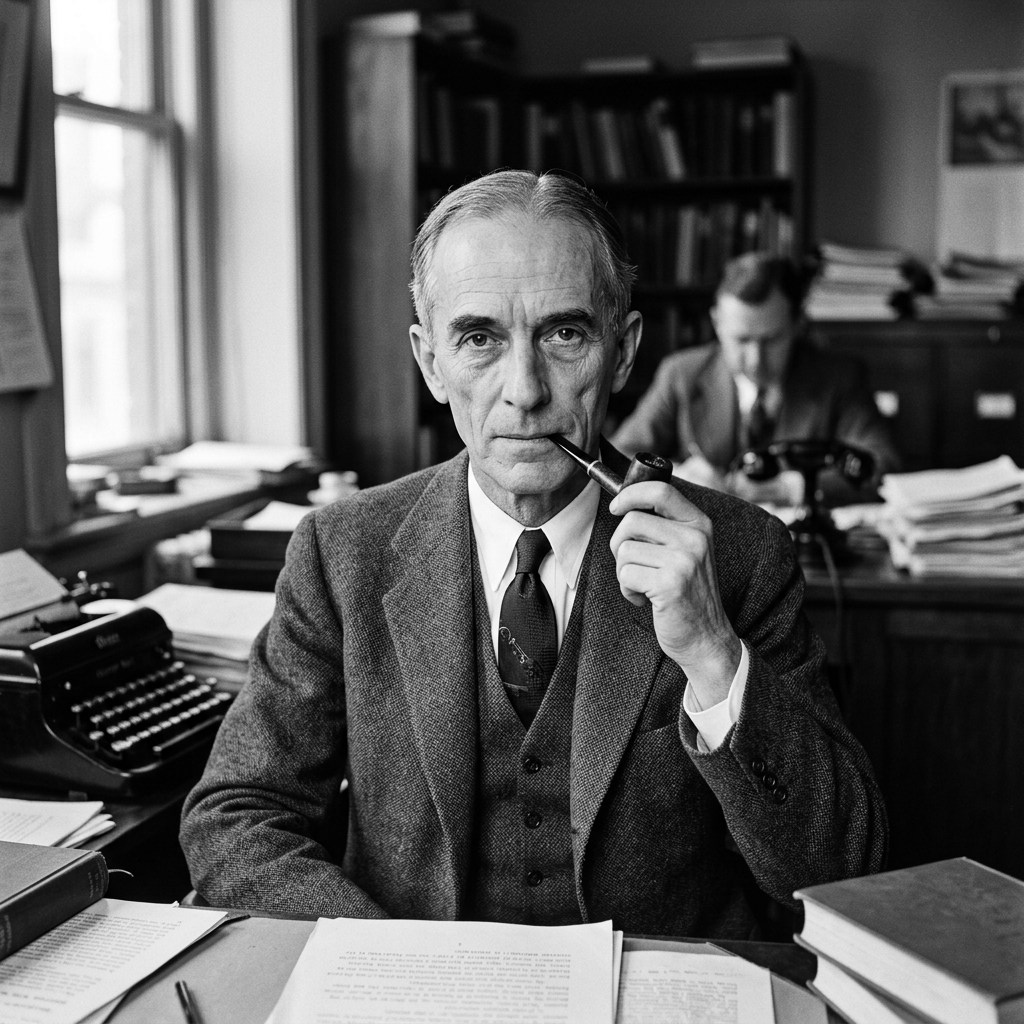
Featured image: Albert Jay Nock (AI illustration)