In a small manufactory, ten men worked at making pins. One drew out the wire, another straightened it, a third cut it, and so it went on until some eighteen distinct operations had turned out a finished pin. Together the ten produced more than 48,000 pins in a day. Had each of them done every step alone, he could certainly not, as Smith writes, have made twenty, and perhaps not even a single one.
The man who described this workshop said he had seen it with his own eyes. In 1776 Adam Smith placed it at the opening of his major work, An Inquiry into the Nature and Causes of the Wealth of Nations, usually known simply as The Wealth of Nations, and used it to explain where the wealth of nations comes from. He found it in labor that is divided and in exchange, which is what makes that division possible in the first place. To this day the book is regarded as the founding work of economics and as one of the most influential arguments for a free economic order.
At a glance
- Life: baptized June 5, 1723, in Kirkcaldy (Scotland); died July 17, 1790, in Edinburgh
- Work: professor in Glasgow (1751 to 1764), traveling companion of the Duke of Buccleuch in France and Geneva (1764 to 1766), commissioner of customs for Scotland in Edinburgh (from 1778)
- Major works: The Theory of Moral Sentiments (1759, greatly expanded 1790), The Wealth of Nations (1776)
- Circle: Scottish Enlightenment, student of Francis Hutcheson, close friend of David Hume
- In one sentence: He showed that prosperity grows out of free exchange and that a society flourishes when people are left to go their own way.
From the lecture hall in Glasgow to the customs house in Edinburgh
Smith’s father, comptroller of customs in the port town of Kirkcaldy, died a few months before his son was born. At fourteen, Adam Smith entered the University of Glasgow, where he attended the lectures of the moral philosopher Francis Hutcheson. In 1740 he went on a scholarship to Balliol College, Oxford, where he stayed until 1746.
After giving lectures in Edinburgh, Smith became professor of logic in Glasgow in 1751 and shortly afterward professor of moral philosophy, a subject that at the time also included law and political theory. He was bound to David Hume by a friendship that lasted until Hume’s death. In 1759 The Theory of Moral Sentiments appeared and made him known.
In 1764 he gave up his professorship to accompany the young Duke of Buccleuch on a journey. It took them by way of Toulouse and Geneva to Paris, where Smith met the economists around François Quesnay and Anne Robert Jacques Turgot. Back in Scotland, he worked for about ten years, mostly in his mother’s house in Kirkcaldy, on the book that appeared in 1776. In 1778 he became one of the commissioners of customs for Scotland and moved to Edinburgh, where he died in 1790, after having most of his manuscripts destroyed.
How pins become prosperity
With the pin workshop, Smith shows why specialization multiplies productivity: each worker becomes more skilled at his particular task, loses no time switching between jobs, and machines come into being that let one person do the work of many. A second insight follows from this, one he used as the title of a chapter of its own: the division of labor is limited by the extent of the market. In the scattered hamlets of the Scottish Highlands, Smith observes, every farmer must be butcher, baker, and brewer for his own family.
So the wider the circle of people with whom one may freely trade, the more finely labor can be divided and the more prosperous everyone involved becomes. Every tariff and every trade ban shrinks that circle, and therein lies an essential part of his case for free trade.
The butcher, the brewer, and the baker
The book’s best-known sentence comes in the second chapter: “It is not from the benevolence of the butcher, the brewer, or the baker that we expect our dinner, but from their regard to their own interest.” (Book I, Chapter 2) With it Smith described an order in which people serve one another without having to know or love one another.
The image of the invisible hand, which is linked to his name, appears only once in The Wealth of Nations. The passage concerns a merchant who prefers to invest his capital at home because he can keep a better eye on it there. He thinks only of his own security and his own gain, and yet, Smith says, he is led by an invisible hand to promote an end that was no part of his intention (Book IV, Chapter 2). Dryly, Smith adds that he has never known much good to be done by those who claimed to trade for the public good.
Anyone who takes Smith for a preacher of selfishness overlooks his first book. The Theory of Moral Sentiments opens with the observation that, however selfish man may be supposed to be, there are evidently principles in his nature that make him take an interest in the fortunes of others (Part I, Section I, Chapter 1, paraphrased). The invisible hand appears there too: the rich, who seek only to satisfy their own desires, distribute the necessaries of life through their demand for labor almost as if the earth had been divided into equal portions (Part IV, Chapter 1).
The consumer as the measure
A large part of The Wealth of Nations is devoted to what Smith called the mercantile system. Its adherents believed that a country grows rich by exporting more than it imports and piling up precious metal. “Consumption is the sole end and purpose of all production,” he wrote, and the interests of producers deserve attention only so far as they serve those of consumers (Book IV, Chapter 8). Under the mercantile system, by contrast, the consumer is almost always sacrificed to the producer.
This explains his distrust of merchants who ally themselves with politics. People of the same trade, he remarked, seldom meet together, even for amusement, without the conversation ending in a conspiracy against the public or in some scheme to raise prices. Such meetings, however, could not be prohibited without violating liberty and justice. But the law ought not to make them easier, let alone necessary (Book I, Chapter 10). Smith, then, defended competition, and precisely for that reason he rejected guild regulations, trade monopolies, and protective tariffs by which the state grants advantages to particular groups.
He took an equally sober view of the colonial system: Great Britain, he argued, derives nothing but loss from its rule over the colonies, yet no nation has ever voluntarily given up a province. He judged slavery on both economic and moral grounds. Someone who can acquire no property can have no other interest than to eat as much and to work as little as possible, which is why the work of slaves is in the end the most expensive of all (Book III, Chapter 2). In The Theory of Moral Sentiments he called the Africans carried off into slavery nations of heroes whom fortune had cruelly subjected to the refuse of the jails of Europe (Part V, Chapter 2).
The pieces on the chessboard
One of the most important passages for friends of liberty is found not in The Wealth of Nations but in the last edition of The Theory of Moral Sentiments. In 1790, a few months before his death, Smith added an entirely new sixth part to the book. In it he describes the “man of system,” who is so enamored of his ideal plan of government that he will tolerate no deviation from it.
This man, Smith writes, seems to imagine that he can arrange the members of a great society as easily as the hand arranges the pieces on a chessboard. He does not consider that the pieces on the board have no other principle of motion than the one the hand impresses on them, whereas on the great chessboard of human society every single piece has a principle of motion of its own, altogether different from the one the legislator might choose to impose on it (Part VI, Section II, Chapter 2, paraphrased). If the two principles move in the same direction, the game goes on easily; if they oppose each other, society falls into the highest degree of disorder.
Almost two centuries later, Friedrich August von Hayek spoke in his 1974 Nobel lecture of The Pretence of Knowledge, and the kinship between the two ideas is plain: no planner knows the intentions, abilities, and circumstances of millions of people.
A few tasks, done well
At the end of the fourth book, Smith sums up his idea of a free order. Once all systems of preference and restraint are removed, the “simple system of natural liberty” establishes itself of its own accord. Every man, as long as he does not violate the laws of justice, is then left perfectly free to pursue his own interest in his own way (Book IV, Chapter 9). The sovereign is then relieved of a duty for which no human wisdom could ever suffice: directing the labor of private people.
Smith leaves the state three tasks: protection against attack from outside, an exact administration of justice, and certain public works and institutions that do not pay for individuals, such as roads, bridges, and elementary schools. Because he considered defense more important than opulence, he even regarded the English Navigation Act, which largely reserved sea trade for English ships, as a wise rule. Smith, then, explicitly assigned certain tasks to the state; his call for restraint applied above all to the steering of trade and industry.
How little he asked of a state is shown by a note from 1755, preserved by his first biographer, Dugald Stewart: to carry a state to the highest degree of opulence from the lowest barbarism, little else is required but “peace, easy taxes, and a tolerable administration of justice.” All the rest is brought about by the natural course of things.
What friends of liberty can learn from him
The first lesson concerns where prosperity comes from: it arises when people are allowed to specialize and to trade freely, and whoever closes borders to goods makes the people on both sides poorer.
Smith also teaches that a free market is something other than the rule of business owners. His measure was the consumer, and his distrust was directed at anyone who sought protection from competition through the state, a distinction that helps whenever someone calls for subsidies or protective tariffs.
Perhaps the most important lesson is the modesty that speaks from the image of the chessboard. People have their own goals and their own knowledge, and an order that respects this succeeds better than any plan, however clever. That the same author also wrote a book about sympathy is a reminder that for him the defense of the market and respect for one’s neighbor belonged together.
Why a nation grows rich
To the question of where a country’s prosperity comes from, Adam Smith gave an answer that is both modest and demanding. He saw prosperity arising in the hands of millions of people who work, trade, and serve one another, and he trusted them more than any legislator who wants to move them around like pieces on a board. More than two centuries after his death, it is worth asking, with every new tariff and every new plan, whether the pieces on the board have not long known where they want to go.
Further reading
- Adam Smith: Der Wohlstand der Nationen. Eine Untersuchung seiner Natur und seiner Ursachen, translated by Horst Claus Recktenwald, dtv, Munich (in German); in English: An Inquiry into the Nature and Causes of the Wealth of Nations
- Adam Smith: Theorie der ethischen Gefühle, edited by Walther Eckstein, Felix Meiner Verlag, Hamburg (in German); in English: The Theory of Moral Sentiments
- Ian Simpson Ross: The Life of Adam Smith, Clarendon Press, Oxford 1995
- Friedrich August von Hayek: Die Anmaßung von Wissen, Nobel lecture, Stockholm 1974 (in German); in English: The Pretence of Knowledge
This article is part of our series on thinkers, doers, and historical figures of liberty.
Sources
- Smith, Adam: The Theory of Moral Sentiments, Andrew Millar, London 1759; 6th edition with new Part VI, London 1790. Full text (earlier edition): https://www.gutenberg.org/cache/epub/67363/pg67363.txt; 6th edition: https://www.econlib.org/library/Smith/smMS.html
- Smith, Adam: An Inquiry into the Nature and Causes of the Wealth of Nations, W. Strahan and T. Cadell, London 1776. Full text: https://www.gutenberg.org/cache/epub/3300/pg3300.txt
- Smith, Adam: Der Wohlstand der Nationen, translated and edited by Horst Claus Recktenwald, dtv, Munich (in German).
- Smith, Adam: Theorie der ethischen Gefühle, translated and edited by Walther Eckstein, Felix Meiner Verlag, Hamburg (in German).
- Stewart, Dugald: Account of the Life and Writings of Adam Smith, LL.D., 1793 (preserves Smith’s note of 1755); quotation as given by the Online Library of Liberty: https://oll.libertyfund.org/quote/adam-smith-on-the-need-for-peace-easy-taxes-and-a-tolerable-administration-of-justice-1755
- Hayek, Friedrich August von: The Pretence of Knowledge, Nobel lecture, Stockholm, December 11, 1974, https://www.nobelprize.org/prizes/economic-sciences/1974/hayek/lecture/
- Stanford Encyclopedia of Philosophy: Adam Smith’s Moral and Political Philosophy, https://plato.stanford.edu/entries/smith-moral-political/
- Encyclopaedia Britannica, 11th edition, 1911: Smith, Adam, https://en.wikisource.org/wiki/1911_Encyclop%C3%A6dia_Britannica/Smith,_Adam
- University of Glasgow, World Changing: Adam Smith, https://worldchanging.glasgow.ac.uk/notable-people/?id=126
- Wikiquote: Adam Smith (wording of the chessboard passage), https://en.wikiquote.org/wiki/Adam_Smith
- Wikipedia (English): Adam Smith, https://en.wikipedia.org/wiki/Adam_Smith (overview, dates)
- Levy, Jacob T.: “Very difficult, perhaps altogether impossible,” EconLog, https://www.econlib.org/econlog/very-difficult-perhaps-altogether-impossible-smiths-political-science-at-econlib
- Ross, Ian Simpson: The Life of Adam Smith, Clarendon Press, Oxford 1995.
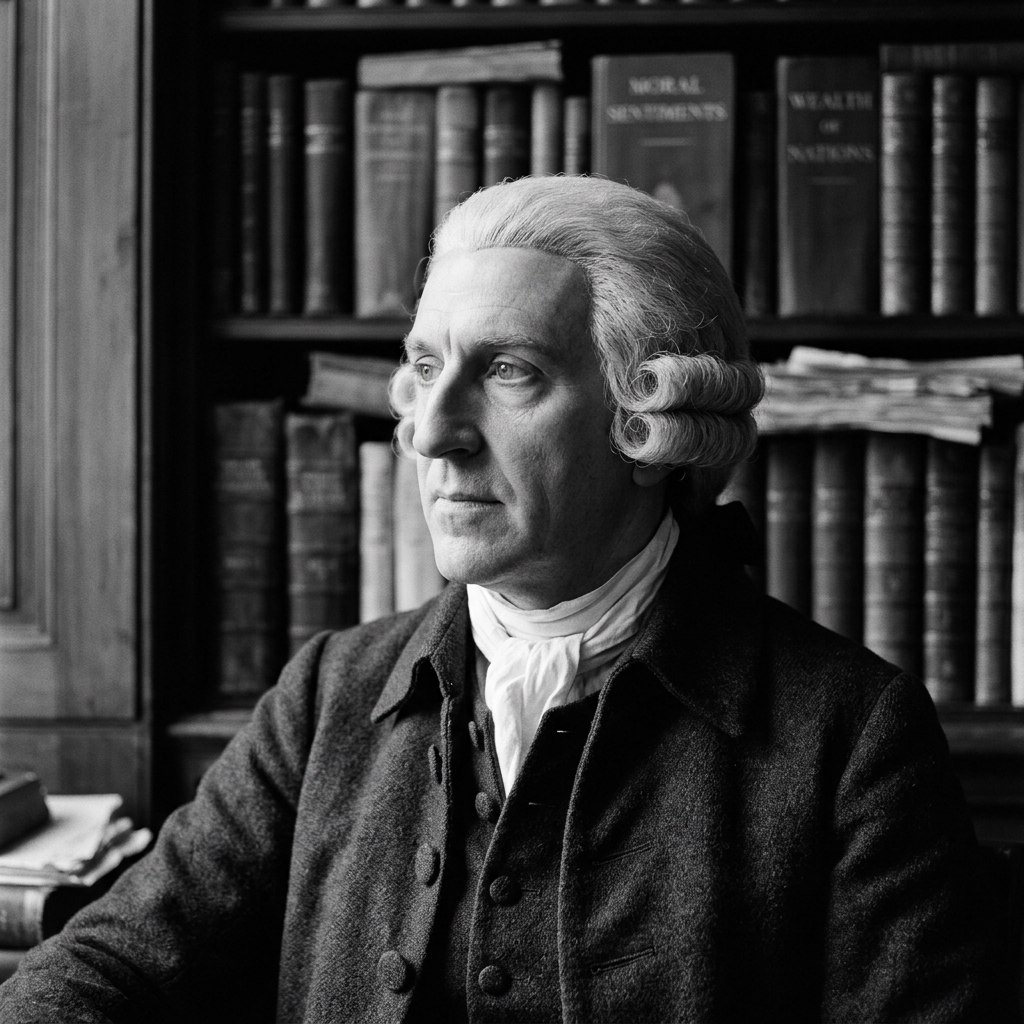
Featured image: Adam Smith (AI illustration)