In Jonathan Swift’s novel, Gulliver is held to the ground by the inhabitants of Lilliput after his shipwreck. None of their tiny threads could have held the giant on its own, but together they leave him unable to move. In 2021 the economist Stefan Kooths applied this image to German economic policy and spoke of a “Gulliver syndrome”: “Gulliver was not held to the ground by a single thread, but by a whole web of them.” The same is true, he argued, of the state’s influence on the economy, both in the density of regulation and in government spending.
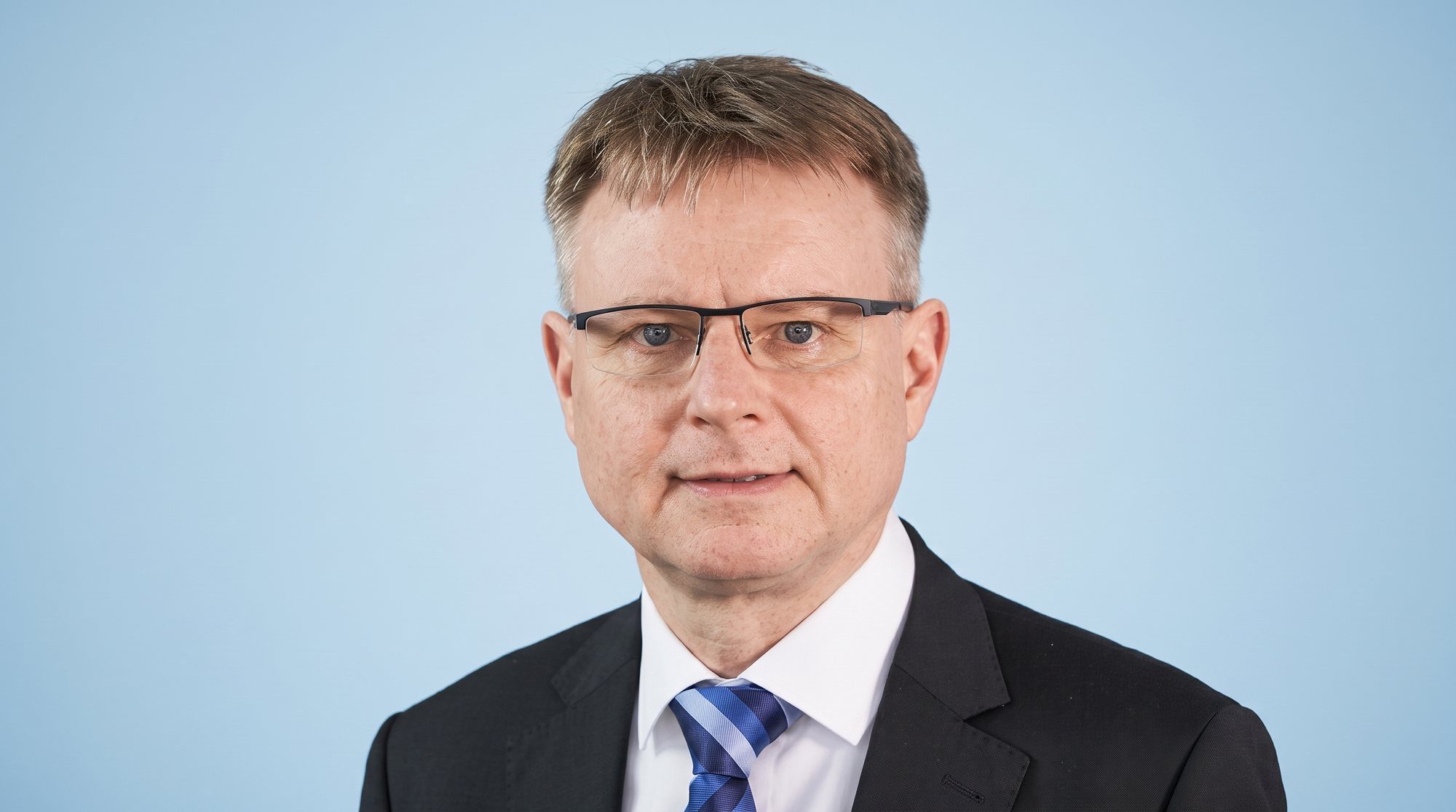
Much of his thinking is contained in this image. Kooths is a business cycle researcher, someone whose job is to interpret quarterly figures and incoming orders. At the same time he chairs the Friedrich A. von Hayek Society, which makes him one of the most audible voices for the market economy in Germany. For him the two belong together: anyone who wants to understand why an economy grows or stalls must, he is convinced, look at the order within which millions of people coordinate their plans with one another.
At a glance
- Born: 1969, high school diploma (Abitur) 1988 in Mettmann
- Work: Director of the Research Center Business Cycles and Growth at the Kiel Institute for the World Economy (since 2020, previously head of its Forecasting Center from 2014), professor of economics at BSP Business and Law School in Berlin and Hamburg
- Offices: Chairman of the Friedrich A. von Hayek Society (since 2019), member of the Mont Pèlerin Society (since 2020), interim co-head of the Kiel Institute from 2021 to 2023
- Major work: Marktwirtschaft. Wohlstand, Wachstum, Wettbewerb (Market Economy: Prosperity, Growth, Competition, 2025)
- In one sentence: He reads the business cycle as a mirror of the economic order and argues for using the forces of the market instead of governing against them.
From Computer Model to Forecast
Kooths studied economics in Münster from 1988 to 1993 as a scholar of the German Academic Scholarship Foundation (Studienstiftung des deutschen Volkes). While he was still a student, his learning program for macroeconomics, MAKROMAT, won the German-Austrian University Software Prize in 1992. His doctoral dissertation, completed in Münster in 1998 and honored with the university’s dissertation prize, bears the title Erfahrungsregeln und Konjunkturdynamik (Rules of Experience and Business Cycle Dynamics). As the subtitle Makromodelle mit Neuro-Fuzzy-generierten Erwartungen (macro models with neuro-fuzzy-generated expectations) suggests, it dealt with the question of how people form their expectations from experience, modeled with learning methods from computer science.
After years as a university assistant and managing director of the Muenster Institute for Computational Economics, he moved in 2005 to the business cycle department of the German Institute for Economic Research (DIW) in Berlin. In 2010 he joined the Kiel Institute for the World Economy, where he took over the Forecasting Center in 2014 and has headed the Research Center Business Cycles and Growth since November 2020. When the institute’s then president, Gabriel Felbermayr, left in the fall of 2021, Kooths and Holger Görg jointly took over its academic leadership on an interim basis until Moritz Schularick became president in June 2023. Alongside this, Kooths has taught as a professor of economics in Berlin since 2013, since 2020 at BSP Business and Law School. He has been a member of the Free Democratic Party (FDP), Germany’s liberal party, since 1995.
As the Kiel Institute’s chief business cycle economist, Kooths presents its forecasts and puts them in context. In its fall forecast of September 3, 2026, the institute raised its growth projection for Germany to 1.3 percent while stressing that the structural deficits remain. “The continuing decline in competitiveness reflects the weaknesses of Germany as a business location,” he said.
The Economy as Coordination
Kooths explains macroeconomic imbalances above all as the result of disrupted coordination processes, and accordingly he studies misaligned incentives in money and credit, in labor markets, in the tax and transfer system, and in regulation. In this view, markets are procedures through which people who do not know one another coordinate their plans. Prices act as signals that show what is scarce and where effort pays off.
He worked out this idea in his 2025 book Marktwirtschaft. Wohlstand, Wachstum, Wettbewerb, a 548-page volume published by Kohlhammer. According to the publisher, it aims to overcome the old divide between demand-side and supply-side economic policy with a coordination-economics approach and to connect microeconomics and macroeconomics. It explicitly does not set out to be a textbook; it links its topics to the economic order and its social philosophy. In his review for the Frankfurter Allgemeine Zeitung in March 2026, Patrick Welter counted Kooths, in substance, among the most interesting German economists and was reminded of Hayek by his combination of business cycle analysis and liberal spirit. He noted, however, that large parts presuppose prior knowledge, and singled out the last third, with essays on growth, free trade, and subsidies, as particularly worth reading.
The Compass in the Crisis
What this thinking looks like in practice is shown by his essay “Außer Betrieb: Ordnungspolitischer Kompass” (Out of Service: The Compass of Economic Order), which he published in 2021 in the magazine CIVIS. In the middle of the pandemic he wrote: “More lastingly than the damage caused by the pandemic, policy-made defects in this country threaten our prosperity.” The relief programs, he argued, had too often targeted the wrong indicators, and a value-added tax cut of 18 billion euros had missed the core of the crisis, because people did not lack purchasing power when stores were closed.
More fundamental is his distinction between short-term stabilization and long-term structural policy. The latter, in his view, should get by with as few case-by-case interventions as possible and instead adjust the framework of rules within which people find their own way by means of price signals. As a successful example he cites the European emissions trading system: because the total quantity of allowances is capped, the cost of carbon dioxide enters every calculation, and businesses and consumers alike look for the cheapest ways to reduce it themselves. According to his analysis, additional climate subsidies miss their goal within this system, because they do not change the total quantity and merely redistribute rents among the participants.
This is also where the Gulliver image comes in. It is never a single regulation or a single spending program that weighs on economic dynamism, he writes, “rather, it is the sum of such measures, whose sheer quantity attacks the quality of the economic order.” A major project that claims two percent of economic output may seem attractive on its own terms. “If there were 50 such projects, nothing would be left of the market economy, even in theory.” What policy needs, he argues, is a safety margin from this limit, and there is only one way to get it: “That only works with market forces and not against them.”
Money, Liability, and the Debt Brake
As a business cycle researcher, Kooths watches money particularly closely. As early as the spring of 2021, when consumer prices jumped at the start of the year, he and Salomon Fiedler wrote in the Zeitschrift für das gesamte Kreditwesen, a German banking journal, that inflation risks were higher over the medium term. A year later, with inflation above five percent, he explained in a guest article where the pressure came from: during the pandemic, central banks had financed government aid with the printing press, creating incomes that were not matched by any production. “For the economy as a whole, these are phantom incomes,” he wrote, and he stated: “In the medium and long term, price stability remains exclusively a matter of monetary policy.”
For the eurozone, this implies a clear allocation of responsibilities. As early as 2021 he criticized that the no-bailout clause had been abandoned in the debt crisis and that the ban on borrowing for the EU budget had fallen in the coronavirus crisis, putting monetary policy ever more firmly in the “headlock of fiscal dominance.” In October 2026, in an interview with the Swiss portal finews.ch, he reaffirmed that every state must answer for its own debts: “Any restriction of this full liability undermines the monetary union.” The European Central Bank’s crisis instrument for supporting individual countries’ government bonds should be abolished, he said, because the discipline that lenders enforce is the most effective means of ensuring sound public finances.
He also defends the debt brake, Germany’s constitutional limit on government borrowing, with an argument from economic order. It limits the room for a state’s least important expenditures, while the most important ones can always be financed, he wrote in 2021, pointing out that the government investment ratio in 2019 was as high as it had been at any time since the mid-1990s. In an interview with the German magazine Tichys Einblick at the end of 2025, he summed up his diagnosis of Berlin’s economic policy in one sentence: “The fundamental problem is a deep-seated distrust of market processes.” In his conversation with finews.ch, he described Germany’s problem as a structural growth weakness, held back by an aging population, high taxes and contributions, and dense regulation. On the loosening of the debt rules in 2025, he concluded there: “There was quick agreement on more spending, but not on reforms that would enable stronger growth and improve debt sustainability.”
At the Head of the Hayek Society
In June 2019, at the Hayek Days in Vienna, the members of the Friedrich A. von Hayek Society elected Kooths as their chairman, succeeding the Hamburg economist Wolf Schäfer. The Kiel Institute reported at the time that he wanted to keep the society strictly nonpartisan and to sort debates not by right and left but by the contrast between individual liberty and constructivist collectivism. He also wanted to support young talent. In September 2020 he was admitted to the Mont Pèlerin Society, which Hayek had co-founded in 1947.
The most visible moment of his tenure came on June 22, 2024, in Hamburg, when the society awarded the Hayek Medal to Argentine President Javier Milei. In his laudation, Kooths placed Milei in a line of great liberal reformers of the postwar era, from Ludwig Erhard to Margaret Thatcher and Ronald Reagan to New Zealand’s Roger Douglas and Poland’s Leszek Balcerowicz. He recalled why stable money is the precondition for everything else: “In order to coordinate in a decentralized way, market participants need prices as signals of scarcity.” He did not conceal the harshness of Argentina’s course: “The treatment resembles chemotherapy; the side effects are severe and the risks high.” Without it, however, he continued, even greater dangers loomed, up to the emigration of those who no longer see any prospects in their own country.
Since then the medal has gone to the physicist and cabaret comedian Vince Ebert in 2025 and in 2026 to the economist Veronika Grimm and to the American politician Ron Paul. Under his chairmanship, the list of honorees thus ranges from academia through politics to the stage.
What friends of liberty can learn from him
The most important lesson is to look at the whole. Anyone who examines only individual measures will find a good justification for almost every one of them. Kooths directs attention to the sum, which turns many well-meant interventions into a net in which no one can move freely anymore. The argument needs no dispute over first principles, because it rests on simple arithmetic: fifty projects of two percent each add up to the entire economic output.
Just as instructive is his distinction between the framework of rules and intervention. He does not deny that the state must set rules, and the example of emissions trading shows how far he takes this idea. What matters to him is the reliability of the rules: “A framework of rules should above all help the actors to form expectations.” In this he builds on Hayek and on the German tradition of ordoliberal economic policy (Ordnungspolitik), which sees the state above all as the guardian of reliable rules of the game.
Finally, Kooths shows that a love of liberty and scientific sobriety go well together. The Kiel Institute is one of the institutes that twice a year prepare the Joint Economic Forecast (Gemeinschaftsdiagnose) for the German federal government, and whoever heads business cycle research there has to back up his judgments with data. That he also openly advocates the market economy gives his case additional weight.
Untying the Threads
In the end, everything leads back to Gulliver. If it is the sum of the threads that holds an economy down, then the way out lies in untying them again, with patience and a sense of direction. For this, Kooths calls for a compass of economic order that applies especially in times of crisis, because otherwise, as he wrote in 2021, with every crisis one moves further away from the goal one originally set out for. Whether policymakers take this compass in hand again will be decided in many small steps, and for each of these steps he supplies the calculation as well.
Further reading
- Stefan Kooths: Marktwirtschaft. Wohlstand, Wachstum, Wettbewerb, W. Kohlhammer, Stuttgart 2025 (in German)
- Stefan Kooths: “Außer Betrieb: Ordnungspolitischer Kompass. Wie Wirtschafts- und Finanzpolitik wieder in die Spur finden,” in: CIVIS, 2021 (in German)
- Stefan Kooths: laudation for Javier Milei on the award of the Hayek Medal, Hamburg, June 22, 2024 (published by the Friedrich A. von Hayek Society, in German)
This article is part of our series on thinkers, doers, and historical figures of liberty.
Sources
- Kooths, Stefan: Marktwirtschaft. Wohlstand, Wachstum, Wettbewerb, W. Kohlhammer, Stuttgart 2025, 548 pp., ISBN 978-3-17-033598-1 (in German).
- Kooths, Stefan: “Außer Betrieb: Ordnungspolitischer Kompass. Wie Wirtschafts- und Finanzpolitik wieder in die Spur finden,” in: CIVIS, 2021, pp. 66–70 (in German), https://www.bsp-campus-hamburg.de/files/Fakult%C3%A4t_Creative_Business/Business%20and%20Law%20School/News/2021-kooths_CIVIS-OrdnungspolitischerKompass.pdf
- Kooths, Stefan: “Überdruck auf den Preisventilen, heute und übermorgen,” guest article, January 25, 2022 (in German), https://www.echo24.de/welt/inflation-teuerungsrate-preisauftrieb-gefahren-coronavirus-deutschland-stefan-kooths-ifw-gastbeitrag-zr-91253383.html
- Kooths, Stefan; Fiedler, Salomon: “Sprung bei den Verbraucherpreisen: läuft die Inflation aus dem Ruder?,” in: Zeitschrift für das gesamte Kreditwesen 6/2021, pp. 290–293 (in German).
- Kooths, Stefan: laudation for Javier Milei on the occasion of the award of the Hayek Medal, Hamburg, June 22, 2024 (in German), https://hayek.de/wp-content/uploads/2024/07/Laudatio-Prof.-Kooths-auf-J.Milei-Hayek-Medaille.pdf
- Kooths, Stefan: Erfahrungsregeln und Konjunkturdynamik. Makromodelle mit Neuro-Fuzzy-generierten Erwartungen, dissertation, University of Münster 1998 (in German).
- Kooths, Stefan: website and CV, https://kooths.de/ and https://kooths.de/cv/index.htm (accessed November 9, 2026)
- Interview: “IfW-Ökonom Kooths: Bundesregierung traut der Marktwirtschaft nicht,” Tichys Einblick, December 15, 2025 (in German), https://www.tichyseinblick.de/daili-es-sentials/ifw-oekonom-stefan-kooths-marktwirtschaft/
- Interview: “Stefan Kooths: «Berlin sendet ein verheerendes Signal an die Welt»,” finews.ch, October 27, 2026 (in German), https://www.finews.ch/news/finanzplatz/74114-stefan-kooths-ifwkiel-staatsanleihen-verschuldung-ewu-ezb-konjunkturforschung-afd-linke-hayek-milei
- Kiel Institute for the World Economy: “Stefan Kooths leads Friedrich August von Hayek Society,” June 16, 2019, https://www.kielinstitut.de/stefan-kooths-leads-friedrich-august-von-hayek-society
- Kiel Institute for the World Economy: fall forecast 2026, press release of September 3, 2026 (idw, in German), https://idw-online.de/de/news876773
- Kiel Institute for the World Economy: “Moritz Schularick takes office as president of the Kiel Institute,” May 31, 2023, https://www.ifw-kiel.de/publications/news/moritz-schularick-takes-office-as-president-of-the-kiel-institute
- Börsen-Zeitung: “Interimslösung für Kieler Institut,” December 1, 2021 (in German), https://www.boersen-zeitung.de/personen/interimsloesung-fuer-kieler-institut-f06e165c-52b1-11ec-b45e-40d03ac0b54e
- Friedrich A. von Hayek Society: board and home page (Hayek Medal 2024 to 2026), https://hayek.de/vorstand/ and https://www.hayek.de/ (in German, accessed November 9, 2026)
- Internationaler Wirtschaftssenat: announcement of the admission to the Mont Pèlerin Society, September 15, 2020 (in German), https://www.deutscherpresseindex.de/?p=378761
- Perlentaucher: Stefan Kooths, Marktwirtschaft, with a note on the review by Patrick Welter, FAZ, March 30, 2026 (in German), https://www.perlentaucher.de/buch/stefan-kooths/marktwirtschaft.html
- Joint Economic Forecast, spring 2026 (in German), https://gemeinschaftsdiagnose.de/wp-content/uploads/2026/04/IfW_Kiel_GD_1_2026_final.pdf
- Hoover Institution: The Mont Pèlerin Society, https://www.hoover.org/research/mont-pelerin-society
- Wikipedia (de): Stefan Kooths, https://de.wikipedia.org/wiki/Stefan_Kooths (starting point, biographical data)
Featured image: Background edited