In the summer of 1960, a thirty-year-old economist was working as an intern at the Department of Labor in Washington. He had just earned his master’s degree at Columbia University, had written his thesis on Karl Marx’s theory of business cycles, and considered himself a Marxist. His assignment was to study minimum wages in Puerto Rico’s sugar industry. With every increase, employment there fell. Some attributed this to the minimum wage itself, which was pushing workers out of the market; others blamed a series of hurricanes that had destroyed the sugar cane in the fields. The labor unions preferred the second explanation.
The intern suggested simply checking: all it would take was finding out how much sugar cane had been standing in the fields before the storms. He expected praise. Instead, as he recalled in a 1999 interview with Salon magazine, he saw “looks of shock on people’s faces.” At the time, roughly a third of the department’s budget came from administering the wage and hours laws. Thomas Sowell drew a lesson from this that he kept for six decades: a government agency, too, is an organization with interests of its own, and anyone who wants to know what a policy accomplishes should not ask those who make their living from it.
At a glance
- Born: June 30, 1930, in Gastonia, North Carolina
- Work: Economist and social scientist; professor at Cornell and the University of California, Los Angeles, among others; Senior Fellow at the Hoover Institution at Stanford since 1980, today its Rose and Milton Friedman Senior Fellow Emeritus; newspaper columnist until 2016
- Awards: Francis Boyer Award (1990), National Humanities Medal (2002), Bradley Prize
- Major works: Knowledge and Decisions (1980), A Conflict of Visions (1987), The Vision of the Anointed (1995), Basic Economics (2000), Affirmative Action Around the World (2004), Intellectuals and Society (2010), Social Justice Fallacies (2023)
- In one sentence: He measures good intentions by their results and reminds us that every decision has a cost.
From Harlem to Harvard
Sowell’s origins could hardly have been humbler. His father died shortly before he was born; his mother, a housemaid with four other children, gave him up, and his great-aunt Molly raised him. He later recalled a wooden house in Charlotte without electricity or running water and wrote that it had never occurred to him that they were living in poverty. As a child he moved with the extended family to Harlem. He won admission to the prestigious Stuyvesant High School but had to leave as a teenager because money was short and the family was torn by quarrels. He delivered telegrams for Western Union and worked in a machine shop.
In 1951, during the Korean War, he was drafted into the Marine Corps. He opposed the war, but the Marines used him as a photographer, and photography remained his passion. After his discharge in 1952 he took a civil service job in Washington and attended evening classes at Howard University. From there he transferred to Harvard, where he graduated with honors in economics in 1958. After his master’s degree at Columbia University, he followed his teacher George Stigler to the University of Chicago, where he earned his doctorate in 1968.
He taught at Rutgers, Howard, Cornell, Brandeis, Amherst, and UCLA before joining the Hoover Institution at Stanford full time in 1980, where he had been a fellow since 1977. Alongside this, for decades he wrote a newspaper column that ran nationwide. When he ended it in December 2016 at the age of 86, he wrote that the real question was not why he was stopping but why he had kept going for so long.
What a Market Knows and an Agency Does Not
His major theoretical work, Knowledge and Decisions, appeared in 1980. The impetus came from Friedrich August von Hayek’s 1945 essay “The Use of Knowledge in Society.” It had given him, Sowell said that same year in an interview with Reason magazine, “a set of questions to ask.” Hayek’s idea is that the knowledge an economy needs is dispersed among countless people and consists largely of familiarity with particular circumstances that no central authority can gather.
Sowell turned this into a study of institutions. He asks who decides what in a society, what knowledge is available to the decision maker, and what feedback he receives when he is wrong. A business owner who produces things nobody wants sees it in his numbers and has to change course. Those who make political decisions often receive such signals late or not at all, and they rarely bear the costs of their mistakes themselves. What sounds like dry theory can be read as a sequel to that summer in Washington, when the question was whether an institution even wants to find out what it is doing.
Two Views of Human Nature
A Conflict of Visions, published in 1987, had an influence far beyond economics. In it Sowell describes two basic outlooks that lie behind the great political controversies and usually go unstated. The constrained vision regards human nature as fundamentally unchangeable and human beings as self-interested. It therefore puts its trust in the rule of law, tradition, experience, and checks and balances among the branches of government. The unconstrained vision regards human beings as fundamentally good, distrusts decentralized processes, and expects that an ideal solution can be found for every problem.
The first outlook gave rise to the idea that also heads this article and remains tied to Sowell’s name: there are no solutions, there are only trade-offs. Two examples make it concrete. Whoever introduces a rent cap makes housing cheaper for those who already have an apartment and makes it harder for everyone else to find one. Whoever raises the minimum wage increases the income of some and can push others out of work altogether. Good policy, in Sowell’s view, comes about where these prices are named openly and weighed against one another.
In The Vision of the Anointed (1995), he applied the distinction to the present day. The “anointed,” in his usage, are those who consider themselves morally called to make decisions on behalf of others. Steven Pinker took up Sowell’s pair of concepts in 2002 in The Blank Slate (in German, Das unbeschriebene Blatt), spoke of a tragic and a utopian vision, and called Sowell’s explanation the best theory that had been put forward up to that point.
Ideas Without Accountability
Sowell continued this line of thought in Intellectuals and Society, published in early 2010. He understands intellectuals as people whose end product is ideas, and precisely this, in his eyes, makes them so influential and at the same time so seldom accountable. Their ideas are judged by whether they persuade colleagues and audiences, and hardly by whether they work in reality. A military commander who makes the wrong decision may pay with his own life and those of his soldiers. The commentator who accuses him from behind a desk of excessive harshness bears no such risk. In this way Sowell carried the question of incentives, which economists usually put to businesses and government agencies, over to the world of ideas itself.
What Sets Groups Apart
A large part of Sowell’s work is devoted to the question of why ethnic groups, immigrants, and regions fare so differently economically. As early as Ethnic America (1981), he compared the paths of various immigrant groups. Wealth, Poverty and Politics (2015) starts with geography and then moves on to culture: to trust, education, and attitudes toward work. Discrimination and Disparities (2018) gathers evidence against the assumption that differing economic outcomes can be explained by a single cause, whether discrimination, exploitation, or heredity.
Particularly thorough is Affirmative Action Around the World, published by Yale University Press in 2004. In it Sowell compared programs of preferential treatment for particular groups in the United States, India, Malaysia, Sri Lanka, and Nigeria. His finding was that they benefit above all those who are already better off within the preferred group. They tempt others to classify themselves as members of a preferred group, and a supposedly temporary program tied to a goal that is never reached could, in his words, more aptly be called “eternal.” What interested him most was whether such programs actually help the people they are meant to serve.
One of his most recent books, Social Justice Fallacies (2023), carries these reflections further. At over ninety, he once again examines widespread assumptions in the debate over social justice.
Economics for Everyone
What sets Sowell apart from many of his fellow economists is his language. Basic Economics, subtitled a citizen’s guide, now in five editions, explains in plain terms how prices, scarcity, and incentives work, from rent control to the balance of payments. For decades his columns reached readers who would never have opened a textbook. The documentary Thomas Sowell: Common Sense in a Senseless World, released in 2021 by the Free to Choose Network, and the biography Maverick by journalist Jason L. Riley, published the same year, introduce him to a younger generation.
He has never liked being pinned down to a political label. In his 1999 conversation with Salon, he said that “libertarian” probably fit him better than many other labels, even though he disagreed with the libertarian movement on some issues, such as military defense. As early as 1980 he had told Reason that he found “much to agree with” in libertarian ideas but had trouble with the notion of providing national defense through the market.
What friends of liberty can learn from him
The most important lesson is to look at consequences. A policy does not become good because its supporters mean well, and anyone who wants to judge it must know what it actually does. For this Sowell has again and again recommended three simple questions, which run roughly as follows: Compared to what? At what cost? And what hard evidence is there?
Just as valuable is his attention to accountability and feedback. Decisions turn out better when they rest with those who feel their consequences, and that is why markets and rules that have grown over time often deserve more trust than a government agency’s plan. Here he meets Hayek and the Chicago School around Milton Friedman, whose name his position at the Hoover Institution also bears.
Finally, his life itself teaches something. A boy without a high school diploma who delivered telegrams became, by way of evening classes, Harvard, and Chicago, a widely read economist. That he expects a great deal of readers without academic training and trusts ordinary people to run their own lives fits this path.
Compared to What?
In June 2026, Thomas Sowell turned 96. For more than six decades he has kept the patience to let numbers speak where others prefer to let intentions speak. His work is an invitation to ask of every new proposal what it costs, who bears the costs, and how we will later be able to tell whether it worked. How different would politics look if every government agency were as curious about the effects of its own rules as that intern was in the summer of 1960?
Further reading
- Thomas Sowell: Basic Economics. A Citizen’s Guide to the Economy, Basic Books, New York 2000 (five editions since)
- Thomas Sowell: A Conflict of Visions. Ideological Origins of Political Struggles, revised edition, Basic Books, New York 2007
- Thomas Sowell: Knowledge and Decisions, Basic Books, New York 1980 (new edition 1996)
- Jason L. Riley: Maverick. A Biography of Thomas Sowell, Basic Books, New York 2021
This article is part of our series on thinkers, doers, and historical figures of liberty.
Sources
- Sowell, Thomas: Knowledge and Decisions, Basic Books, New York 1980 (new edition 1996).
- Sowell, Thomas: Ethnic America. A History, Basic Books, New York 1981.
- Sowell, Thomas: A Conflict of Visions. Ideological Origins of Political Struggles, William Morrow, New York 1987; revised edition, Basic Books, New York 2007.
- Sowell, Thomas: The Vision of the Anointed, Basic Books, New York 1995.
- Sowell, Thomas: Basic Economics. A Citizen’s Guide to the Economy, Basic Books, New York 2000 (five editions).
- Sowell, Thomas: Affirmative Action Around the World. An Empirical Study, Yale University Press, New Haven 2004.
- Sowell, Thomas: Intellectuals and Society, Basic Books, New York 2010.
- Sowell, Thomas: Wealth, Poverty and Politics, Basic Books, New York 2015.
- Sowell, Thomas: Discrimination and Disparities, Basic Books, New York 2018.
- Sowell, Thomas: Social Justice Fallacies, Basic Books, New York 2023.
- Hazlett, Thomas W.; Klausner, Manuel: Interview with Thomas Sowell, in: Reason, December 1980, https://reason.com/?p=225556
- Sawhill, Ray: “Black and right,” interview with Thomas Sowell, Salon, November 10, 1999, https://www.salon.com/1999/11/10/sowell_2/
- Hayek, Friedrich A. von: “The Use of Knowledge in Society,” in: American Economic Review 35 (1945), no. 4.
- Hoover Institution: Thomas Sowell profile, https://www.hoover.org/profiles/thomas-sowell
- Hoover Institution: Black History Month Profile: Thomas Sowell, https://www.hoover.org/news/black-history-month-profile-thomas-sowell
- Wikipedia (en): Thomas Sowell, https://en.wikipedia.org/wiki/Thomas_Sowell (biography, awards)
- Wikipedia (en): A Conflict of Visions, https://en.wikipedia.org/wiki/A_Conflict_of_Visions
- Wikipedia (en): Intellectuals and Society, https://en.wikipedia.org/wiki/Intellectuals_and_Society
- Wikipedia (en): Affirmative Action Around the World, https://en.wikipedia.org/wiki/Affirmative_Action_Around_the_World
- Wikipedia (en): Wealth, Poverty and Politics, https://en.wikipedia.org/wiki/Wealth,_Poverty_and_Politics
- Pinker, Steven: The Blank Slate, 2002 (German edition: Das unbeschriebene Blatt, Berlin Verlag, Berlin 2003, in German); also FEE: Sowell’s Visions, https://fee.org/articles/sowells-visions/
- Riley, Jason L.: Maverick. A Biography of Thomas Sowell, Basic Books, New York 2021.
- Free to Choose Network: Thomas Sowell: Common Sense in a Senseless World, documentary, 2021, https://www.hoover.org/events/thomas-sowell-common-sense-senseless-world
- Quarterly Journal of Austrian Economics: review of Social Justice Fallacies, https://mises.org/quarterly-journal-austrian-economics/book-review-social-justice-fallacies
- Cato Institute: article on his 96th birthday, June 30, 2026, https://www.cato.org/node/120953
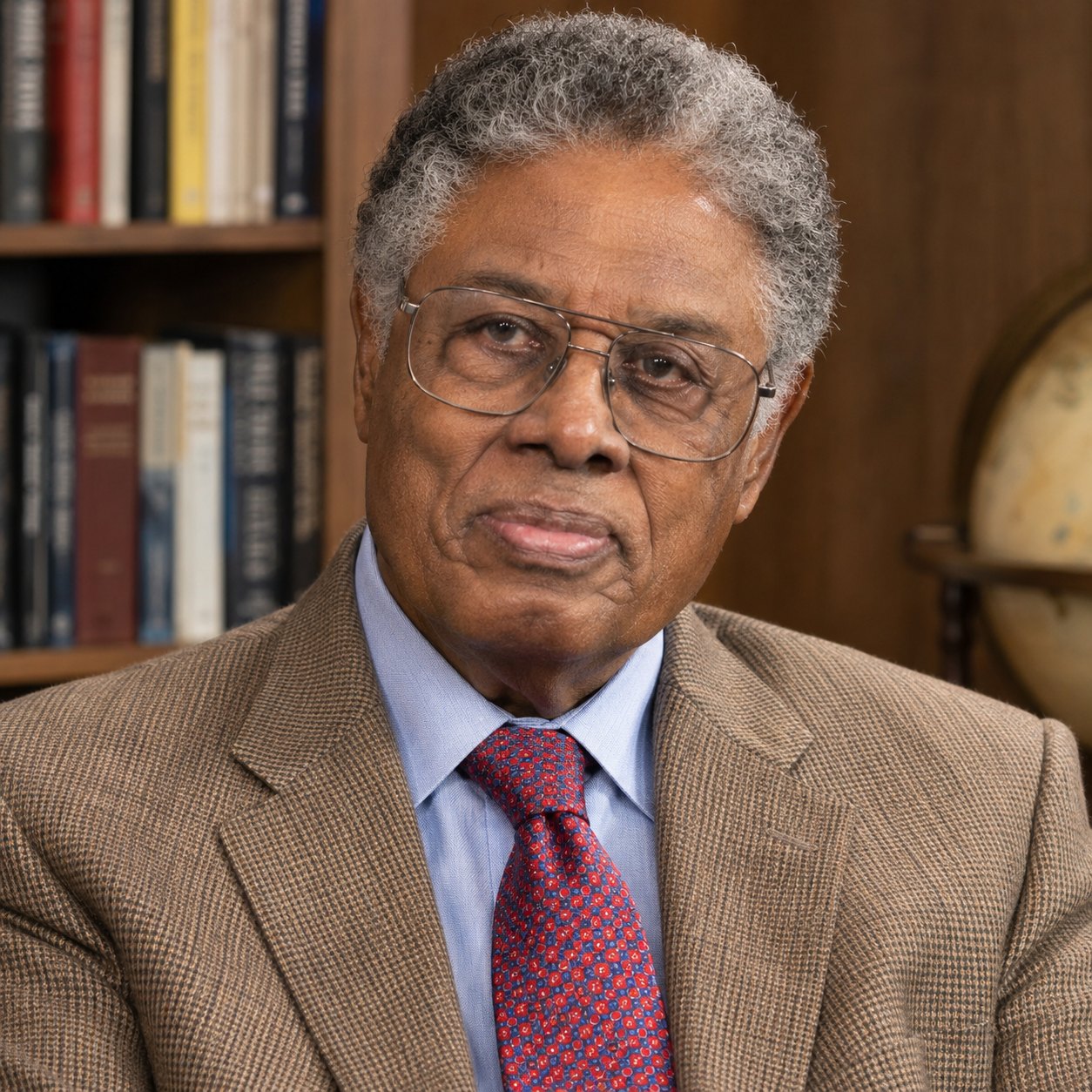
Featured image: Thomas Sowell (AI illustration)