On January 11, 1844, a lawyer from Massachusetts wrote to the Postmaster General of the United States, announcing that he intended shortly to set up a letter mail from Boston to Baltimore. Two weeks later his messengers were traveling daily by rail and steamboat between Boston, New York, Philadelphia, and Baltimore. At the time, the government post charged 18¾ cents for a letter from Boston to New York; the American Letter Mail Company advertised 6¼ cents and sold twenty stamps for a dollar.
The business was illegal under the law of the day, and its founder argued in a pamphlet of his own that the laws against private letter carrying were incompatible with the Constitution. The man’s name was Lysander Spooner, and two decades later he would ask an even more fundamental question: by what right does a government demand obedience at all?
At a glance
- Life: January 19, 1808, in Athol, Massachusetts, to May 14, 1887, in Boston
- Work: lawyer, entrepreneur, and pamphleteer; founder of the American Letter Mail Company (1844), opponent of slavery, later a writer for Benjamin Tucker’s journal Liberty
- Major works: The Unconstitutionality of Slavery (1845), An Essay on the Trial by Jury (1852), No Treason (1867 to 1870), Vices Are Not Crimes (1875), Natural Law (1882)
- In one sentence: He took the promise that governments rest on the consent of the governed at its word and checked whether it was being kept.
A Farmer’s Son Against the Guild
Spooner grew up the second of nine children on a farm in Athol. At 25 he went to Worcester, worked as a clerk in the registry of deeds, and read law with John Davis, later governor and senator, and with Charles Allen. He had no college education. Massachusetts law required applicants without a college degree to serve an apprenticeship with a lawyer that was years longer than the one required of college graduates, a rule in which Spooner saw a protection of the wealthy against the poor.
In 1835, after three years of apprenticeship, he opened his law office in Worcester anyway and, in a petition he sent to the Worcester Republican, called for the rule to be abolished. The following year the legislature repealed it. Even this early dispute shows what drove him all his life: he did not accept privileges just because they were written in the statute book.
A land speculation in Ohio failed, and in 1840 he returned to his father’s farm.
Letters for Six Cents
The federal government reacted quickly. Six days after the company started, a motion to investigate private mail services was before Congress. By the end of March 1844, Spooner and his messengers had been arrested in Maryland while carrying letters by rail, and every single letter counted as a separate offense.
In March 1845, Congress passed a law that imposed heavy penalties on private letter carrying and at the same time cut postage drastically: from July 1845, a letter traveling up to 300 miles cost only five cents, and ten cents beyond that. Spooner’s company could not withstand the pressure. From July 1851, a prepaid letter cost three cents. That same year Spooner asked in a pamphlet whom the public actually had to thank for the reduction of postage, and later accounts credit his competition with a good part of it.
The Constitution as a Weapon Against Slavery
The Unconstitutionality of Slavery appeared in 1845, followed by a second part two years later. William Lloyd Garrison and Wendell Phillips considered the Constitution of the United States a pact with the slaveholders from which any decent person had to dissociate himself. Spooner countered that the clauses usually read as tolerating slavery did not support it at all. Anyone who took the text at its word and, in case of doubt, interpreted it in favor of liberty would find in it no right of one person to own another.
The abolitionists of the Liberty Party used his arguments in their political fight. But the book had its most important effect on Frederick Douglass, the best-known Black abolitionist of his time. In May 1851, Douglass declared publicly that he now regarded the Constitution as an antislavery document, and he traced his change of mind to his study of Lysander Spooner, Gerrit Smith, and William Goodell.
Spooner fought against slavery until the outbreak of the Civil War in 1861. In 1858 he drafted a plan that called on the non-slaveholders of the South to organize into vigilance committees and come to the aid of slaves. A late echo shows how far his 1845 work reaches: in 2008, Justice Antonin Scalia cited it at the Supreme Court in the decision District of Columbia v. Heller.
Twelve Citizens and the Law
In 1852 Spooner published An Essay on the Trial by Jury, whose very first sentence already contains its thesis. Since Magna Carta in 1215, he argued, it had been a clear principle of English and American constitutional law that in criminal cases juries judge not only the facts, the law, and the intent of the accused. It was also their right and their primary duty “to judge of the justice of the law, and to hold all laws invalid, that are, in their opinion, unjust or oppressive.”
Today this is called jury nullification: a jury acquits a defendant because it refuses to apply the law under which he has been charged. For Spooner, it was the citizens’ last safeguard against the legislature. A footnote in the book shows how concretely he meant this: the Fugitive Slave Act of 1850, he wrote, was so hated by a large part of the population that a conviction under it seemed hopeless.
Who Signed the Contract?
After the Civil War, Spooner, who had fought slavery for two decades, answered the charge of treason against the Southern states with a question of his own. Treason presupposes a duty of allegiance, and a duty arises through consent. So who had ever consented to the Constitution? Two pamphlets appeared under the title No Treason in 1867, and in 1870 the sixth followed, with the subtitle The Constitution of No Authority. He never published numbers three through five.
The sixth pamphlet opens with the sentence: “The Constitution has no inherent authority or obligation.” At best, it presents itself as a contract between people who lived eighty years earlier, and they are dead. Even among them, only a small fraction had been asked at all. Voting, too, proves no consent. Someone who goes to the polls may only be defending himself against a power to which he is subject anyway, and with the secret ballot it is not even possible to determine who voted for the government.
The third section became famous. In it, Spooner says the government tells the citizen, like a highwayman: “Your money, or your life.” The comparison, however, comes out in the robber’s favor. The robber bears the responsibility and the danger of his act himself, does not claim to have a right to your money or to use it for your own good, and does not follow you afterward to set himself up as your rightful ruler. He does not have the effrontery, Spooner writes, to pass himself off as a mere “protector.” In the appendix he sums up: whatever the Constitution may mean, it has either authorized a government such as the one people had experienced or been powerless to prevent it. “In either case, it is unfit to exist.”
The constitutional scholar Randy Barnett finds this objection to the doctrine of tacit consent convincing. His 2004 book Restoring the Lost Constitution starts from Spooner and therefore looks for a different basis for when a constitution may be binding.
Vices Are Not Crimes
In 1875 the physician Dio Lewis edited the volume Prohibition a Failure, a polemic against the ban on alcohol that had been in force in Massachusetts for some twenty years. It included an anonymous contribution titled Vices Are Not Crimes. That Spooner was its author was not rediscovered until the 1970s.
The text opens with a distinction that still resonates in the literature of liberty today: “Vices are those acts by which a man harms himself or his property. Crimes are those acts by which one man harms the person or property of another.” According to Spooner, the law may punish only the latter, because in the case of the former there is no one whose rights have been violated. Each person judges for himself what harms him.
Justice as a Science
Spooner summed up his legal philosophy in 1882 in Natural Law; or The Science of Justice, a slim pamphlet that went through three editions in three years. For him, justice is the science of mine and thine, and it can be learned like any other science. He condensed its core into the old maxim of Roman law: “To live honestly, to hurt no one, to give to every one his due.” In the second chapter he calls legislation that issues commands beyond this an intrusion and a usurpation.
During these years the old man worked day after day in the reading room of the Boston Athenaeum. A close companion of this period was the anarchist Benjamin Tucker, with whom he worked on the Radical Review in 1877 and 1878 and who later printed Spooner’s open letters to the politician Thomas F. Bayard and to President Grover Cleveland in his journal Liberty. Spooner died on May 14, 1887, in his rooms on Myrtle Street. In his obituary, Tucker recalled the stooped figure of an old man bent over a desk full of dusty volumes.
What friends of liberty can learn from him
The first lesson concerns consent. Governments like to invoke a social contract, and Spooner showed how little there is behind it when no one has signed it and no one can cancel it.
The second lesson comes from his mail service. A monopoly fears nothing so much as a competitor who shows that it can be done more cheaply, and even a small challenger can lower prices for everyone. The third leads to the distinction between vice and crime, which can still be used today to test any ban meant to protect adults from their own decisions.
Perhaps most impressive is his consistency. Spooner read the Constitution against slavery as long as he hoped it could serve liberty, and he denied it all authority once he had seen what it was used for. In 1972 Murray Rothbard compiled a selection of his writings under the title Let’s Abolish Government, and two years later he paid tribute to him as the only constitutional lawyer who became an individualist anarchist.
A Question That Remains
Lysander Spooner took on a monopoly with a business of his own, gave the opponents of slavery an argument that convinced Frederick Douglass, and reminded citizens in the jury box of their strongest weapon against unjust laws. Yet his most important legacy is a question that anyone who pays taxes and obeys laws can answer for himself: When and where did I actually consent to this?
Further reading
- Lysander Spooner: No Treason. No. VI. The Constitution of No Authority, Boston 1870
- Lysander Spooner: Vices Are Not Crimes. A Vindication of Moral Liberty, Boston 1875
- Lysander Spooner: An Essay on the Trial by Jury, John P. Jewett, Boston 1852
- James J. Martin: Men Against the State. The Expositors of Individualist Anarchism in America, 1827–1908, chapter VII
This article is part of our series on thinkers, doers, and historical figures of liberty.
Sources
- Spooner, Lysander: The Unconstitutionality of the Laws of Congress, Prohibiting Private Mails, New York 1844.
- Spooner, Lysander: The Unconstitutionality of Slavery, Bela Marsh, Boston 1845 (Part 2: 1847).
- Spooner, Lysander: Who Caused the Reduction of Postage?, Boston 1851.
- Spooner, Lysander: An Essay on the Trial by Jury, John P. Jewett, Boston 1852, https://gutenberg.org/cache/epub/32984/pg32984-images.html
- Spooner, Lysander: A Plan for the Abolition of Slavery, and To the Non-Slaveholders of the South, 1858.
- Spooner, Lysander: No Treason. No. VI. The Constitution of No Authority, self-published, Boston 1870, https://www.gutenberg.org/cache/epub/36145/pg36145.txt
- Spooner, Lysander: Vices Are Not Crimes. A Vindication of Moral Liberty, in: Dio Lewis (ed.): Prohibition a Failure, James R. Osgood, Boston 1875, https://oll.libertyfund.org/titles/2292
- Spooner, Lysander: Natural Law; or The Science of Justice, A. Williams & Co., Boston 1882, https://en.wikisource.org/wiki/Natural_Law;_or_The_Science_of_Justice/Chapter_1
- Spooner, Lysander: Let’s Abolish Government, selected by Murray N. Rothbard, Arno Press / The New York Times, New York 1972, https://mises.org/library/book/lets-abolish-government
- Douglass, Frederick: “Change of Opinion Announced,” The Liberator, May 23, 1851.
- Tucker, Benjamin R.: “Our Nestor Taken From Us,” Liberty, May 28, 1887 (obituary), reproduced in Barnett 2009 (see below).
- Martin, James J.: Men Against the State. The Expositors of Individualist Anarchism in America, 1827–1908, ch. VII, https://mises.org/online-book/men-against-state/vii-lysander-spooner-dissident-among-dissidents
- Barnett, Randy E.: Restoring the Lost Constitution. The Presumption of Liberty, Princeton University Press, Princeton 2004.
- Barnett, Randy E.: “Remembering Lysander Spooner,” The Volokh Conspiracy, May 14, 2009, https://volokh.com/2009/05/14/remembering-lysander-spooner/
- Mathew, Naomi: “Lysander Spooner: The Anarchist Who Single-Handedly Took on the US Post Office,” FEE, January 12, 2019, https://fee.org/articles/lysander-spooner-the-anarchist-who-single-handedly-took-on-the-us-post-office/
- United States Postal Service: Domestic Letter Rates 1792–1863, https://about.usps.com/who/profile/history/domestic-letter-rates-1792-1863.htm
- Cato Institute: “Frederick Douglass: The US Constitution Is an Anti-Slavery Document,” https://www.cato.org/blog/frederick-douglass-us-constitution-anti-slavery-document
- Smith, George H.: “Dio Lewis, Lysander Spooner, and Prohibition,” libertarianism.org, https://www.libertarianism.org/columns/dio-lewis-lysander-spooner-prohibition
- Anarchy Archives (Pitzer College): Lysander Spooner, biography, https://pzacad.pitzer.edu/Anarchist_Archives/bright/Spooner/lspoonerbio.html
- Wikipedia (en): Lysander Spooner, https://en.wikipedia.org/wiki/Lysander_Spooner; American Letter Mail Company, https://en.wikipedia.org/wiki/American_Letter_Mail_Company (starting point)
- District of Columbia v. Heller, 554 U.S. 570 (2008).
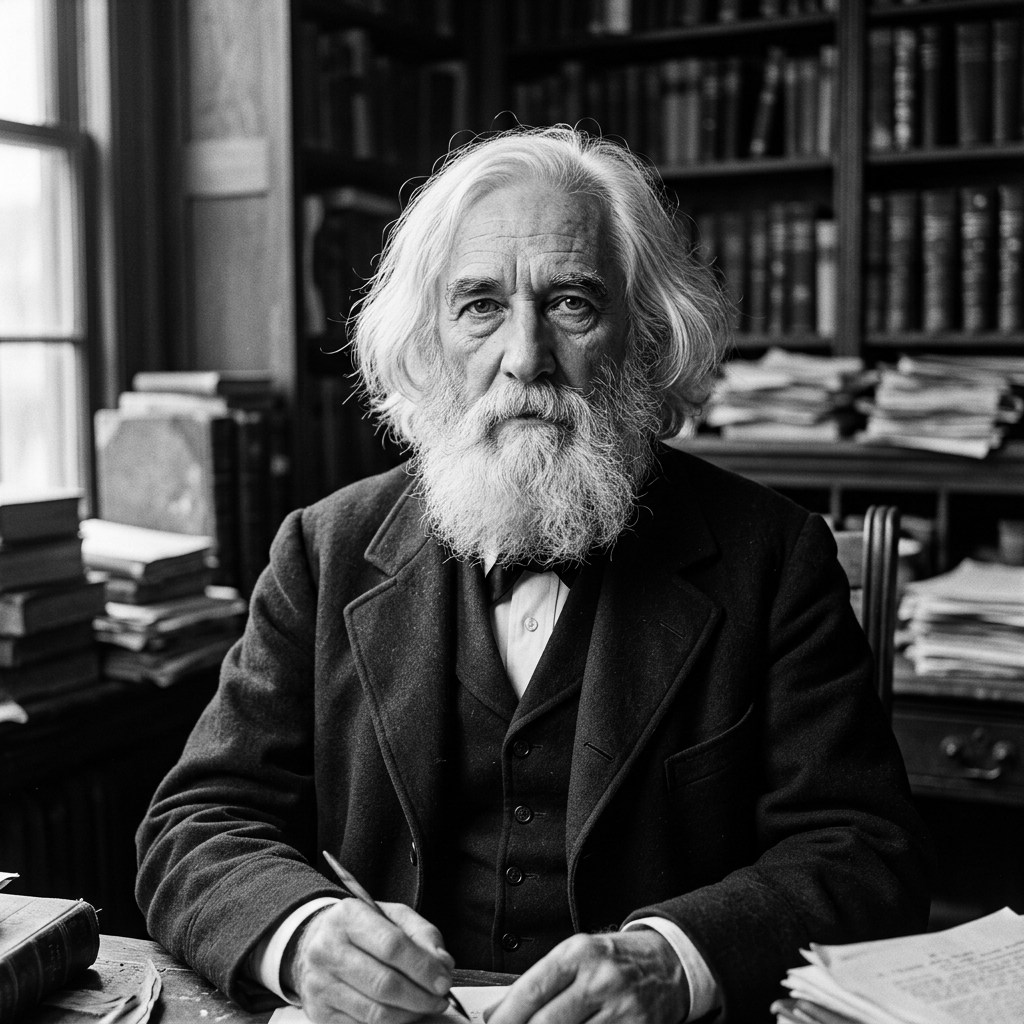
Featured image: Lysander Spooner (AI illustration)