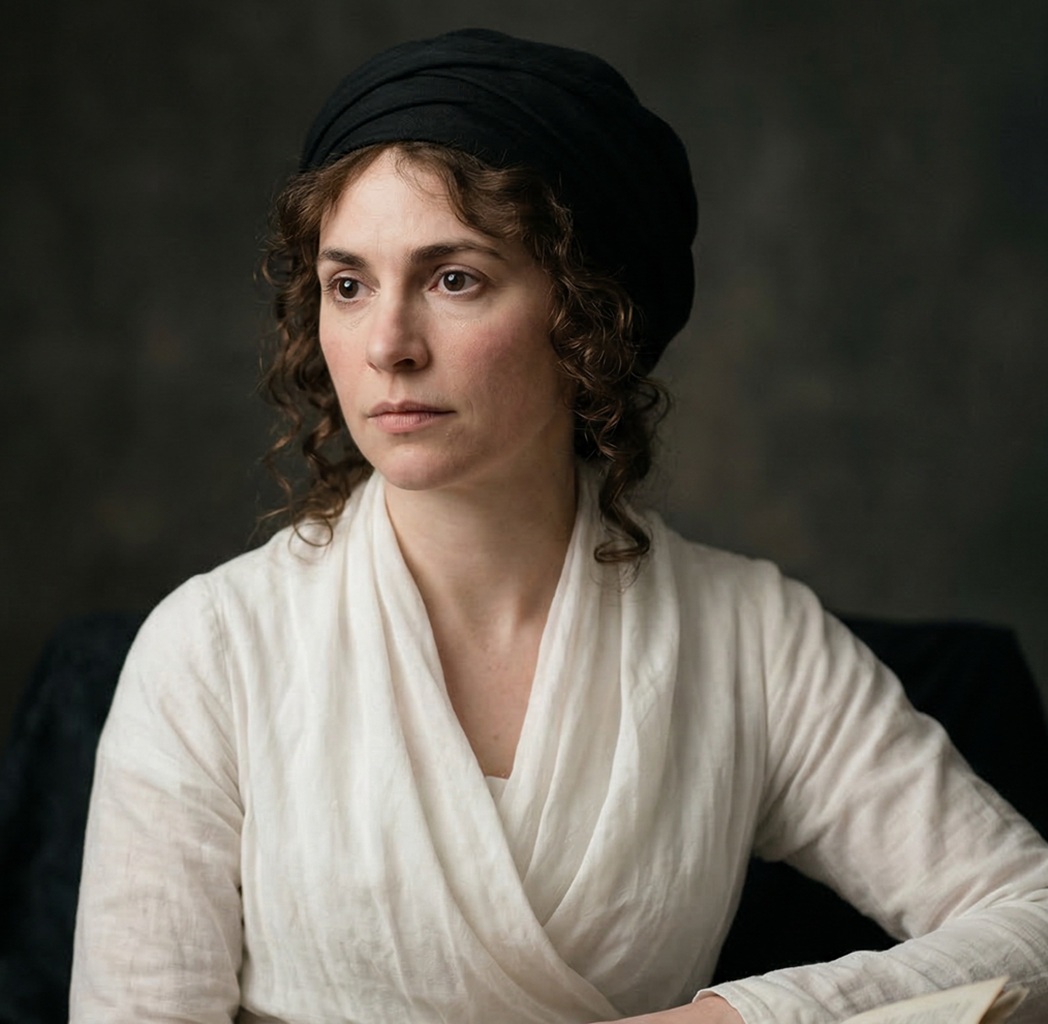
On November 1, 1790, Edmund Burke’s Reflections on the Revolution in France appeared in London, an eloquent defense of custom, nobility, and inheritance against the upheavals in Paris. Less than four weeks later, on November 29, the first reply was in the bookshops, printed anonymously by the publisher Joseph Johnson. When the second edition came out in December, the author’s name stood on the title page: Mary Wollstonecraft, thirty-one years old and without any formal schooling.
Two years later she published A Vindication of the Rights of Woman, the book for which she is known to this day. It is considered one of the founding texts of feminism. Read alongside her reply to Burke, it also reveals itself as a polemic for the self-determination of the individual, which its author consistently applied to the half of humanity that her contemporaries excluded from it.
At a glance
- Life: April 27, 1759, in Spitalfields, London, to September 10, 1797, in London
- Work: Teacher, governess, reviewer, and translator; political writer in the circle around the publisher Joseph Johnson
- Major works: A Vindication of the Rights of Men (1790), A Vindication of the Rights of Woman (1792), An Historical and Moral View of the French Revolution (1794), Letters Written during a Short Residence in Sweden, Norway and Denmark (1796)
- In one sentence: She insisted that every rational human being may judge his or her own happiness, and she made no exception for any guardian in doing so.
A Life Built on Her Own Strength
Mary Wollstonecraft was born the second of seven children. Her father squandered his inheritance and tried his hand at farming without success; the family moved from place to place and slid down the social ladder. What she knew, she largely taught herself. In 1784 she founded a school with her sisters and her friend Fanny Blood in Newington Green, a village outside London. There she met the preacher Richard Price, a Dissenter, that is, a Protestant outside the established church, whose defense later led her to political writing. The school did not last long, and after a period as a governess in Ireland she began to live from her writing.
Joseph Johnson published her first books, among them Thoughts on the Education of Daughters in 1787, and from 1788 on she wrote more than two hundred reviews for his journal, the Analytical Review. She also translated a moral book for children by the Thuringian educator Christian Gotthilf Salzmann into English, adapting it freely as she went.
In December 1792 she traveled alone to Paris to see the Revolution up close. There she began a relationship with the American Gilbert Imlay, with whom she had a daughter, Fanny, in 1794. Imlay left her, and Wollstonecraft went through severe crises. In 1797 she married the philosopher William Godwin. At the end of August that year she gave birth to her second daughter, the future Mary Shelley, author of Frankenstein. Eleven days after the birth, Mary Wollstonecraft died of complications from it, at the age of thirty-eight.
Liberty Compatible with the Liberty of One’s Neighbor
Right at the beginning of her reply to Burke, Wollstonecraft offers a definition that could be printed in any liberal textbook. The birthright of man, she writes, is “such a degree of liberty, civil and religious, as is compatible with the liberty of every other individual.”
Her concept of property is just as clear. The only security of property that nature and reason approve, she argues, is the right to enjoy the fruits of one’s own talents and industry and to bequeath them to whomever one chooses. Her anger is directed at inherited wealth and at titles that fall to people without any effort of their own and, as she observed, produce nothing but idleness.
She formulates her sharpest objection to Burke with an example. If custom alone deserved respect, then the slave trade could never be abolished either, because ignorant forefathers had sanctioned it. Even a centuries-old custom can rob people of their rights, and here the mere appeal to tradition reaches its limit.
Who Made Man the Exclusive Judge?
In 1792 she dedicated the Rights of Woman to the French politician Talleyrand, whose plan for the new French school system would have confined girls to domestic education alone. In the dedication she asks: when men fight for their freedom and demand the right to judge their own happiness for themselves, is it not inconsistent and unjust to subjugate women, even if one believes that one is thereby promoting their good? “Who made man the exclusive judge, if woman partake with him the gift of reason?” she writes.
This, she continues, is how tyrants of every kind argue, “from the weak king to the weak father of a family.” All of them want to crush reason, and yet they claim to occupy its throne only in order to be useful. Elsewhere she expresses the hope that the divine right of husbands may be contested just like the divine right of kings.
It is remarkable that this idea also strikes at well-meant paternalism. Wollstonecraft denies that anyone has the right to take away from a rational person the judgment over his or her own life, even for that person’s own good. Anyone who later reads in John Stuart Mill why a person’s own good alone is no reason to coerce him will find a related idea.
Reason Needs Practice and Independence
Wollstonecraft traces the supposed weakness of women, which Rousseau and other authors of her time considered natural, to upbringing and circumstances. Girls, she argues, are raised to please rather than to judge, and so they are taught the very dependence that is afterward held against them as a trait of their nature. Rousseau had warned that the more women were educated like men, the less power they would have over men. Her reply in the fourth chapter has become famous: “I do not wish them to have power over men; but over themselves.”
For her, independence is therefore more than a legal concept. Already in the dedication she writes that she has always regarded independence as “the grand blessing of life, the basis of every virtue.” In the ninth chapter this becomes a very practical program. Women could study medicine and become physicians, work as midwives, concern themselves with politics, and carry on businesses of various kinds, if only they were properly educated. Then they would no longer have to marry in order to be provided for. They would only become free, she writes in the twelfth chapter, once they could earn their own living, independent of men, just as one man is independent of another.
This link between liberty and earning one’s own living is perhaps the most modern feature of her work. What she demands for women is access to education, to professions, and to an income of their own and, as a cautiously dropped “hint,” to political representation as well, so that they are no longer governed arbitrarily. At the same time she mocks taxes on the necessities of life, with which working people pay for an endless procession of idle princes and princesses.
Schools for All Ranks
On the subject of education, Wollstonecraft takes a path that many liberals after her view more skeptically. She proposes day schools established by the government, in which boys and girls, poor and rich, learn together. For children from five to nine they are to be free of charge. Her reasoning: as long as teachers depend on the whims of paying parents, they cannot educate children in the way that serves their understanding. The teachers are to be chosen by a committee in each parish, to which parents can turn with complaints. The children continue to live at home, since she rejects separating them from their parents.
Wollstonecraft wanted to raise children to become people who can judge for themselves, and she did not trust the market for private tutors of her day to do so. The writer Jim Powell, who portrays her in an essay as a libertarian feminist, faults her at this point for a naive belief that the very governments that discriminated against women would run good schools. The objection is justified, yet it changes nothing about the direction of her thinking, for in her view the school, too, was meant to lead children to maturity and independent judgment.
What Remains of Her Work
First, the standard of equal liberty. Wollstonecraft took the liberal principle that everyone should be as free as is compatible with the liberty of others more seriously than many of her male contemporaries, who claimed it for themselves and denied it to their wives, daughters, and servants.
Then, her objection to paternalism. The sentence about the weak king and the weak father of a family is aimed at every authority that justifies itself by the welfare of those it governs, and it is therefore worth reading wherever authorities today declare that they know better what is good for people.
Finally, the link between liberty and self-reliance. Whoever earns his own living need not ingratiate himself with anyone, and that is exactly why she cared so much about opening the way into professions and business for women.
A Long Shadow and a Late Return
The Rights of Woman sold out within a year. A second edition followed, an American edition, and translations into French and German; the German one appeared in 1793 under the title Rettung der Rechte des Weibes, edited by that same Salzmann whose children’s book she had adapted. Then came the setback. In early 1798 Godwin published memoirs of his wife that spoke openly of her love affairs, her illegitimate daughter, and her suicide attempts, and her reputation suffered for almost a century afterward. In America, Lucretia Mott and Elizabeth Cady Stanton nevertheless read the book; they later led the women’s rights movement in the United States.
Today Mary Wollstonecraft is regarded as one of the great voices of the Enlightenment, and scholars debate whether she belongs more to the liberal or to the republican tradition, which understands liberty as independence from arbitrary power. More important than this classification is the question she put to Talleyrand, which can be addressed to any authority. Who made you the judge of another person’s happiness, if that other person can think just as well as you? In the last chapter of her book she gives the answer herself, the one that holds her entire work together: “Let woman share the rights, and she will emulate the virtues of man.”
Further reading
- Mary Wollstonecraft: A Vindication of the Rights of Woman (1792), freely available at Project Gutenberg
- Mary Wollstonecraft: A Vindication of the Rights of Men and A Vindication of the Rights of Woman, ed. Sylvana Tomaselli, Cambridge University Press, Cambridge 1995
- Sylvana Tomaselli: article “Mary Wollstonecraft,” Stanford Encyclopedia of Philosophy (revised 2025)
- Jim Powell: “Mary Wollstonecraft: Libertarian Feminist,” Foundation for Economic Education, 2016
This article is part of our series on thinkers, doers, and historical figures of liberty.
Sources
- Wollstonecraft, Mary: A Vindication of the Rights of Men, in a Letter to the Right Honourable Edmund Burke, Joseph Johnson, London 1790 (quoted from Project Gutenberg #62757, https://www.gutenberg.org/ebooks/62757).
- Wollstonecraft, Mary: A Vindication of the Rights of Woman, with Strictures on Political and Moral Subjects, Joseph Johnson, London 1792 (quoted from Project Gutenberg #3420, https://www.gutenberg.org/ebooks/3420); German translation: Rettung der Rechte des Weibes, translated by Georg Friedrich Christian Weissenborn, ed. Christian Gotthilf Salzmann, 1793 (in German).
- Wollstonecraft, Mary: A Vindication of the Rights of Men and A Vindication of the Rights of Woman and Hints, ed. Sylvana Tomaselli, Cambridge Texts in the History of Political Thought, Cambridge University Press, Cambridge 1995.
- Mill, John Stuart: On Liberty, London 1859, ch. 1 (Project Gutenberg #34901, https://www.gutenberg.org/ebooks/34901).
- Tomaselli, Sylvana: “Mary Wollstonecraft,” Stanford Encyclopedia of Philosophy, first published 2008, revised February 22, 2025, https://plato.stanford.edu/entries/wollstonecraft/
- Powell, Jim: “Mary Wollstonecraft: Libertarian Feminist,” Foundation for Economic Education, April 29, 2016 (essay from 1996), https://fee.org/articles/mary-wollstonecraft-libertarian-feminist/
- Wikipedia (en): Mary Wollstonecraft, https://en.wikipedia.org/wiki/Mary_Wollstonecraft (dates of publication, marriage, death, and reception, cross-checked with the Stanford Encyclopedia)
- Wikipedia (en): Memoirs of the Author of A Vindication of the Rights of Woman, https://en.wikipedia.org/wiki/Memoirs_of_the_Author_of_A_Vindication_of_the_Rights_of_Woman
- Wikipedia (en): Christian Gotthilf Salzmann, https://en.wikipedia.org/wiki/Christian_Gotthilf_Salzmann (German translation of 1793, Elements of Morality)
- Branch Collective: Death of Wollstonecraft, https://branchcollective.org/?p=899