At the end of the Persian Letters, which appeared in 1721 without the author’s name and were a great success, the tone changes. Usbek, the Persian traveler who judges foreign customs so shrewdly in Europe, receives from his seraglio in Isfahan a last letter from his wife Roxane, with the poison already working in her veins. She could live in servitude, she writes, yet she was always free, for she reformed his laws according to those of nature.
The man who invented this letter was a baron and judge from Bordeaux. Charles-Louis de Secondat, Baron de Montesquieu, belonged to the privileged of his country, and yet he described more precisely than almost any contemporary how rule over people goes off the rails and what can be done about it. His major work, The Spirit of the Laws, supplied the idea that the Founding Fathers of the United States invoked and that still stands in the constitutions of free countries today: power must be distributed so that it holds itself in check.
At a glance
- Life: January 18, 1689, at the Château de La Brède near Bordeaux to February 10, 1755, in Paris
- Work: President at the Parlement of Bordeaux, the region’s highest court (from 1716), member of the Académie française and the Royal Society
- Major works: Persian Letters (1721), Considerations on the Causes of the Greatness of the Romans and Their Decline (1734), The Spirit of the Laws (1748)
- In one sentence: He showed that liberty depends less on good rulers than on an order in which no single power decides alone.
A judge who preferred to write
Montesquieu was educated by the Oratorians at Juilly and completed his law studies in Bordeaux in 1708. In 1716 he inherited from his uncle the title of Baron de Montesquieu and the office of a president at the Parlement of Bordeaux. The parlements of old France were high courts of law that share only the name with a modern parliament, and their offices could be bought and inherited. Montesquieu held the office for about ten years and sold it in the mid-1720s in order to devote himself entirely to study and writing.
The Persian Letters had made him famous. In January 1728 he was admitted to the Académie française, and soon afterward he set out on a long journey through Austria, Italy, and Germany. At the end of 1729 he arrived in England, where he stayed until 1731 and was elected to the Royal Society in 1730. Back on his estate at La Brède, he worked on his major work while his eyesight grew steadily weaker. The Spirit of the Laws appeared anonymously in Geneva in 1748, comprised 31 books, and, according to the Académie française, went through 22 editions within eighteen months.
So that power checks power
Montesquieu formulated the basic idea in the fourth chapter of the eleventh book. It is an eternal experience, he writes, that every man who has power is inclined to abuse it, and that he goes on until he meets limits. Then comes an aside that shows his sobriety: “Who would have thought it! Even virtue needs limits.” So that no one can abuse power, power must, by the arrangement of things, check power (XI, 4; here and below our own translation from the French).
Montesquieu distrusts even the virtuous and therefore looks for an institution that works independently of the character of those who govern. In the sixth chapter of the same book, which describes the constitution of England, this becomes a blueprint. He distinguishes the legislative, the executive, and the judicial power. If the first two are united in the same person or the same body, there is no liberty, because it is to be feared that the same monarch or the same senate will make tyrannical laws in order to execute them tyrannically. If the judicial power is not separated, power over the life and liberty of citizens becomes arbitrary, “for the judge would be the legislator.”
Whether the English actually enjoy this liberty, he does not wish to examine, he writes at the end of the chapter; it is enough for him that it is established in their laws. What mattered to him was a principle that can be transferred.
Liberty means feeling safe
Montesquieu defines liberty in a way that remains convincing today. Political liberty, he writes, is that tranquility of mind that arises from each individual’s conviction of his own safety, and for people to have this liberty, the government must be so constituted that no citizen need fear another (XI, 6). Already in the third chapter he says briefly that liberty is the right to do everything the laws permit (XI, 3). What he means is an order in which the same rules apply to everyone and no one is exposed to the arbitrary will of others.
One of his finest sentences appears in the twelfth book, which deals with criminal law: it is the triumph of liberty when criminal laws derive each penalty from the particular nature of the crime. Then all arbitrariness ceases, the penalty no longer follows from the whim of the legislator, and it is no longer man who does violence to man (XII, 4).
Where there is trade, manners grow gentle
With the twentieth book, Montesquieu became the forefather of an argument that liberals still make today. Commerce cures destructive prejudices, he writes, and it is almost a general rule that wherever manners are gentle there is commerce, and wherever there is commerce there are gentle manners (XX, 1). The natural effect of commerce is to lead to peace. Two nations that trade with each other become mutually dependent: if one has an interest in buying, the other has an interest in selling (XX, 2).
An observation in the 21st book reaches even further. In the Middle Ages, Montesquieu relates, the persecuted Jews were repeatedly plundered by princes and therefore invented the bill of exchange. The historian Francesca Trivellato has shown that this origin story is a legend, but what matters is the conclusion Montesquieu draws from it. Ever since the richest merchant has owned only invisible goods that can be sent anywhere and leave no trace, commerce has been able to evade violence. Princes were forced to govern themselves more wisely than they themselves would have thought, and it is fortunate for people to be in a situation where their passions prompt them to do evil, but their interest advises against it (XXI, 20).
In The Passions and the Interests (1977), the economist Albert O. Hirschman interpreted these passages as an early theory of how economic interests and movable wealth tame those in power.
The tree the despot cuts down
Montesquieu distinguishes three forms of government according to the principle that keeps each in motion. The republic rests on virtue, monarchy on honor, despotism on fear. For despotism he found an image that one does not forget: when the savages of Louisiana want fruit, they cut down the tree and pick the fruit. “That is despotic government” (V, 13).
As a bulwark against this danger he saw the intermediate powers between the king and his subjects, above all the nobility. No monarch, no nobility; no nobility, no monarch, he writes in Book II, “but one has a despot” (II, 4). In this he was defending the order to which he himself belonged, and at the same time he recognized that liberty needs institutions that stand between the individual and the central power and can push back against it.
His sharpest pages are directed against slavery. It is by its nature not good, neither for the slave nor for the master (XV, 1). In the fifth chapter of Book 15 he lets an advocate of slavery speak, whose arguments expose themselves: sugar would be too expensive if slaves did not grow it; the people concerned have such flat noses that one can hardly pity them; and it is impossible to suppose that they are men, because then one would have to begin to believe that one is not a Christian oneself (XV, 5). Two chapters later he says without irony: since all men are born equal, it must be said that slavery is against nature (XV, 7). That in the same chapter he granted hot countries extenuating circumstances is part of his theory of climate, which tried to explain national characters by heat and cold and is now considered outdated.
Laws with a spirit
The title of his major work is a program. For Montesquieu, laws have a spirit, namely the sum of their relations to a people’s climate and soil, way of life, religion, wealth, and commerce (I, 3). From this follows a deep caution toward legislators who want to design an ideal order at their desks and impose it on every people. In the last part of the work he confesses that it seems to him he wrote the entire book only to prove one thing: the spirit of moderation must be the spirit of the legislator (XXIX, 1).
In The Constitution of Liberty (1960), Friedrich August von Hayek distinguished two traditions of liberty: a British one that trusts in evolved orders and experience, and a French one that relies on planning reason. In his judgment, Montesquieu, later Benjamin Constant, and above all Alexis de Tocqueville stood closer to the British tradition.
The oracle of the Founding Fathers
The work had its strongest effect on the other side of the Atlantic. When James Madison defended the proposed Constitution of the United States in 1788 in No. 47 of the Federalist Papers, he called Montesquieu “the oracle who is always consulted and cited on this subject.” The accumulation of all powers in the same hands, Madison wrote, “may justly be pronounced the very definition of tyranny.” When the political scientist Donald Lutz analyzed American political writings from 1760 to 1805 in 1984, Montesquieu was the most frequently cited individual author, ahead even of William Blackstone and John Locke.
What friends of liberty can learn from him
The best-known lesson is the one most easily forgotten: the separation of powers protects only as long as the powers really pursue interests of their own and actually check one another. When parliament, government, and courts agree that the state should take over more and more, the mechanism still exists on paper but stops no one. His remark that even virtue needs limits applies above all to projects with the best of intentions.
Just as valuable is his concept of liberty as security from the arbitrary will of others. It leads straight to what liberals call the rule of law: general, predictable rules, proportionate penalties, and judges who do not govern at the same time. Added to this is the insight that trade makes people and nations dependent on one another and thereby more peaceful. And anyone who takes his spirit of moderation seriously treats evolved orders with caution, because every new law intervenes in them.
An order for fallible people
Montesquieu trusted power as little as virtue and sought an order in which neither good intentions nor bad rulers decide alone. His idea stands today in almost every constitution, but whether the powers still check one another is shown only by the everyday work of legislation, administration, and the courts, and it is there that it is decided whether a citizen must fear another citizen or the state.
Further reading
- Montesquieu: Vom Geist der Gesetze, translated by Ernst Forsthoff, 2 vols., Laupp, Tübingen 1951 (in German); in English: The Spirit of the Laws, translated and edited by Anne M. Cohler, Basia Carolyn Miller, and Harold Samuel Stone, Cambridge University Press, Cambridge 1989
- Montesquieu: Persische Briefe (1721), numerous German editions, e.g., Reclam (in German); in English: Persian Letters, translated by C. J. Betts, Penguin Classics
- Albert O. Hirschman: Leidenschaften und Interessen. Politische Begründungen des Kapitalismus vor seinem Sieg, Suhrkamp, Frankfurt am Main 1980 (in German); in English: The Passions and the Interests: Political Arguments for Capitalism before Its Triumph, Princeton University Press, Princeton 1977
- Friedrich August von Hayek: Die Verfassung der Freiheit, Mohr Siebeck, Tübingen 1971 (in German); in English: The Constitution of Liberty, University of Chicago Press, Chicago 1960
This article is part of our series on thinkers, doers, and historical figures of liberty.
Sources
- Montesquieu: Lettres persanes, anonymous, 1721; Letter 161 (Roxane to Usbek), text: https://fr.wikisource.org/wiki/Lettres_persanes/Lettre_161
- Montesquieu: De l’esprit des lois, anonymous, Barrillot & Fils, Geneva 1748, especially Books II, III, V, XI, XII, XV, XX, XXI, XXIX; text (éd. Nourse): https://fr.wikisource.org/wiki/De_l%E2%80%99esprit_des_lois_(%C3%A9d._Nourse); German: Vom Geist der Gesetze, translated by Ernst Forsthoff, Laupp, Tübingen 1951.
- Montesquieu: Défense de l’Esprit des lois, Geneva 1750.
- Madison, James (Publius): The Federalist No. 47, 1788, https://avalon.law.yale.edu/18th_century/fed47.asp
- Stanford Encyclopedia of Philosophy: “Montesquieu,” https://plato.stanford.edu/entries/montesquieu/
- Académie française: Charles de Secondat, baron de Montesquieu (Fauteuil 2), https://www.academie-francaise.fr/les-immortels/charles-de-secondat-baron-de-montesquieu
- Royal Society, archive catalog: Montesquieu, https://catalogues.royalsociety.org/CalmView/rdf/persons/NA7849
- Lutz, Donald S.: “The Relative Influence of European Writers on Late Eighteenth-Century American Political Thought,” American Political Science Review 78 (1984), pp. 189–197.
- Hayek, Friedrich August von: The Constitution of Liberty, University of Chicago Press, Chicago 1960, ch. 4; German: Die Verfassung der Freiheit, Mohr Siebeck, Tübingen 1971.
- Hirschman, Albert O.: The Passions and the Interests, Princeton University Press, Princeton 1977; German: Leidenschaften und Interessen, Suhrkamp, Frankfurt am Main 1980.
- Trivellato, Francesca: The Promise and Peril of Credit. What a Forgotten Legend about Jews and Finance Tells Us about the Making of European Commercial Society, Princeton University Press, Princeton 2019.
- Wikipedia (en): Montesquieu, https://en.wikipedia.org/wiki/Montesquieu (starting point only)
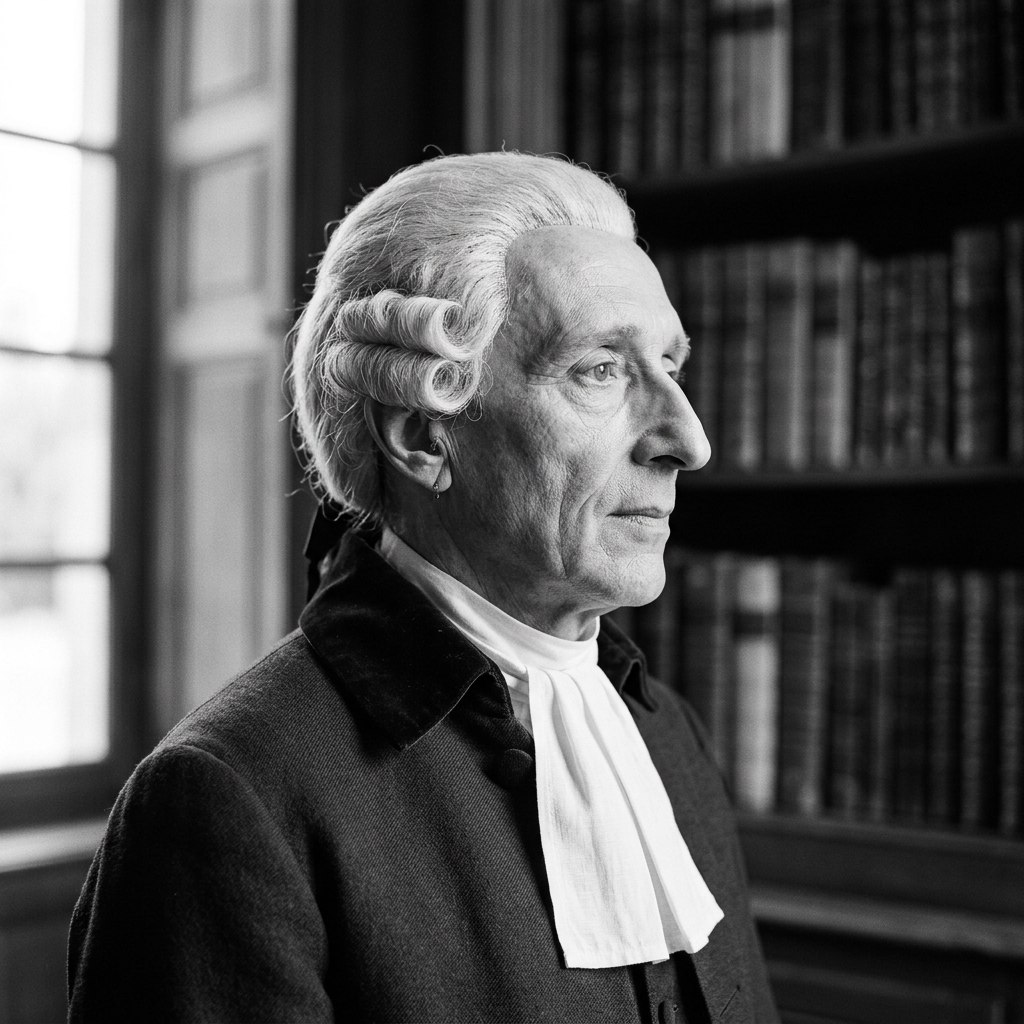
Featured image: Montesquieu (AI illustration)